Tag Archives: United States Government

Presidential Memorandum — Presidential Determination on Syria Drawdown

By The White House

MEMORANDUM FOR THE SECRETARY OF STATE

THE SECRETARY OF DEFENSE

SUBJECT: Drawdown Pursuant to Section 552(c)(2)of the Foreign Assistance Act of 1961 of up to $10 Million in Commodities and Services from any Agency of the United States Government to the Syrian Opposition Coalition (SOC) and the Syrian Opposition's Supreme Military Council (SMC)

Pursuant to the authority vested in me as President by the Constitution and the laws of the United States, including section 552(c)(2) of the Foreign Assistance Act of 1961, as amended (FAA), 22 U.S.C. 2348a, I hereby determine that:

(1) as a result of an unforeseen emergency, the provision of assistance under chapter 6 of part II of the FAA in amounts in excess of funds otherwise available for such assistance is important to the national interests of the United States; and

(2) such an unforeseen emergency requires the immediate provision of assistance under chapter 6 of part II of the FAA.

In addition, pursuant to the authority vested in me as President by the Constitution and the laws of the United States, including section 614 of the FAA, I hereby determine that it is important to the security interests of the United States to furnish this assistance to the SOC and the SMC without regard to any other provision of law within the purview of section 614(a)(1) of the FAA.

I therefore direct the drawdown of up to $10 million in nonlethal commodities and services from the inventory and resources of any agency of the United States Government to provide food and medical supplies to the SOC and the SMC for distribution to those in need.

The Secretary of State is authorized and directed to report this determination to the Congress, to arrange for its publication in the Federal Register, and to coordinate execution of this drawdown.

BARACK OBAMA

From: http://www.whitehouse.gov/the-press-office/2013/04/11/presidential-memorandum-presidential-determination-syria-drawdown

Fact Sheet: U.S. Security Sector Assistance Policy

By The White House

United States policy on Security Sector Assistance is aimed at strengthening the ability of the United States to help allies and partner nations build their own security capacity, consistent with the principles of good governance and rule of law. The United States has long recognized that the diversity and complexity of the threats to our national interest require a collaborative approach, both within the United States Government and among allies, partners, and multilateral organizations. More than ever before, we share security responsibilities with other nations and groups to help address security challenges in their countries and regions, whether it is fighting alongside our forces, countering terrorist and international criminal networks, participating in international peacekeeping operations, or building institutions capable of maintaining security, law, and order, and applying justice. U.S. assistance to build capabilities to meet these challenges can yield critical benefits, including reducing the possibility that the United States or partner nations may be required to intervene abroad in response to instability.

Effectively building security capacity requires multi-year investments, though such up-front costs are relatively small when compared to the larger political, economic, and societal costs in the event that local institutions flounder and instability ensues. While security sector assistance can yield significant benefits, the United States cannot build capacity in all countries. It is essential that we are selective and focus our targeted assistance where it can be effective and is in line with our broader foreign policy and national security objectives. Investments of such assistance are critical to better share the costs and responsibility of global leadership.

To address these challenges, the United States must improve its ability to enable partners in providing security and justice for their own people and responding to common security challenges. Therefore, the United States will pursue a new approach to security sector assistance to better meet this complex and interdependent security environment. This approach will align with the goals and guidelines outlined below.

The Definition of Security Sector Assistance

The security sector is composed of those institutions – to include partner governments and international organizations – that have the authority to use force to protect both the state and its citizens at home or abroad, to maintain international peace and security, and to enforce the law and provide oversight of those organizations and forces. It includes both military and civilian organizations and personnel operating at the international, regional, national, and sub-national levels. Security sector actors include state security and law enforcement providers, governmental security and justice management and oversight bodies, civil society, institutions responsible for border management, customs and civil emergencies, and non-state justice and security providers. Security sector assistance refers to the policies, programs, and activities the United States uses to:

• Engage with foreign partners and help shape their policies and actions in the security sector;
• Help foreign partners build and sustain the capacity and effectiveness of legitimate institutions to provide security, safety, and justice for their …read more

Source: FULL ARTICLE at The White House Press Office

Statement by the Press Secretary on the U.S. Security Sector Assistance Policy

By The White House

Today, President Obama issued a new policy directive on security sector assistance. The goals of this new policy are to: help partner nations build the sustainable capacity to address common security challenges; promote partner support for the policies and interests of the United States; strengthen collective security and multinational defense arrangements and organizations; and promote universal values.

The “security sector” of a government is composed of institutions that have the authority to use force to protect both the state and its citizens at home or abroad, maintain international peace and security, and to enforce the law and provide oversight of security institutions and forces. Security sector assistance refers to the policies, programs, and activities the United States Government employs to engage with foreign partners in these areas, including to help them build and sustain the capacity and effectiveness of institutions to provide security, safety, and justice for their people; and to contribute to efforts that address common security challenges.

The United States has long recognized that the diversity and complexity of the threats to our national security require a collaborative approach, both within the United States Government and among allies, partners, and multilateral organizations. U.S. security sector assistance yields important and tangible benefits, including reducing the need for the United States or partner nations to intervene abroad in response to instability. The policy directive issued by the President today will enhance the responsiveness, impact, and effectiveness of our security sector assistance, including through effective management and alignment of efforts across multiple agencies.

…read more

Source: FULL ARTICLE at The White House Press Office

Letter — Continuation of the National Emergency with Respect to Somalia

By The White House

April 4, 2013

Dear Mr. Speaker: (Dear Mr. President:)

Section 202(d) of the National Emergencies Act (50 U.S.C. 1622(d)) provides for the automatic termination of a national emergency unless, within 90 days prior to the anniversary date of its declaration, the President publishes in the Federal Register and transmits to the Congress a notice stating that the emergency is to continue in effect beyond the anniversary date. In accordance with this provision, I have sent to the Federal Register for publication the enclosed notice stating that the national emergency declared in Executive Order 13536 of April 12, 2010, with respect to Somalia is to continue in effect beyond April 12, 2013.

On January 17, 2013, the United States Government announced its formal recognition of the Government of Somalia. The United States had not recognized a government in Somalia for the previous 22 years. Although the U.S. recognition underscores a strong commitment to Somalia's stabilization, it does not remove the importance of U.S. sanctions, especially against persons undermining the stability of Somalia. For this reason, I have determined that it is necessary to continue the national emergency with respect to Somalia and to maintain in force the sanctions to respond to this threat.

Sincerely,

BARACK OBAMA

…read more

Source: White House Press Office

Why Don’t We Just Buy Chinese Fighters For The Air Force?

By Fred Weinberg

Air Force Why Dont We Just Buy Chinese Fighters For The Air Force?

Just a little over a year ago, I brought to your attention the screwing of the American worker in Wichita, Kansas by the Iran-friendly Brazilian government; a Sparks, Nevada front company; and our friends in the Obama Administration.

At issue was a contract to send a half a billion dollars worth of light attack aircraft to our “friends” in Afghanistan (at our expense, of course).

It seems that despite the fact that the United States Government and its allies already own about 750 Beechcraft AT-6 aircraft proudly manufactured in Wichita by union machinists, the Obama Administration seemed hellbent on sending the new contract to a company called Embraer, which, despite a company in Sparks, Nevada fronting for them, is largely subsidized and formerly owned by the Iran-friendly Brazilian government.

Last year, the contract was re-examined.

But the Obamaites don’t quit.

Shortly after President Wonderful was re-elected, the folks in Wichita found out that elections did, indeed, have consequences.

You know all those things President Wonderful said about jobs?  He meant Brazilian jobs. Certainly not Kansas jobs.  Kansas is a red state.  Interestingly, the new plane is supposed to be produced largely in Florida. Again, elections have consequences.

It seems that despite a three year battle, the Air Force (read that the Obamaites in DoD) has decided to use the same sort of sleazy lawyer tricks to go ahead and get started building the Brazilian planes despite a Government Accountability Office stop work order on the contract while it investigates.

This is apparently what President Wonderful meant when he talked about “spreading the wealth around.”

To refresh your memories, the Beechcraft plane is already widely used by our armed forces and our allies.  The Brazilian plane is used by (hold your breath) Brazil, the Dominican Republic, and Colombia.

It might even be a good plane.

But it’s certainly not built in Wichita, Kansas by highly skilled American workers.

And its purchase in bulk benefits a nation that has a trading relationship with the same clowns who are building a nuclear weapon and who want to wipe our best ally, Israel, off the face of the Earth.

We have put sanctions in place against Iran.  Brazil has not. Why should we support directly or indirectly a regime that trades with people who make improvised explosive devices used against Israel and our own troops in Afghanistan and Iraq?

Wouldn’t a better method of getting what we want from Iran be making their friends and trading partners know that actions have consequences?

Buying the Embraer plane is wrong on so many levels that only an administration as amateurish and incompetent as Barack Obama’s would even consider it.

I know that I’m going to take a load of crap from the Nevada front company for the Brazilians, Sierra Nevada Corporation.  They are a large local presence, but they happen to be in bed with the wrong people in this case.  Nothing personal, guys.  But if you were fronting for Boeing or General Dynamics or …read more
Source: FULL ARTICLE at Western Journalism

Fulfilling our Commitment to Open Government

By Lisa Ellman and Nick Sinai

Since taking office, President Obama has made clear that his Administration is committed to Open Government—that the Nation is made stronger by making the Federal Government accountable to citizens and by giving those citizens opportunities to participate in their government.

That’s why, in September 2011, President Obama, Brazilian President Dilma Rousseff, and the leaders of six other governments launched the global Open Government Partnership – a global effort to encourage transparent, effective, and accountable governance driven by citizens and civil society around the world. Demonstrating the Nation’s domestic commitment to the Partnership, President Obama launched the U.S. National Action Plan on Open Government that same day, saying:

“We pledge to be more transparent at every level — because more information on government activity should be open, timely, and freely available to the people. We pledge to engage more of our citizens in decision-making — because it makes government more effective and responsive. We pledge to implement the highest standards of integrity — because those in power must serve the people, not themselves. And we pledge to increase access to technology — because in this digital century, access to information is a right that is universal.”

In just over a year, the Administration has made significant progress toward implementing the National Action Plan, working closely and in partnership with American citizens and organizations.

For example, with the launch of the White House's “We the People” petition platform, citizens now have a more powerful voice in government. With the passage of the Whistleblower Protection Enhancement Act, and President Obama’s landmark directive extending whistleblower protections to the intelligence and national security communities for the first time, Federal workers who expose waste, fraud, and abuse of authority in government will receive the protection they deserve. And, through innovative, accessible platforms like data.gov, the government is unleashing more information than ever before to fuel innovation and entrepreneurship. But we’re not stopping there.

As part of our ongoing commitment to Open Government, the United States Government will publish a Self-Assessment Report this spring, that outlines our significant progress to date and highlights areas where there is more work to be done. And, in the true spirit of Open Government—we want you to participate in the process.

Many of the best ideas that helped shape the National Action Plan on Open Government were suggested from citizens and outside groups. Starting today, for the next two weeks, we want to hear from you, as we work to develop our Open Government self-assessment report.

Here’s how: You can share your ideas and feedback through Q&A site Quora, or through a web form on WhiteHouse.gov. Specifically, we’d like to hear from you about:

  • What Open Government commitments need the most additional work in the near term?
  • How can we be more responsive to your feedback?
  • How can we work more closely with the public to enhance the Government’s effectiveness?

Your feedback will inform our upcoming Self-Assessment Report on Open Government and ensure that your voice is heard as …read more
Source: FULL ARTICLE at The White House

Weekly News & Politics Digest, February 8, 2013

  • What’s On Your Mind • Noah: Today…
    Noah: Today…

    Image

    In the year 2011, the Lord came unto Noah,
    who was now living in America and said:
    “Once again, the earth has become wicked and over
    -populated, and I see the end of all flesh before me.”
    “Build another Ark and save 2 of every living thing
    along with a few good humans.”
    He gave Noah the blueprints, saying:
    “You have 6 months to build the Ark before I will
    start the unending rain for 40 days and 40 nights.

    Image


    Six months later, the Lord looked down and saw Noah
    weeping in his yard – but no Ark.
    “Noah!,” He roared, “I’m about to start the rain!
    Where is the Ark?”
    “Forgive me, Lord,” begged Noah, “but things have changed.

    Image


    “I needed a Building Permit.”

    Image


    “I’ve been arguing with the Boat Inspector
    about the need for a sprinkler system on it.”

    Image


    “My neighbors claim that I’ve violated the neighborhood by-laws by building the Ark in my back yard and exceeding the height limitations. We had to go to the local Planning Committee for a decision.”

    Image


    “Then the local Council and the Electricity Company demanded a shed load of money for the future costs of moving power lines and other overhead obstructions, to clear the passage for the Ark’s move to the sea. I told them that the sea would be coming to us, but they would hear none of it.”

    Image


    “Getting the wood was another problem. There’s a ban
    on cutting local trees in order to save the Greater Spotted Barn Owl.” “I tried to convince the environmentalists that I needed the wood to save the owls – but no go!”

    Image


    “When I started gathering the animals the ASPCA took me to court. They insisted that I was
    confining wild animals against their will. They argued the accommodations were too restrictive, and it was cruel and inhumane to put so many animals in a confined space.”

    Image


    “Then the Environmental Agency ruled that I couldn’t build the Ark until they’d conducted an environmental impact study on your proposed flood.”

    Image


    “I’m still trying to resolve a complaint with the
    Human Rights Commission on how many minorities I’m
    supposed to hire for my building crew.”

    Image

    “The Immigration Dept. is checking the
    visa status of most of the people who want to work.”

    Image


    “The trade unions say I can’t use my sons. They
    insist I have to hire only Union workers with
    Ark-building experience.”

    Image


    “To make matters worse, the IRS seized all my assets, claiming I’m trying to leave the country illegally
    with endangered species.”
    “So, forgive me, Lord, but it would take at least 10
    years for me to finish this Ark.”

    Image


    “Suddenly the skies cleared, the sun began to shine,
    and a rainbow stretched across the sky.”

    Image


    Noah looked up in wonder and asked,
    “You mean you’re not going to destroy the world?

    Image


    “No,” said the Lord.
    ” The Government beat me to it.”

    HELLO-TRUTH!

    Image

    Statistics: Posted by Gary Triplett — Thu Feb 07, 2013 9:07 pm


  • Virginia State Government • VA’s House of Delegates agreed – Wants to Mint Its Own Coins
    HOUSE JOINT RESOLUTION NO. 590
    FLOOR AMENDMENT IN THE NATURE OF A SUBSTITUTE
    (Proposed by Delegate Marshall, R.G.
    on February 4, 2013)
    (Patron Prior to Substitute–Delegate Marshall, R.G.)

    Establishing a joint subcommittee to study the feasibility of a metallic-based monetary unit. Report.
    WHEREAS, the purpose of money is to provide a reliable measure of value to facilitate the voluntary exchange of goods and services to the economic benefit of society; and

    WHEREAS, the need to establish a sound money unit was deemed so essential for assuring the success of the United States that Thomas Jefferson personally assumed the task of defining the dollar as a fixed standard of value in his Notes on the Establishment of a Money Unit and of a Coinage for the United States; and

    WHEREAS, our nation’s most fundamental principles – equal rights, rule of law, private property rights, individual liberty – still require a dependable dollar to be meaningfully preserved; and

    WHEREAS, unprecedented monetary policy actions recently taken by the Federal Reserve through activist intervention in banking and credit markets, including massive purchases of federal debt, have raised concern over the risk of dollar debasement and prompted inquiries into whether a metallic basis for United States currency might engender a more stable money unit consistent with limited government; and

    WHEREAS, foreign threats to the United States in the form of sophisticated cyberattacks have begun to target banks and financial institutions, including primary banking service providers based in or operating within the Commonwealth, with the aim of undermining consumer confidence and seriously disrupting the functioning of our nation’s economy; and

    WHEREAS, the availability of a trustworthy money unit to facilitate productive economic and financial activity has historically been a major factor in restoring confidence and civil order under conditions of duress, and since the United States Constitution (Article I, Section 10) decrees that “no state shall make anything but gold and silver coin a tender in payment of debts”; now, therefore, be it

    RESOLVED by the House of Delegates, the Senate concurring, That a joint subcommittee be established to study the feasibility of a metallic-based monetary unit. The joint subcommittee shall have a total membership of 10 members that shall consist of eight legislative members and two nonlegislative citizen members. Members shall be appointed as follows: five members of the House of Delegates to be appointed by the Speaker of the House of Delegates in accordance with the principles of proportional representation contained in the Rules of the House of Delegates; three members of the Senate to be appointed by the Senate Committee on Rules; one nonlegislative citizen member with expertise in monetary and financial issues to be appointed by the Speaker of the House of Delegates; and one nonlegislative citizen member with expertise in monetary financial issues to be appointed by the Senate Committee on Rules. Nonlegislative citizen members of the joint subcommittee shall be citizens of the Commonwealth of Virginia. The joint subcommittee shall elect a chairman and vice-chairman from among its membership, who shall be members of the General Assembly.

    In conducting its study, the joint subcommittee shall receive testimony from such witnesses and take such other evidence as it deems appropriate and shall consider recommendations for legislation, with respect to the need, means, and schedule for establishing a metallic-based monetary unit to serve as a contingency currency for the Commonwealth.

    Administrative staff support shall be provided by the Office of the Clerk of the House of Delegates. Legal, research, policy analysis, and other services as requested by the joint subcommittee shall be provided by the Division of Legislative Services. Technical assistance shall be provided by the Treasurer of the Commonwealth of Virginia and the Bureau of Financial Institutions of the State Corporation Commission. All other agencies of the Commonwealth shall provide assistance to the joint subcommittee for this study, upon request.

    The joint subcommittee shall be limited to four meetings for the 2013 interim, and the direct costs of this study shall not exceed $17,440 without approval as set out in this resolution. Approval for unbudgeted nonmember-related expenses shall require the written authorization of the chairman of the joint subcommittee and the respective Clerk. If a companion joint resolution of the other chamber is agreed to, written authorization of both Clerks shall be required.

    No recommendation of the joint subcommittee shall be adopted if a majority of the House members or a majority of the Senate members appointed to the joint subcommittee (i) vote against the recommendation and (ii) vote for the recommendation to fail notwithstanding the majority vote of the joint subcommittee.

    The joint subcommittee shall complete its meetings by November 30, 2013, and the chairman shall submit to the Division of Legislative Automated Systems an executive summary of its findings and recommendations no later than the first day of the 2014 Regular Session of the General Assembly. The executive summary shall state whether the joint subcommittee intends to submit to the General Assembly and the Governor a report of its findings and recommendations for publication as a House or Senate document and shall specify the date by which the report shall be submitted. The executive summary and the report shall be submitted as provided in the procedures of the Division of Legislative Automated Systems for the processing of legislative documents and reports, and shall be posted on the General Assembly’s website.

    Implementation of this resolution is subject to subsequent approval and certification by the Joint Rules Committee. The Committee may approve or disapprove expenditures for this study, extend or delay the period for the conduct of the study, or authorize additional meetings during the 2013 interim.virginia.png

    Statistics: Posted by Gary Triplett — Tue Feb 05, 2013 8:24 pm


  • US Federal Government • Enrolled Bill H.R.325 – No Budget, No Pay Act of 2013

    AT THE FIRST SESSION

    Begun and held at the City of Washington on Thursday,
    the third day of January, two thousand and thirteen

    To ensure the complete and timely payment of the obligations of the United States Government until May 19, 2013, and for other purposes.

    Be it enacted by the Senate and House of Representatives of the United States of America in Congress assembled,

    SECTION 1. SHORT TITLE.
    This Act may be cited as the “No Budget, No Pay Act of 2013”.

    SEC. 2. TEMPORARY SUSPENSION OF DEBT CEILING.
    (a) Suspension.—Section 3101(b) of title 31, United States Code, shall not apply for the period beginning on the date of the enactment of this Act and ending on May 18, 2013.

    (b) Special Rule Relating To Obligations Issued During Suspension Period.—Effective May 19, 2013, the limitation in section 3101(b) of title 31, United States Code, as increased by section 3101A of such title, is increased to the extent that—

    (1) the face amount of obligations issued under chapter 31 of such title and the face amount of obligations whose principal and interest are guaranteed by the United States Government (except guaranteed obligations held by the Secretary of the Treasury) outstanding on May 19, 2013, exceeds

    (2) the face amount of such obligations outstanding on the date of the enactment of this Act.

    An obligation shall not be taken into account under paragraph (1) unless the issuance of such obligation was necessary to fund a commitment incurred by the Federal Government that required payment before May 19, 2013.

    SEC. 3. HOLDING SALARIES OF MEMBERS OF CONGRESS IN ESCROW UPON FAILURE TO AGREE TO BUDGET RESOLUTION.
    (a) Holding Salaries In Escrow.—

    (1) IN GENERAL.—If by April 15, 2013, a House of Congress has not agreed to a concurrent resolution on the budget for fiscal year 2014 pursuant to section 301 of the Congressional Budget Act of 1974, during the period described in paragraph (2) the payroll administrator of that House of Congress shall deposit in an escrow account all payments otherwise required to be made during such period for the compensation of Members of Congress who serve in that House of Congress, and shall release such payments to such Members only upon the expiration of such period.

    (2) PERIOD DESCRIBED.—With respect to a House of Congress, the period described in this paragraph is the period which begins on April 16, 2013, and ends on the earlier of—

    (A) the day on which the House of Congress agrees to a concurrent resolution on the budget for fiscal year 2014 pursuant to section 301 of the Congressional Budget Act of 1974;
    or

    (B) the last day of the One Hundred Thirteenth Congress.

    (3) WITHHOLDING AND REMITTANCE OF AMOUNTS FROM PAYMENTS HELD IN ESCROW.—The payroll administrator shall provide for the same withholding and remittance with respect to a payment deposited in an escrow account under paragraph (1) that would apply to the payment if the payment were not subject to paragraph (1).

    (4) RELEASE OF AMOUNTS AT END OF THE CONGRESS.—In order to ensure that this section is carried out in a manner that shall not vary the compensation of Senators or Representatives in violation of the twenty-seventh article of amendment to the Constitution of the United States, the payroll administrator of a House of Congress shall release for payments to Members of that House of Congress any amounts remaining in any escrow account under this section on the last day of the One Hundred Thirteenth Congress.

    (5) ROLE OF SECRETARY OF THE TREASURY.—The Secretary of the Treasury shall provide the payroll administrators of the Houses of Congress with such assistance as may be necessary to enable the payroll administrators to carry out this section.

    (b) Treatment Of Delegates As Members.—In this section, the term “Member” includes a Delegate or Resident Commissioner to the Congress.

    (c) Payroll Administrator Defined.—In this section, the “payroll administrator” of a House of Congress means—

    (1) in the case of the House of Representatives, the Chief Administrative Officer of the House of Representatives, or an employee of the Office of the Chief Administrative Officer who is designated by the Chief Administrative Officer to carry out this section; and

    (2) in the case of the Senate, the Secretary of the Senate, or an employee of the Office of the Secretary of the Senate who is designated by the Secretary to carry out this section.

    Attest:

    Speaker of the House of Representatives.

    Attest:

    Vice President of the United States and
    President of the Senate.

    Statistics: Posted by Gary Triplett — Tue Feb 05, 2013 12:07 pm


  • Virginia • Summit Archives – Communities of the Northern Piedmont
    Summit Archives – Communities of the Northern Piedmont

    The WayBack Machine at archive.org archived “www.summit.net” starting in 1999. The first pages of Summit (then: Summit Web Communications Internet Services) were not archived since Summit’s content began in 1995, four years before The Wayback Machine grew to archive the information.

    Although outdated, some information found here is still relevant. At any rate, it’s interesting to see the past and compare the many changes around the world over time.

    The Internet Archive is a 501(c)(3) non-profit that was founded to build an Internet library. Its purposes include offering permanent access for researchers, historians, scholars, people with disabilities, and the general public to historical collections that exist in digital format. Founded in 1996 and located in San Francisco, the Archive has been receiving data donations from Alexa Internet and others. In late 1999, the organization started to grow to include more well-rounded collections. Now the Internet Archive includes texts, audio, moving images, and software as well as archived web pages in our collections, and provides specialized services for adaptive reading and information access for the blind and other persons with disabilities.

    We hope you enjoy…
    iframe

    Statistics: Posted by Gary Triplett — Mon Feb 04, 2013 5:22 pm


US Federal Government • Enrolled Bill H.R.325 – No Budget, No Pay Act of 2013

By Gary Triplett

AT THE FIRST SESSION

Begun and held at the City of Washington on Thursday,
the third day of January, two thousand and thirteen

To ensure the complete and timely payment of the obligations of the United States Government until May 19, 2013, and for other purposes.

Be it enacted by the Senate and House of Representatives of the United States of America in Congress assembled,

SECTION 1. SHORT TITLE.
This Act may be cited as the “No Budget, No Pay Act of 2013”.

SEC. 2. TEMPORARY SUSPENSION OF DEBT CEILING.
(a) Suspension.—Section 3101(b) of title 31, United States Code, shall not apply for the period beginning on the date of the enactment of this Act and ending on May 18, 2013.

(b) Special Rule Relating To Obligations Issued During Suspension Period.—Effective May 19, 2013, the limitation in section 3101(b) of title 31, United States Code, as increased by section 3101A of such title, is increased to the extent that—

(1) the face amount of obligations issued under chapter 31 of such title and the face amount of obligations whose principal and interest are guaranteed by the United States Government (except guaranteed obligations held by the Secretary of the Treasury) outstanding on May 19, 2013, exceeds

(2) the face amount of such obligations outstanding on the date of the enactment of this Act.

An obligation shall not be taken into account under paragraph (1) unless the issuance of such obligation was necessary to fund a commitment incurred by the Federal Government that required payment before May 19, 2013.

SEC. 3. HOLDING SALARIES OF MEMBERS OF CONGRESS IN ESCROW UPON FAILURE TO AGREE TO BUDGET RESOLUTION.
(a) Holding Salaries In Escrow.—

(1) IN GENERAL.—If by April 15, 2013, a House of Congress has not agreed to a concurrent resolution on the budget for fiscal year 2014 pursuant to section 301 of the Congressional Budget Act of 1974, during the period described in paragraph (2) the payroll administrator of that House of Congress shall deposit in an escrow account all payments otherwise required to be made during such period for the compensation of Members of Congress who serve in that House of Congress, and shall release such payments to such Members only upon the expiration of such period.

(2) PERIOD DESCRIBED.—With respect to a House of Congress, the period described in this paragraph is the period which begins on April 16, 2013, and ends on the earlier of—

(A) the day on which the House of Congress agrees to a concurrent resolution on the budget for fiscal year 2014 pursuant to section 301 of the Congressional Budget Act of 1974;
or

(B) the last day of the One Hundred Thirteenth Congress.

(3) WITHHOLDING AND REMITTANCE OF AMOUNTS FROM PAYMENTS HELD IN ESCROW.—The payroll administrator shall provide for the same withholding and remittance with respect to a payment deposited in an escrow account under paragraph (1) that would apply to the payment if the payment were not subject to paragraph (1).

(4) RELEASE OF AMOUNTS AT END OF THE CONGRESS.—In order to ensure that this section is carried out in a manner that shall not vary the compensation of Senators or Representatives in violation of the twenty-seventh article of amendment to the Constitution of the United States, the payroll administrator of a House of Congress shall release for payments to Members of that House of Congress any amounts remaining in any escrow account under this section on the last day of the One Hundred Thirteenth Congress.

(5) ROLE OF SECRETARY OF THE TREASURY.—The Secretary of the Treasury shall provide the payroll administrators of the Houses of Congress with such assistance as may be necessary to enable the payroll administrators to carry out this section.

(b) Treatment Of Delegates As Members.—In this section, the term “Member” includes a Delegate or Resident Commissioner to the Congress.

(c) Payroll Administrator Defined.—In this section, the “payroll administrator” of a House of Congress means—

(1) in the case of the House of Representatives, the Chief Administrative Officer of the House of Representatives, or an employee of the Office of the Chief Administrative Officer who is designated by the Chief Administrative Officer to carry out this section; and

(2) in the case of the Senate, the Secretary of the Senate, or an employee of the Office of the Secretary of the Senate who is designated by the Secretary to carry out this section.

Attest:

Speaker of the House of Representatives.

Attest:

Vice President of the United States and
President of the Senate.

Statistics: Posted by Gary Triplett — Tue Feb 05, 2013 12:07 pm


Source: FULL ARTICLE at gov.summit.net

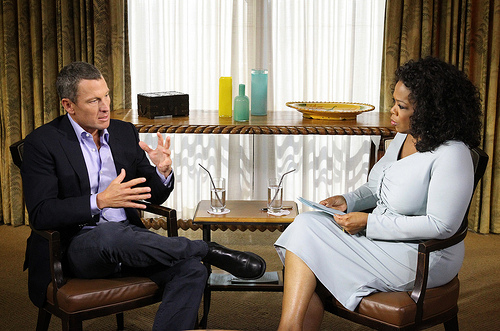
Oprah And Lance; Why Should We Care?

By Fred Weinberg

Lance Oprah SC Oprah And Lance; Why Should We Care?

Like many folks, I watched Lance Armstrong “confess” to Oprah. For about 20 minutes. It was all the self-serving crapola from both Armstrong and Oprah I could take.

Big deal.

Some months ago, I wrote that Armstrong was being persecuted by the United States Government with $10 million dollars a year of our money.

I was right then, and I’m right now.

Do I care a whit that he used some fancy concoctions to help his endurance?

No.

I also don’t care if Roger Clemons, Mark McGuire, or Sammy Sosa used steroids or if Babe Ruth and Ty Cobb were belligerent drunks. And I still think that Pete Rose should be in the Hall of Fame.

Frankly, we are way too concerned with what an athlete is willing to do to win.  To put it in perspective, remember that the average life span of an NFL linebacker is 57 years, and nobody complains about that.

And, don’t you find it just a little bit upsetting that the arbiters of what is right and wrong are largely people who never played the game?  Take the Hall of Fame election for baseball.  The election is from members of the Baseball Writer’s Association.  These are largely people who drink their lunch, mostly see life from the left lane, and, again, never played the game.

I saw Jim Gray on the Fox News Channel pontificating about a college football player who said that he was duped into thinking he had an internet girlfriend who died.  Now why this is a story is beyond my comprehension since nobody suffered any damages, but let’s get back to Jim Gray.

This was the clown who in game two of the 1999 World Series had the following colloquy with Pete Rose after Rose was named to the Major League Baseball All Century team, an honor which most people with more than 3,000 hits get.

Jim Gray: Pete, let me ask you now. It seems as though there is an opening, the American public is very forgiving. Are you willing to show contrition, admit that you bet on baseball and make some sort of apology to that effect?

Pete Rose: Not at all, Jim. I’m not going to admit to something that didn’t happen. I know you’re getting tired of hearing me say that. But I appreciate the ovation. I appreciate the American fans voting me on the All-Century Team. I’m just a small part of a big deal tonight.

Gray: With the overwhelming evidence in that report, why not make that step. . .

There’s an example of the kind of ‘expert’ who is passing judgment on people who actually played the game. (By the way, Gray also thinks that Bob Costas’ anti gun rant was acceptable, to put him in perspective.)

I’m not a big fan of professional cycling.  I could care less if someone needs an edge to win a race of more than 2,000 miles.  Unless Armstrong had an engine on that bike, my viewpoint is that he won the Tour De France seven times in a row; and nothing, including $10 million a year of our tax dollars going to a private doping police force, is going to change that.

As far as his “defrauding” the Post Office because of their sponsorship, what a load of crap.

His team won; that’s what sponsors pay for in professional sports, end of story.  Except that I don’t believe that any government entity should be spending advertising money on professional sports or subsidizing stadiums.  That includes the NFL, Major League Baseball, and the National Guard’s sponsorship of Dale Earnhardt Jr.’s number 88 Sprint Cup car.

The same media that is having a slobbering love affair with our President is way too focused on everything but the game.

As big an animal lover as I am (and a Pit Bull owner at that), I didn’t think it was the NFL’s job to ban Michael Vick back when he got caught running a dog fighting ring.  I think it is the prosecutor’s job to put him in prison so he couldn’t play football.

I didn’t think the NCAA had any business sanctioning Penn State in the very sick Jerry Sandusky affair.  That is the job of the Governor, the courts, and the so-called adult supervision.

I never said Lance Armstrong wasn’t a jerk.  Or that Pete Rose is a prince.

But just as I don’t hold Barbara Streisand’s ludicrous political viewpoints against her skills as a singer, I refuse to judge Lance Armstrong’s athletic career (or Roger Clemons’ or Barry Bonds’) by what he may have ingested before he played the game.

And, frankly, as a sports fan (and recovering sportswriter), I think that the only votes for halls of fame should come from the same fans who make and break the careers of the players.

Now, can we get back to talking about real news?

Photo credit: lwpkommunikacio (Creative Commons)

Source: FULL ARTICLE at Western Journalism