By Bruno Korschek
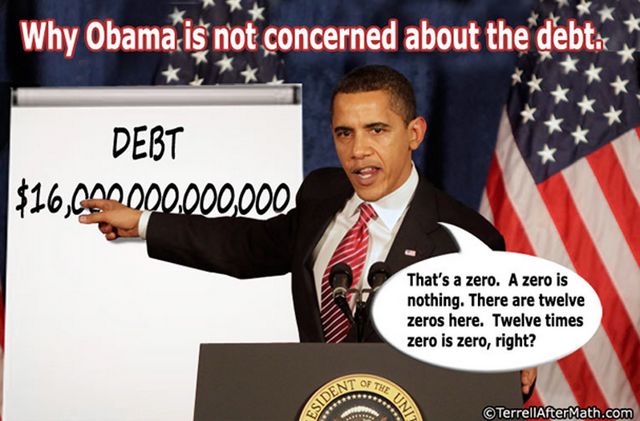
Sometime next month, the nation will hit its current debt ceiling limit, setting off a frantic, embarrassing, and last minute effort to avoid defaulting on some Federal government debts because the government’s ability to borrow money and continue living beyond its means will be in jeopardy. If the fiscal cliff fiasco is any indication, the nation’s debt ceiling will be raised at the last minute; taxes may go up; credit rating agencies will probably downgrade the quality of our debt status; and the needed restraint on government spending will be delayed again.
And again, our politicians would have proven to us and the world that they do not have the ability, the will, or the fortitude to make the necessary cuts in Federal spending that are driving the country to the brink of fiscal insolvency. They would rather continue to fund their political backers or not take the time to clean up the corruption, redundancy, and criminal fraud that pervades every Federal Department and program.
The very sad thing about the situation is that the heavy lifting, the in-depth analyses, and research of the Federal budget has already been done by a number of non-governmental and government entities. They have gone through the minute details of the Federal government’s excessive and unnecessary spending habits. These analyses have been done by the following organizations:
- U.S. Public Interest Group
- The National Taxpayer Union
- General Accountability Office
- Congressional Budget Office
- Associated Press
- Internal Revenue Service
- Senate Reports
- The Cato Institute
- Housing And Urban Development
- Federal government inspector generals
If you look at their detailed analyses in total, you will find that these people have already researched and identified almost $9 trillion worth of ways to reduce our national debt. And the best thing about it is that this debt reduction of $9 trillion does not involve tax increases on any American and minimal financial pain to the average U.S. household.
However, those companies that rely on crony capitalism to survive, those companies that continually get government favors in return for financing political election campaigns, those criminals who currently defraud the American taxpayer of hundreds of billions of dollars a year, and those Federal entities that do not fulfill any viable purpose would see their lives change dramatically.
For the first time ever, the combined efforts of the above organizations have been tabulated to prove that taking trillions of dollars out of our national debt is possible and painless:
1) Annual taxpayer wealth lost to waste, inefficiencies, and criminal fraud in the following Federal programs:
- Medicare: $60 – $90 billion
- Medicaid: $30 – $40 billion
- Social Security: $100 billion
- One Federal Unemployment Program: $19 billion
- One Federal Food Stamp Program: $2 – $3 billion
- Total: $211 – $252 billion, midpoint = $231 billion
- Savings over ten years = $2.3 Trillion
- Savings if only 50% of the fraud and waste was cleaned up = $1.16 Trillion
2) Annual uncollected taxes due to the Federal government but not collected from tax evaders:
- $325 Billion
- Savings over ten years = $3.25 Trillion
- Savings over ten years if you just reduce the illegal tax evasion by 50% – $1.625 Trillion
3) The U.S. has about 84,000 combat troops unnecessarily stationed in Europe, about 30,000 combat troops unnecessarily stationed in South Korea, and about 25,000 combat troops unnecessarily stationed in Japan, serving defense purposes that were obsoleted decades ago. The Obama administration is about to unnecessarily deploy about 2,500 troops in Australia. If 75% of these troops were brought home, the country would save about $212 billion over ten years.
4) If we cancel the production of the V-22 Osprey aircraft because it is over budget, likely to under-perform, and has been designated as not critical by the Sustainable Defense Task Force, we would save $6.2 billion over the next five years.
5) If we cancel the production of the F-35 jet fighter, which, according to the Sustainable Defense Task Force, “may represent all that is wrong with our acquisition process” and “would provide a capability that is not warranted considering emerging threats,” we would save $22.5 billion over the next five years.
6) If we cancel the military Space Tracking and Surveillance System, which can be replaced with lower cost and more reliable options, we would save the Pentagon $5 billion over the next five years.
7) If we cancel the outdated, unreliable, and unneeded Expeditionary Fighting Vehicle (because the General Accountability Office has cited the program’s history of cost growth, schedule misses-14 years late-and performance failures as reasons for terminating the program, we would save $16.3 billion over the next five years.
8) The General Accountability Office found that the Army, Navy, and Air Force are wasting billions of dollars a year by purchasing items that were either never used or were never required. The GAO identified purchasing reform processes that could save $36.9 billion a year (or about $369 billion over ten years.)
9) Terminating various unneeded corporate welfare programs would produce substantial savings. These programs include the Overseas Private Investment Corporation, the Market Access Program, trade association subsidies for foreign marketing, subsidies to large agriculture business and wealthy farmers, tax credits for the blending of ethanol, the ultra-deepwater natural gas and petroleum research program, public timber sales subsidies, and the Southeastern Power Administration. Ending these corporate welfare programs would save about $12 billion a year or about $120 billion over ten years.
10) The Federal government owns more than 55,500 buildings that are either not used or are underused. If 50% of these buildings were eliminated over the next five years, savings in the area of $48 billion would be realized.
11) Government audits of Housing and Urban Development found the Federal government wastes about $4.5 billion a year due to bad accounting and billing processes. Fix this problem, and save about $45 billion over ten years.
12) Annual earmarks, which are usually nothing more than thinly disguised ways for incumbent politicians to fund their re-election campaign with taxpayer money, cost the Federal government about $16 billion a year in unneeded expenses. Eliminating earmarks would save $160 billion over ten years.
13) According to the General Accountability Office:
- The Federal government has 15 different agencies overseeing food safety laws.
- It has more than 20 programs helping the homeless.
- It has 80 programs to help economic development.
- It has 82 agencies working on improving teacher quality, few of which are working if you see how poorly American kids are being educated vs. the rest of the world.
- It has 47 agencies working on job training.
- It has 18 programs working on food and nutrition assistance.
A formal Senate report and analysis of the situation estimates that between $100 billion and $200 billion a year could be saved by consolidating and downsizing these functions. If we take the mid-range of the estimates, we end up with $1.5 trillion in savings over ten years.
14) An extensive Congressional Budget Office (CBO) report identified detailed savings in many areas of government spending:
- Science, Space, and Technology savings over ten years – $25.26 billion
- Agriculture – $3.87 billion in savings over ten years. This does not include the termination of unneeded ethanol subsidies and other farm support programs that are no longer needed.
- Natural Resources and Environment savings over ten years – $32.23 billion. These savings are concentrated in programs that support corporations, not endangering basic government environmental programs.
- Commerce and Housing savings over ten years – $5.42 billion. This does not include the savings that could be found by cutting back on the widespread fraud and mismanagement in government housing programs.
- Transportation savings over ten years – $141.64 billion
- Community and Regional Development savings over ten years – $21.94 billion
- Education, Training, Employment, and Social Services savings over ten years – $45.42 billion
- Income Security savings over ten years – $68.83 billion
- Veterans Benefits and Services savings over ten years – $21.50 billion
- Allowances savings over ten years – $2.54 billion
- Administrative of Justice savings over ten years – $10.26 billion
- Social Security savings over ten years – $388.52 billion.
- General Government expense savings over ten years – $5.21 billion
15) Since 2009, the Federal payroll has grown by 231,000 civilian. Since most would agree that we have not seen a corresponding rise in the quality of government service since these people have been hired, getting rid of them, like most efficient businesses would do, would not result in a degradation in Federal government services.
If we conservatively estimate that the weighted taxpayer cost (wages, benefits, and retirement costs) for these newly hired employees is $80,000 a year, than letting them go would result in annual savings of about $18.48 billion a year or $184.8 billion over ten years.
16) In any measure of education attainment, U.S. kids usually fare very poorly when compared to the education received by kids in other countries. Usually, the U.S. is bested by a dozen or more countries when it comes to comparing standardized test results. The Department of Education has been around for about thirty years and has done nothing to change this low performance.
Given this anemic and failing performance by the Department of Education, the job of educating our kids should be sent back to state and local governments. Phasing out this Department over the next few years would reduce Federal spending by about $900 billion over the next ten years.
17) Much like the Department of Education, the Federal Department of Energy has done nothing to get us to a coherent national energy strategy and policy and has not funded any breakthrough energy technologies. Terminate the entity and let the private market research and develop new energy technologies. 10 year savings according to Cato – $382.8 billion.
18) Cato has done similar analyses on just about every other Federal organization, coming up with the following expense cuts independent of everything listed so far:
- Commerce Department – 10 year savings of $21.2 billion if you assume only half of what Cato identified is attained.
- Department of Transportation cuts – 10 year savings of $424.4 billion if you assume only half of what Cato identified is attained.
These cuts alone would save the Federal government just under $9 TRILLION in expenses and costs over the next ten years with minimal impacts on needy Americans and ordinary American citizens. The $9 trillion does not include additional savings that would come from the following areas:
- More non-vital military cuts not listed above.
- Reining in Medicare and Medicaid costs beyond the fraud and waste savings listed above.
- Deny Social Security payments in retirement to any American who had a net wealth of over $3 million and raising the retirement age to 70 years, with a hardship exception.
- Savings from interest payments not paid because the Federal government took almost $9 TRILLION of debt out of play.
- The termination of the Federal Housing Authority, Fannie Mae, and Freddie Mac government agencies and the associated hundreds of billions of dollars in taxpayer subsidies they are likely to consume in the next ten years.
- Elegantly privatize some government functions such as what Canada and other European countries have successfully done with their national air traffic control processes and postal systems and allow private contractors to do the TSA screening function at all U.S. airports since we know from experience that they can do a far better job for less budget money than government employed TSA screeners.
People far smarter than me can determine the value of these additional efficiencies in government operations. In fact, Cato has already done all of this work and summarized it at their Downsizing Government website. Their comprehensive analysis found a way to reduce annual Federal government spending over time by about $1.16 trillion a year, creating a debt reduction of $11.6 trillion-also without raising taxes and with minimal pain to an average American.
Most of these cost cuts would have a minimal impact on the average American. More importantly, it would reduce government expenses (allowing more Americans to keep more of their personal wealth), it would increase our personal freedom, it would help clear up the uncertainty that the Obama administration has injected into the economy, and it would keep the social programs that many Americans rely on (e.g. Social Security, Medicare, etc.) viable and fiscally solvent.
Given the history of the Obama administration and the rest of the political class, this solution appears to be beyond their capabilities, comprehension, and attention spans. Otherwise, they would have taken these steps towards fiscal responsibility long before we reached a national debt in excess of $16 trillion. Einstein identified this our dilemna decades ago:
We cannot solve our problems with the same thinking we used when we created them.
Apparently, we also cannot solve our problems with the same politicians that created them.
Source: FULL ARTICLE at Western Journalism
 A new campaign by the U.S. Travel Association aims to promote the benefits of travel to consumers who have been cutting back due to economic concerns. It comes on the heels of new laws, partnerships, packages, and rates designed to make leisure and business travel more accessible and less arduous.


 A traveler from South Korea did not take to kindly to America’s airport security and is in jail as a result. Authorities say Hyunjoo Kim, 39, slapped one female TSA employee at Orlando International Airport and shoved another, reports the Orlando Sentinel . The slap came after a patdown and the…
 Today, in really important travel news: You can finally carry that snow globe on your flight. That is, as long as it “appears to contain less than 3.4 ounces” of liquid, explains the TSA blog . How to tell if yours qualifies? Make sure it’s smaller than a tennis ball….