

The delay of PPACA’s employer mandate makes repealing the medical-device excise tax and health-insurance premium tax more difficult. …read more
Source: FULL ARTICLE at Forbes Opinions
The delay of PPACA’s employer mandate makes repealing the medical-device excise tax and health-insurance premium tax more difficult. …read more
Source: FULL ARTICLE at Forbes Opinions
By Sean Williams, The Motley Fool
Filed under: Investing
In eight months and a hair over one week the Patient Protection and Affordable Care Act, also known as Obamacare, will go into full effect. The PPACA is a sweeping reform of our current health-care system aimed squarely at keeping premiums from skyrocketing; holding insurance companies accountable for the premiums they bring in by insuring they spend at least 80% of those dollars on patient care; and mandating that individuals and large businesses take responsibility for themselves and their employees by carrying health insurance or providing group coverage.
President Obama signing the PPACA into law. Source: White House on Flickr.
Obamacare: Friend or foe?
Earlier this month, I decided to take a walk on both sides of the aisle to point out the benefits and the drawbacks of Obamacare. Make no mistake about it — there are benefits and there are weaknesses to the bill. But perhaps no aspect of Obamacare works out as more controversial than the insurance mandate.
On a personal level, the insurance mandate is pretty clear. By law you are required to carry insurance — buy it or face a tax penalty, which will incrementally increase to 2.5% of your adjusted gross income by 2016. Looking at it from a business perspective is where things get a lot trickier.
For businesses with fewer than 50 employees, no such rules are in place to require them to provide health coverage to employees. Where things go a bit haywire is when you get into larger corporations. Large corporations, under the PPACA, will be required to provide insurance to full-time employees that meet the basic minimum standards under the new law. Employers aren’t required to pay for any of a full-time employees’ insurance; however, they will be penalized between $2,000 and $3,000 per employee for each situation where health costs wind up exceeding 9.5% of that employee’s income. If these businesses choose not to offer health insurance whatsoever, they will face a stiff $2,000 fine per employee.
As you might imagine, the reaction among the nation’s largest businesses has been mixed in response to the passing and upholding of the PPACA by the Supreme Court.
Now hiring, part-time only
In one corner, we have businesses across a myriad of sectors that have made no qualms about reducing their headcount or rolling back their employees’ hours in order to reduce their exposure or skirt the system entirely. Reconstructive, medical, and surgical device maker Stryker made the very unpopular decision to eliminate 5% of its workforce in November 2011 in order to reduce its expenses by more than $100 million annually because of the now-in-effect 2.3% medical device excise tax. Yet an even scarier scenario for America’s workforce exists that isn’t tied to layoffs or even outsourcing — it’s the threat of being bumped into the part-time category.
Part-time workers fall into the gray area of the PPACA in that only full-time employees of
Source: FULL ARTICLE at DailyFinance
By Sean Williams, The Motley Fool
Filed under: Investing
You would think that the medical-device sector would be rife with big gainers thanks to an aging population, but it’s not quite as simple as that. Just as we saw when we examined the biotechnology sector last week, there are pros and cons to investing in medical devices.
The pros and cons of medical devices
On the positive side, medical devices should make a logistically smart play for an aging population. As technologies and manufacturing processes improve — and health-care insurance becomes a mandate because of the full implementation of the Patient Protection and Affordable Care Act, known loosely as Obamacare, in 2014 — the demand for medical devices ranging from implantables to simply disposable-use products in hospitals is bound to increase.
Conversely, medical-device companies walk a fine line when it comes to product efficacy sometimes and must now deal with a 2.3% medical-device excise tax that comes straight off their total revenue to help pay for the Medicaid expansion under the PPACA. St. Jude Medical, for instance, has dealt with two recalls in the past three years because of the long-term durability of its implantable products. In 2010, it recalled its defibrillator leads known as Riata, and in February, it recalled its Amplatzer TorqVue FX Delivery System for fear of fracturing in the device over time. On top of this, St. Jude will fork over 2.3% of its revenue because of the medical-device excise tax.
The Buffett factor
Warren Buffett, as my Foolish colleague Brian Orelli has pointed out, tends to shy away from the health-care sector as a whole — save for a few very large and diverse companies — because he doesn’t have the time or energy to follow the developing pipeline of a company, whether it be biotech or medical devices.
But, just as we saw with regard to biotech, I think Buffett and Berkshire Hathaway are missing a crucial component in their investment portfolio by predominantly passing up the medical-device sector. It’s true that Buffett and Berkshire do have some medical-device exposure thanks to ownership in shares of Johnson & Johnson , which purchased Synthes last year for nearly $20 billion. Synthes has a large spinal implant operation, which will give J&J plenty of fast-growing emerging market exposure and will probably put big smiles on Berkshire shareholders’ faces. But overall, J&J is a diversified conglomerate with only partial exposure to medical devices.
Instead, I propose we once again focus on Buffett’s key investable points — sustainability, growth, and income — to deliver the best possible medical-device company for Buffett’s and Berkshire’s portfolio.
Sustainability
When talking about sustainability, I’m hitting on Buffett’s penchant for seeking out well-established product lines that can essentially run themselves. Buffett’s set-it-and-forget-it investing philosophy requires that cash flow and profits remain relatively consistent. In this category, I’d say there’s only one pure-play example and two other companies that somewhat fit the bill.
The pure play, as I see
From: http://www.dailyfinance.com/2013/04/14/the-1-medical-device-company-warren-buffett-should/
By Sean Williams, The Motley Fool

Filed under: Investing
Whether you’re ready for it or not, the Patient Protection and Affordable Care Act, known collectively as Obamacare, is going to be fully implemented in less than nine months. The blatant rising costs of health care in this country, compounded by the successful implementation of socialized health care from our neighbors to the north, pre-empted President Obama and lawmakers to vote for change in 2010. Yesterday, in fact, I examined five ways that this bill will improve the scope of health care in this country.
However, not everyone is on board with the proposed changes set forth in this bill. In fact, the opposition has tried everything under the sun in order to get Obamacare repealed without any success.
Source: White House on Flickr.
Today, I propose to turn the tables and examine five areas where Obamacare appears destined to fail.
1. Health insurers will keep most of their leverage.
If you recall, one of the key points I touched on yesterday where Obamacare is a boon for paying members is that it requires the insurance industry to spend at least 80% of its premium revenue on actual health services. This will cap the profit potential of insurers and is expected to cancel out unwarranted premium hikes under the PPACA.
Conversely, there’s little in the way of fines and regulations that will ultimately stop health insurers from raising their premiums or from shocking current members with huge premium hikes in advance of the full implementation of the PPACA in 2014. Obamacare was expected to take the power of premium pricing away from health insurers and put it into the hands of consumers in a competitive marketplace, but it appears it will be more of the same even after the bill is put into action.
A perfect case in point is the complete 180 that the Centers for Medicare and Medicaid Services, or CMS, pulled on Medicare Advantage providers last week. In February, insurers like Humana and Universal American that provide Medicare Advantage — a broader-care coverage plan for seniors that involves fewer out-of-pocket costs — were informed that their Medicare reimbursement rates would drop 2.3%. Following weeks of rigorous lobbying to lawmakers, the CMS reversed its decision from a 2.3% reduction in reimbursements to a 3.3% increase, claiming that it changed the scope by which it expected doctor pay to fall as its reasoning. In essence, by complaining and lobbying, the insurance industry orchestrated itself a nice raise and completely debunked the premise of Obamacare, which is to reduce the reliance of private insurers on the governments’ wallet.
2. Premiums will continue to rise.
The entire premise of creating the PPACA was to avert what seemed like an exponential growth in health-care costs due to high hospitalization and prescription drug costs. However, it appears that the usually conservative Society of Actuaries believes otherwise.
The SOA released a report (link opens PDF) two …read more
Source: FULL ARTICLE at DailyFinance
By Sean Williams, The Motley Fool
Filed under: Investing
With the passing of the Patient Protection and Affordable Care Act in 2010, also known in shorthand as Obamacare, lawmakers and President Obama ushered in the winds of change in the health-care industry. Having witnessed the successful implementation of socialized and subsidized health care in Canada and Switzerland — and seeing the average health-care premiums paid by employers and individuals rise by 62% and 82%, respectively, from 2000 to 2010 — the time had come in 2010 to make sweeping reforms… and the PPACA was it!
Both sides of the aisle have presented very convincing and heated arguments over the past couple of years about why Obamacare is right or wrong for America. It nearly didn’t make it into law when the constitutionality of its individual mandate, as well as other aspects of the bill, was brought into question in the highest of all U.S. courts — the Supreme Court – last year. However, in June the Supreme Court ruled in favor of upholding the validity and nearly all aspects of the PPACA, paving the way for its full implementation by 2014.
Source: WhiteHouse on Flickr.
Whether you’re for or against Obamacare, it’s clear that advantages and disadvantages exist. Today, I plan to focus on the advantages of Obamacare and lay out five ways that it will succeed in bettering our health-care system.
1. It will reduce hospitals’ exposure to doubtful accounts.
Under our current system, no one is required by mandate to carry insurance. This means that any of the 48.6 million uninsured Americans as of the end of 2011, according to the U.S. Census Bureau, could walk into a hospital and receive stabilizing treatment in an emergency room since public hospitals can’t turn away people in need of care, regardless of their financial status.
Unfortunately for many hospitals, this has exposed them to a rather large annual provision for doubtful accounts (those accounts where treatment is given but payment goes uncollected). In 2012, HCA Holdings , the largest hospital operator in the U.S., generated $36.8 billion in revenue, but set aside $3.77 billion, or 10.25%, for doubtful accounts. The smaller rival of HCA, Tenet Healthcare , set aside less on a percentage basis in 2012, just 7.9% of total revenue. But it also saw its provision for doubtful accounts rise by nearly 10% year-over-year.
Obamacare will solve the majority of this problem by mandating that employers with more than 50 employees provide health-care solutions to their employees, and that individuals and small business with fewer than 50 employees get health insurance either themselves or through their state’s insurance pool. With fewer uninsured and underinsured people walking into hospital emergency rooms, hospitals will be setting significantly less aside for doubtful accounts and should ultimately see a boost to their bottom line. This boost in profits could be used to reward shareholders through share repurchases or a dividend payout, but, in all likelihood, it could be used to buy …read more
Source: FULL ARTICLE at DailyFinance
By Sean Williams, The Motley Fool
Filed under: Investing
The Patient Protection and Affordable Care Act, also known loosely as Obamacare, was passed in 2010 to completely reform our current health-care system. The majority of those reforms were targeted at minimizing the rising costs of health care, requiring insurance companies to accept patients with pre-existing conditions, and protecting our hospitals and citizens by giving them access to broader forms of health coverage.
Part of those reforms — as we found out in February through a statement released by the Centers for Medicare and Medicaid Services, or CMS — included what was expected to a mid-single-digit drop in reimbursements for insurers who provided Medicare Advantage plans.
Medicare Advantage plans are more expensive than traditional Medicare plans, but they offer significantly better coverage — including vision care — and often allow for lower out-of-pocket costs, making them the perfect solution for more than 13 million seniors around the country.
There was serious concern from the get-go for insurers like Humana , Universal American , UnitedHealth Group and Health Net — which generate 63.5%, 75%, 25%, and 25%, respectively, of their revenue from Medicare Advantage plans. These insurers made it clear that if these rates were to continue into 2014 they would simply reduce the amount of benefits offered and shrink the overall scope of the provider network.
The idea of higher premiums and fewer benefits didn’t sit too well with Congressional lawmakers, insurers, or insurance advocacy groups, which took to aggressive lobbying since the decision was announced in February. Last night, that lobbying turned out to be wholly worthwhile.
As a warning shot aimed directly across the bow of Obamacare, the insurers operating in the Medicare Advantage industry were informed by the CMS on Monday that it had decided to reverse its original recommendation of a 2.3% reimbursement cut in 2013 in favor of a 3.3% increase in the rate of reimbursement!
The reversal decision came about after the assumption was made that Congress would keep payment rates to doctors from falling next year, which is in contrast to the reduction in pay rate that had been factored into the February assessment. It also acts against the premise of the PPACA, which is to wean private insurers from relying on government aid for certain health care plans, including Medicare Advantage.
The bigger story here appears to be the kick in the shin that Obamacare just took at the hands of the insurance industry. By exerting its lobbying power — hinting at the possibility of reducing benefits for 13 million-plus seniors in 2014 — and getting some 160 lawmakers to write letters to persuade the CMS to change its opinion, the insurance industry effectively dictated itself a raise.
From an investment standpoint, insurers like Humana and Universal American — which have significantly more revenue and profit exposure to Medicare Advantage than anything else in the product portfolio — should benefit the most. UnitedHealth Group and Health Net should benefit as well, although their …read more
Source: FULL ARTICLE at DailyFinance
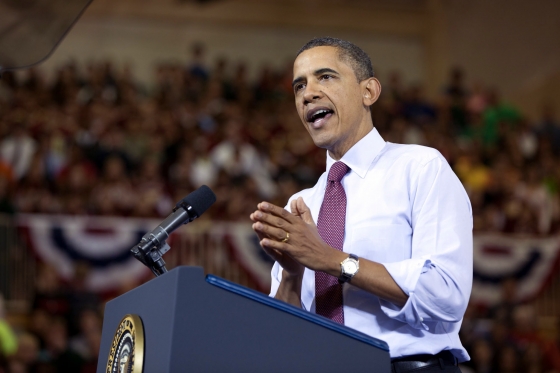
Despite surviving a number of threats, President Obama’s health care law remains harmful, unstable, and unpopular. It also remains vulnerable to repeal, largely because Congress and the Supreme Court have granted each state the power to veto major provisions of the law before they take effect in 2014.
The Patient Protection and Affordable Care Act (PPACA) itself empowers states to block the employer mandate, to exempt many of their low- and middle-income taxpayers from the individual mandate, and to reduce federal deficit spending, simply by not establishing a health insurance “exchange.” Supporters of the law do not care for this feature, yet they adopted it because they had no choice. The bill would not have become law without it.
To date, 34 states, accounting for roughly two-thirds of the U.S. population, have refused to create Exchanges. Under the statute, this shields employers in those states from a $2,000 per worker tax that will apply in states that are creating Exchanges (e.g., California, Colorado, New York). Those 34 states have exempted at least 8 million residents from taxes as high as $2,085 on families of four earning as little as $24,000. They have also reduced federal deficits by hundreds of billions of dollars.
The Obama administration is nevertheless attempting to tax those employers and individuals, contrary to the plain language of the PPACA and congressional intent, and to deny millions of Americans the opportunity to purchase low-cost, high-deductible coverage. Employers, consumers, and even state officials in those 34 states can challenge those illegal taxes in court, as Oklahoma has done. States can also block those illegal taxes—and even stop the federal government from operating an Exchange—by approving a strengthened version of the Health Care Freedom Act.
The PPACA’s Medicaid expansion, which would cost individual states up to $53 billion over its first 10 years, is now optional for states, thanks to the Supreme Court’s ruling in NFIB v. Sebelius. Some 16 states have announced they will not expand their programs, while half of the states remain undecided. Yet the Obama administration is trying to coerce states into implementing parts of the expansion that the Court rendered optional. States can replicate Maine’s lawsuit challenging this arbitrary attempt to limit the Court’s ruling.
Read More at cato.org . By Michael F. Cannon.
Despite surviving a number of threats, President Obama’s health care law remains harmful, unstable, and unpopular. It also remains vulnerable to repeal, largely because Congress and the Supreme Court have granted each state the power to veto major provisions of the law before they take effect in 2014.
The Patient Protection and Affordable Care Act (PPACA) itself empowers states to block the employer mandate, to exempt many of their low- and middle-income taxpayers from the individual mandate, and to reduce federal deficit spending, simply by not establishing a health insurance “exchange.” Supporters of the law do not care for this feature, yet they adopted it because they had no choice. The bill would not have become law without it.
To date, 34 states, accounting for roughly two-thirds of the U.S. population, have refused to create Exchanges. Under the statute, this shields employers in those states from a $2,000 per worker tax that will apply in states that are creating Exchanges (e.g., California, Colorado, New York). Those 34 states have exempted at least 8 million residents from taxes as high as $2,085 on families of four earning as little as $24,000. They have also reduced federal deficits by hundreds of billions of dollars.
The Obama administration is nevertheless attempting to tax those employers and individuals, contrary to the plain language of the PPACA and congressional intent, and to deny millions of Americans the opportunity to purchase low-cost, high-deductible coverage. Employers, consumers, and even state officials in those 34 states can challenge those illegal taxes in court, as Oklahoma has done. States can also block those illegal taxes—and even stop the federal government from operating an Exchange—by approving a strengthened version of the Health Care Freedom Act.
The PPACA’s Medicaid expansion, which would cost individual states up to $53 billion over its first 10 years, is now optional for states, thanks to the Supreme Court’s ruling in NFIB v. Sebelius. Some 16 states have announced they will not expand their programs, while half of the states remain undecided. Yet the Obama administration is trying to coerce states into implementing parts of the expansion that the Court rendered optional. States can replicate Maine’s lawsuit challenging this arbitrary attempt to limit the Court’s ruling.
Read More at cato.org . By Michael F. Cannon.
By Brian D. Pacampara, The Motley Fool
Filed under: Investing
Based on the aggregated intelligence of 180,000-plus investors participating in Motley Fool CAPS, the Fool’s free investing community, managed care provider UnitedHealth Group has earned a coveted five-star ranking.
With that in mind, let’s take a closer look at UnitedHealth and see what CAPS investors are saying about the stock right now.
UnitedHealth facts
|
Headquarters (founded) |
Minnetonka, Minn. (1974) |
|
Market Cap |
$54.9 billion |
|
Industry |
Managed health care |
|
Trailing-12-Month Revenue |
$110.6 billion |
|
Management |
CEO Stephen Hemsley (since 2006) |
|
Return on Equity (average, past 3 years) |
18.5% |
|
Cash/Debt |
$11.4 billion / $16.8 billion |
|
Dividend Yield |
1.6% |
|
Competitors |
Aetna |
Sources: S&P Capital IQ and Motley Fool CAPS.
On CAPS, 96% of the 3,484 members who have rated UnitedHealth believe the stock will outperform the S&P 500 going forward.
Just last week, one of those Fools, ValueInvestor747, offered a cautiously bullish take on UnitedHealth:
A bit risky for me as I do not like an industry with such small margins and such a large amount of government regulation; that being said, [UnitedHealth] is the dominant player in the industry and past growth has been solid. I think any Medicare Advantage cuts will be more than offset by added customers under the PPACA. Additionally, acquisitions will be huge in years to come and as such a giant, [UnitedHealth] has a huge advantage. They are also expanding into the Medicaid realm, which will play out nicely when Obamacare kicks in.
Of course, that short pitch doesn’t even come close to telling the entire story for UnitedHealth. You’re in luck, though. The Fool’s brand-new premium report on UnitedHealth looks at all sides of one of the most compelling health care plays in the market. You can grab your copy here, which comes with free updates for 12 months.
//<!– var FoolAnalyticsData = FoolAnalyticsData || []; FoolAnalyticsData.push({ eventType: "TickerReportPitch", contentByline: "Brian D. Pacampara", …read more
Source: FULL ARTICLE at DailyFinance


