Tag Archives: Net Applications

IE10 captures second place among Microsoft's browsers

Internet Explorer 10 (IE10) jumped into second place among Microsoft’s browsers last month, pushing past IE9 through an enforced upgrade.

IE10’s user share climbed from 16.5 percent to a record 24 percent of all copies of Internet Explorer in June, according to Web measurement firm Net Applications.

Among Microsoft’s five supported browsers, IE10 was the second-most-used, leapfrogging the two-year-old IE9, which shed user share to end June with 20.9 percent of all copies of Internet Explorer. The 12-year-old IE6 was fourth with 10.9 percent, while 2009’s IE8 remained in first with 40.4 percent.

IE10’s climb has accelerated: June’s user share increase was the largest since the browser’s introduction on Windows 7 in February. As in previous months, June’s jump was fueled by the automatic update from IE9 to IE10 on Windows 7 that kicked in last winter.

To read this article in full or to leave a comment, please click here

…read more

Source: FULL ARTICLE at PCWorld

Microsoft's Gaining Smartphone Market Share

By Daniel Sparks, The Motley Fool

Filed under:

When Nokia announced its Lumia running Microsoft Windows Phone on Nov. 28, 2011, no one really knew whether the phone would be a success or not. Now, slowly but surely, the phone is gaining meaningful market share in the fast-growing smartphone market. Two recent reports, in particular, uncover surprisingly bullish data for Nokia’s Lumia.

An Apple and Google world
During the first 12 months of the phone’s existence, Lumia sales were pretty insubstantial. This changed, however, when Nokia announced 4.4 million units sold in the fourth quarter. That figure was an increase of 51% from the prior quarter.

When we consider the sales volume of its competitors, however, these numbers seem less impressive. Apple , for instance, sold 47.8 million iPhones during the corresponding quarter. Samsung sold a whopping 63 million smartphones. Most of the latter devices, of course, use Google‘s Android for their mobile OS. When it comes to monster sales, Apple and Samsung are on top.

Together, Google and Apple make up about 90% of top smartphone platforms in the U.S., according to a study published last week by comScore that measures installed user base of smartphone platforms. So far, the smartphone market is still an Apple and Google world. So Microsoft‘s place in the highly competitive market may seem small, but the company is vying for third place.

Two surprising reports
comScore revealed that Microsoft earned the No. 4 spot among smartphone operating systems in the U.S., with a 3.2% share in February compared to 3% in November. BlackBerry‘s market share, on the other hand, fell substantially — from 7.3% in November to 5.4% in February. The change in sales is likely even more drastic. As MacRumors notes, “comScore’s data tracks installed user base rather than new handset sales, which means it is more reflective of real-world usage but slower to respond to shifting market trends than some other studies.”

A report from Net Applications, published last Wednesday, revealed that mobile Internet traffic generated by Microsoft’s Internet Explorer is already more than double the traffic from BlackBerry’s browser. Microsoft claimed 1.99% market share while BlackBerry’s share dipped to just 0.91%. Perhaps much of BlackBerry’s installed base of smartphones is sitting around unused.

Microsoft should claim third place
Apple’s iOS and Google’s Android still dominate the smartphone market, but Microsoft is on pace to officially claim the third spot. Recent reports of Lumia success in China — one of the world’s fastest-growing smartphone markets — indicate that Microsoft has an even better chance of attaining meaningful market share.

Is it time to bet big on Microsoft in the smartphone market? Probably not. But Microsoft is poised to potentially pull off a surprise. For now, investors should view Microsoft’s small success in smartphones as a possible upside bonus, though its continued ascent far from certain, given Apple and Google’s dominance.

It’s been a frustrating path for Microsoft investors, who’ve watched the company fail to capitalize on the incredible …read more

Source: FULL ARTICLE at DailyFinance

Windows XP decline stalls as users hold onto aged OS despite 2014 deadline

The decline in usage share of Windows XP, which is slated for retirement in 53 weeks, has slowed significantly, hinting that millions of its users will hold onto the operating system much longer than some, including Microsoft, expect.

Data published monthly by California-based Web analytics company Net Applications indicates that XP‘s long-running slide has virtually stalled since Jan. 1.

In the past three months, Windows XP‘s monthly drop in share has averaged just 0.12 of a percentage point. That’s less than a fifth as much as the 12-month average of 0.68 percentage points.

Other averages point to a major deceleration in declining usage share: XP‘s most recent six-month average decrease of 0.42 percentage points was less than half the 0.94 point average for the prior six months.

To read this article in full or to leave a comment, please click here

…read more
Source: FULL ARTICLE at PCWorld

Apple Continues Its Mobile-Browser Domination

By Evan Niu, CFA, The Motley Fool

Filed under:

In recent times, Apple has been trying to shift consumer focus away from market share in unit terms while emphasizing different usage statistics, arguing that even though people may buy competing devices, they might not be using them as much.

Well, if the Mac maker is looking for more ammo, it needs to look no further than new data out from Net Applications. The mobile version of Apple’s Safari browser has now reached 61.8% in March, well ahead of Google‘s Android browser at 21.9%. Opera Mini ranked third with 8.4% share, and Google’s Chrome grabbed a 2.4% share. Microsoft Internet Explorer earned just 2%.

Chrome for Android only launched just over a year ago, which means all smartphones running older versions of Android (which is a lot) don’t get the popular browser as a default. It can still be downloaded manually from Google Play, but the figures imply that most users just stick with what’s already there.

Apple’s figure in March was a jump from the 55.4% it posted in February, although its mobile browser share tends to fluctuate between 60% and 66% most of the time. Apple offers other browsers on its iOS platform, but subtly undermines them by only allowing Safari as the default and prohibiting alternatives from using the Nitro JavaScript Engine for better performance (Apple claims this is for security reasons).

Browser usage is just one of the numerous ways in which tech heavyweights vie for consumer mindshare, since browsers allow companies to shape how we view the Internet. Browser choice has even landed Microsoft in hot regulatory water recently, when it agreed to pay up a $732 million fine to the European Commission.

While you may think that Apple’s mobile browser share would draw regulatory scrutiny, it’s still hard to argue that Apple’s mildly anticompetitive practices are translating into total market domination, since regulators tend to focus more on unit share over usage share.

Still, the figures raise an obvious question: Why aren’t Android users browsing the web more?

It’s incredible to think just how much of our digital and technological lives are almost entirely shaped and molded by just a handful of companies. Find out “Who Will Win the War Between the 5 Biggest Tech Stocks?” in The Motley Fool’s latest free report, which details the knock-down, drag-out battle being waged by Apple, Microsoft, Google, Facebook, and AmazonClick here to keep reading.

The article Apple Continues Its Mobile-Browser Domination originally appeared on Fool.com.

Fool contributor Evan Niu, CFA, owns shares of Apple. The Motley Fool recommends Amazon.com, Apple, Facebook, and Google. The Motley Fool owns shares of Amazon.com, Apple, Facebook, Google, and Microsoft. Try any of our Foolish newsletter services free for 30 days. We Fools may not all hold the same opinions, but we all believe that considering a diverse range of insights makes us better investors. The Motley …read more
Source: FULL ARTICLE at DailyFinance

Windows 8 slowly gains market share traction, analysis shows

Tom Bergeron

Barely five months after its release, Windows 8 has captured 3.17 percent of the desktop operating systems market share, though it’s still lagging behind Vista, according to the March stats from Net Applications.

Windows 8 shipped in October 2012, and its market share has grown slowly but steadily. In November, Net Analytics tracked a 1.09 percent share for Windows 8, which went up to 1.72 percent in December. It hit 2.26 percent in January, then 2.67 in February, and took another jump to reach 3.17 percent in March.

Windows captures more than 91 percent of the desktop OS market (Macs collectively have 6.94 percent and Linux systems, 1.17 percent), but Windows 7 is used on 44.73 percent of systems and XP has 38.73 percent of the market. At 3.17 percent of the market, Windows 8 is the fourth most popular OS, still behind Vista (which retains 4.99 percent) but ahead of Mac OSX 10.8 Mountain Lion (2.65 percent).

The Net Applications stats are obtained by tracking 40,000 web sites and data captured from 160 million unique visitors across the web. Another company that tracks market share is StatCounter, which calculates its figures based on 15 billion page views from web sites it tracks. StatCounter’s figures are not very different from those of Net Applications, showing Windows 8 at 3.9 percent for March, a slight increase from 3.16 percent in February.

To read this article in full or to leave a comment, please click here

…read more
Source: FULL ARTICLE at PCWorld

Analysts Debate: Is Monster Beverage Still a Top Stock?

By Alex Planes, Sean Williams, and Travis Hoium, The Motley Fool

MNST PE Ratio TTM Chart

Filed under:

The Motley Fool has been making successful stock picks for many years, but we don’t always agree on what a great stock looks like. That’s what makes us “motley,” and it’s one of our core values. We can disagree respectfully, as we often do. Investors do better when they share their knowledge.

In that spirit, we three Fools have banded together to find the market‘s best and worst stocks, which we’ll rate on The Motley Fool’s CAPS system as outperformers or underperformers. We’ll be accountable for every pick based on the sum of our knowledge and the balance of our decisions. Today, we’ll be discussing Monster Beverage , the largest publicly traded energy drink purveyor in the world.

Monster by the numbers
Here’s a quick snapshot of the company’s most important numbers:

Statistic

Result (TTM or Most Recent Available)

Market Cap 

$8.1 billion

P/E and forward P/E

26.2 and 16.4

Revenue

$2.1 billion

Operating margin

26.7%

Net income

$340 million

Free cash flow

$238 million

Cash and investments

$320 million

Sales by customer type 

  • Full-service distributors: 63%
  • Club stores, drugstores, mass merchandisers: 9%
  • International: 22%
  • Grocery, specialty chains, wholesalers: 4%
  • Other: 2%

Case sales (192-ounce cases)

  • 202.9 million

U.S. alternative* beverage market share

4.7%

Key competitors

  • Coca-Cola
  • Pepsi
  • Dr Pepper Snapple
  • Starbucks
  • Red Bull

Sources: Morningstar, corporate reports, Net Applications, and press releases.
* Includes ready-to-drink iced tea, lemonade, juice and fruit beverages, dairy and coffee drinks, sports drinks,” natural” sodas, flavored sparkling beverages, single-serve water, and energy drinks.

Alex’s take
I’ve had my eye on Monster for some time, but I found it to be too pricey an opportunity last year as its P/E soared toward bubbly territory:

Source: MNST P/E Ratio TTM data by YCharts.

However, now that investors have backed away — a flight that began, contrary to what you may think, well before the legal challenges over several purported deaths — Monster is starting to look a bit more palatable. With the exception of a brief period after the financial crash and in early 2010, Monster’s valuation hasn’t been this low in a decade. Is this an opportunity or the warning sign of a pending sales slowdown? While Monster didn’t offer up any annual guidance for its 2013 fiscal year, we can extrapolate its growth rate from analyst estimates:

Year 

Revenue Growth*

Net Income Growth*

2009

11%

94%

2010

14%

1%

2011

31%

35%

2012

21%

19%

2013 (estimated )

13%

22%

Sources: Morningstar, Yahoo! Finance. * Year-over-year growth rate.

Monster can’t keep up its monster (pardon the pun) growth rates forever. The energy drink segment is reaching maturity in the American market, according to a Nielsen report on a 13-week sales period that ended in mid-February. During this period, …read more
Source: FULL ARTICLE at DailyFinance

Microsoft's Windows 8 Uptake Growing Slowly

By Chuck Jones, Contributor

Windows 7 and XP still dominate web traffic for the Windows platform with 44.6% and 39% share respectively in February per Net Applications.  It is not too surprising that Windows 8 hasn’t had higher usage (it was 2.67% in February) since businesses are going to need to test and train its employees and I don’t think consumers are rushing to buy a new PC or looking to upgrade to an operating system that they can’t fully take advantage of on older technology.  It seems like they would prefer to keep using their existing system and buy a tablet, mainly the iPad. …read more
Source: FULL ARTICLE at Forbes Latest

Windows 8 adoption: Worse than Vista, better than OS X Mountain Lion

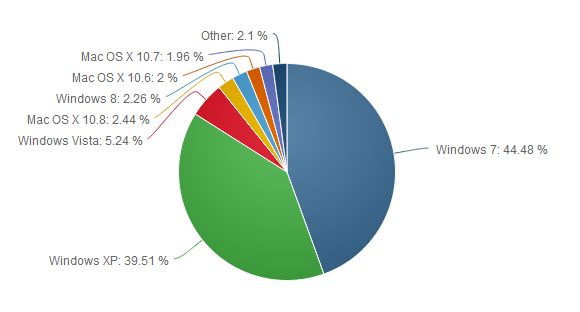
Wait until January before you cast judgment on Windows 8, they said. That’s when the big boost from holiday sales will—or won’t—show up, and you’ll be able to get a better idea of how the operating system is doing. Well, Net Application’s January desktop usage data is in. What do the numbers show? Is Windows 8’s usage rate lagging?

It depends on how you look at it.

Net Applications
Net Application’s January desktop share data.

Let’s get the bleak news out of the way first. Three months after its release, Microsoft’s new-look operating system was found on 2.26 percent of all the traditional PCs tracked by Net Applications, whose web measurement network is comprised of 40,000 websites that receive roughly 160 million unique visits each month. By comparison, Windows 7 claimed a 7.57 percent browser share at its three-month mark, while Windows Vista was sitting slightly less pretty with a 3.3 percent share three months in.

The monthly gulf between Windows Vista’s uptake and Windows 8’s uptake is only widening, in other words. People still consider Windows Vista to be a stinker, rightly or wrongly, and that reputation no doubt helped to fuel Windows 7’s lightning-fast adoption. Conversely, Windows 7’s all-around excellence is likely holding back Windows 8—there simply isn’t a compelling reason to leap to Windows 8 and its redesigned modern UI if you’re a happy Windows 7 user.

To read this article in full or to leave a comment, please click here

Source: FULL ARTICLE at PCWorld