Tag Archives: MLP

Refiners Were the Market's Winners Today

By Dan Dzombak, The Motley Fool

Filed under:

Oil prices were on the move today after a weaker-than-expected unemployment report stoked fears of a slowdown in the U.S. economy. At 5:00 pm EDT on Thursday, Brent crude was down 0.62%, to $106.31, and WTI crude was down 1.26%, to $93.35. U.S. natural gas was up 1.49%, to $3.96.

Today’s oil and gas stocks leaders were all refiners. Last Friday, the EPA announced new rules for gasoline that include a 67% reduction in sulfur in an effort to improve air quality. On Tuesday, the sector was crushed after a spokesman for Valero said the company expected the new EPA rules for gasoline would cost it $300-$400 million over the next few years. That announcement sent the stock down 6% on Tuesday, and the sector as a whole fell with it. The decline continued yesterday, as the market was also down.

VLO data by YCharts

Today, refiners as a whole were up as investors took advantage of the drops in prices.

Among companies with over a $1 billion market cap, today’s oil and gas stocks leader was Alon USA Energy , up 4.95% to $17.16. During the refiners’ drop on Tuesday and Wednesday, Alon dropped 12.89%. Despite the comeback today, the stock is still down 8.6% from where it was before the plunge. Alon USA owns refineries in Louisiana and California, 11 asphalt terminals, as well as 300 7-11 retail locations. The company has been profiting heavily from the massive price difference between WTI and Brent crude. In November of 2012, the company IPO’d its Big Springs refinery as a master limited partnership, Alon USA Partners LP, the proceeds of which Alon used to pay down debt.

Second among oil and gas stocks today was Delek U.S. Holdings up 4.78%, to $37.28. During the refiners’ drop on Tuesday and Wednesday, Delek dropped 9.88%. Despite the comeback today, the stock is still down 5.6% from where it was before the plunge. The company owns two refineries in Texas, terminals throughout Texas, Arkansas, and Tennessee, and retail stores throughout Tennessee, Alabama, and Georgia.

Third among oil and gas stocks today was Western Refining up 4.14%, to $32.43. During the refiners’ drop on Tuesday and Wednesday, Delek dropped 11%. Despite the comeback today, the stock is still down 7.32% from where it was before the plunge. Last month, after crushing its earnings, Western Refining announced they were considering launching a master limited partnership for some of their midstream assets. MLP spinoffs have been a hot topic the past year as more and more companies take advantage of investors’ hunt for yield, and the tax savings MLPs offer. Fool senior analyst Jim Mueller added to his holdings of Western Refining in February at prices slightly higher than today — find out why by reading his pitch here.

Foolish bottom line

It’s easy to forget the necessity of midstream operators that seamlessly transport oil and gas throughout the United …read more

Source: FULL ARTICLE at DailyFinance

Tortoise Capital Advisors Introduces New Open-End Mutual Fund

By Business Wirevia The Motley Fool

Filed under:

Tortoise Capital Advisors Introduces New Open-End Mutual Fund

The Tortoise North American Energy Independence Fund provides dedicated focus on oil and gas production growth potential, supporting energy independence

LEAWOOD, Kan.–(BUSINESS WIRE)– Tortoise Capital Advisors today announced the introduction of the Tortoise North American Energy Independence Fund, an open-end mutual fund that invests primarily in equity securities of North American oil and gas production companies.

“We are in a new era of unprecedented North American production growth that has the potential to make our nation increasingly energy independent. This fund seeks to directly participate at the heart of this opportunity, targeting companies across North America with a strong presence in premier shale basins,” said Tortoise senior investment analyst, Rob Thummel.

The fund expands upon Tortoise’s leadership and history in the sector. Tortoise formed the first NYSE-listed closed-end fund focused on energy infrastructure MLPs in 2004 and is one of the largest investment managers of registered energy infrastructure funds. As an industry pioneer, Tortoise has managed energy infrastructure investments for nearly a decade, across economic cycles and natural disasters.

“The newest addition to the Tortoise family is a differentiated and complementary investment alternative, providing dedicated access to domestic oil and gas production that could dramatically alter North American relevance around the globe,” stated Tortoise’s director of product development, Michelle Kelly. “Additionally, the fund supports job creation, increased tax revenues, national security and the theme of energy independence for decades to come.”

The fund is structured as a traditional mutual fund providing daily liquidity at NAV, with flow-through tax treatment and no taxation at the fund level. Simplified tax reporting is provided to investors through a single 1099. Investor, C Class and Institutional shares are available under the symbols TNPTX, TNPCX and TNPIX, respectively.

The fund was initiated in cooperation with Montage Investments. Montage’s diverse group of boutique asset managers offer multiple investment solutions, including mutual funds, closed-end funds, separately managed accounts and alternative partnership investments. Additional information regarding the fund may be obtained by calling 855-TCA-FUND (855-822-3863) or visiting www.tortoiseadvisors.com.

About Tortoise Capital Advisors, LLC

Tortoise Capital Advisors, L.L.C. is an investment manager specializing in listed energy investments. Tortoise is considered a pioneer in managing portfolios of MLP securities and other energy companies for individual, institutional and closed-end fund investors As of …read more
Source: FULL ARTICLE at DailyFinance

1 Reason Why This Dividend is Safer Than its Peers

By Matt DiLallo, The Motley Fool

Filed under:

Having the highest yield doesn’t necessarily mean a company has the best yield. In fact, sometimes a high yield can actually be a sign of weakness. The good news is that the high-yielding upstream MLP segment is actually a pretty safe bet for investors. These oil and gas companies, although structured as an MLP or LLC for tax purposes, are, at their cores, income producing machines.

That being said, not all of these high yields come without risk. As we drill down into some of the top upstream MLPs, you need to consider which distribution is best for your risk tolerance. For me, one company is clearly the safest choice, and that’s enough for me to be able to sleep at night, because I know that the company will continue to securely produce the income I expect for years to come.

The yield
If you look at the chart below, you’ll see quite a variation in the distribution yield of some of the top upstream MLPs:

Company

Market Capitalization

Distribution Yield

BreitBurn Energy Partners

$2.0 Billion

9.40%

QR Energy

$1.5 Billion

11.10%

LINN Energy

$8.5 Billion

8.00%

Vanguard Natural Resources

$2.0 Billion

8.50%

At first glance, it would be easy to be drawn into QR Energy’s extremely high yield. The question that needs to be answered is, how safe, really, are any of these yields? And, which company would be best for your yield-hungry portfolio? Let’s dig a little deeper and see if there’s more to the story.

How safe is it?
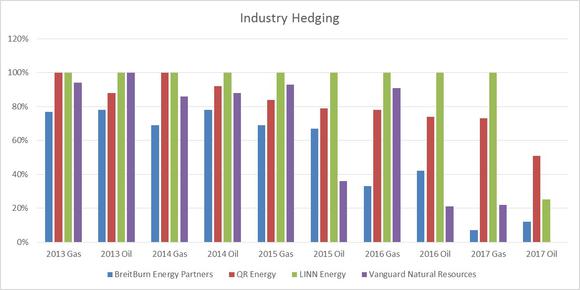
Many energy companies hedge oil and gas production in order to smooth out cash flows from commodity price volatility. One big difference between a traditional exploration and production company structured as a C-Corp, and those structured like our MLPs, is the percentage of oil and gas production that is hedged, and its duration. The more production that’s hedged for the greatest length of time brings more safety to the MLP‘s payout. Which company has the safest payout? Take a look at the chart below:

Source: Company Website and Author Calculations

Do you see that green bar consistently hitting the top line at 100% hedged? That’s LINN Energy, a company that’s called its hedging strategy its “secret sauce.” Before we declare LINN the clear winner, let’s drill down a bit deeper into each company.

BreitBurn at most hedges 78% of its production, and its hedges really fall off after 2015. If you believe commodities are heading higher, that’s not a bad thing. However, if you want secure cash flow, the risk is that the company won’t be able to deliver it on its unhedged volumes. The other item to note, which you can’t see on the above chart, is that a majority of the company’s hedges are swaps that are fixed-price contracts. The company uses very few puts or collars to …read more
Source: FULL ARTICLE at DailyFinance

This MLP Spinoff Will Be Hard to Resist

By Aimee Duffy, The Motley Fool

Filed under:

It’s official: Phillips 66 is going to IPO a master limited partnership before the end of this year. The company announced yesterday it has filed registration paperwork with the SEC. Currently a wholly owned subsidiary, Phillips 66 Partners will trade under the ticker PSXP. Management has yet to decide how many limited partner units will be offered, or how they will be priced, but it intends to raise about $300 million in proceeds from the sale. This could be a great opportunity for investors looking for a stable business to add to their portfolios. With that in mind, let’s take a closer look at the midstream story at Phillips 66. 

Midstream at PSX
Phillips 66 has a significant midstream business, and reorganizing into an MLP makes plenty of sense. The assets that will fall under the Phillips 66 Partners entity include:

  • Clifton Ridge crude oil pipeline
  • Terminals and storage in Louisiana, Illinois, and Texas
  • Sweeny to Pasadena refined products pipeline
  • Hartford Connector refined products pipeline
  • 3 NGL fractionators: 130,000 bpd capacity 

Phillips 66 also holds a 50% interest in DCP Midstream, the parent company of DCP Midstream Partners . Spectra Energy holds the other 50% stake. DCP specializes in natural gas gathering systems, and is also one of the largest producers and marketers of natural gas liquids in the U.S. The company produced 400,000 bpd of NGLs, and contributed EBITDA of $1.1 billion to Phillips 66 in 2012. .

Room to run
Phillips 66 Partners will IPO in the second half of this year, but don’t expect this MLP to sit still for very long. Management sees compelling growth opportunities ahead, especially in exports, and is looking to significantly increase full-year EBITDA from the current level of about $180 million.

Both Phillips 66 and DCP Midstream have a strong asset footprint on the Gulf Coast, which makes it easy to target export growth. PSXP will focus on international markets for petrochemicals and heating, specifically aiming to increase exports of liquefied petroleum gas and NGLs.

DCP Midstream is also targeting growth, and it expects to grow its NGL production by 25% over the next five years.

Foolish takeaway
I encourage Fools interested in this IPO to take a long look at the prospectus, once it becomes available on the SEC website. Specifically, look for an indication of what level of commodity risk PSXP will be exposed to. NGL prices have wreaked havoc on the industry in the past, and by Phillips 66’s own calculation, a $0.01 change in NGL prices causes a $4 million change in net income.  If PSX structures fee-based contracts with the new MLP, this IPO will be hard to resist.

Enterprise Products Partners is another midstream company targeting export growth. To help investors decide whether Enterprise Products Partners is a buy or a sell today, click here now to check out The Motley Fool’s brand new premium research report on the company.

…read more
Source: FULL ARTICLE at DailyFinance
Kayne Anderson Midstream/Energy Fund Increases its Quarterly Distribution to $0.45 per Share for Q1

By Business Wirevia The Motley Fool

Filed under:

Kayne Anderson Midstream/Energy Fund Increases its Quarterly Distribution to $0.45 per Share for Q1 2013

HOUSTON–(BUSINESS WIRE)– Kayne Anderson Midstream/Energy Fund, Inc. (the “Fund”) (NYS: KMF) announced today a quarterly distribution of $0.45 per share for the quarter ended February 28, 2013. This distribution represents an increase of 1.7% from the prior quarter’s distribution of $0.4425 per share and an increase of 5.9% from the distribution for the quarter ended February 29, 2012. This represents the sixth consecutive quarterly increase by the Fund.

The distribution will be payable on April 26, 2013 to common stockholders of record on April 19, 2013, with an ex-dividend date of April 17, 2013. It is anticipated that none of the distribution will be treated as a return of capital for tax purposes. The final determination of such amount will be made in early 2014 when the Fund can determine its earnings and profits. The final tax status of the distribution may differ substantially from this preliminary information.

Kayne Anderson Midstream/Energy Fund, Inc. is a non-diversified, closed-end management investment company registered under the Investment Company Act of 1940, whose common stock is traded on the New York Stock Exchange. The Fund’s investment objective is to provide a high level of total return with an emphasis on making quarterly cash distributions to its stockholders by investing at least 80% of its total assets in securities of companies in the Midstream/Energy Sector, consisting of: (a) Midstream Master Limited Partnerships (“MLPs”), (b) Midstream Companies, (c) Other MLPs and (d) Other Energy Companies. The Fund anticipates that the majority of its investments will consist of investments in Midstream MLPs and Midstream Companies. See Glossary of Key Terms on page ii of the Prospectus for definitions of certain key terms.

CAUTIONARY NOTE REGARDING FORWARD-LOOKING STATEMENTS: This press release contains “forward-looking statements” as defined under the U.S. federal securities laws. Generally, the words “believe,” “expect,” “intend,” “estimate,” “anticipate,” “project,” “will” and similar expressions identify forward-looking statements, which generally are not historical in nature. Forward-looking statements are subject to certain risks and uncertainties that could cause actual results to differ from the Fund’s historical experience and its present expectations or projections indicated in any forward-looking statements. These risks include, but are not limited to, changes in economic and political conditions; regulatory and legal changes; MLP industry risk; leverage risk; valuation risk; interest rate risk; tax risk; and other risks discussed in the Fund’s filings with the …read more
Source: FULL ARTICLE at DailyFinance

See What This $65 Billion Hedge Fund Company Is Up To

By Selena Maranjian, The Motley Fool

Filed under:

Every quarter, many money managers have to disclose what they’ve bought and sold, via “13F” filings. Their latest moves can shine a bright light on smart stock picks.

Today, let’s look at Citadel Advisors, founded and run by Kenneth Griffin. It’s one of the biggest hedge fund companies around, with a reportable stock portfolio totaling $65.3 billion in value as of Dec. 31, 2012.

According to the folks at InsiderMonkey.com, Griffin and his team use “a combination of advanced computer code, complicated financial algorithms and secrecy. Griffin was using quantitative, technology-based methods before many other firms had cell phones.” The company took a big hit of more than 50% back in 2008, and with an impressive 20% gain in 2011, finally surpassed its 2008 high.

Interesting developments
So what does Citadel’s latest quarterly 13F filing tell us? Here are a few interesting details:

The biggest new holdings are Gulfport Energy and ADT. Other new holdings of interest include Linn Energy , a Houston-based oil and natural gas master limited partnership (MLP) with a dividend yield of about 8%. Some expect the dividend to rise further, due to recent income-generating acquisitions. The company specializes in buying mature, productive energy assets and has also been successful at long-term hedging. Its organic production growth has been strong, too. To some, it seems a very promising investment, but others are wary of its aggressive share issuance, upping its shares outstanding by 74% over the past five years.

Among holdings in which Citadel increased its stake were Halcon Resources and American Capital Agency . Halcon, an oil and gas company, is expected to grow by 30% annually over the coming years. It operates in the promising Bakken region (as well as in the Woodbine and Utica regions), and recently reported 2012 net daily production 128% higher than year-ago levels and proven reserves up 417%. The stock has averaged annual losses of more than 13% over the past five years, but management remains confident. In a recent presentation, it stressed its focus on cash-flow protection, noting that it aims to hedge 80% of its expected production over the coming 18 to 24 months.

American Capital Agency offers investors a huge dividend yield topping 15%. Some worry that the dividend may get reduced (as has happened with some mortgage REITs), but its CEO has offered reassurance by buying more than $500,000 worth of shares for himself recently. In the meantime, the company has boosted the proportion of its portfolio that isn’t likely to suffer from borrowers refinancing and prepaying mortgages. Be wary, though, as there are some aspects of the company that aren’t too appealing, such as its significant use of leverage). My colleagues have questioned some of management’s moves, too.

Citadel reduced its stake in lots of companies, including Skyworks , which is a semiconductor company supplying, among other things, radio chips for iDevices. Its focus extends beyond …read more
Source: FULL ARTICLE at DailyFinance

Today's Top 3 Energy Stocks

By Dan Dzombak, The Motley Fool

Filed under:

Oil prices were on the move today as the market overlooked the threat of Cyprus to Europe. At 4 p.m. on Tuesday, Brent crude was up 0.12% to $107.61 and WTI crude was up 1.51% to $93.84. U.S. natural gas was up 0.03% to $3.94.

Today’s top 3 energy stocks
Among companies with market caps greater than $1 billion, today’s energy stocks leader was Walter Energy , which was up 3.51% to $29.45. Walter Energy is a pure-play metallurgical coal producer with mines around the U.S. and Canada.

Today, Walter Energy announced a $350 million private placement of debt due 2021, $250 million of which will go toward paying down debt. Walter Energy and other coal producers have been hit hard the past two years as low natural gas prices caused natural gas to steal market share from coal among utility companies. The company’s stock has also been beaten down as investors fret over a high $2.4 billion debt load.

This past year, the company has faced criticism and a proxy challenge from Audley Capital, which is looking to replace five members of Walter Energy’s board at the company’s annual meeting next month. On March 11, the current board laid out its case in a letter to shareholders and said they are “intensely focused on maximizing the value of your investment in the Company.” Audley Capital begs to differ and hopes investors give their nominees fair consideration.

Second among energy stocks today was Ferrellgas Partners L.P. up 2.93% to $20.05 on no real news. Ferrellgas Partners is a master limited partnership (MLP) focused on the distribution of propane. It is the second-largest distributor of propane in the U.S. with a 9% market share, behind AmeriGas Partners , who holds a 15% market share. Ferrellgas, though, is the largest distributor of portable propane tanks, operating under the Ferrellgas and Blue Rhino brands. Ferrellgas has largely grown through acquisitions in the heavily decentralized propane distribution business and the company believes there is plenty more opportunity for acquisitions in the future with 68% of the market independent retailers.

Third among energy stocks today was BP , up 2.71% to $42.00. Yesterday the oil and gas giant completed the previously announced sale of its stake in TNK-BP to Russian firm Rosneft in exchange for 18.5% of Rosneft and $4.5 billion in cash. Today, the company announced it would buy back $8 billion worth of shares, roughly the same amount it spent forming TNK-BP.

 BP CEO Bob Dudley said, “BP is moving on to the next phase of its business in Russia, becoming the largest private shareholder in Rosneft, Russia‘s leading oil company. In the process we have also released cash, equivalent to at least six years of BP‘s anticipated future dividends from TNK-BP. We look forward now to working closely with Rosneft and together developing opportunities to create value for both companies.”

There are many different ways to play the energy sector, …read more
Source: FULL ARTICLE at DailyFinance

Energy Tangle: Making Sense of the ETP Holdco Buyout

By Aimee Duffy, The Motley Fool

Filed under:

Earlier this week Energy Transfer Partners announced it was buying Energy Transfer Equity‘s stake in ETP Holdco for $3.75 billion. ETE is the general partner to the master limited partnership ETP. That relationship, together with the similar names of all of these entities, can complicate one’s understanding of what exactly this acquisition means. With that in mind, today we’re going beyond the press release and breaking down this deal. For the sake of clarity, the Energy Transfer entities will be referred to by their respective ticker symbols.

Holdco refresher
ETP and ETE formed Holdco in October 2012 to jointly own the equity interests in Southern Union Company and Sunoco. ETE closed on the Southern Union merger in March of last year, while ETP closed on the Sunoco one in October. At the time of creation, ETE had a 60% stake and ETP had a 40% stake, though the majority board membership belonged to ETP.

Southern Union‘s assets are primarily natural gas pipeline systems. Its 15,000 miles include the Panhandle Eastern Pipeline Company, the Trunkline Gas Company, the Sea Robin Pipeline Company, Trunkline LNG Company, Southwest Gas Storage, and an operating interest in Florida Gas Transmission.

Energy Transfer previously announced that it was selling a portion of Southern Union‘s original asset base to Laclede for $1 billion. The assets involved in the divestiture were Missouri Gas Energy and the New England Gas Company. Additionally, ETE announced last month that it would sell Southern Union Gas Services to its other MLP, Regency Energy Partners , for $1.5 billion.

Sunoco’s assets include 4,900 gas stations and convenience stores and its stake in the midstream MLP Sunoco Logistics Partners . That stake is important; it is made up of 32.4% of SXL‘s limited partner units, as well as its general partner stake and incentive distribution rights. SXL‘s assets include more than 5,000 miles of crude oil pipelines, 2,500 miles of refined products pipelines, and 42 refined products terminals.

The other side of the deal
ETP obviously gets full control of all of the Southern Union and Sunoco assets. ETE will receive $1.4 billion in cash, and $2.35 billion in ETP units. ETE will forgo incentive distribution rights on the new units for the first eight consecutive quarters after the close. From there, it will receive 50% of the IDRs for eight consecutive quarters, then moving on to 100% receipt of IDRs.

Remember, many general partners forgo incentive distribution rights on big deals like this in order to give the MLP a chance to integrate assets and realize the commercial benefits of the transaction.

Foolish takeaway
Both Energy Transfer entities are touting this deal as a means to simplify organizational structure, and it certainly does that. Streamlining has been one of management’s goals, and following through on this is important. Especially given that one of management’s other goals is to increase distribution payments to investors.

Though its structure can be confusing, at its …read more
Source: FULL ARTICLE at DailyFinance

Kayne Anderson MLP Investment Company Increases Distribution to $0.565 per Share for Q1 2013

By Business Wirevia The Motley Fool

Filed under:

Kayne Anderson MLP Investment Company Increases Distribution to $0.565 per Share for Q1 2013

HOUSTON–(BUSINESS WIRE)– Kayne Anderson MLP Investment Company (the “Company”) (NYS: KYN) announced today its quarterly distribution of $0.565 per share for the quarter ended February 28, 2013. This distribution represents an increase of 2.7% from the prior quarter’s distribution of $0.55 per share and an increase of 9.2% from the distribution for the quarter ended February 29, 2012. This represents the tenth consecutive quarterly increase by the Company.

The distribution will be payable on April 12, 2013 to common stockholders of record on April 5, 2013, with an ex-dividend date of April 3, 2013. It is anticipated that a portion of this distribution will be treated as a return of capital for tax purposes. The final determination of such amount will be made in early 2014 when the Company can determine its earnings and profits. The final tax status of the distribution may differ substantially from this preliminary information.

Kayne Anderson MLP Investment Company is a non-diversified, closed-end management investment company registered under the Investment Company Act of 1940, whose common stock is traded on the NYSE. The Company’s investment objective is to obtain a high after-tax total return by investing at least 85% of its total assets in energy-related master limited partnerships and their affiliates (collectively, “MLPs”), and in other companies that, as their principal business, operate assets used in the gathering, transporting, processing, storing, refining, distributing, mining or marketing natural gas, natural gas liquids (including propane), crude oil, refined petroleum products or coal.

CAUTIONARY NOTE REGARDING FORWARD-LOOKING STATEMENTS: This press release contains “forward-looking statements” as defined under the U.S. federal securities laws. Generally, the words “believe,” “expect,” “intend,” “estimate,” “anticipate,” “project,” “will” and similar expressions identify forward-looking statements, which generally are not historical in nature. Forward-looking statements are subject to certain risks and uncertainties that could cause actual results to differ from the Company’s historical experience and its present expectations or projections indicated in any forward-looking statements. These risks include, but are not limited to, changes in economic and political conditions; regulatory and legal changes; MLP industry risk; leverage risk; valuation risk; interest rate risk; tax risk; and other risks discussed in the Company’s filings with the SEC. You should not place undue reliance on forward-looking statements, which speak only as of the date they are made. The Company undertakes no obligation to publicly update or revise any forward-looking statements made herein. There is no assurance that the Company’s investment objectives will be …read more
Source: FULL ARTICLE at DailyFinance

Why Do Investors Hate This Top-Traded Natural Gas Stock?

By Matt DiLallo, The Motley Fool

Filed under:

Natural gas exploration and production company Quicksilver Resources is a day trader’s dream. With millions of shares being traded daily, and more than 20 million shares trading hands last Friday, Quicksilver is a company the market likes to move. Not only are traders buying and selling shares of Quicksilver in rapid-fire action but many of those traders have made bearish bets on the company as evidenced by the 16.8% of its outstanding shares being sold short. 

Those taking bearish bets have to be getting nervous considering that shares are up nearly 40% in the past week. That being said, bearish themes abound and are the force driving shares down 80% over the past two years, taking the company’s market cap below $500 million. With all the heavy trading surrounding this stock let’s take a look at why its both hated and loved by traders. 

Why it’s hated
If there are two things investors hate these days its energy companies that produce a lot of natural gas and have a debt-laden balance sheet. That’s a big problem for Quicksilver as 72% of its production is natural gas and the company’s balance sheet is weighted down by $2.1 billion of debt. Liquidity concerns are a bigger problem for Quicksilver and are a big reason why shares hit a low of $1.67 just on March 6.

The combination of a high debt burden and a focus on natural gas production has been the downfall of another hated natural gas stock: Chesapeake Energy . The company seems to have provided the blueprint followed by so many in the industry, including Quicksilver. While there are a lot of similarities between the two, Chesapeake seems to be a bit further along in its plan to grow its liquids production. The company is spending 85% of its 2013 capital budget to grow liquids production to 26% of total production, while Quicksilver will still be at just 18% liquids production in 2013. Still, there is a silver lining here that investors need to keep an eye on. 

Why it should be loved
Quicksilver is well aware of its liquidity issues. CEO Glenn Darden has said that his company’s “… top priorities are to improve liquidity through asset sales, joint ventures and other measures, further reduce the overall company cost structure, and match capital spending to operational cash flow.” To accomplish this, the company plans to only spend about $120 million in capital for 2013, which is a substantial cut from the $270 million it spent in 2012. The key here is that the company has resolved to limit its spending to its expected cash flow. It’s also promised to reduce spending further if it needs to preserve liquidity. 

One way the company will accomplish this is by concluding its advanced negotiations to monetize its Barnett Shale assets with a deal. The company is considering either an asset sale or an MLP for the assets and is …read more
Source: FULL ARTICLE at DailyFinance

Adding It All Up: Why BreitBurn Energy's Reserves Matter

By Matt DiLallo, The Motley Fool

Filed under:

Reserves are the lifeblood of an energy production company, but they matter even more if you’re an upstream MLP like BreitBurn Energy Partners . Most traditional exploration and production companies reinvest a majority, if not all, of their cash flow to explore for new sources of production in order to offset the natural decline of current production.

Companies like BreitBurn instead send that cash back to investors. That’s why it needs to be smart in buying assets that have a long reserve life that are also not in rapid decline. Let’s take a quick look at BreitBurn’s reserves and see how they stack up.

The big picture
BreitBurn had an estimated 151 million barrels of oil equivalent in reserves at the end of last year. Those reserves are spread across seven states and are estimated to last about 18 years.

Source: BreitBurn Investor Presentation

The company’s production is split evenly between gas and oil. Not all of its assets are of equal importance to the company so let’s take a closer look at segment.

Northern division
The assets lumped into BreitBurn’s northern division includes the Antrim Shale, New Albany Shale, and its Wyoming assets. The company’s Antrim Shale assets in Michigan make up the greatest portion of reserves at about 35% of the total. These primarily low-decline natural gas assets that are fairly predictable. Investors can expect the company’s more than 3,600 wells to produce for an average of 16 years.

These are solid MLP-type assets, which is why it’s no surprise that fellow upstream MLP LINN Energy also owns assets in Michigan. LINN‘s asset base is a much smaller portion of its overall reserves at less than 6%. The key here is that these are low-decline natural gas assets that are a good fit from an upstream MLP.

In addition to Michigan, BreitBurn has just over 250 wells in Indiana and Kentucky that are dedicated to the New Albany Shale. These just have an average reserve life of seven years and make up a very small portion of the company’s asset base. In Wyoming on the other hand, BreitBurn has a very large asset base, second only to its Michigan assets. These assets add an oily component to its production mix. Just last year the company spent $95 million to acquire a 100% oil asset in the Big Horn Basin. When you add in its crude oil producing Powder River Basin assets to the gassier Green River Basin assets you get a nice mix of production. These days the oilier the production you can get the better; however, given how well-hedged upstream MLPs are, it’s not as critical.

Southern division
BreitBurn’s southern division produces out of three states: California, Florida, and Texas. Of the three, its California assets are its largest. California oil assets are among the best assets for an MLP to own because of the low-decline rate. That is one of the main reasons …read more
Source: FULL ARTICLE at DailyFinance

5 Stocks That Are Too Stingy With Their Dividends

By Dan Caplinger, The Motley Fool

Filed under:

Investors want dividend income, and most companies have been more than willing to deliver higher dividends to their shareholders. With nearly 2,900 companies having raised their dividends during 2012, most investors got to share in the strong corporate-earnings results that helped push the stock market so strongly last year.

Yet even as dividends have increased, companies haven’t necessarily been as forthcoming about giving you as much in quarterly payouts as you might deserve. With the average payout ratio of dividends to earnings at just 36%, far below its usual level of closer to 50%, there’s plenty of room for companies to be freer about sharing their wealth. Today, let’s take a look at five companies that are particularly closed-fisted about making dividend payments.

National Oilwell Varco , 8.4% payout ratio
As a major player in the energy-services industry, National Oilwell Varco has done an excellent job of cashing in on the boom in oil and gas. By providing complex equipment like drilling rigs as well as simple supplies like drill pipe and bits and related services, the company has made itself an integral part of the production process for oil and gas producers across the industry.

Yet given how fast the company’s profits have grown, National Oilwell Varco‘s dividends haven’t keep up. Consider: Since 2010, Varco has seen its earnings jump 45%, with the company earning $5.86 per share over the past 12 months. Yet the company has only raised its annual dividend by a puny $0.08. Even if growth slows down or even stops in the near future, Varco still has plenty of capacity to pay more than its 0.7% yield.

Southwest Airlines , 5.2% payout ratio
No airline has been more consistently profitable over the years than Southwest. Even though its decision not to charge baggage fees has left Southwest as the odd player out in the industry, with its rivals adding billions to their bottom lines through fees, Southwest has nevertheless used its customer service advantage to keep itself in the black.

Where Southwest hasn’t soared is in paying dividends. Even though the company finally doubled its long-standing payout rate to a full $0.01 per share quarterly, that still equates to just a 0.3% yield. Admittedly, the airline industry is one where it’s important to have plenty of capital on hand, but Southwest’s strong track record suggests that it should be able to afford handing back more than just peanuts to shareholders.

CF Industries , 5.6% payout ratio
CF Industries has found itself in the right place at the right time, with its lucrative fertilizer business having soared in the wake of rising food prices and high demand from farmers seeking to improve yields. With holdings in both nitrogen-based and phosphate fertilizers, CF hasn’t suffered from a lack of income.

In that light, CF‘s dividend yield of just 0.8% doesn’t make much sense. By contrast, MLP subsidiary Terra Nitrogen pays a 6.6% yield, much …read more
Source: FULL ARTICLE at DailyFinance

This Little Energy Stock Just Got Bigger

By Aimee Duffy, The Motley Fool

Filed under:

Typically when the Permian Basin makes it into the news, the focus is on one of the fields in West Texas — but not today. Today New Mexico is in the spotlight, as growing production in the Permian across the border has allowed midstream MLP Holly Energy Partners to expand its crude oil capacity by 100,000 barrels per day.

The deal
Earlier this month, Holly Energy announced its plan to convert a refined products pipeline to crude oil service, and construct several new pipelines segments. It will also expand an existing pipeline and build truck unloading stations and crude storage capacity. Capital expenditures are expected to reach $35 million-$40 million, and the line should be in service no later than 2014.

Beyond higher volumes, there is significant upside here. The deal expands Holly Energy‘s customer base outside of its general partner, HollyFrontier . The refiner currently contracts 100% of Holly Energy‘s capacity through fee-based agreements. The fact that outside shippers have already committed enough volumes to get this project off the ground is important because it diversifies Holly Energy‘s income.

The familial bond remains intact, of course, not only because HollyFrontier owns a 44% stake in the MLP, but because there is a good chance that some of the oil will end up at its Navajo refinery in Artesia, N.M. The capacity of that refinery is 100,000 barrels per day, so it would be virtually impossible for HFC to take absorb it all.

Another look at the Land of Enchantment
Let’s get back to New Mexico for a second. Most of our “top oil-producing states” lists stop at five, which means the sixth-largest oil producer doesn’t get much attention. It is also the seventh-largest producer of U.S. natural gas.

The Energy Information Administration estimates that in November 2012, the most recent data available, New Mexico produced around 7.4 million barrels of oil, leaving it just shy of Oklahoma’s 8 million barrels.

As of 2011, the most recent full-year data that the state itself provides, Concho Resources and Occidental Petroleum were the largest oil producers, cranking out 13.7 million barrels and 6.2 million barrels of oil, respectively, in 2011.

Foolish takeaway
Both HollyFrontier and Holly Energy Partners have a significant presence in New Mexico. While Texas may get all the attention right now, expect to see production ramp up west of the border as well. The two Hollys and Occidental Petroleum are just a few of the companies that will benefit as producers hone their expertise in the Permian.

Enterprise Products Partners is much bigger than Holly Energy, but still offers stable distribution growth. With its superior integrated asset base, Enterprise can profit from the massive bottlenecks in takeaway capacity by taking on large-scale projects. To help investors decide whether Enterprise Products Partners is a buy or a sell today, click here now to check out The Motley Fool’s brand-new premium research report on the company.

…read more
Source: FULL ARTICLE at DailyFinance

An Investor's Guide to Master Limited Partnerships: MLPs and IRAs

By Tyler Crowe, The Motley Fool

Filed under:

Master limited partnerships have become a darling for investors. As high-yielding investments, they can be a great addition to an income-seeking portfolio. The Alerian MLP ETF , which is one gauge of the broader MLP industry, has a trailing-12-month dividend yield of 5.95% compared with the S&P 500 average of 2.16%.

MLPs have been around for several years, but only in recent years have they taken off in the energy space.  The tricky part about MLPs is that they aren’t like investing in a regular C-corporation. I’ve gone over some of the basics of investing in MLPs, but there are still some questions left unanswered. Today, let’s look at how an MLP works in your IRA.

Pass the (taxable) buck
One of the largest reasons for a company to set up as an MLP is the preferential tax status. An MLP passes all tax obligations for the company along to the unitholders, who pay based on their personal marginal tax rate. A C-corporation, in contrast, would pay a corporate tax rate and then pay out a dividend, which is subsequently taxed as a capital gain for the individual. By passing along the tax obligation to the individual, not only does it generate more income for the individual, but it also takes money away from the IRS that would normally be collected if it was a C-corp.

And that’s one of the primary reasons the government adjusted MLP laws back in the 1980s to limit them to companies that engaged in certain types of business. Before that ruling, several companies were setting up as MLPs only to avoid paying corporate taxes, so the government had to step in to ensure the continuation of tax revenues. 

On the other side of the coin, we have IRAs. Traditional IRAs are taxed as the money comes out as income, and Roth IRAs contain after-tax investments. Either way, any earnings or gains that occur in the account aren’t taxed at the time they’re earned, giving individual investors a great method to plan for retirement without worrying about having taxes take out big chunks along the way.  

The Unrelated Business Income Tax
As good as both IRAs and MLPs sound, don’t expect to completely skip paying taxes if you buy MLPs in an IRA. A section of the tax code imposes what’s called the Unrelated Business Income Tax, or UBIT, on IRAs with MLP income exceeding $1,000 annually.

Those who have worked with non-profit organizations may be more familiar with the UBIT. The tax code stipulates that if a non-profit entity receives income from a source not directly related to its tax-exempt function, then it’s taxed on that revenue. The rule also applies to your IRA.  

The IRA is considered a non-profit entity with the goal of providing individuals with a source of income when they retire through investments. Whenever you realize a gain in your IRA from more traditional methods, such as interest, dividends, or royalties, they’re considered “investment income” and are thus …read more
Source: FULL ARTICLE at DailyFinance

5 Fat Dividend Yields to Consider

By Selena Maranjian, The Motley Fool

Filed under:

Dividends from healthy, growing companies deliver to us, like mail carriers, in any kind of weather: boom, bust, or stalled economy. As 2012 drew to a close, I offered some high-yield dividend payers for you to consider. There are a lot of other promising income-generating stocks out there, though, and the year is still young, so if you’ve been meaning to add some dividends to your portfolio, read on for additional ideas.

Below are a few companies about which you might want to learn more. They each feature a combination of promising traits, such as dividend yields of at least 3%, positive expected EPS growth over the next few years, and debt levels under control. As you hunt for stocks, whether dividend payers or not, it’s good to see expected growth — and it’s also a plus when a company is saddled with heavy debt, as that can limit its potential. Each of the companies below offer solid income as well as growth potential.

Note that several of the companies are limited partnerships (MLPs), which offer some tax advantages as well as some complications. Note, too, that very high yields are sometimes tied to riskier stocks that have fallen in value. Be sure to research such companies carefully before jumping in.

Northern Tier Energy : The relatively newly public oil refiner yields about 16% and is profitable, with positive free cash flow, as well. (Such high yields are often unsustainable, but even a halving from that level would leave a fetching payout.) Northern Tier also operates more than 160 convenience stores. All is not perfect, though, as the company was recently paying out more than its earnings per share, and it does carry some risks, such as needing pipeline projects to be completed, ideally on time, in order to maximize production. It’s also riskier than many other MLPs, as its payouts are less certain. Management plans to increase production and also to cut costs by investing more in its trucking operation.

Hi-Crush Partners : Like Northern Tier, Hi-Crush, recently yielding 10.3%, is also an energy MLP, profiting via providing sand for fracking. Bulls like its low costs and long-term contracts with customers. Bears worry about controversies surrounding the practice of fracking. If fracking is reined in, companies such as Hi-Crush will be hurt. The company’s fourth-quarter results may not have been as impressive as some analysts had hoped, but they were still impressive, featuring double-digit gains in revenue and earnings.

Nam Tai Electronics , a China-based company yielding 4.2%, has seen its stock surge 176% over the past year. It’s involved in the manufacturing of tablets such as the iPad mini. In its strong fourth quarter, the relatively unknown company reported sales up 263% over year-ago levels, and noted that it’s boosting profit margins by shedding less profitable operations. Bulls like its forward P/E of 7, but a concern is a recent dip into negative free cash flow. 

Intel , …read more
Source: FULL ARTICLE at DailyFinance

Rentech Earnings: An Early Look

By Dan Caplinger, The Motley Fool

Filed under:

Earnings season is winding down, with most companies already having reported their quarterly results. But there are still some companies left to report, and Rentech is about to release its quarterly earnings. The key to making smart investment decisions with stocks releasing their quarterly reports is to anticipate how they’ll do before they announce results, leaving you fully prepared to respond quickly to whatever inevitable surprises arise. That way, you’ll be less likely to make an uninformed knee-jerk reaction to news that turns out to be exactly the wrong move.

Rentech has an interesting mix of businesses that includes not only a significant player in the fertilizer business but also segments aimed at renewable energy and synthetic fuels. Let’s take an early look at what’s been happening with Rentech over the past quarter and what we’re likely to see in its quarterly report on Tuesday.

Stats on Rentech

Analyst EPS Estimate

$0.02

Year-Ago EPS

($0.04)

Revenue Estimate

$91.7 million

Change From Year-Ago Revenue

45%

Earnings Beats in Past 4 Quarters

2

Source: Yahoo! Finance.

Will Rentech power higher this quarter?
Analysts have gotten slightly more optimistic about Rentech lately, having pushed up their earnings-per-share estimates for the most-recent quarter by a penny and sending 2013 estimates higher by $0.03 per share. The stock, though, has been stuck in neutral, falling about 1% since mid-December.

The renewable-fuel industry has been a very tough one to find profits from, as most companies have had a tough time ramping up production to become financially viable. Solazyme and its algae-based fuel business has been a money-loser for years, despite having managed to get a big partnership with Bunge to produce between 300,000 and 400,000 metric tons of fuel in the next few years. Amyris has seen similar pressure with its sugar-based fuels, with the company expected to keep seeing negative cash flow until 2014.

But Rentech’s saving grace has been its roughly 60% stake in subsidiary Rentech Nitrogen Partners , which has consistently produced profits from its nitrogen-based fertilizer business. Given low prices for natural gas, the master limited partnership has benefited from a favorable environment for nitrogen-fertilizer production, and Rentech’s 23.2 million unit stake in the MLP has produced nearly $90 million in income that the parent has used essentially to subsidize losses in its renewables business.

In its quarterly report, expect Rentech to discuss its decision to close its Colorado-based research and development unit. Although discontinuing money-losing operations is always a smart move, the question is whether the “more immediate growth opportunities” it identified will truly bring in the income that has thus far eluded Rentech. Unless it can do so, investors should take a close look at Rentech Nitrogen Partners as a more direct way to own Rentech’s major profit-producing asset.

There are many different ways to play …read more
Source: FULL ARTICLE at DailyFinance

Why Are These MLPs Spinning Off C-Corporations?

By Tyler Crowe and Aimee Duffy, The Motley Fool

Filed under:

MLPs are all the rage in the energy sector, and several companies want to get into the game by spinning off assets into an MLP strucutre. But Fool.com contributor Tyler Crowe sees a few companies trying their hand at the other direction and spin off some of their assets into C corporations. Linn Energy was one of the leading companies to try its hand at spinning off a C-corp with its IPO of LinnCo back in October. Now some others are looking at it as well.

In this video, Tyler and Aimee Duffy discuss how these moves not only help companies raise more capital, but how they also provide a vehicle for institutional investors to get in the game and facilitate acquisitions. Investors should keep a sharp eye on upstream MLPs like these — not only because of share dilution, but also because some of the risks the upstream sectors has that could pose a larger threat to an MLP.

The growing production of natural gas from hydraulic fracturing and horizontal drilling is flooding the North American market and resulting in record-low prices for natural gas. Enterprise Products Partners, with its superior integrated asset base, can profit from the massive bottlenecks in takeaway capacity by taking on large-scale projects. To help investors decide whether Enterprise Products Partners is a buy or a sell today, click here now to check out The Motley Fool’s brand-new premium research report on the company.

var FoolAnalyticsData = FoolAnalyticsData || []; FoolAnalyticsData.push({ eventType: “TickerReportPitch”, contentByline: “Tyler Crowe and Aimee Duffy“, contentId: “cms.23704”, contentTickers: “NYSE:EPD, NASDAQ:LINE, NASDAQ:LNCO, NYSE:BRY, NYSE:VNR”, contentTitle: “Why Are These MLPs Spinning Off C-Corporations?”, …read more
Source: FULL ARTICLE at DailyFinance

Westwood Income Opportunity Fund Surpasses $1 Billion in Assets

By Business Wirevia The Motley Fool

Filed under:

Westwood Income Opportunity Fund Surpasses $1 Billion in Assets

DALLAS–(BUSINESS WIRE)– Westwood Holdings Group, Inc. (NYSE: WHG) today announced that the Westwood Income Opportunity mutual fund has surpassed $1 billion in assets. Advisors and investors continue to demonstrate a strong appetite for the fund’s combination of current income, the opportunity for capital appreciation and potentially lower volatility delivered in a multi-asset fund.

Brian Casey, Westwood’s President & CEO, commented, “This is truly a remarkable achievement as only 6% of mutual funds have assets greater than $1 billion. I applaud the team effort of Mark Freeman, Chief Investment Officer and Senior Portfolio Manager; Todd Williams, Portfolio Manager; and our entire investment research department for delivering such high quality results in a tumultuous market environment. Achieving this milestone is the result of not just one good decision, but a series of good decisions.”

The Westwood Income Opportunity Fund invests in a diversified group of income-producing asset classes including dividend-paying common stock, preferred stock, convertible securities, government and corporate debt securities, money market instruments, royalty trusts, master limited partnerships (“MLPs”) and real estate investment trusts (“REITs”). The Fund is available in an institutional share class (WHGIX) and an A share class (WWIAX).

About Westwood

Westwood Holdings Group, Inc. provides investment management services to institutional investors, private wealth clients and financial intermediaries. Westwood manages a variety of investment strategies including U.S., Global, and Emerging Markets equities as well as income-oriented portfolios. Access to these strategies is available through separate accounts, commingled funds and the Westwood FundsTM family of mutual funds. Westwood has significant, broad-based employee ownership and trades on the New York Stock Exchange under the symbol “WHG.” Based in Dallas, Westwood also has offices in Omaha and Toronto.

For more information on Westwood, please visit www.westwoodgroup.com.

For more information on the Westwood Funds, please contact Mark Dunbar at mdunbar@westwoodgroup.com or visit www.westwoodfunds.com.

Mutual fund investing involves risk, including possible loss of principal. In addition to the normal risks associated with investing, bonds and bond funds are subject to interest rate risk and will decline in value as interest rates rise. High yield bonds are highly speculative and carry a greater degree of risk. REIT investments are subject to changes in economic conditions, credit risk and interest rate fluctuations. Additionally, investments in securities of MLPs involve risk that differ from investments in common stock including risks related to limited control and limited rights to vote on matters affecting the MLP. …read more
Source: FULL ARTICLE at DailyFinance

What's the Deal With MLP Spin-Offs?

By Aimee Duffy and Tyler Crowe, The Motley Fool

Filed under:

Between the tail end of 2012 and the early days of 2013, the midstream industry has experienced a wave of companies talking about spinning off certain assets into master limited partnerships. In this video, Motley Fool contributor Aimee Duffy explains the increased activity, considers what types of companies are doing this and why, and takes a look at some success stories along the way.  

These new MLP spin-offs certainly have their advantages, but its hard to compete with the asset footprint of the traditional midstream companies. Energy Transfer Partners is a company that helps alleviate our current glut in supply with its 23,500 miles of transformational pipelines. To see if ETP and its sizable dividend payment could be a good fit for your portfolio, you’re invited to check out The Motley Fool‘s premium research report on the company. Simply click here now for our thorough expert analysis of this midstream.

var FoolAnalyticsData = FoolAnalyticsData || []; FoolAnalyticsData.push({ eventType: “TickerReportPitch”, contentByline: “Aimee Duffy and Tyler Crowe“, contentId: “cms.23689”, contentTickers: “NYSE:DVN, NYSE:HFC, NYSE:WNR, NYSE:PSX, NYSE:MPC”, contentTitle: “What’s the Deal With MLP Spin-Offs?”, hasVideo: “True”, pitchId: “61”, pitchTickers: “NYSE:ETP“, …read more
Source: FULL ARTICLE at DailyFinance