Tag Archives: LINN

What's LINN Energy Worth?

By Matt DiLallo, The Motley Fool

Filed under:

Over the past month or so LINN Energy has been under a bit of an attack from short sellers. The company has been quick to respond to these comments and its most recent response (link opens a PDF) had a very detailed analysis of its net asset value. It’s always a good idea to have at least some basis for what an investment is worth, so let’s drill down into LINN’s net asset value.

LINN’s recent presentation provided investors with two different analyses of its net asset value. One is the company’s internal analysis and the other came from a third-party advisor. Both showed that LINN is currently undervalued, and possibly has an upside of up to 70% even before taking the company’s recently announced Berry Petroleum  merger into account. Let’s take a look at what this all means to current and potential LINN Energy investors.

LINN’s own internal analysis implies an equity value of $44.74-$64.74 per unit. The foundation of its analysis is its proved reserves, which when you add it all up, gives a base value of $8.8 billion. These reserves include both proved developed and unproved developed which are believed to hold approximately 5 trillion cubic feet of equivalent, or Tcfe, of reserves.

One thing I will point out is that in LINN’s valuation it is using a PV-7.5 instead of a more traditional PV-10 value. What it’s doing is taking the present value of these reserves and not discounting it as deeply. Given LINN’s low cost of capital, and the fact that these are known reserves, it’s not using an overly aggressive rate but it is something an investor needs to know.

In addition to the reserves that LINN has in place, it owns a gas processing plant that it acquired from BP in the Hugoton deal last year. At the time the plant was just 41% utilized giving it significant excess capacity and future upside. LINN has value in its hedge book as well as additional assets and facilities that hold value. Together, these assets add another $1.3 billion in value to the company.

From here the value gets a little more complicated and is more open for debate. LINN has a significant inventory of future drilling sites which could possibly yield upwards of 14 Tcfe of reserves. A large portion of this future potential is located in its Granite Wash acreage which could deliver 5.2 Tcfe of future production, however, in order for that production to be realized, gas needs to move above $4.70 per MMBtu after 2018 and oil needs to remain above $90 per barrel.

When you incorporate this future potential it adds significantly to LINN’s net asset value. Using both PV-15 and PV-10 rates these reserves could add between $6.5 billion and $11.2 billion to the company’s value respectively. Taking that top number, and netting out its debt, it implies a value upwards of $65 per unit.

LINN’s third-party …read more

Source: FULL ARTICLE at DailyFinance

LINN Energy Makes a Return

By Matt DiLallo, The Motley Fool

Filed under:

After spending billions to build up its oil and gas reserves, LINN Energy and its partners are now on the selling end of a transaction. LINN, along with Panther Energy and Red Willow Mid-Continent, announced the sale of properties in the Anadarko Basin to Midstates Petroleum for $620 million in cash. LINN originally acquired its 40% stake in the properties for $220 million back in 2011.

The producing properties encompass 140,000 net acres and proved reserves of 34.4 million barrels of oil equivalent that are 45% oil and 21% natural gas liquids. It adds 8,000 barrels of oil equivalent production per day to Midstate’s production base. Further, it adds over 700 low-risk, repeatable horizontal drilling opportunities. It’s a good deal for Midstates because it’s accretive to cash flow, reserves, and production.  

When LINN acquired its share in the properties almost two years ago CEO Mark Ellis noted: “The acquisition of these properties enhances LINN‘s overall position in the Texas Panhandle area, and marks our entry into the liquids-rich window of the horizontal Cleveland play in the Anadarko Basin.” He further noted: “Partnering with Panther will align us with an experienced and efficient operator that has been active and successful in this area for several years. This acquisition provides high rate-of-return projects and we expect it to be immediately accretive to our unitholders.” However, the opportunity to cash out now appears to be the more attractive option.

The company did note when it originally acquired its stake that what was attractive about the asset was its high rate of returns and quick payback. After less than two years of ownership, the asset is certainly living up to that quick payback. However, given how active LINN has been at purchasing assets, I’m surprised that it didn’t bid for control of the asset.

Instead, LINN is cashing in and will likely deploy the cash elsewhere. LINN, and affiliate LinnCo are in the midst of acquiring Berry Petroleum so the company does have a lot on its plate as its works toward closing that massive deal. What this does demonstrate is that LINN really is a disciplined acquirer of assets, and won’t make a deal just to grow. Instead, it focuses on those transactions that can move the needle and add to its distributable cash flow.

As a LINN Energy or LinnCo investor, a transaction like this should give you confidence that LINN is operating the company with returns in mind. This is not a company seeking growth at all costs; it’s focused on steadily growing its distribution to unitholders. I continue to believe in the LINN story and think it’s one worth believing in for a long, long time.

LINN represents just one of the many different ways to play the energy sector. While I prefer the company, it might not be right for your portfolio. If you’re looking for something a bit different, The Motley Fool’s analysts have …read more

Source: FULL ARTICLE at DailyFinance
1 Reason Why This Dividend is Safer Than its Peers

By Matt DiLallo, The Motley Fool

Filed under:

Having the highest yield doesn’t necessarily mean a company has the best yield. In fact, sometimes a high yield can actually be a sign of weakness. The good news is that the high-yielding upstream MLP segment is actually a pretty safe bet for investors. These oil and gas companies, although structured as an MLP or LLC for tax purposes, are, at their cores, income producing machines.

That being said, not all of these high yields come without risk. As we drill down into some of the top upstream MLPs, you need to consider which distribution is best for your risk tolerance. For me, one company is clearly the safest choice, and that’s enough for me to be able to sleep at night, because I know that the company will continue to securely produce the income I expect for years to come.

The yield
If you look at the chart below, you’ll see quite a variation in the distribution yield of some of the top upstream MLPs:

Company

Market Capitalization

Distribution Yield

BreitBurn Energy Partners

$2.0 Billion

9.40%

QR Energy

$1.5 Billion

11.10%

LINN Energy

$8.5 Billion

8.00%

Vanguard Natural Resources

$2.0 Billion

8.50%

At first glance, it would be easy to be drawn into QR Energy’s extremely high yield. The question that needs to be answered is, how safe, really, are any of these yields? And, which company would be best for your yield-hungry portfolio? Let’s dig a little deeper and see if there’s more to the story.

How safe is it?
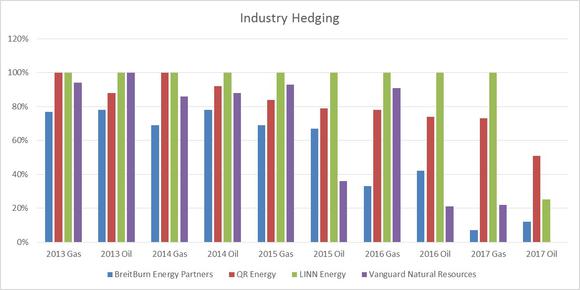
Many energy companies hedge oil and gas production in order to smooth out cash flows from commodity price volatility. One big difference between a traditional exploration and production company structured as a C-Corp, and those structured like our MLPs, is the percentage of oil and gas production that is hedged, and its duration. The more production that’s hedged for the greatest length of time brings more safety to the MLP‘s payout. Which company has the safest payout? Take a look at the chart below:

Source: Company Website and Author Calculations

Do you see that green bar consistently hitting the top line at 100% hedged? That’s LINN Energy, a company that’s called its hedging strategy its “secret sauce.” Before we declare LINN the clear winner, let’s drill down a bit deeper into each company.

BreitBurn at most hedges 78% of its production, and its hedges really fall off after 2015. If you believe commodities are heading higher, that’s not a bad thing. However, if you want secure cash flow, the risk is that the company won’t be able to deliver it on its unhedged volumes. The other item to note, which you can’t see on the above chart, is that a majority of the company’s hedges are swaps that are fixed-price contracts. The company uses very few puts or collars to …read more
Source: FULL ARTICLE at DailyFinance

3 Attractive Acquisition Targets for Oil Majors

By Tyler Crowe, The Motley Fool

Filed under:

For a major oil and gas company to meet its production growth targets, it takes a lot of capital and a little luck. If it can’t meet those production goals through exploration, the company may go out and buy a company or two. For example, when ExxonMobil wanted to get in on the shale plays in Alberta last year, it bought Celtic Exploration for $2.6 billion. The deal bolstered the company’s holdings in the area by about 139 million barrels of oil equivalent of proved and probable reserves, a much-needed boost for a company that has struggled to meet its production goals as of late.

Like investors, major oil companies are always looking to get value out of their purchases. Today, let’s look at a way to value a company for an acquisition and see if there are any companies that could be on he block for potential buyout.

Getting bang for your buck
While there are certainly some very complicated methods for evaluating an energy company, a quick and dirty method is to see how the enterprise value of the company (all equity and debt minus cash) compares to the total proved reserves on the company’s books. For example, Berry Petroleum , which was just acquired by LINN Energy for a final price tag of $4.3 billion, had just over 274 million barrels of oil equivalent in proved reserves. This means that the company paid about $15.33 per barrel of oil equivalent for the company’s reserves. Based on an S&P Capital IQ screen of exploration and production companies with a total enterprise value between $4 billion and $45 billion, an average company in this space would have an enterprise value per barrel of oil equivalent of $21.53. So based on this metric, it appears that LINN didn’t overpay for this asset.

There is also one thing to consider when using a metric like this. Companies evaluate barrel of oil equivalents based on a BTU equivalency, but gas and oil spot prices trade at very different rates than this basis. For example, a gas-heavy company like Ultra Petroleum would have a value of about $9.69 per barrel of oil equivalent. This is misleading because over 95% of its reserves are in gas. Keep this in mind if you do this kind of calculation on your own.

Using this method for evaluating companies, let’s take a look at a couple companies that could be selling at a deep discount.

Devon Energy
Some people might see Devon’s $11 billion in debt as a little too much bulk for a $28 billion. But with an enterprise value of $8.97 per barrel of oil equivalent, Devon could be a great deal for someone who wants a well-diversified portfolio. Overall, Devon itself is pretty well-diversified, with about 47% of proven reserves in oil and natural gas liquids. One of the possible reasons for the lower price tag may be that the company has 68% of all its proven …read more
Source: FULL ARTICLE at DailyFinance

Adding It All Up: Why BreitBurn Energy's Reserves Matter

By Matt DiLallo, The Motley Fool

Filed under:

Reserves are the lifeblood of an energy production company, but they matter even more if you’re an upstream MLP like BreitBurn Energy Partners . Most traditional exploration and production companies reinvest a majority, if not all, of their cash flow to explore for new sources of production in order to offset the natural decline of current production.

Companies like BreitBurn instead send that cash back to investors. That’s why it needs to be smart in buying assets that have a long reserve life that are also not in rapid decline. Let’s take a quick look at BreitBurn’s reserves and see how they stack up.

The big picture
BreitBurn had an estimated 151 million barrels of oil equivalent in reserves at the end of last year. Those reserves are spread across seven states and are estimated to last about 18 years.

Source: BreitBurn Investor Presentation

The company’s production is split evenly between gas and oil. Not all of its assets are of equal importance to the company so let’s take a closer look at segment.

Northern division
The assets lumped into BreitBurn’s northern division includes the Antrim Shale, New Albany Shale, and its Wyoming assets. The company’s Antrim Shale assets in Michigan make up the greatest portion of reserves at about 35% of the total. These primarily low-decline natural gas assets that are fairly predictable. Investors can expect the company’s more than 3,600 wells to produce for an average of 16 years.

These are solid MLP-type assets, which is why it’s no surprise that fellow upstream MLP LINN Energy also owns assets in Michigan. LINN‘s asset base is a much smaller portion of its overall reserves at less than 6%. The key here is that these are low-decline natural gas assets that are a good fit from an upstream MLP.

In addition to Michigan, BreitBurn has just over 250 wells in Indiana and Kentucky that are dedicated to the New Albany Shale. These just have an average reserve life of seven years and make up a very small portion of the company’s asset base. In Wyoming on the other hand, BreitBurn has a very large asset base, second only to its Michigan assets. These assets add an oily component to its production mix. Just last year the company spent $95 million to acquire a 100% oil asset in the Big Horn Basin. When you add in its crude oil producing Powder River Basin assets to the gassier Green River Basin assets you get a nice mix of production. These days the oilier the production you can get the better; however, given how well-hedged upstream MLPs are, it’s not as critical.

Southern division
BreitBurn’s southern division produces out of three states: California, Florida, and Texas. Of the three, its California assets are its largest. California oil assets are among the best assets for an MLP to own because of the low-decline rate. That is one of the main reasons …read more
Source: FULL ARTICLE at DailyFinance

What Sets These MLPs Apart?

By Matt DiLallo, The Motley Fool

Filed under:

While most investors these days are familiar with midstream MLPs and the generous distributions paid, far fewer are familiar with the growing number of upstream oil and gas MLPs. These companies pay the same large distributions but, instead of transporting oil and gas around the country, they’re taking it out of the ground.

Traditional exploration and production companies still do most of the heavy lifting. An upstream MLP simply buys up mature producing wells to squeeze out every last drop of oil and gas from them while distributing virtually all of the profits to investors. To help you better determine which upstream MLP you might want to buy, I’ve compiled the top reason why you’d want each company in your portfolio.

If you want to own the top dog
LINN Energy
, and by association LinnCo , is by far and away the top dog in the upstream MLP segment. Though, as some might point out, LINN‘s not exactly an MLP as its true structure is that of an LLC. That aside, LINN is not only the largest company in the space that it created, but it is bigger than every one of its peers combined: 

Source: LINN Energy investor presentation

LINN‘s not just big, but it’s also the most hedged operator in the energy industry. It has hedged its natural gas output until 2017 and its oil production is hedged through 2016. This enables LINN and LinnCo to lock in cash flow to investors, allowing both companies to pay an 8% distribution. Bottom line here, if you want to earn income from oil and gas production, LINN‘s could be the safest way to play.

If you want to be paid monthly
If you want a slightly larger yield hitting your brokerage account a bit more often Vanguard Natural Resourcesmonthly distribution might be for you. Like its upstream peers, Vanguard’s lifeblood is its ability to acquire mature, long-life production. Just last week the company announced a $275 million deal to acquire oil and gas properties in the Permian Basin from Range Resources . The deal added 136 billion cubic feet equivalent of liquid-rich reserves and has an estimated reserve life of nearly 20 years. It’s a great MLP-type asset that should help Vanguard to keep its growing distribution flowing to investors. 

If you want a bit more growth
While both LINN Energy and Vanguard are known for slower growth and rising distributions, EV Energy Partners is more of a faster growth story. The company operates in less mature plays like the Barnett Shale and the Utica Shale. It also has a growing midstream business in the fast-growing Utica. Because of the focus on growth, its distribution has been relatively flat over the first few years. 

With this growth comes a lot of upside. The company is currently marketing its 100,000 acres in the Utica which could be worth upwards of $10,000 an acre …read more
Source: FULL ARTICLE at DailyFinance

Get Paid More Often With These Stocks

By Matt DiLallo, The Motley Fool

Filed under:

I remember back to when I first started investing right out of grad school. Not having a lot of income at the time, I got hooked on buying income-producing stocks in the hopes that someday they’d provide enough income for me to quit my day job. I’m still waiting for that day to arrive.

What I’ve done in the meantime is built a fairly balanced income-generating portfolio where I’ve staggered my dividend payers so that I get roughly the same income each month. As you know, most companies that pay a dividend do so quarterly, which creates a bit of a challenge if you want more regular income. That was until I discovered the companies that paid a monthly dividend.

I say “discover,” but what really happened was that a company I owned, Prospect Capital needed to cut its payout, but as part of that deal it switched to paying investors on a monthly basis. Prospect, which is structured as a business development company, has to pay out 90% of its taxable income to investors. Today that equates to a nearly 12% yield, which it still pays in monthly installments. Even better, each month Prospect has given investors a small raise, making it a great choice for steady monthly income. 

Prospect is not alone, as just last year Vanguard Natural Resources switched to a monthly payout. The company, which is a publicly traded partnership, is engaged in the acquisition, production, and development of oil and natural gas properties. Its MLP-like structure has a similar payout requirement as Prospect Capital, leading to a large yield of almost 9% on an annual basis. While investors liked the yield, they wanted to see it more often. According to CFO Richard Robert:

We have listened to investors and we believe that we are giving them what they want. A monthly distribution should allow investors to better manage their finances by matching their monthly cash outflows with monthly cash inflows. In addition, a monthly distribution will allow us to reward our investors in a timelier manner as we make accretive acquisitions in the future. We believe the decision to pay distributions monthly rather than quarterly will be welcomed by both our current Vanguard unitholders as well as other potential investors looking to invest in high-yielding energy securities.

It would appear that more companies will be joining the monthly-payout bandwagon. LINN Energy hinted in its last earnings release that it, too, will be switching to a monthly payout. Specifically, the company said that “management is evaluating a change in the company’s distribution policy to increase the frequency of its cash distributions from quarterly to monthly.” The change would also be likely to affect investors in its affiliate, LinnCo , as the company only owns units of LINN and pays out out all of its income to investors. As an investor in both, I wouldn’t mind seeing more frequent payments.

It also wouldn’t surprise me to …read more
Source: FULL ARTICLE at DailyFinance

Where LINN Energy Plans to Grow in 2013

By Matt DiLallo, The Motley Fool

Filed under:

Oil and natural gas income giant LINN Energy is out with its 2013 capital spending plan. With more than 10,000 prospective drilling locations across its more than half dozen core operating areas, LINN has plenty of options with which to invest its capital. Let’s drill down and examine where LINN will be looking to boost its organic production growth in the year ahead.

A quick look back
Last year, LINN drilled 440 gross wells, with only four of them coming up dry. Those wells cost the company around $1 billion and boosted organic production by 15%. They also helped the company to produce a reserve replacement ratio of about 150% if you exclude price-based revisions and undeveloped reserves more than five years old. Those were great results for the company, which is expecting even more in the year ahead.

Drilling down into the 2013 capital budget
LINN plans to spend $1.1 billion on developing its oil and liquids-rich acreage. That money will allow LINN to drill or participate in about 500 wells over the next year. If everything goes according to plan, those wells should help LINN deliver another year of double-digit organic production growth.

The money will be split across its portfolio:

Source: LINN Energy Investor Presentation.

The Granite Wash is far and away the most important growth asset for LINN at the moment. The company is planning to spend more than a third of its capital to drill 80 wells into the play. The liquids-rich Hogshooter formation will continue to be the key target area for the company, as it generated excellent returns in 2012. Aside from that, the Permian Basin will see its share of capital in the coming year. While it is getting just 18% of the capital, LINN will use it to drill nearly 100 wells. Finally, the most interesting aspect of the drilling budget, in my opinion, is that LINN will be spending a great deal of capital to further develop its Jonah Field, which it acquired from BP last year, while spending minimally on the Hugoton assets, which it also bought from BP last year.

Jonah is more of a gas asset, as 73% of production is natural gas. It also has a higher decline rate of 14%. Hugoton’s production, on the other hand, has a lower decline at 7%, while it’s just 63% natural gas. The likely reason for the focus on Jonah is that the company will be participating with Encana on approximately 58 wells while only drilling 18 wells that LINN will operate. That makes more sense, especially when you consider that Encana is one of the few companies that’s still drilling for natural gas these days.

Harvesting future fruit
While the deal won’t close until the second half of the year, LINN’s purchase of Berry Petroleum in conjunction with its affiliate LinnCo will add even more organic production growth. Before the deal was announced, Berry …read more
Source: FULL ARTICLE at DailyFinance