Tag Archives: DRS

Getting started with KVM coming from Vmware

By karlochacon

hi guys

In order to test new ideas and reduce cost I would like to test KVM.
I think Vmware has these 3 things which are valuable:
– HA which restart VMs (Virtual Machines) in other hosts when a Hardware failure.
– DRS which basically is an intelligent VM placement when a hosts is overcommited
– vMotion which migrates VMs up and running to other hosts.

So my question:
Can I get those 3 features using KVM? I suppose I need a KVM Central Console equivalent to vCenter?

is there such console offering those 3 things? for free?
Will Openstack cover those 3?

is just I need to talk to my boss about moving to KVM but I know for sure he will ask OK…does it have the same capabilities as Vmware has?

thanks a lot guys

…read more

Source: FULL ARTICLE at The UNIX and Linux Forums

Australia angst over review system in Ashes loss

Profligate use of reviews ultimately cost Australia a heart-breaking first Test loss and has damaged their chances of regaining the Ashes, the nation’s newspapers said.

England just held their nerve to win the first Test by 14 runs at Trent Bridge on Sunday amid continuing controversy over the Decision Review System (DRS) which ended Australia’s brave bid to stage a miraculous come-from-behind victory.

While conceding England were the better team over the five compelling days of the opening Test, Australia’s media said their team paid for their poor use of the DRS at critical moments in the tense match.

“Had there been more diligent use of the umpire decision review system Australia would have had a review remaining late on day three when Stuart Broad was inexplicably given not out by umpire Aleem Dar when a thick edge flew from the gloves of Brad Haddin to Michael Clarke at slip,” The Sydney Daily Telegraph’s Malcolm Conn said.

“The thick edge that Broad survived is a complete contrast to the finest touch from Haddin’s bat which Dar and bowler Jimmy Anderson did not hear but which was awarded to England on review, ending the Test in such dramatic fashion.

“The DRS was originally conceived to rid the game of the howler and will remain fundamentally flawed until that is achieved but it is the system both teams must use in this series and Clarke admits Australia must get better at it,” he added.

The Melbourne Age lamented the below par contributions of Australia’s top order batsmen in the post-mortem examination of the defeat.

“It was this simple, and this impossible: England won the nine topmost wickets of this heart-stopping, heart-warming and heart-breaking Test match by 240 runs, and Australia won the last wicket by 226 runs,” The Age’s Greg Baum wrote.

“For Australia, in the end, vastly too much was asked of miserably too few, who so nearly and miraculously delivered anyway. But England’s win was merited and meritorious.

“The finishing note was both poetic and anti-climactic: an appeal, a not out decision, a referral and an overturning. Australia had blown seven referrals in the match, England just one, and now had one left when it most mattered. So it was that the Test match finished not with the last ball, but the Decision Review System’s deconstruction of it.”

The Australian’s Wayne Smith said the Trent Bridge Test would be remembered for the angst over the DRS.

“The opening Test has ended on an appropriate note of DRS controversy after a not-out ruling against Brad Haddin 15 runs short of victory was overturned on referral,” he said.

“This should be a Test recalled for the batting heroics of teenage Australian debutant Ashton Agar and the inspired 10-wicket swing bowling of England pace spearhead James Anderson but instead it will be remembered mainly for all the angst caused by the Decision Review System.”

Fairfax Media’s Malcolm Knox said England had now lost their psychological weapon: the sense of inevitability.

“When a team has a recent history of winning, the first thing it wants to do is …read more

Source: FULL ARTICLE at Fox World News

Teen Agar holds Australia's Test hopes: press

Australia’s newspapers are hoping debutant Ashton Agar can replicate his record-breaking first Test innings and guide his team to victory in the fluctuating first Ashes Test against England.

While the media Sunday highlighted yet more umpiring controversies that have dogged the series opener at Nottingham, commentators pointed to the 19-year-old rookie as Australia’s unlikely saviour after his amazing debut knock of 98 batting at number 11.

England were on the brink of winning the first Test with Australia 174 for six at stumps on Saturday’s fourth day, needing a further 137 runs to reach their victory target of 311.

No side has made more to win in the fourth innings of a Trent Bridge Test than England’s 284 for six against New Zealand in 2004.

Former Test captain Ian Chappell described Agar as the next Shane Warne, quickly adding: “Forget about his bowling, I’m talking about as a batsman.

“Very few Test debutants can say they saved a series for their team. If Agar hadn’t stunned England and amazed the cricket world with his batting, Australia may have lost the first Test so badly a comeback would have been difficult,” Chappell wrote in The Sunday Telegraph.

“Thanks to him, Australia now have a realistic chance of competing in this suddenly captivating series.”

Chappell said as a bowler, Agar would not be another Warne, but he “looks to be a rarity among recent Australian spin bowlers; he has the talent and temperament to be a building block for the future”.

The Australian’s Wayne Smith said Agar, promoted to bat at number eight in the second innings on the strength of his first effort, will need another sizeable innings if Australia are to go one up in the five-Test series.

“Anyone who saw Agar’s breathless 98 on day two would have been convinced they were witnessing a once-in-a-lifetime feat but if Australia, still needing another 137 runs for victory, is to triumph on the final day, he surely will need to replicate it on Sunday,” Smith said.

The Australian press reported on continuing umpiring controversies, with claims that four umpire calls for close leg before wicket decisions had gone against Australia, while they also bemoaned the team’s brittle top order batting.

“England has again exposed Australia’s soft underbelly, with another batting collapse in the first Test leaving Australia on the brink of defeat,’ The Sunday Telegraph’s Malcolm Conn said.

“Chief amongst Australia’s concerns is Ed Cowan. His double failure in this Test, batting in a new position at number three, could spell the end of his Test career.”

The Melbourne Age columnist Greg Baum said the Australians cannot blame the decision review system (DRS) for their plight.

“When the Australians review this first Test, form says they will botch it. Indiscriminate recourse to the decision review system contributed to, but did not cause, their imminent defeat. It would also behoove the ICC to review the system,” Baum wrote.

“Three of the six wickets that fatally undermined Australia’s quixotic bid for victory were processed through DRS. Obtaining a Test wicket has become something akin to negotiating terms of …read more

Source: FULL ARTICLE at Fox World News

The Only 2013 Formula 1 Season Preview You’ll Need

By Austin Lindberg

The action in Formula 1 doesn’t stop once the season ends: Once the champagne has gone flat in Brazil, teams have less than 12 weeks before their first public on-track appearances for the next season. Over those precious three months, teams will spend hours poring over the revised rulebook to discover any loopholes that can be exploited—while staying within “the spirit of the rules,” of course. There will be changes in ownership, management, and sponsorship, as well as teams that may cease to exist entirely. And, as seems to happen every year, tire compounds and constructions will change, adding another element for the engineers to deal with. And while the 2012 season will go down as one of the most exciting in F1 history, what’s transpired since Jenson Button finished first last November in São Paulo indicates that 2013 could be as good, if not better.

Major Changes at Mercedes

When Bernie’s traveling circus reconvened in Jerez and Barcelona for preseason testing, no fewer than eight drivers vacated their cars, but the biggest action was over at Mercedes. Legend Michael Schumacher announced his retirement last fall after his three-year comeback tour with Benz fell well short of expectations. But his departure was just the second step in what would become a massive overhaul at Mercedes as the 2012 season wound down. A week prior to Schumacher’s announcement, Lewis Hamilton made known that he would swap his McLaren for a Mercedes starting in 2013. Six weeks later, Benz’s head of motorsport, Norbert Haug, was relieved of his duties and subsequently was replaced by three-time world champion Niki Lauda. And, early this year, Paddy Lowe, who had been with McLaren for the past 20 years, was announced as Mercedes’ technical director beginning in 2014. Lowe’s appointment likely serves as writing on the wall for team principal Ross Brawn, who has led the non-business side of the team since moving from his eponymous effort to Mercedes for the 2010 season. The other driver changes for 2013 are detailed below in the team previews.

Double-DRS Banned

While the names affiliated with the teams are ever in flux, so too are the rules. Of the 2013 changes, of most interest is the ban on “double-DRS systems,” similar to what was used by Mercedes last season. Essentially, when the driver engages DRS (Drag-Reduction System), the rear wing opens to reduce drag. Benz’s double DRS exposed a pair of intakes, which channel air to the front of the car and stalled the front wing, further decreasing downforce and increasing top speed. Already we’ve seen teams exploiting a loophole in this new regulation. “Passive double-DRS,” in which intakes are permanently exposed and automatically activate above a certain speed rather than being driver-activated, is allowed, and both Red Bull and Lotus have been experimenting with the idea.

Tire Updates

Another obstacle for the engineers is that Pirelli—the exclusive tire supplier since 2011—has again changed its choices for 2013. The entire range will …read more
Source: FULL ARTICLE at Car & Driver

2014 McLaren P1 Specs: 903 hp, F1-Style IPAS and DRS Systems, Plug-In Hybrid Powertrain [2013 Geneva Auto Show]

By Alexander Stoklosa

2013 Geneva auto show full coverage

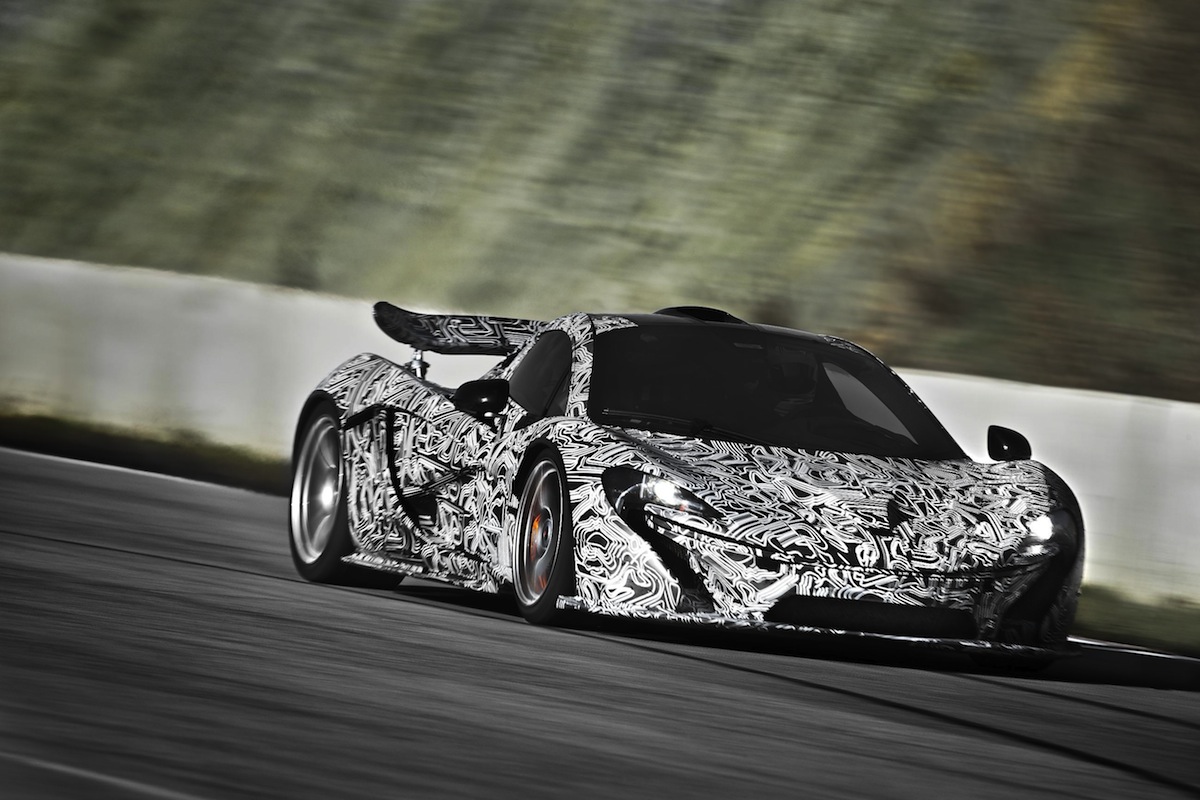
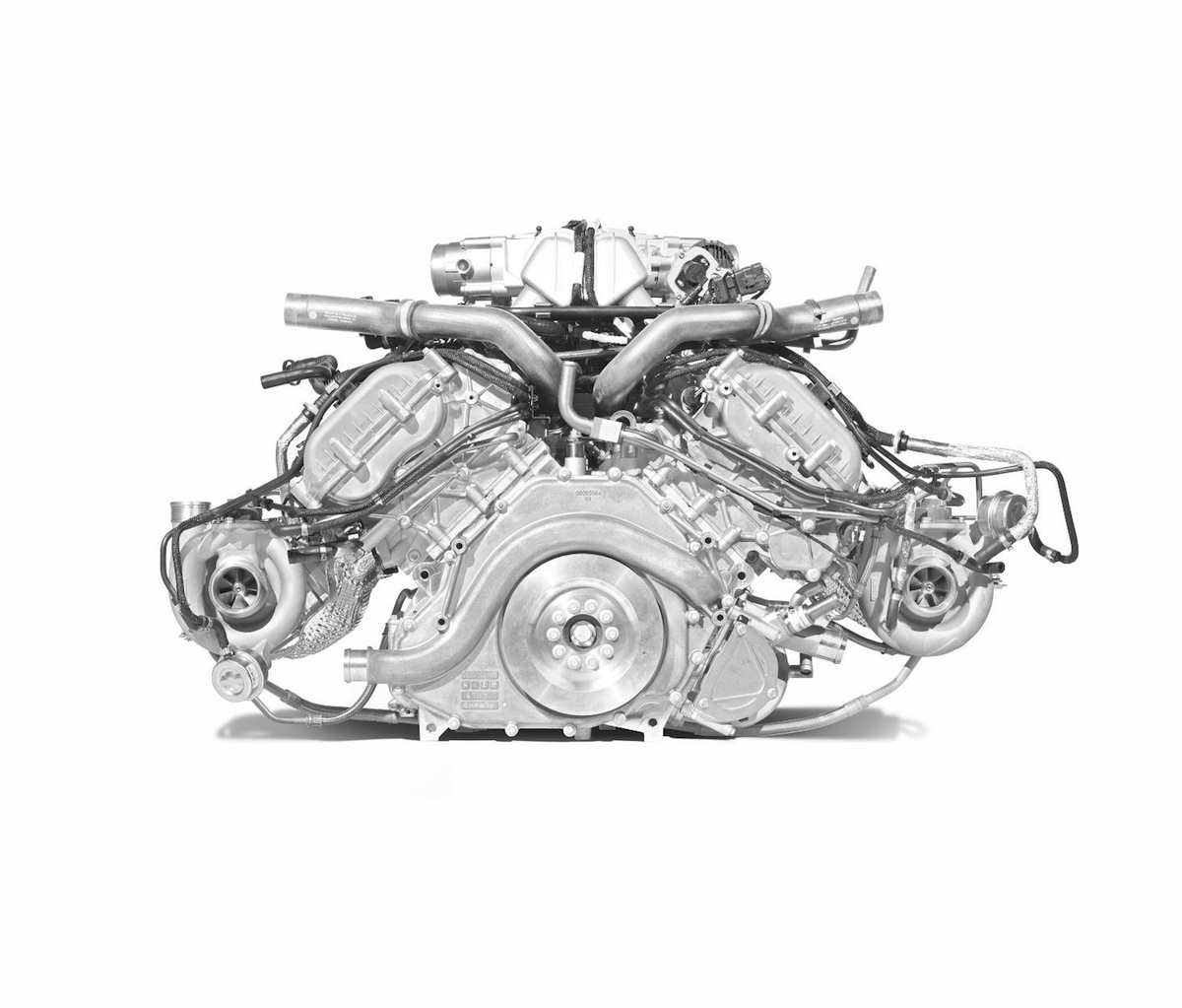
McLaren has been releasing teasing previews of nearly every aspect of the 2014 P1 supercar in the run-up to the 2013 Geneva auto show, but now it has dropped the motherload: The car’s until-now unknown powertrain specs. As expected, the F1 successor’s details are impressive, including 903 horsepower and 664 lb-ft of torque from a twin-turbocharged, 3.8-liter V-8 engine—and an electric motor. Yes, the P1 has an electric motor powered by a medium-sized battery pack. In fact, the P1 is technically a plug-in hybrid. 

The mid-mounted gas engine is a heavily worked-over iteration of the same twin-turbo 3.8-liter V-8 that powers McLaren’s less-extreme MP4-12C sports car, and the electric motor was designed in-house by the company’s electronics division. The engine produces a healthy 727 horsepower and 531 lb-ft of torque on its own, while the electric motor is rated for 177 ponies and 192 lb-ft. McLaren reworked the V-8′s engine-block casting to enable the electric motor to nuzzle up to its lower left side, and the duo’s might is funneled to the rear wheels via a seven-speed dual-clutch automatic transmission. McLaren even fiddled with the electric motor such that it provides drag torque on the engine during upshifts to lower revs more quickly, which allows the transmission to shift faster.

As mentioned, combined output is 903 horsepower and 664 lb-ft of torque, with max twist arriving at 4000 rpm. An E-Mode enables electric-only motoring for just over six miles on a full battery; the cells are replenished via motor-based regeneration on deceleration or by using a plug-in charger that fits in the luggage area. The 212-pound, liquid cooled battery pack lives above the fuel tank and just ahead of the mid-mounted engine, and is directly connected to the P1′s carbon-fiber monocoque. McLaren has yet to reveal the battery’s chemical make-up or capacity, but claims greater power density than any other production automotive battery.


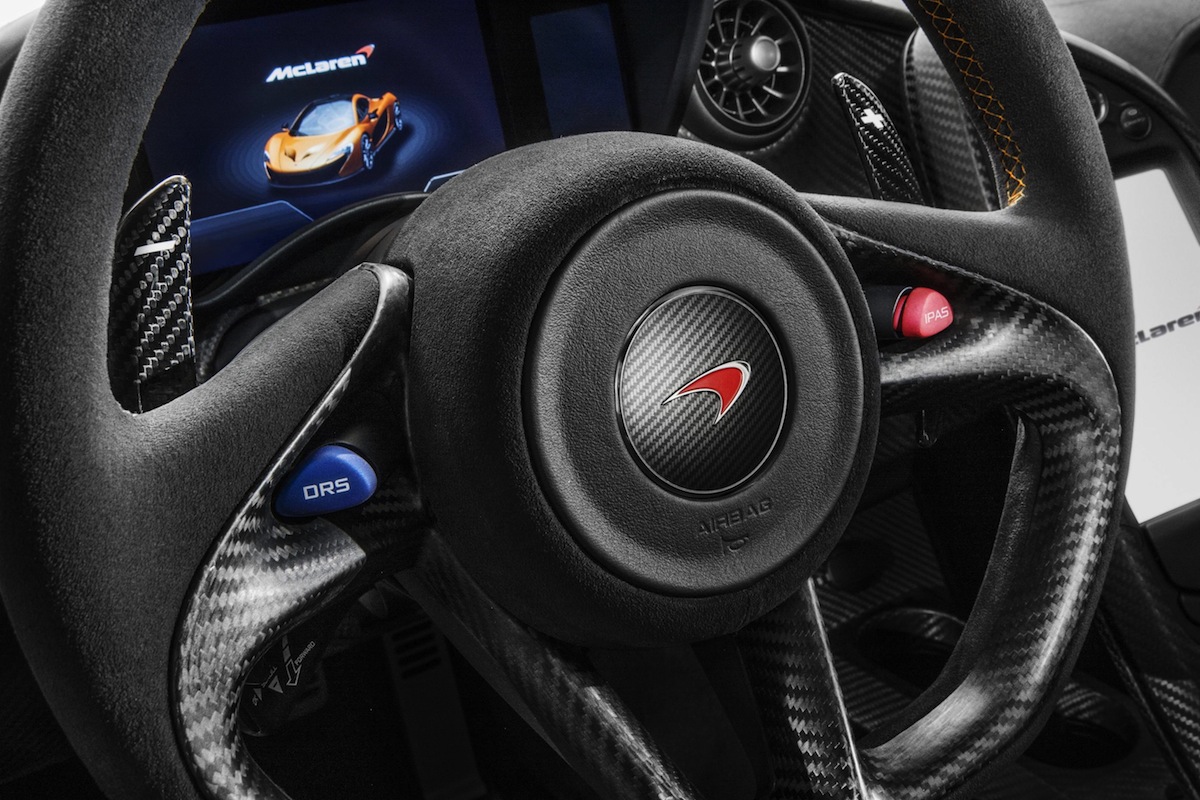
2014 McLaren P1 steering wheel

Performance-wise, the P1 should be properly epic. But everything is made better by go-faster buttons, and McLaren put two of them on the P1′s F1-inspired steering wheel. The buttons control F1-style boost functions: IPAS (Instant Power Assist System) and DRS (Drag Reduction System). When activated, IPAS instantly unleashes full electric power—so all 177 horses. Push the DRS button, and the P1′s rear wing drops to a lower angle, reducing drag by 23 percent. The wing returns to its original, draggy position when the button is released or if the driver hits the brakes.

At the rate it’s going, McLaren won’t even need to reveal the P1 in Geneva—we can practically gather up all the individual details and put the puzzle together ourselves. You can bet it’s a puzzle the boys at Ferrari are scrambling to solve, too, given …read more
Source: FULL ARTICLE at Car & Driver

McLaren P1′s Twin Power System To Deliver 903 Horsepower

By Kurt Ernst

McLaren's P1 supercar - image: McLaren

McLaren’s P1 supercar – image: McLaren

So far, McLaren has been tight-lipped about the potential output of its new P1 supercar. Until now, all we’ve known for certain is that it will benefit from a supplemental Kinetic Energy Recovery System (KERS), meant to boost horsepower under acceleration. Technically, speaking, that makes the P1 a hybrid automobile, though that’s where the similarities between it and a Prius end.

McLaren's P1 supercar - image: McLaren

McLaren’s P1 supercar – image: McLaren

The P1’s twin-turbo 3.8-liter V-8 (borrowed from the McLaren MP4-12C) will make 727 horsepower on its own, with peak torque (531 pound-feet) available from 4,000 rpm. Boosting output is a McLaren Electronics-designed electric motor, rated at an additional 176 horsepower and 192 pound-feet of torque. Since electric motors make peak torque from 0 rpm, that’s power that can be used to get the P1 moving, quickly, from a standstill, and if you’re keeping score at home that produces a total output of 903 horsepower and 723 pound-feet of torque.

McLaren's P1 supercar - image: McLaren

McLaren’s P1 supercar – image: McLaren

Feeding the electric motor is a high-density battery pack that adds just 211 pounds to the car’s weight. To ensure maximum efficiency and cell life, the pack is liquid cooled, and it can be completely recharged (with a supplied plug-in charger) in only two hours. Once full, the pack supplies enough power in full electric mode for up to 10 kilometers (6.2 miles) of driving.

McLaren's P1 supercar - image: McLaren

McLaren’s P1 supercar – image: McLaren

The real purpose of the hybrid system, however, is supplemental power. There’s an IPAS (Instant Power Assist System) button on the steering wheel, and pressing it instantly serves up the extra 176 horsepower and 192 pound-feet of torque the electric motor delivers. KERS isn’t the only Formula One technology employed by the P1, either; opposite the IPAS button on the P1’s steering wheel is a button labeled DRS, for Drag Reduction System.

McLaren's P1 supercar - image: McLaren

McLaren’s P1 supercar – image: McLaren

Like an F1 car, the P1 uses a movable rear wing to adjust downforce. While downforce adds grip in a corner, it also takes away speed in a straight line. Thumbing the DRS button will change the rear wing’s angle of attack, decreasing drag by as much as 23-percent. Release the button, or hit the brakes, and the rear wing takes a steeper angle, increasing drag and rear downforce.

Look for further details on the McLaren P1 to be revealed when the car breaks cover at the upcoming Geneva Motor Show.

…read more
Source: FULL ARTICLE at Automotive Addicts

Motorsports: Lotus opens the 2013 Formula One season with the launch of the E21 [w/video]

By Jonathon Ramsey

Filed under: , ,

Lotus has broken the seal on the 2013 Formula One season, launching the E21 car at its factory in Enstone. With the regulations this year quite similar to those of last year, there are no dramatic changes in form compared to the E20. After some teams lobbied to be able to cover the stepped nose with a “vanity panel,” Lotus retained the configuration, the team’s technical director saying that the panel would add more weight and didn’t make sense to put on the car unless it also added performance.

Beyond that, the E21 is said to be an comprehensive advance in its details – the suspension gets a new layout, the Coanda exhaust and the passive double DRS system are evolutions from last year, the front wing is “a continuation of concepts” from 2009.

After securing fourth in the Constructor’s Championship last year, this is the chassis that drivers Kimi Räikkönen and Romain Grosjean will use to try and move the team up a place, which would mean beating one of the big three teams over the course of the season. The quietly and impressively consistent Räikkönen managed third in the Driver’s Championship, and we’re sure he wouldn’t mind a move up in the standings, either.

You can watch a replay of the reveal on Sky Sports in the video below – it commences at 43:10, and there’s a sound bite of the car starting up just below that. Other unveilings this week will be two of those big teams Lotus wants to conquer, McLaren on Thursday and Ferrari on Friday.

Continue reading Lotus opens the 2013 Formula One season with the launch of the E21 [w/video]

Lotus opens the 2013 Formula One season with the launch of the E21 [w/video] originally appeared on Autoblog on Wed, 30 Jan 2013 19:15:00 EST. Please see our terms for use of feeds.

Permalink | Email this | Comments

Source: FULL ARTICLE at Autoblog