
Tag Archives: Bob Schieffer

The Fourth Estate, Or For The State?

By Shawn Paul

Obama Liberal Media Weapons Gladiator SC The Fourth Estate, or For the State?

It’s very unlikely that the traditional media we know today at all resembles the entity our founding fathers wished to protect in their day.

It’s not even very likely that it resembles the group admired by Edmund Burke when he is said to have coined the term “the fourth estate” in reference to the press in the middle of the 19th century.

Based on their writings and the documents they co-authored, our founding fathers wished to preserve a free press for the purpose of preserving a free people. The current remnant of a once-free press is now simply an extension and arm of the government, which means that they aren’t really a “free press” at all. They have come to be, knowingly or not, for the state, or the current ultimate powers of the U.S. federal government.

To put Burke’s term into context, it’s necessary to look at the history of medieval “estates of the realm,” which formally recognized the three “estates” of the clergy, the nobility, and the commoners. Burke and Thomas Carlyle, who popularized the term “the fourth estate,” recognized the press as a group of distinction that played an important role in lending a democratic voice to the people of a true republic. It now seems, unfortunately, that those days are gone and that once again, only three estates are represented, with the press, or media, being encompassed by the estate of the nobility. In more modern and recognizable terms, those in our government and “media” are often referred to as “the elite,” even if only in terms that denote the self-perception of many in this estate.

Sean Hannity declared in 2008 that “the media is dead”; but in a historical sense, it was already dying long before then.

Ever since Cronkite’s field coverage of the Vietnam War, the mainstream media has continued on a downward spiral. The difference between the journalists of that era and the so-called “journalists” of today is that the inquiring public news consumers’ sense of objectiveness and sincerity from these anchors has now been decimated. Many journalists of the recent past at least seemed sincere in their dedication to reporting truth. Today, the messages of the media mainstream are blatantly and admittedly laden with hearsay, inaccuracy, half-truths, and whole lies.

Still, Hannity seems to be on to something, as the media has continually sunk to new lows over the course of the last five years. It can be seen in Newsweek’s post-print fake cover honoring Obama’s second inauguration as “The Second Coming,” penned by Evan Thomas, who once described Obama on MSNBC as “sort of like God” in being above the traditional political fray. We should also remember CBS Political Director John Dickerson’s plea in a January 2012 Obama-Biden ad to “Go for the Throat! Why if he wants to transform American politics, Obama must declare war on the Republican Party”… and declare and wage he has.

The legendary CBS reporter Bob Schieffer, after an Obama gun control speech, suggested that “the president is going to have …read more
Source: FULL ARTICLE at Western Journalism

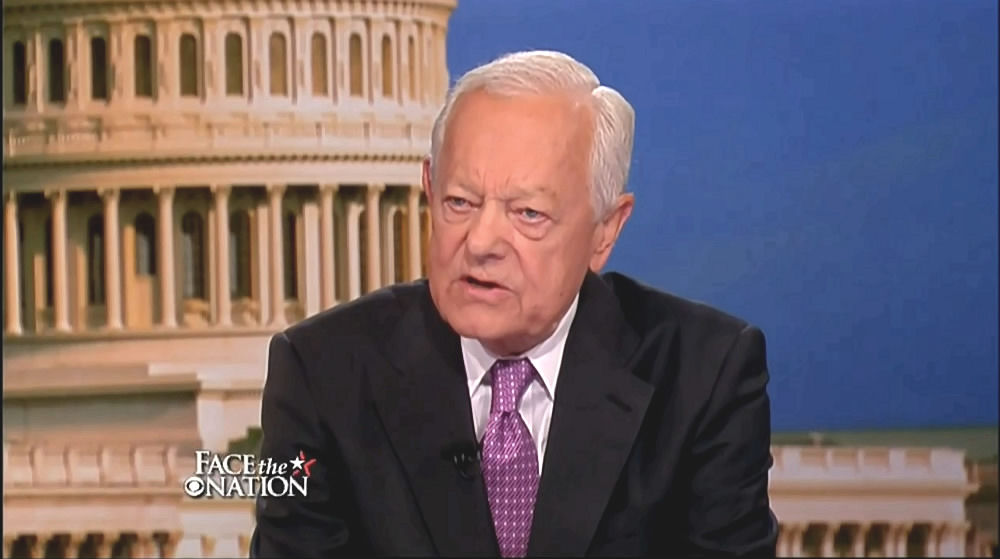
CBS’s Schieffer Contends ‘Extreme’ Republicans ‘Holding Rest Of Party Hostage’

By Breaking News

Bob Schieffer  CBS’s Schieffer Contends ‘Extreme’ Republicans ‘Holding Rest of Party Hostage’

“Do you all feel that your party is somehow being held hostage?” Bob Schieffer asked Republican Senators John McCain and Lindsey Graham, presumably referring to those opposed to raising taxes. Touting President Obama as the reasonable one who “has talked about kind of a ‘common sense caucus,’” within the same long-winded question on Face the Nation, Schieffer repeated his accusation: “Are people on the extreme ends of your party holding the rest of you hostage here?”

Not ten minutes later, however, with Democratic Senator Dick Durbin, Schieffer not only failed to characterize Obama as an obstinate extremist for demanding another tax hike two months after Republicans acceded to one, but he suddenly decided: “I think we are beyond arguing about who’s fault it is on how we got here.”

What chutzpah!

Read More at The Media Research Center . By Brent Baker.

…read more
Source: FULL ARTICLE at Western Journalism

Is Mandatory National Service For Kids A Good Idea?

By Fred Weinberg

US Flag 3 SC Is Mandatory National Service For Kids A Good Idea?

Retired General Stanley McChrystal said something on Face the Nation last week which, perhaps, is worth thinking about.

Asked by Bob Schieffer whether we needed a military draft, McChrystal suggested that we did need all young people to do some sort of national service—not necessarily military.

One of his reasons—and this is what caught my attention—was “we’re also a nation which doesn’t get to know each other well.  Someone from one part of an inner city never meets someone from an upper class neighborhood.”

It occurs to me in the context of the ongoing debate about gun violence, parenting, video games, media, etc. that he’s right. I can make a no-cost phone call to London with something I carry in my pocket, but I’m embarrassed to admit that I’d have to ask my wife what our neighbor’s phone number (or last name) is.

At age 60, looking back on when I was growing up, I participated in activities—as did most of my contemporaries—which made those introductions from neighborhood to neighborhood and socio-economic group to socio-economic group.  It started in the Cub Scouts, continued in the Boy Scouts and, for me, went on to the Civil Air Patrol and then to college. My sisters were all Brownies and Girl Scouts and had much the same experience.

By the time I finished my freshman year at Southern Illinois University, I had indeed met folks from just about every kind of neighborhood (and some of those people are still friends today.)  I didn’t need a class in diversity because I lived it, growing up.

You would think, given the fact that we all carry Star Trek-style personal communicators these days, which are all capable of talking to anyone, anywhere, anytime that we would communicate with each other.

McChrystal is right.  We don’t.

When I was growing up, we lived in a subdivision.  Everybody knew each other.  The parents knew who their children were playing with.  When somebody new moved into the neighborhood, there was an immediate procession of neighbors to the door of the new folks, introducing themselves.

My late father and my late favorite uncle were known family-wide for talking to anybody about anything almost any place.  My uncle would drive the streets of New York with his windows down so he could start a conversation at red lights and in traffic jams.

Today, these conversations may be carried on by email and text message; but how many face-to-face interactions between people—neighbors even—are there as opposed to back in the 60s and 70s?

It’s a lot easier to do violence to people you don’t have any clue exist in the non-electronic world.  A whack job who communicates with no one gets a gun and kills 20 first graders, and we blame the gun?

Here are some interesting statistics from the Boy Scouts of America:

The number of Scouts nationally was at its peak in the early 1970s, with about 6.5 million. The number of all Scouts as of the end of 2010 was down to about 2.7 million, according to the BSA website.

It’s probably fair to assume that the same sort of declines exist in other youth-oriented groups.

That means that not nearly as many young people are meeting each other in the kind of environment that fosters lifetime relationships between kids of all sorts. For whatever the reason, meeting all kinds of people is no longer cool these days.

Maybe some sort of mandatory national service—military or otherwise—is an, if not the, answer.

Today’s society is a wonderful place for people who don’t like people.  You can communicate all you want without ever actually having to meet anyone.  You can have virtual friends who may or may not actually exist.

Maybe the only way to get people to know other people in today’s society is through some sort of national service which, at least, would have the additional benefit of binding the people to the nation they live in, as McChrystal suggested.

I’m not wild about the idea of allowing the government to become an extended babysitter, but I sure can see the benefits of extending military or civilian service to everybody between the ages of 18 and 20.

At the very least, it might give people from red states and blue states something in common.

And if we’re about to have a “national conversation” about violence, this certainly deserves to be part of the debate.

Source: FULL ARTICLE at Western Journalism