
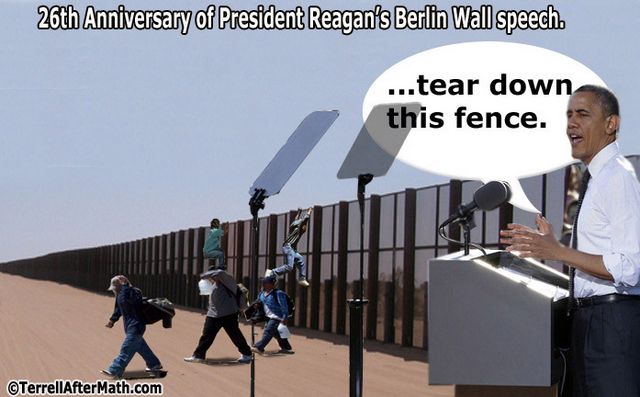
Barack Obama has never been clear on the distinction between sovereign and servant, between the American people and those, including himself, elected to do the people’s business. We saw that yet again this week with the president’s unilateral rewrite of the Bataan Death March known as the Affordable Care Act — Obamacare. For this president, laws are not binding expressions of the popular will, but trifling recommendations to be ignored when expedient.
The collapse of law — not just Obamacare but law in general — is the Obama administration’s most egregious scandal. With the IRS here, Benghazi there, and Eric Holder’s institutionalized malevolence crowding the middle, it gets little direct attention. Perhaps it is so ubiquitous, so quotidian, that we’ve become inured to it.
Above all else, though, the office of the president was created to take care that the laws be faithfully executed. For this president, to the contrary, law is non-existent — and not merely law in the traditional sense of our aspiration to be “a nation of laws, not men.” Obama has contorted the law into a weapon against our constitutional order of divided powers and equal protection for every American.
As with most things Obama, this Olympian outrage springs from a kernel of propriety. We want our laws enforced, particularly when they reflect basic obligations of government in a free, civil society. Nevertheless, we know that the resources of government are finite, that laws are numerous and elastic, and that a federalist system implies a significant enforcement role for states. Thus, our legal system is premised on executive discretion. Not every law can or should be enforced to its fullest extent — nobody would want to live in that sort of society. To execute the laws faithfully is to remain mindful of the federal government’s essential but finite role in our framework and to concentrate its limited resources on enforcement of the most vital laws.
As a practical matter, this necessitates selectivity — some laws will go unenforced, some wrongs unaddressed. With a president who acts in good faith, this is not a problem. For example, simple possession of prohibited narcotics is a federal crime. But it is also a state crime. Given the need to prioritize, it is sensible for the feds to focus their efforts on what the federal government was designed for — international and interstate challenges that the states are not well equipped to address. So the Justice Department targets major drug-importation and distribution networks, leaving less serious drug infractions to the local district attorneys. Notice: This does not mean the executive branch is effectively decriminalizing less serious drug offenses in contravention of Congress’s statutes. It means the public’s federal buck goes to where it gets the best bang.
The separation-of-powers principle also has implications for executive discretion. To promote liberty, the Framers constructed a central government of divided authorities in which each branch was given tools to check inevitable encroachments by the others. Congress has an irresistible propensity to enact laws that usurp the …read more