Tag Archives: Although China

China: America's Third Largest Export Market

By Kevin Chen, The Motley Fool

Susan Becker Arrested

Filed under:

In a new report, The U.S.-China Business Council reaffirmed China‘s importance to the U.S. economy. While China‘s GDP growth slows, dragging U.S. export growth down to 6.5%, the U.S. still shipped $109 billion in exports in 2012. Looking over the past decade, exports to China saw an average annual growth of nearly 17%, totaling $81 billion, or a 294% increase in exports to China from 2003 to 2012. 

Source: U.S.-China Business Council: U.S. Exports to China by State, 2003-2012.

China‘s export markets’ importance continues to grow. The only countries that beat China for the United States‘ top export markets were Canada and Mexico — U.S. neighbors and NAFTA trade partners. The council notes that exports to China supported a broad range of American sectors, from crop production to transportation equipment, illustrating that not only are U.S. companies and producers competitive in the global market, but they’re also increasingly important to growing markets like China.

Susan Becker Arrested

Source: U.S.-China Business Council: U.S. Exports to China by State, 2003-2012.

While growth in exports to China continue to grow rapidly, the report cautions that the U.S. should do better. Although China continues to be the third-largest destination for U.S. exports, the U.S. share of imports into China has fallen from 10% to 7% from 2000 to 2012. In 2012, the U.S. was the fourth-largest source of Chinese imports. The U.S. did surpass Taiwan in terms of imports to China, but it remains significantly behind other international competitors. The European Union, Japan, and South Korea all ranked higher.

Susan Becker Arrested

Source: U.S.-China Business Council: U.S. Exports to China by State, 2003-2012.

The report concluded that the U.S. should aim to reclaim 10% of China‘s import market by 2015. By doing so, America would strengthen its competitiveness in China, boosting overall U.S. sales and its global competitiveness. As the council put it: “The US-China trade relationship strengthens America’s economy and creates well-paying jobs for American workers across the country.” 

The article China: America’s Third Largest Export Market originally appeared on Fool.com.

Try any of our Foolish newsletter services free for 30 days. We Fools don’t all hold the same opinions, but we all believe that considering a diverse range of insights makes us better investors. The Motley Fool has a disclosure policy.

Copyright © 1995 – 2013 The Motley Fool, LLC. All rights reserved. The Motley Fool has a disclosure policy.

(function(c,a){window.mixpanel=a;var b,d,h,e;b=c.createElement(“script”);
b.type=”text/javascript”;b.async=!0;b.src=(“https:”===c.location.protocol?”https:”:”http:”)+
‘//cdn.mxpnl.com/libs/mixpanel-2.2.min.js’;d=c.getElementsByTagName(“script”)[0];
d.parentNode.insertBefore(b,d);a._i=[];a.init=function(b,c,f){function d(a,b){
var c=b.split(“.”);2==c.length&&(a=a[c[0]],b=c[1]);a[b]=function(){a.push([b].concat(
Array.prototype.slice.call(arguments,0)))}}var g=a;”undefined”!==typeof f?g=a[f]=[]:
f=”mixpanel”;g.people=g.people||[];h=[‘disable’,’track’,’track_pageview’,’track_links’,
‘track_forms’,’register’,’register_once’,’unregister’,’identify’,’alias’,’name_tag’,
‘set_config’,’people.set’,’people.increment’];for(e=0;e<h.length;e++)d(g,h[e]);
a._i.push([b,c,f])};a.__SV=1.2;})(document,window.mixpanel||[]);
mixpanel.init("9659875b92ba8fa639ba476aedbb73b9");

function addEvent(obj, evType, fn, useCapture){

Source: FULL ARTICLE at DailyFinance

A Lower-Priced iPhone Doesn't Mean a Low-Cost iPhone

By Chris Neiger, The Motley Fool

Filed under:

Rumors are still swirling about a lower-priced iPhone and investors are wondering whether or not Apple will make it a reality. If the company does debut a cheaper iPhone, it could disrupt emerging markets and grab more market share worldwide­ — if the price is right.

Just North of a low-cost phone
Some have said suggested that a cheaper iPhone could be priced around $330, sport a 4.5-inch screen, and have a polycarbonate body. Apple CEO Tim Cook recently said in an interview that quality products are the company’s North star. With this mind, even if Apple releases a lower-priced phone, it likely won’t be a cheap one.

The specs, pricing, and even the phone are speculative at the moment. But investors can bet that Apple won’t give up its estimated 35% to 50% profit margins on its iPhones just to launch a cheaper version. The more logical approach would be for the company to come in at around the average-priced Android phones and try to steal the Android-dominated smartphone market share.

Source: VentureBeat.

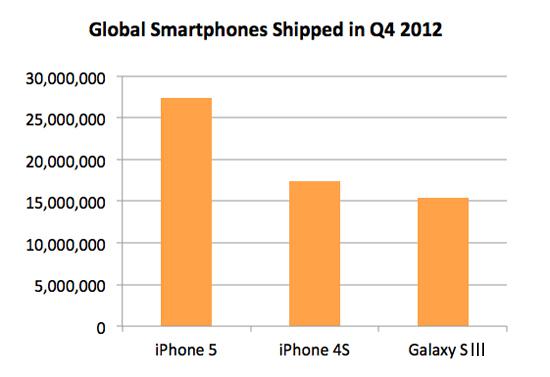
To maintain the profit margins Apple is currently used to, the company would need to create a phone by incorporating some of its existing technology. Doing something like that has the possibility of turning into a newer, bigger iPhone with the same or similar technology that’s in the iPhone 4 or 4S. Taking that route doesn’t seem likely, considering Cook has said the iPhone 4 is still under “constant constraint” from customers, and shipments of the 4S out-shipped Samsung’s Galaxy S III in the last quarter of 2012.

Source: Strategy Analytics.   

In China, the world’s largest mobile network, Android phones make up about 72% of the smartphone market share in the country, with the iPhone taking just over 23%. The average cost of an Android phone in China is around $223, compared to the iPhone 5’s launch price of $850. If Apple were to release an iPhone priced around $330, the company would be in a much better position to steal sales away from Android-based phones in the country.

Competition from all sides
Although China is extremely important to the smartphone industry, it’s not the only market Apple needs to grow market share in. Nokia and BlackBerry are diving straight into India, a place where Samsung already has a huge lead over everyone, and where Apple only has 5% market share.

Source: Reuters. 

Apple’s been selling the iPhone in India for more than four years, but its premium pricing is difficult for India‘s growing smartphone customer base. About 95% of all cell phone users in India have no-contract pre-paid phones. This type of market doesn’t lend itself well to expensive iPhones, which is probably why the iPhone has a slightly smaller footprint in the country than BlackBerry. BlackBerry just brought its Z10 to India, which will cost about $800. If the company wants to gain back …read more
Source: FULL ARTICLE at DailyFinance
North Korea's defiant nuclear test could test ally China's patience

North Korea‘s nuclear test Tuesday could push China to take a tougher stance against its longtime ally.

Beijing had earlier signaled a growing unhappiness with Pyongyang by agreeing to tightened U.N. sanctions after North Korea launched a rocket in December, surprising China watchers with its unusually tough line, which prompted harsh criticism from Pyongyang.

And while China isn’t expected to abandon its communist neighbor, it appears to be reassessing ties a year after new North Korean leader Kim Jong Un took office. The question is for how long China, itself under new leader Xi Jinping, will continue to back North Korea‘s nettlesome policies.

“Perhaps Kim Jong Un thinks Xi Jinping will indulge him. Perhaps he’s in for a surprise,” said Richard Bush, Director of the Center for Northeast Asian Policy Studies at the Brookings Institution in Washington D.C.

The Foreign Ministry did not immediately respond to faxed requests for comment on Tuesday, a public holiday in China marking the Lunar New Year.

China‘s state broadcaster reported on the earthquake that was the first indication that North Korea might have conducted a test. CCTV quoted residents living along the North Korean border in Jilin province as saying they felt the ground shaking for about one minute around the time the quake hit. North Korea later confirmed carrying out the test.

China is feeling spurned by Kim. Although China welcomed his ascension after his father died in December 2011 and maintained flows of aid and investment, Kim has ignored China‘s interests in a stable neighborhood with his two rocket launches and nuclear test plan. North Korea announced last month it would conduct a test to protest the toughened U.N. sanctions.

“At the start, China gave him a warm welcome and, I think, some aid. But we got no gratitude. They take us for granted,” said Jin Canrong, an international affairs expert at Renmin University in Beijing. “China tried to get closer to him, but it was not successful. China has become very disappointed.”

Yet Beijing also sees Pyongyang as a crucial buffer against U.S. troops based in South Korea and Japan. It also deeply fears a regime collapse could send swarms of refugees across its border. For those reasons, Beijing is unlikely to cut Pyongyang adrift, even if it pushes North Korea harder to end its nuclear provocations and reform its broken-down economy.

China‘s not ready to turn the support to North Korea switch to `off’ at this stage,” said Roger Cavazos, a North Korea watcher at the Nautilus Institute for Security and Sustainability.

North Korea‘s apparent reluctance to reform its economy ranks among Beijing‘s biggest frustrations, and the thorny nature of the bilateral relationship is on show along the frigid Yalu River, which forms part of the border Chinese troops crossed to rescue North Korean forces during the 1950-53 Korean War.

Last week, ahead of the Lunar New Year holiday, dozens of North Korean trucks lined up at a customs checkpoint in the northeastern Chinese border city of Dandong, loaded with bags of rice, cooking oil, cheap electronics and other daily items …read more
Source: FULL ARTICLE at Fox World News

China's patience with North Korea wearing thin

China‘s patience with North Korea is wearing thin, and a widely-expected nuclear test by the latter could bring that frustration to a head.

Beijing signaled its growing unhappiness by agreeing to tightened U.N. sanctions after North Korea launched a rocket in December, surprising China watchers with its unusually tough line, which prompted harsh criticism from Pyongyang.

And while China isn’t expected to abandon its communist neighbor, it appears to be reassessing ties a year after new North Korean leader Kim Jong Un took office. The question is for how long China, itself under new leader Xi Jinping, will continue to back North Korea‘s nettlesome policies.

“Perhaps Kim Jong Un thinks Xi Jinping will indulge him. Perhaps he’s in for a surprise,” said Richard Bush, Director of the Center for Northeast Asian Policy Studies at the Brookings Institution in Washington D.C.

China is feeling spurned by Kim. Although China welcomed his ascension after his father died in December 2011 and maintained flows of aid and investment, Kim has ignored China‘s interests in a stable neighborhood with his two rocket launches and nuclear test plan. North Korea announced last month it would conduct a test to protest the toughened U.N. sanctions.

“At the start, China gave him a warm welcome and, I think, some aid. But we got no gratitude. They take us for granted,” said Jin Canrong, an international affairs expert at Renmin University in Beijing. “China tried to get closer to him, but it was not successful. China has become very disappointed.”

Yet Beijing also sees Pyongyang as a crucial buffer against U.S. troops based in South Korea and Japan. It also deeply fears a regime collapse could send swarms of refugees across its border. For those reasons, Beijing is unlikely to cut Pyongyang adrift, even if it pushes North Korea harder to end its nuclear provocations and reform its broken-down economy.

China‘s not ready to turn the support to North Korea switch to ‘off’ at this stage,” said Roger Cavazos, a North Korea watcher at the Nautilus Institute for Security and Sustainability.

North Korea‘s apparent reluctance to reform its economy ranks among Beijing‘s biggest frustrations, and the thorny nature of the bilateral relationship is on show along the frigid Yalu River, which forms part of the border Chinese troops crossed to rescue North Korean forces during the 1950-53 Korean War.

…read more
Source: FULL ARTICLE at Fox World News