Tag Archives: Western Digital

The Flashification of Hard Drive Companies

By Tom Coughlin, Contributor Micron just announced that it is sampling 16 nm NAND flash—pushing the envelope on possible NAND flash device densities and thus storage capacity.  At the same time, Seagate and Western Digital have made major moves in solid state drive introductions as well as acquisition of flash memory and flash software companies.  Flash memory capacity increases are continuing while HDD areal density increases have been almost non-existent for almost 2 years.  What are the implications for the future of HDDs? …read more

Source: FULL ARTICLE at Forbes Latest

The 5 Cheapest Stocks in the Market

By Dan Caplinger, The Motley Fool

Filed under:

With the S&P 500 having hit a new all-time high on Thursday, many investors are thinking about getting back into the stock market. But concerns about whether the market might be poised for a downturn have investors looking for good bargains.

With that in mind, I found five S&P 500 companies that are trading at particularly attractive valuations right now, according to the latest price-to-earnings figures from S&P Capital IQ. Yet before you simply go and buy all five stocks, let’s take a closer look to see if they’re actually a good value for investors right now.

Apollo Group , 5.43 P/E
Apollo is the company behind the popular online for-profit giant University of Phoenix. The entire for-profit educational industry has faced difficult times recently, as falling enrollment and rising student-loan default rates among graduates have led to investor concerns as well as inquiries from government entities and other regulatory authorities.

In part because of those enrollment pressures, profits at Apollo are expected to drop by about 25% in fiscal 2013 compared with last year. Yet the real overhang on shares is the threat of more draconian measures from regulators that could endanger the entire business model on which Apollo and its peers operate. If you’re willing to take on that risk and believe that for-profit education will survive and recover, then Apollo shares look quite inexpensive.

Western Digital and Seagate Technology , 6.04 and 4.76 P/Es
The fortunes of these two companies are strongly linked, given their joint history in dominating the hard-disk-drive space. What’s sent these stocks downward is the precipitous drop in PC demand, with an accompanying drop in demand for the hard-drives that typically accompany PCs.

Still, the companies have two viable strategies going forward. First, the rise of the cloud-computing Big Data initiative has increased the need for high-volume storage mechanisms, and that could lead to a resurgence in hard-drive demand for purposes that don’t need the higher speeds available from alternative media. Second, both companies have looked to hybrid solid-state hard drives to try to combine high-speed features for key elements like faster boot-up speed with the more cost-effective storage capacity available from traditional hard drives. If either of these strategies proves successful, then both Western Digital and Seagate should be able to limit their future earnings declines and even potentially begin to grow again.

CF Industries , 6.71 P/E
Fertilizer-maker CF Industries has benefited from favorable conditions in the agricultural market for years now. Combined with benign cost considerations for fertilizer production, CF has reaped the rewards in strong earnings. Unfortunately, rising natural gas prices could start to hamper its profit growth, as the energy source is a major component of the company’s production process.

As the ag market starts to revert to more normal conditions, analysts see CF‘s earnings falling by 7% to 10% annually in 2013 and 2014. Yet as long as earnings hit bottom near their …read more
Source: FULL ARTICLE at DailyFinance

How Boeing Is Lifting the Dow Toward New Highs

By Dan Caplinger, The Motley Fool

Filed under:

As has happened so much recently, the stock market answered yesterday’s worries with renewed strength today. Investors seem willing to set aside lingering doubts that the resolution to the banking crisis in Cyprus could have greater consequences in larger economies in the eurozone, particularly Italy and Spain. Instead, strength in the U.S. economy sent stocks moving higher, with durable-goods orders posting a 5.7% advance in February on the strength of transportation-related orders. Moreover, housing prices measured by the Case-Shiller Index rose a whopping 8.1% year over year in January — its best annual rise in nearly seven years — and even a larger-than-expected drop in new-home sales wasn’t enough to squelch investor enthusiasm. By 11 a.m. EDT, the Dow Jones Industrials were up 95 points, trading near their recently set record highs.

The big gainer in the Dow is Boeing , which rose more than 2% after successfully completing a test flight of its 787 Dreamliner aircraft. With the Dreamliner having been grounded since mid-January due to safety concerns regarding its lithium batteries, Boeing investors have worried about the potential impact on customers. But if the redesigning of the aircraft’s battery components eliminates overheating issues that can increase the risk of fire, then the plane’s better fuel economy should keep the Dreamliner looking attractive to airlines.

Elsewhere, RF Micro Devices jumped almost 8% as analyst firm Oppenheimer upgraded the stock. The company makes radio-frequency components that help smartphones communicate via wireless networks, successfully avoiding the trap that many of its peers have fallen into of concentrating too much on a single customer. With Samsung using more of the company’s products in its latest Galaxy smartphone model, RF Micro seems poised to continue benefiting from the mobile revolution.

Finally, storage giants Western Digital and Seagate have notched sizable gains of about 4.5% this morning. Both companies have been working hard to figure out the next step beyond their legacy hard-disk drive businesses, as the rise of solid-state drives and flash memory has threatened to make their business models obsolete. Yet for now, the huge rise in information volume leaves the door open for their products to serve vital roles in overall big-data solutions, especially because not all data is so time-critical as to need the speed advantage that solid-state technology has over hard drives. Western Digital‘s strategic investment in Skyera earlier this month signals its latest move to advance in the industry, and Seagate should also continue moving forward with its own growth initiatives.

Boeing took a big step today, but will the aircraft maker fully recover from the Dreamliner fiasco? In our premium research report on the company, two of The Motley Fool’s best minds on industrials have collaborated to provide investors with the must-know info on Boeing. They’ll be updating the report as key news hits, so don’t miss out — simply click here now to claim your copy today.

…read more
Source: FULL ARTICLE at DailyFinance

Micron Earnings: An Early Look

By Dan Caplinger, The Motley Fool

Filed under:

Earnings season is winding down, with most companies already having reported their quarterly results. But there are still some companies left to report, and Micron Technology is about to release its quarterly earnings report. The key to making smart investment decisions with stocks releasing their quarter reports is to anticipate how they’ll do before they announce results, leaving you fully prepared to respond quickly to whatever inevitable surprises arise. That way, you’ll be less likely to make an uninformed kneejerk reaction to news that turns out to be exactly the wrong move.

Micron makes memory chips, which has exposed the company to a rocky market for years as the industry has gone through severe gluts that pushed prices down sharply. Lately, though, investors have been hopeful that a turnaround is finally taking shape. Let’s take an early look at what’s been happening with Micron over the past quarter and what we’re likely to see in its quarterly report on Thursday.

Stats on Micron

Analyst EPS Estimate

($0.20)

Year-Ago EPS

($0.29)

Revenue Estimate

$1.91 billion

Change From Year-Ago Revenue

(4.7%)

Earnings Beats in Past 4 Quarters

0

Source: Yahoo! Finance.

Will Micron help investors remember the good times this quarter?
Over the past few months, analysts have gotten a lot more worried about Micron. They’ve nearly doubled their loss estimate for the just-ended quarter, and widened their consensus for the company’s fiscal 2013 full-year loss by nearly a quarter per share. Yet the stock has rocketed higher, rising 37% since mid-December.

One big reason for the disparity between earnings expectations and Micron’s stock-price movement is that Micron got resolution in a long-standing patent dispute with Rambus . Early this year, a court ruled that Rambus’s patents were unenforceable, finally giving Micron some closure and taking away a threat that had held the stock down.

But Micron still faces a tough environment in its core DRAM and Flash memory business. Its acquisition of Japanese memory supplier Elpida will let Micron gain access to the lucrative iPhone 5, but with questions having arisen about the smartphone’s success, any shortfall in its sales could negatively affect Micron. Moreover, an analyst firm downgraded Micron earlier this month, arguing that DRAM demand is slowing.

Still, the big opportunity for Micron comes from the broader Big Data initiative that many technology companies are focusing on. Although Micron rival SanDisk has also seen its stock rise as demand for flash memory picks up, even old-style hard-drive makers Seagate Technology and Western Digital have gotten into the game, with Seagate having introduced a third-generation solid-state hybrid drive to boost speed and keep up with the level of innovation industrywide.

In Micron’s quarterly report, watch for the company’s latest calls on the health of the memory industry and its progress in moving forward with the Elpida acquisition. How the company handles its new foray into …read more
Source: FULL ARTICLE at DailyFinance

The 5 Best Value Stocks in Tech

By Andrew Tonner, The Motley Fool

Filed under:

Traditionally, tech investors look for growth stories. In this video, Andrew Tonner does just that, using a screen to identify five tech companies that are cheap value stocks. More importantly, you’ll also learn something about why it’s not enough to look at a low P/E ratio to see whether a value stock is really worth investing in. Western Digital, for example, was influenced by flooding in Thailand, which helped keep its prices high over the past 12 months. Its price structure may not continue once Thailand comes back online. Dig into the details before buying.

The amount of data we store every year is growing by a mind-boggling 60% annually! To make sense of this trend and pick out a winner, The Motley Fool has compiled a new report called “The Only Stock You Need to Profit From the NEW Technology Revolution.” The report highlights a company that has gained 300% since first recommended by Fool analysts but still has plenty of room left to run. To get instant access to the name of this company transforming the IT industry, click here — it’s free.

The article The 5 Best Value Stocks in Tech originally appeared on Fool.com.


Andrew Tonner has no position in any stocks mentioned. The Motley Fool owns shares of Western Digital. Try any of our Foolish newsletter services free for 30 days. We Fools don’t all hold the same opinions, but we all believe that considering a diverse range of insights makes us better investors. The Motley Fool has a disclosure policy.

Copyright © 1995 – 2013 The Motley Fool, LLC. All rights reserved. The Motley Fool has a disclosure policy.

(function(c,a){window.mixpanel=a;var b,d,h,e;b=c.createElement(“script”);
b.type=”text/javascript”;b.async=!0;b.src=(“https:”===c.location.protocol?”https:”:”http:”)+
‘//cdn.mxpnl.com/libs/mixpanel-2.2.min.js’;d=c.getElementsByTagName(“script”)[0];
d.parentNode.insertBefore(b,d);a._i=[];a.init=function(b,c,f){function d(a,b){
var c=b.split(“.”);2==c.length&&(a=a[c[0]],b=c[1]);a[b]=function(){a.push([b].concat(
Array.prototype.slice.call(arguments,0)))}}var g=a;”undefined”!==typeof f?g=a[f]=[]:
f=”mixpanel”;g.people=g.people||[];h=[‘disable’,’track’,’track_pageview’,’track_links’,
‘track_forms’,’register’,’register_once’,’unregister’,’identify’,’alias’,’name_tag’,
‘set_config’,’people.set’,’people.increment’];for(e=0;e<h.length;e++)d(g,h[e]);
a._i.push([b,c,f])};a.__SV=1.2;})(document,window.mixpanel||[]);
mixpanel.init("9659875b92ba8fa639ba476aedbb73b9");

function addEvent(obj, evType, fn, useCapture){
if (obj.addEventListener){
obj.addEventListener(evType, fn, useCapture);
return true;
} else if (obj.attachEvent){
var r = obj.attachEvent("on"+evType, fn);
return r;
}
}

addEvent(window, "load", function(){new FoolVisualSciences();})
addEvent(window, "load", function(){new PickAd();})

var themeName = 'dailyfinance.com';
var _gaq = _gaq || [];
_gaq.push(['_setAccount', 'UA-24928199-1']);
_gaq.push(['_trackPageview']);

(function () {

var ga = document.createElement('script');
ga.type = 'text/javascript';
ga.async = …read more
Source: FULL ARTICLE at DailyFinance

3 Stocks Near 52-Week Highs Worth Selling

By Sean Williams, The Motley Fool

Filed under:

The Dow Jones Industrial Average is on a nine-day winning streak as of this writing and it appears as if the market can do no wrong. For skeptics like me, that’s an opportunity to see whether companies have earned their current valuations.

Keep in mind that some companies deserve their current valuations. Hard-disk drive maker Western Digital, for example, trades at a bare-bones valuation because investors are concerned about increased commoditization and weaker PC sales weighing on earnings. However, with Western Digital able to double-dip in cloud computing, supplying the storage for both the computers and the data centers, it still has plenty of growth yet to come.

Still, other companies might deserve a kick in the pants. Here’s a look at three companies that could be worth selling.

What’s soon to be black and blue all over?
Sometimes even having one of the most prestigious names in publishing isn’t enough to save your stock from the dreaded red thumb. That’s the case of Washington Post , which is currently the most-shorted stock within the S&P 500 based on days to cover according to Forbes.

The problem with Washington Post is that I can’t stomach many of their business segments. Newspapers have slowly been bleeding customers for years with most content moving to a digital platform. This isn’t to say that Washington Post is twiddling its thumbs while this happens as it’s set up digital media platforms as well – but the trend has been decisively away from paying for newspaper content. As evidence, its newspaper publishing division’s revenue declined 7% in 2012 to $581.7 million.

Even worse is its educational segment, headed by Kaplan University. Kaplan is among the many online for-profit universities that have come under increasing regulatory scrutiny for the way they market themselves to potential students, divvy out student loans, and portray promises of employment after graduation. Revenue in this segment fell a whopping 9% in 2012 to $2.2 billion and accounts for about 55% of Washington Post‘s total revenue.

Tack up these two dying segments and you’ll get about 70% of Washington Post‘s revenue. Even if its cable television and television broadcasting segment grow by double digits, there’s really no way this should be valued at close to 20 times forward earnings.

Match the estimate, I dare you!
Anything related to housing is hot, hot, hot, right now! That goes the same for listing services such as Move which operates Realtor.com and allows online users to browse listings and peruse moving companies. But the one big beef I have with Move that I just can’t let slip by: It can’t meet Wall Street‘s earnings estimates to save its life.

<td …read more
Source: FULL ARTICLE at DailyFinance

Quarter + Year

Consensus EPS

Reported EPS

Surprise

Q1 2010

$0.05

$0.08

$0.03

Q2 2010

$0.06

$0.04

($0.02)

Q3 2010

$0.07

$0.04

($0.03)

Q4 2010

$0.07

$0.04

($0.03)

Q1 2011

Seagate Goes Hybrid

By Richard Saintvilus, The Motley Fool

Filed under:

The long-term prospects of hard disk drive titans Seagate and Western Digital have not looked good. In a recent article, I argued the logic of being bullish on this industry if personal computers are indeed beginning to die. It stands to reason that HDD manufacturers such as Seagate should perish as well. But Seagate has other ideas.

Can hybrids improve the economics of storage?
The company has introduced its third-generation SSHD, or solid state hybrid drives: the Seagate Laptop SSHD, 7 mm-high Seagate Laptop Thin SSHD, and the Seagate Desktop SSHD. I think this is a smart move by Seagate, especially since Apple recently announced its Fusion Drive, which is said to boot much faster while offering better read/write performance.

Scott Horn, Seagate’s vice president of marketing, describes them this way:

Our new SSHDs serve up your favorite content with the lightning-fast performance you have to experience to believe. With these new drives it’s like adding a turbo-charge to your PC, without having to sacrifice capacity, at a price that’s easy on your wallet. Now consumers can create, store and consume digital content like a pro without having to spend like one.

Even though Apple has not used the term “hybrid” to describe Fusion, the word is being used by writers and analysts in their descriptions. So if Seagate and Western Digital, which began shipping its own hybrids in January, are moving into the SSHD platform to support new industry standards from (among others) Apple, then it’s good idea. But how well will this work? More specifically, can hybrids change the economics of the desktop storage business?

That’s the question investors must first answer, which was the thesis of my previous sell recommendation. While Seagate has been able to fight the increased adoption of solid state drives, or SSDs, the company now understands that it can’t fight the rise of mobile devices infinitely. Essentially, evolve or die. But these hybrids look more like a “gap-closing” solution than anything “game-changing.” And Horn’s description of “adding a turbo-charge to your PC” sounds familiar.

Yes, yes, very impressive, but…
While the features boast tons of speed and performance, there’s a part of me than thinks… so what! As groundbreaking as these new SSHD drives might be, they are still just internal components of an industry that’s in decay. But Seagate is not the first to attempt “the next big thing in PC.” It’s a good idea, but investors have to prepare for a possible thud if expectations become too unrealistic.

There’s still a bigger issue at hand. Intel has not been able to excite consumers with new/faster PC chips. Even though they have consistently improved over the years, the company has still posted year-over-year declines in chip revenue the past three quarters. Likewise, even though Microsoft‘s new Windows 8 operating system was a step in the right direction, the adoption among consumers have been far below the company’s expectations.

Plus, a case …read more
Source: FULL ARTICLE at DailyFinance

Western Digital acquires Arkeia to boost SMB storage offering

Western Digital has acquired data protection company Arkeia Software as it looks to address growing storage demands among small and medium-size companies.

Arkeia specializes in network backup software and appliances for physical as well as virtual environments, and will expand Western Digital’s portfolio with a more feature-rich data-protection offering for larger SMBs.

The transaction, which closed in December, includes Arkeia’s technology, products and employees, Western Digital said Tuesday. It did not disclose other terms of the transaction.

The company will be integrated into Western Digital’s SMB unit. The products will initially retain the Arkeia name, and all customers on current maintenance plans will continue to receive support, according to Western Digital, which plans to retain Arkeia’s software and appliance product lines.

To read this article in full or to leave a comment, please click here

Source: FULL ARTICLE at PCWorld

Western Digital My Net AC Bridge review: Another great 802.11ac bridge

If you’re building an 802.11ac network, you have two options on the client side: Purchase a second 802.11ac router from the same manufacturer and configure it to operate as a bridge, or purchase a dedicated 802.11ac wireless bridge. Unless you need to connect only one client, we strongly recommend the latter option, as it’s less expensive and a whole lot easier to set up. If you do have just one client, Netgear’s A6200 Wi-Fi USB adapter is a cheaper option (we’ll have a review of that device soon).

Photograph by Robert Cardin
Western Digital‘s My Net AC Bridge delivers great range, but its vertical orientation makes it vulnerable to tipping over after a bump.

Western Digital is the only the third vendor to offer a dedicated 802.11ac bridge, following in the footsteps of Buffalo Technologies (with the AirStation AC1300 bridge) and Cisco (with the Linksys WUMC710). The Buffalo device is basically a clone of that company’s AirStation AC1300 router—it’s equally as big and bulky. WD’s bridge isn’t nearly as compact as Cisco’s, but its footprint is about the same. Whereas the Cisco device is short and squat, the WD bridge is narrow, tall, and permanently mounted to a stand, all of which renders it susceptible to tipping over when bumped. Its height, however, offers an advantage: faster performance at long range.

This 802.11ac wireless bridge offers even better range than Cisco’s Linksys WUMC710 does.

Like the other 802.11ac bridges, the My Net AC Bridge provides four ethernet ports in back for connecting the hardware in your home-entertainment system to your network, and from there to the Internet. Typical clients include a Blu-ray player, a gaming console, a home-theater PC, an AV receiver, and/or a media streamer. LEDs indicating power, WPS (Wireless Protected Setup) pairing status, the Web connection, and the wireless connection are located on the side of the bridge. The LEDs are difficult to see if you’re looking at the device straight on, but you might appreciate not having such a visual distraction in your entertainment center (we certainly do).

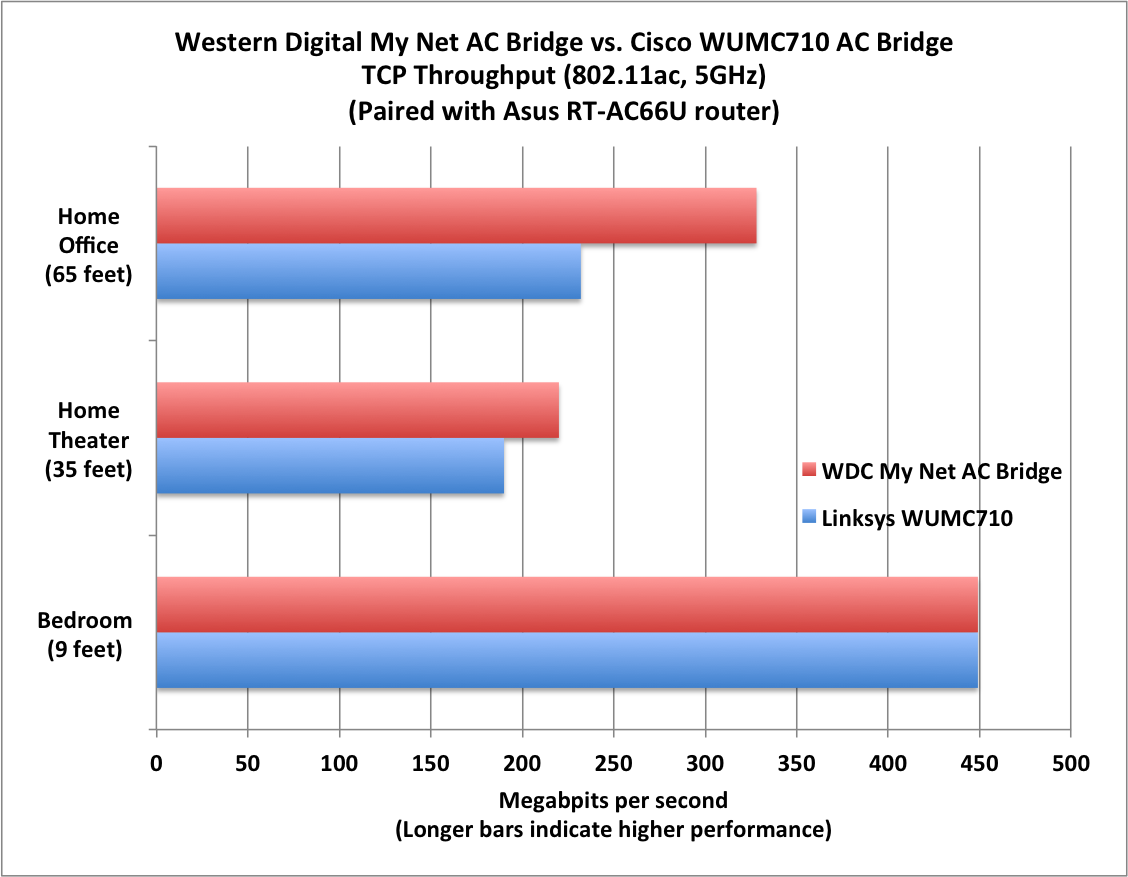
We benchmarked the My Net AC Bridge alongside our current favorite 802.11ac router, the Asus RT-AC66U, and then compared its performance with that of Cisco’s Linksys WUMC710, streaming to three locations inside a 2800-square-foot, single-story home. As you can see in the chart above, Western Digital’s bridge delivered about the same performance at close range (the router and client in the same room, about 9 feet apart) and in our home-theater test (35 feet apart, with four walls in between). But Western Digital’s bridge offered much higher performance than Cisco’s model did when we moved the client to a home office that was located 65 feet from the router and separated by three walls.

To read this article in full or to leave a comment, please click here

Source: FULL ARTICLE at PCWorld