Tag Archives: Sam Club

The U.S.' 10 Most Valuable Retail Brands of 2013

By Dan Dzombak, The Motley Fool

Filed under:

Recently, brand consultancy Interbrand came out with its report on the 50 most valuable U.S. retail brands of 2013. Read on to find out the top 10.

So how did Interbrand determine their value? In short, Interbrand looks at three key aspects. First is the financial performance of the branded products or services. Interbrand only considers companies with publicly available data that are creating economic value (meaning a positive EBITDA) and generating a minimum of 50% of their sales from their retail stores (this excludes Apple).

The other two aspects Interbrand considers are the role of the brand in the purchase decision process and the strength of the brand — meaning, “the ability of the brand to create loyalty and, therefore, to keep generating demand and profit into the future.”

Here are Interbrand’s 10 most valuable U.S. retail brands of 2013:

Rank

Company

Brand Value
(in billions)

Change From 2012

1

Wal-Mart

$141.0

1%

2

Target

$25.0

7%

3

Home Depot 

$22.9

4%

4

Amazon.com

$18.6

46%

5

CVS

$15.9

(8%)

6

Coach

$14.6

8%

7

Walgreen

$14.4

(4%)

8

Sam’s Club (a subsidiary of Wal-Mart)

$13.5

5%

9

eBay

$10.9

12%

10

Nordstrom

$10.1

7%

Source: Interbrand.

Wal-Mart is the most valuable retail brand in the U.S. by a factor of five. Remarkably, Wal-Mart subsidiary Sam’s Club is the eighth most valuable retail brand in the U.S. Wal-Mart established itself as the dominant low-cost retailer over decades by constantly improving on its processes and supply chain skills under the leadership of Sam Walton. While Sam is no longer with us, Wal-Mart continues to thrive and his family leadership continues today under Chairman S. Robson Walton.

Many people don’t realize the difference in size between Wal-Mart and other retailers. The company’s sales for the fiscal year ended Jan. 31, 2013, were $275 billion in the U.S. Compare that to the second most valuable retail brand in the U.S., Target , with sales of just $72 billion. Even Amazon.com , 2013’s fastest-growing major brand, only did $35 billion in sales in the U.S. in the past year.

Notably absent from the top 10 this year is Best Buy , which moved from fifth in 2012 to 13th in 2013 as the company’s brand value dropped 52% to $8 billion. The electronics retailer had a tough 2012 as shoppers treated its stores as showrooms and then used apps to buy goods cheaper online from Amazon and eBay. In the past, both online retailers benefited from not having to collect state sales taxes, but that advantage is slowly ending.

Best Buy is slowly turning things around this year. It announced in February a policy to match prices found online, and earlier this month that

From: http://www.dailyfinance.com/2013/04/11/the-us-10-most-valuable-retail-brands-of/

5 Simple Ways to Pay Less at the Pump

By Dan Caplinger, The Motley Fool

Filed under:

There may be an energy boom going on in the U.S., but prices at the pump haven’t given Americans any relief lately. With gasoline prices setting new record highs for the winter season in recent months, cash-strapped consumers are looking for every break they can find.

To help you in your search for ways to pay less for gasoline, here are five good prospects. You won’t find all of them everywhere across the country, and some of them will only have a small impact on what you pay. But by combining the ideas that you can take advantage of, they can add up to real savings.

1. Warehouse-club discounts
In order to encourage customers to join their clubs, Sam’s Club, Costco , and BJ’s often have gas stations connected to their stores that offer discounted prices. In some areas, the discounts are are just a few cents, but some reports show cheaper prices of $0.10 per gallon or more.

You’re only allowed to use the pumps if you have a membership card. With memberships costing $40 and up, it usually won’t make sense to join solely to save on gas unless you plan to take advantage of other discounts as well.

2. Grocery-store gas rewards
Many grocery-store chains offer points that you can use to save on gasoline at local stations. SUPERVALU , Safeway , and several grocery retailers established their own proprietary programs as a way to encourage shoppers to spend more money generally as well as to buy certain targeted promotional products. A typical deal might involve saving $0.10 per gallon for every $100 you spend on groceries.

Clearly, if you pay more for groceries, the savings at the pump won’t be worth it. But if you’re shopping at a store anyway, there’s no reason not to take the opportunity to save.

3. Day-of-the-week specials
Some gas stations offer discounts if you buy gas on certain days of the week. The discounts usually aren’t that big, with $0.03 to $0.05 per gallon being a typical amount. Yet many people are able to time their gas purchases to take advantage of those discounts at least part of the time.

4. Credit card rewards
Many credit card companies offer a substantial discount on gas when you use their cards. With rewards of 5% not uncommon, the effective savings can be $0.20 per gallon or more based on current prices. For instance, Pentagon Federal Credit Union issues cards that offer 5% cash back on gas purchases with no annual fee.

With these cards, be sure to read the fine print. Most of the time, you have to slide your card at the pump in order to qualify; going inside to pay can disqualify you from getting the reward. Also, some cards, such as JPMorgan‘s Chase Freedom card and Discover Financial‘s Discover Card, only give special gas discounts during certain times of the year, with

Source: FULL ARTICLE at DailyFinance

Why CVS Charges $133 More Than Costco for Generic Lipitor

By CNNMoney

Filed under: , , , ,

Jb Reed, Bloomberg via Getty Images

By Emily Jane Fox

CVS (CVS) charges $150 for a monthly prescription of the generic version of the cholesterol drug Lipitor. The same drug goes for $17 at Costco.

That’s according to a recent Consumer Reports nationwide survey that sent secret shoppers to 200 pharmacies that carry five blockbuster drugs: Lipitor, Lexapro, Plavix, Actos and Singulair, all of which lost their patents in the last two years.

Shoppers found they could be paying as much as $749, or 447%, more for a generic prescription drug in one year at the highest-priced pharmacy, compared with the lowest.

The priciest places to pick up these prescriptions were CVS, Target (TGT) and Rite Aid (RAD). The least expensive were Costco (COST) and Sam’s Club, while Walmart (WMT), and Walgreen’s (WAG) fell in the middle.

So what’s behind the huge discrepancy?

Lisa Gill, a Consumer Reports editor who focuses on prescription drugs, said the difference stems primarily from what sells at the stores.

“At places like CVS or Rite Aid, the pharmacy is their major source of revenue and profit,” she said. “Costco and Sam’s Club are using the low drug prices to pull people in stores who will spend money on other things.”

Sponsored Linksadsonar_placementId=1505951;adsonar_pid=1990767;adsonar_ps=-1;adsonar_zw=242;adsonar_zh=252;adsonar_jv=’ads.tw.adsonar.com’;

Consumers are often willing to pay higher prices at a drug store because many of them are conveniently located, open 24 hours a day and have drive-through windows, according to Gill.

But for most people, it can be worth the extra hassle. This is especially true for those who take medication long-term, since they will get better deals at the warehouse clubs, or big box stores, Gill said.

Carolyn Castel, a spokeswoman for CVS, said that pricing surveys like this are too small to draw “meaningful conclusions about which pharmacies offer the best overall value.” She also noted that they don’t take into account the discount and third-party insurance programs that pharmacies use to lower prices.

A Target spokeswoman said it offers a number of ways for customers to save on drug prices, like rewards and discount programs.

Consumer Reports‘ Gill said these programs are helpful, but they’re not doing enough to lower costs.

It’s no secret that the cost of drugs can be prohibitive, especially at a time when incomes are stagnating. Consumer Reports found in a separate national telephone survey that Americans who regularly took prescription drugs, spent $758 out of pocket in 2012, or 12% more than the previous year.

Gill said that one way for people to save is by refilling prescriptions every 90 days instead of each month, since most pharmacies provide discounts on three-month supplies.

To get the best price, she said, people …read more
Source: FULL ARTICLE at DailyFinance

Dale Peterson, Gun-Waving Alabama GOP Candidate, Charged With Shoplifting Again

By The Huffington Post News Editors

WASHINGTON — Dale Peterson, an Alabama Republican state official famous for flaunting his rifle in campaign ads promising to be tough on crime, was arrested Wednesday and charged with shoplifting a can of cashews. The arrest, first reported by Yellowhammer.com, marked the second time in six months that Peterson has been accused of stealing.

His new arrest occurred at a Sam’s Club, where police said employees watched Peterson eat a can of cashews in the store, then place the empty can back on a shelf. Store security guards confronted Peterson on his way out. He was released from custody after posting $1,000 bond.

Peterson was charged in October with stealing paper towels and beer from a Walmart. Employees said he pushed his way through the checkout line without paying for the items in his cart, according to police. Peterson later said the incident was “a mistake.”

Read More…
More on Gun Control

…read more
Source: FULL ARTICLE at Huffington Post

Why Costco Is Still a Buy

By Demitrios Kalogeropoulos, The Motley Fool

Filed under:

Even with its stock sitting near a 52-week high, Costco keeps giving investors reasons to continue buying.

The latest excuse to bulk up on shares came when the company reported earnings earlier this week. Costco’s sales were up 8% on the quarter, while profits surged by 38%.

Yes, that profit figure was inflated by accounting for the special dividend it paid shareholders in December. But if you back that out, you still get a blistering 22% rise in profits on a solid 5% growth in comparable-store sales. Overall, for the first half of its fiscal year, the retailer booked a cool $1 billion in profits and more than $47 billion in sales. Costco’s sales growth beat Wal-Mart‘s 2.3% rise at Sam’s Club locations. And it trounced Target‘s 0.4% growth on the quarter.

Those are all great reasons to have bought the stock a while back. But prospective investors have a lot to be excited about, too. There are solid reasons why Costco shares look enticing right now.

Explosive store growth 
First, the retailer is slamming the gas on its store expansion plans. Costco opened five new stores last quarter and 14 through the first half of its fiscal year. By comparison, Wal-Mart opened just 3 new Sam’s Club locations last year.

Globally, Costco expects to open a total of 28 new stores this year. That’s almost double the growth from last year’s tally, and will be the highest annual number of warehouses that it has opened since 2007.

And international expansion continues to be a major focus, as only one of last quarter’s new warehouses was opened stateside. Two more were launched in Canada, one opened in central England, and one was brought to the outskirts of Seoul, Korea. Costco’s business model translates well across geographies.

All of this store growth is good for the usual retail reason: It will boost the square footage available as selling space next year. But the real benefits will accrue in the years ahead as those stores mature.

Costco’s warehouses get better with age. By a lot.

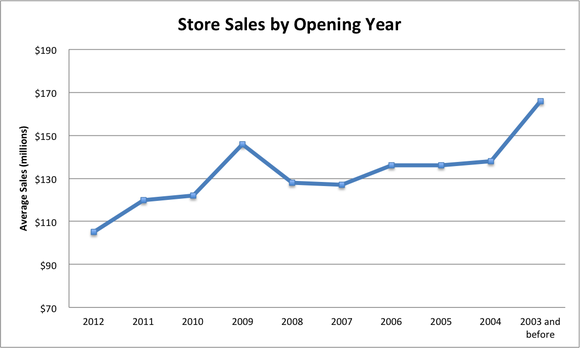
Consider that the 15 locations Costco opened last year averaged a strong $105 million in annual sales, while the company’s oldest stores kicked in a much higher figure, $166 million last year.

New warehouse locations need time in order to build up a large membership base. And you can see a steady trend of increasing sales figures as the stores grow up.

 Source: Costco financial filings.

Loyal membership base
And speaking of members, Costco’s subscriber base just took another step toward loyal fan club. The retailer raised subscription rates about a year ago. That helped boost membership fees to 2.17% of sales, which is a key reason that the company can sell merchandise at such razor-thin margins. Membership fee revenue was about $2.1 billion last year, accounting for three-quarters of Costco’s operating income.

But that fee increase had no negative impact on membership turnover. In fact, just about all of Costco’s renewal rates …read more
Source: FULL ARTICLE at DailyFinance

Midday Report: Costco's Membership Fees, Low Prices a Magic Formula

By DailyFinance Staff

Shoppers buy goods at a Costco store in New York, NY, Monday, March 11, 2013.

Filed under: , , ,

Produced by Drew Trachtenberg

With consumers pinching pennies, why are so many people willing to pay just for the right to shop at one chain?

Costco (COST), it seems, has found a magic formula.

Most of its customers pay $55 a year in membership fees. With that they buy the right to shop in big warehouses, with no décor to speak of. But they also get cheap prices, on everything from socks and paper towels to steaks and garage doors. The company limits its price mark-up on everything to no more than 15 percent. That’s created loyal customers who keep coming back — and paying that membership fee.

(Getty Images)

In fact, Costco collected $528 million in membership fees last quarter, accounting for most of its profit. Overall, net rose 39 percent from a year ago, beating Wall Street expectations.

This combination of guaranteed revenue from membership fees and high sales volume has generated consistent growth. Costco’s main competitors are Wal-Mart (WMT) owned Sam’s Club and BJ’s Wholesale, and analysts say Costco has outperformed them in terms of sales growth and productivity.

Sponsored Linksadsonar_placementId=1505951;adsonar_pid=1990767;adsonar_ps=-1;adsonar_zw=242;adsonar_zh=252;adsonar_jv=’ads.tw.adsonar.com’;

Costco also does a good job of controlling costs. Many of its stores use solar energy to power their electrical needs. And even though they pay their workers a bit more than most retailers, they have less turnover, which also helps the bottom line.

Costco’s stock rose two percent this morning, but it’s been pretty flat this year, despite the double-digit gains for the overall market. Longer term, Costco has fared pretty well: Its shares are up about 15 percent over the past year, and up about 70 percent over three years.

Costco is not without critics. It was sued last month by high-end jewelry retailer Tiffany (TIF), which claims that Costco was selling counterfeit Tiffany diamonds rings. Costco also sells some high-end art, and there have been questions about the authenticity of some of those pieces as well.

Permalink | Email this | Linking Blogs | Comments

…read more
Source: FULL ARTICLE at DailyFinance

These Stocks Overcame the Dow's Monday Blues

By Dan Caplinger, The Motley Fool

Filed under:

As well as the stock market has performed lately, Mondays had been a sore point for the average. Until today, the S&P 500 hadn’t posted a single winning session on a Monday, and early on, it seemed like the stock market would maintain that streak. But later in the day, stocks recovered ground, and the Dow Jones Industrials finished the day with a gain of 38 points, hitting a new five-year high and covering half the ground toward its all-time closing high of 14,164. The Nasdaq and S&P 500 both rose more strongly.

Within the Dow, strength from the consumer sector overcame challenges on the industrial side of the market. Home Depot rose to a new all-time high, gaining nearly 2% as investors continue to gravitate toward housing plays. As long as data on home sales and housing prices remains favorable, you can expect investor sentiment for Home Depot to continue to be positive. Wal-Mart also gained ground, leading the Dow’s gainers with a better than 2% rise. An interesting story pointed to its work with newly public solar installer SolarCity to put panels on Wal-Mart and Sam’s Club stores in Ohio, but the more likely reason for gains is simply the retailer’s exposure to domestic economic forces that push shoppers toward more cost-conscious choices.

Elsewhere, Boyd Gaming rose 14% after announcing along with its earnings report that it has completed the sale of its Echelon property on the Las Vegas Strip. The company posted a wider-than-expected loss even after accounting for a one-time charge related to the ill-fated property, but given Boyd’s precarious financial situation, having resolved the issue once and for all clearly made investors feel more comfortable about its prospects moving forward.

Finally, mortgage-insurer Radian Group soared almost 8%. Not only has the company enjoyed favorable trends as home prices have recovered, but it also got upgraded by Keefe Bruyette this morning. With improving conditions suggesting that Radian and its industry peers could survive and thrive going forward, Radian’s shares arguably have a lot farther to run, especially now that the company has completed its capital-raising offering of stock and convertible bonds.

To find some promising long-term investing ideas, check out the Fool’s special report: “The 3 Dow Stocks Dividend Investors Need.” It’s absolutely free, so just click here and get your copy today.

The article These Stocks Overcame the Dow’s Monday Blues originally appeared on Fool.com.

Fool contributor Dan Caplinger has no position in any stocks mentioned. You can follow him on Twitter @DanCaplinger. The Motley Fool recommends Home Depot. Try any of our Foolish newsletter services free for 30 days. We Fools may not all hold the same opinions, but we all believe that considering a diverse range of insights makes us better investors. The Motley Fool has a disclosure policy.

Copyright © 1995 – …read more
Source: FULL ARTICLE at DailyFinance

Economists examine gender disparity in CEO ranks

(Phys.org)—Women are reaching the upper echelons of business in record numbers—Marissa Mayer at Yahoo!, Meg Whitman at Hewlett-Packard, Ginni Rometty at IBM and Rosalind Brewer at Sam’s Club, to name a few. Even so, women comprise a mere 4 percent of the chief executive officer positions at Fortune 500 companies.
Economists at UC Santa Barbara are exploring some of the reasons behind this continuing disparity, and they’re using a 1-mile race as their data source. Their findings appear in the current issue of the journal Economic Inquiry. …read more
Source: FULL ARTICLE at Phys.org

Victim Too Afraid to Show Her Face

Victim Too Afraid to Show Her Face

victim

KTLA

She was shopping with her child when two men approached her — but it wasn’t until she walked out of the store that her horror began.Chilling moment in Sam’s Club parking lot

Source: FULL ARTICLE at AOL