Tag Archives: Republic Airways

American Airlines Unveils Embraer 175 Regional Jet Design

By Grant Martin, Contributor

As the bankrupt American Airlines continues to revitalize its fleet and prepare for a merger with US Airways, the carrier today introduced a new airplane into its livery: the 175. The Brazillian-made small regional jet will be operated by Republic Airways and will initially fly out of Chicago to New Orleans, Pittsburgh and Albuquerque. As the airline receives further orders, service will be expanded around the country and eventually to other departing airlines. …read more

Source: FULL ARTICLE at Forbes Latest

2 Great Small-Cap Stocks in the Airline Sector

By Adam Levine-Weinberg, The Motley Fool

Filed under:

Small-cap stocks (stocks with a total market capitalization between $300 million and $2 billion, roughly speaking) can provide great investment opportunities for individual investors for several reasons. First, they tend to receive much less coverage from professional analysts, which means that if you do your homework, you can level the playing field with Wall Street. Second, many big institutional investors avoid small-cap stocks because they want to invest a lot of money at one time, which is easier to do with multibillion dollar companies. Together, these factors can occasionally allow you to find great bargains, which are typically harder to find among better-known companies.

In this article, I will highlight two deeply undervalued small-cap stocks in the airline sector. Both trade at rock-bottom forward earnings multiples (less than six times expected 2014 earnings, below peers). Yet both companies have strong business prospects and are expected to grow their earnings over the next five years. Accordingly, I expect these two stocks to beat the market over the next few years.

Hawaiian Airlines: ready to fly again
Hawaiian Holdings
, the parent company of Hawaiian Airlines, has seen very inconsistent stock performance over the past year and a half. On three occasions, the stock has approached $7 (briefly breaking through that level earlier this year), but each time it has retreated to the $5 level. At Monday’s closing price of $5.51, the company has a $283 million market capitalization (which could technically make it a micro-cap, but still places it within the ballpark range for small-cap stocks).

Hawaiian Holdings Two-Year Price Chart, data by YCharts

Hawaiian’s inconsistency can be attributed to the company’s rapid expansion, which has caused earnings results to vary dramatically from quarter to quarter. Yet behind that turbulence, the company is building a strong business model. Hawaiian has dramatically diversified its revenue base in the past three years, so that it is less reliant on the U.S. West Coast-Hawaii travel market. Moreover, it is the only carrier serving many of its new routes, which will give it pricing power, since many travelers are willing to pay a little extra for a direct flight.

Recent earnings misses have led to another sell-off in Hawaiian stock, but these represent growing pains rather than fundamental problems with Hawaiian’s business model. Hawaiian actually operates in a less risky segment of the airline sector, as leisure travel demand is more resilient in recessions than business travel demand. The company’s growth rate will begin to taper off this summer, and I expect significant earnings increases over the next few years as new routes begin to mature. At five times trailing earnings, and less than four times forward earnings, Hawaiian is a substantially undervalued small-cap stock.

Republic Airways Holdings is another undervalued, under-appreciated small-cap airline stock. At Monday’s closing price of $10.64, the company has a market cap of $521 million. Republic Airways has been dogged by its acquisition of two mainline carriers (Frontier …read more

Source: FULL ARTICLE at DailyFinance

Republic Airways Reports March 2013 Traffic

By Business Wirevia The Motley Fool

Filed under:

Republic Airways Reports March 2013 Traffic

INDIANAPOLIS–(BUSINESS WIRE)– Republic Airways Holdings (NAS: RJET) , today reported preliminary passenger traffic results for March 2013. The Company generated approximately 1.6 billion revenue passenger miles (RPMs), a decrease of 12% from March 2012, on a 14% reduction in capacity. Block hours were 3% less than the same period in 2012. Consolidated load factor increased to 83% from 80% in March 2012. Republic Airways carried 2.6 million passengers in March, a slight decrease from the prior year.

…read more
Source: FULL ARTICLE at DailyFinance

      March      
2013       2012

Which Ultra-Low-Cost Carrier Is Right for Your Portfolio?

By Adam Levine-Weinberg, The Motley Fool

Filed under:

The past few years have seen a new innovation in American aviation: the “ultra-low-cost carrier”, or ULCC. Spirit Airlines has led this movement since 2007, when it began charging for checked bags and snacks, two items that had traditionally been complementary in the industry. However, Allegiant Travel had already begun implementing some aspects of the ULCC model, and has continued down that road in recent years. More recently, Republic Airways has focused on converting its Frontier Airlines subsidiary to a ULCC model over the past year or so.

However, the ULCC model is not well-defined; Spirit, Allegiant, and Frontier actually have very different business models. While all three businesses are promising investment candidates, I think that Frontier parent Republic Airways could be the best of the group. Frontier has a much more customer-friendly fee policy than either Spirit or Allegiant, which makes it more likely to gain a loyal customer base. Moreover, the company trades at a significant discount to Spirit and Allegiant, even though management has made significant progress on the company’s turnaround.

Low fares and high fees
Spirit’s strategy is very simple; it finds the lowest-cost way to transport passengers from point A to point B, and then keeps base fares low while charging fees for a variety of optional services. “Non-ticket” revenue from fees for checked and carry-on bags, selling on-board food and drinks, charging for membership in a frequent traveler discount club, and similar sources accounts for approximately 40% of Spirit’s revenue. Spirit keeps costs down by offering a single class of service, using a single fleet type (the Airbus A320 family), and fitting more seats onto each plane than other airlines. The company expects to continue reducing its cost structure (already the lowest in the industry) as it grows.

Spirit targets large existing air travel markets (more than 200 passengers per day each way) with high average fares. As a result, the company competes with legacy carriers on many of its newer routes. However, whereas the legacy carriers offer frequent service to cater to business travelers, Spirit only flies once or twice a day on most routes.

With its low fares, Spirit can attract many leisure travelers who are flexible about scheduling and are willing to sacrifice a little comfort to save money. Low fares also stimulate additional demand from people who could not afford to fly when fares were higher. Spirit serves roughly 125 markets today, but management estimates that there are more than 400 additional markets that meet its criteria for eventual service. This provides a nice runway for future growth.

Small cities go on vacation
Allegiant has many similarities to Spirit. Allegiant also offers a single class of service, charges low base fares, and derives a large and increasing percentage of its revenue from “ancillary” products and services. Furthermore, the company just finished adding 16 seats to each of its MD-80 aircraft to reduce unit costs. However, Allegiant’s business model …read more
Source: FULL ARTICLE at DailyFinance

10,000-Employee Airline Leverages UltiPro's Business Intelligence for Strategic and Operational HR I

By Business Wirevia The Motley Fool

Filed under:

10,000-Employee Airline Leverages UltiPro’s Business Intelligence for Strategic and Operational HR Improvements

WESTON, Fla.–(BUSINESS WIRE)– Ultimate Software (NAS: ULTI) , a leading cloud provider of people management solutions, announced today that Republic Airways Holdings Inc. (NAS: RJET) , an airline holding company that owns Chautauqua Airlines, Frontier Airlines, Republic Airlines, and Shuttle America, is using UltiPro’s capabilities for business intelligence to generate analytics for strategic decision-making and forecasting, automate critical communications and reports necessary for compliance and audits, and make significant improvements to its overall HCM operations.

An Ultimate customer since 2005, Republic Airways has grown to 10,000 employees. With its large employee population, Republic’s HR teams and executives needed visibility into their workforce from a companywide perspective as well as access to employee metrics for fast and accurate insights on specific elements of the business. According to Jon Clahan, manager of HR shared services at Republic Airways, the company is using UltiPro to analyze turnover and employee demographics, and as a result, has made improvements to talent acquisition, re-evaluated its processes for performance management, and implemented succession plans to avoid talent shortages.

“The airline industry is highly regulated, and one of these regulations requires that pilots stop flying after age 65. With UltiPro, we have been able to identify employees who will be retiring and when they will retire. This allows Republic to ramp up hiring when appropriate so we can better fill vacancies that could have a negative impact on the business,” said Clahan. “Our executives have dashboards in UltiPro to more easily and accurately monitor these kinds of trends, and then we can make the best adjustments and decisions for our multiple businesses.”

Republic is using UltiPro to automatically deliver dozens of reports used every day by stakeholders across the organization. Clahan also has created a series of reports to handle most daily requests for information. For example, Republic’s HR team and leaders may need historical workforce information because airline regulations often require manpower data that may be date-specific and relevant to all employees or that is only relevant to a specific group of employees. With UltiPro, Clahan is better positioned to immediately address a full range of reporting needs.

“Information really can be put into almost any system, but what sets UltiPro apart from other HCM platforms is the solution’s ability to enable people to easily extract information and then deliver it to our teams or decision makers …read more
Source: FULL ARTICLE at DailyFinance

Starboard Value Calls for Office Depot to Remake Board

By Rich Duprey, The Motley Fool

Filed under:

Regardless of whether its merger with OfficeMax is completed or not,  Office Depot‘s   major shareholder Starboard Value believes that the board of directors of needs a significant shakeup to be effective.

In a letter filed with the SEC, Starboard’s Jeffrey C. Smith said the office supply retailer needs “a new Board that possesses the appropriate skill sets to oversee a turnaround of Office Depot.” Starboard, which owns 14.8% of Office Depot‘s stock, offered up a slate of eight candidates for the board, including former chairman and CEO of Chrysler and Home Depot Robert Nardelli, and the current president and CEO of Republic Airways‘ Frontier Airlines subsidiary David Siegel

Considering the current operating performance, Starboard is looking for immediate change in the makeup of the board, which will benefit the melding of the two corporate cultures should the merger be approved.

If the current board doesn’t make the changes requested, Starboard says the annual shareholder meeting should be scheduled before the merger is completed, so the shareholders can decide who they want to lead the company.

The article Starboard Value Calls for Office Depot to Remake Board originally appeared on Fool.com.

Fool contributor Rich Duprey has no position in any stocks mentioned. The Motley Fool recommends Home Depot. Try any of our Foolish newsletter services free for 30 days. We Fools may not all hold the same opinions, but we all believe that considering a diverse range of insights makes us better investors. The Motley Fool has a disclosure policy.

Copyright © 1995 – 2013 The Motley Fool, LLC. All rights reserved. The Motley Fool has a disclosure policy.

(function(c,a){window.mixpanel=a;var b,d,h,e;b=c.createElement(“script”);
b.type=”text/javascript”;b.async=!0;b.src=(“https:”===c.location.protocol?”https:”:”http:”)+
‘//cdn.mxpnl.com/libs/mixpanel-2.2.min.js’;d=c.getElementsByTagName(“script”)[0];
d.parentNode.insertBefore(b,d);a._i=[];a.init=function(b,c,f){function d(a,b){
var c=b.split(“.”);2==c.length&&(a=a[c[0]],b=c[1]);a[b]=function(){a.push([b].concat(
Array.prototype.slice.call(arguments,0)))}}var g=a;”undefined”!==typeof f?g=a[f]=[]:
f=”mixpanel”;g.people=g.people||[];h=[‘disable’,’track’,’track_pageview’,’track_links’,
‘track_forms’,’register’,’register_once’,’unregister’,’identify’,’alias’,’name_tag’,
‘set_config’,’people.set’,’people.increment’];for(e=0;e<h.length;e++)d(g,h[e]);
a._i.push([b,c,f])};a.__SV=1.2;})(document,window.mixpanel||[]);
mixpanel.init("9659875b92ba8fa639ba476aedbb73b9");

function addEvent(obj, evType, fn, useCapture){
if (obj.addEventListener){
obj.addEventListener(evType, fn, useCapture);
return true;
} else if (obj.attachEvent){
var r = obj.attachEvent("on"+evType, fn);
return r;
}
}

addEvent(window, "load", function(){new FoolVisualSciences();})
addEvent(window, "load", function(){new PickAd();})

var themeName = 'dailyfinance.com';
var _gaq = _gaq || [];
_gaq.push(['_setAccount', 'UA-24928199-1']);
_gaq.push(['_trackPageview']);

(function () {

var ga = document.createElement('script');
ga.type = 'text/javascript';
ga.async = true;
ga.src = ('https:' == document.location.protocol ? 'https://ssl' : 'http://www') + '.google-analytics.com/ga.js';

var s = document.getElementsByTagName('script')[0];
s.parentNode.insertBefore(ga, s);
})();

<p style="clear: both;padding: 8px …read more
Source: FULL ARTICLE at DailyFinance

Southwest Needs to Reinvent Its "Low-Cost Carrier" Image

By Adam Levine-Weinberg, The Motley Fool

LUV Chart

Filed under:

The 2000s were the decade of the low-cost carrier in the American airline industry. Southwest Airlines has been in business since 1971, but it was a niche player until the 1990s. In the past 10-15 years, Southwest has expanded rapidly, going from less than $5 billion of revenue in 1999 to more than $12 billion of revenue in 2010, and $17 billion in 2012. Meanwhile, new upstart JetBlue Airways began service in 2000 and grew at an astonishing pace to become one of the top-six carriers in the country today, with annual revenue of $5 billion.

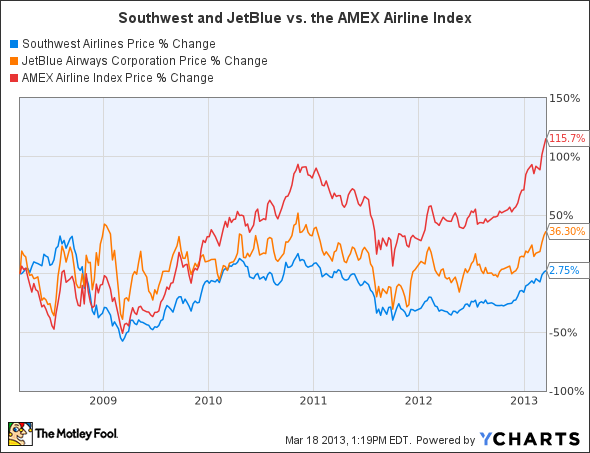
However, Southwest and JetBlue have hit some bumps in the past few years. The large network carriers have dramatically reduced their expenses as they have gone through the bankruptcy process during the past decade while adding fees for checked baggage and other services, boosting ancillary revenue. These developments have allowed the network carriers become quite competitive on price with Southwest and JetBlue for domestic flights. A recent study found that Southwest offered the lowest prices for a given route only 40% of the time. As a result of this more competitive fare environment, Southwest and JetBlue shares have dramatically lagged the industry benchmark over the past five years.

Southwest and JetBlue vs. the AMEX Airline Index, Five-Year Price chart; data by YCharts

Beyond “low-cost”
As legacy carriers have closed the cost and price gap with Southwest and JetBlue, the term “low-cost carrier” has become somewhat of a misnomer. Indeed, Southwest and JetBlue have been ceding their leadership on price to a new group of so-called “ultra-low-cost carriers”: principally Spirit Airlines , Allegiant Travel , and most recently, Frontier Airlines (a subsidiary of Republic Airways ). The differences between LCCs and ULCCs can be seen most dramatically by comparing the seating on Airbus A320s used by JetBlue, Spirit, and Frontier. JetBlue offers best-in-class legroom by putting only 150 seats on an A320. By contrast, Frontier has 168 seats on its A320s, and is looking to expand that to 174. Spirit has pushed the envelope even further, with 178 seats on each A320.

Low prices are thus no longer distinctive features for Southwest and JetBlue. However, the two carriers do differ from competitors in that they provide benefits and amenities that cannot be found on most other U.S. airlines. To maintain their profitability in today’s competitive environment, LCCs need to capitalize on this differentiation, and market themselves as “premium service” carriers. JetBlue has embraced this ideal, and emphasizes its premium amenities heavily in its marketing. By contrast, Southwest has had more trouble distinguishing itself from other carriers now that it is no longer a clear price leader. This messaging problem could continue to drag down Southwest’s performance if it does not clarify what it stands for.

Focus on customer service
Low prices historically helped attract customers to Southwest and JetBlue. They kept costs down by using just one or two aircraft types, offering a single …read more
Source: FULL ARTICLE at DailyFinance

Is Embraer Finally in the Clear?

By Adam Levine-Weinberg, The Motley Fool

Filed under:

Regional jet manufacturer Embraer gave investors a scare in late 2012, when slow sales of E-Jets aircraft for the 70- to 110-seat market raised the specter of production cuts. The company’s order backlog was only $12.5 billion by the end of 2012, down nearly 20% from the beginning of the year. At only 2 times annual revenue, Embraer’s order backlog is much lower than the comparable figures for competitors such as Boeing , which has a backlog equal to seven years of revenue.

Embraer does expect somewhat slower commercial aircraft production in 2013 with 90 to 95 deliveries, compared with 106 in 2012. However, the growing popularity of two class regional jets for the big U.S. network carriers creates a significant opportunity for Embraer to fill open delivery slots for the next few years while rebuilding its order backlog. Furthermore, the company is diversifying its revenue base by growing its private jet and military segments; combined, these will reach nearly half of total company revenue in 2013. These trends may have finally put Embraer on the upswing.

The growing American opportunity
While the U.S. aviation market is mature, demand for large regional jets such as Embraer’s E-Jets is very robust today. This is the result of three factors. First, the rapid rise of oil prices over the past decade has made fuel efficiency critical, and large regional jets burn much less fuel per seat than 50-seat and smaller regional jets. Second, large regional jets can accommodate a first-class section and/or premium economy seating and are more comfortable than 50-seaters in general. These amenities can help attract higher-yielding business passengers. Third, the “Big Three” airlines — Delta Air Lines , United Continental , and American Airlines — have all successfully negotiated with their pilots over the past year for the ability to increase usage of large regional jets.

Delta is the furthest ahead on this strategy and is in the midst of executing a plan that will reduce its 50-seat regional jet fleet from 313 at the end of 2012 to just 125 by the end of 2015. Many of those will be replaced by Boeing 717 mainline aircraft, but there will also be an increase in large regional jet flying.

United and American will see even more growth in large regional jet flying. According to a recently signed pilot agreement, American is permitted to operate more than 300 76-seat regional jets (such as the Embraer E-175), compared with just 47 previously. Embraer has already benefited from this change, as it recently received an order from Republic Airways for 47 E-175s to be operated for American. Deliveries will run from mid-2013 through 2015, and Republic has options for another 47 aircraft. American and its merger partner US Airways will probably look to grow their 76-seat fleet further to better compete with Delta, which gives Embraer a good chance of converting these options to firm orders.

Lastly, United’s recently completed pilot …read more
Source: FULL ARTICLE at DailyFinance

Republic Airways Is Coming Back to Life

By Adam Levine-Weinberg, The Motley Fool

Filed under:

On Wednesday evening, Republic Airways reported adjusted EPS of $0.35, which beat the average analyst estimate of $0.31 and was near the high end of recent guidance for EPS of $0.30-$0.36. As I noted in a previous article, Republic Airways has experienced a rough period of restructuring since its questionable decision to get into the mainline business by purchasing Frontier Airlines and Midwest Airlines. However, the company’s strong Q4 and good outlook bode well for the future, and the likely sale or spin-off of Frontier later this year provides additional upside potential. Furthermore, full-year adjusted EPS of $1.15 gives Republic a very reasonable P/E of eight.

Stabilization at last
Republic now has two main businesses: mainline flying as Frontier Airlines, and regional flying under a variety of brand names. Frontier Airlines managed to grow unit revenue (total revenue per available seat mile) by 5.8% for the full year, from 11.30 cents to 11.96 cents. Meanwhile, cost per available seat mile actually declined from 11.77 cents to 11.66 cents. This helped Frontier swing from a pre-tax loss of $63 million in 2011 to a pre-tax profit of $29.6 million in 2012.

According to Republic’s late December guidance, Frontier Airlines will grow TRASM again in 2013, to a range of 12.4 cents-12.8 cents. This will boost pre-tax margin to 3%-5%. Frontier is achieving these gains primarily through its transition to an “ultra-low-cost carrier” model, similar to Spirit Airlines . Like Spirit, Frontier is reducing costs by putting more seats on its planes than more traditional low-cost carriers like Southwest or JetBlue. However, Frontier is not relying as heavily on fee revenue as Spirit, which may help Frontier achieve stronger customer loyalty.

Meanwhile, Republic has essentially completed the restructuring of its core regional flying business. The regional airline industry has been hurt by the rapid obsolescence of 50-seat (and smaller) regional jets. These planes allowed airlines to serve smaller destinations frequently, but they are gas guzzlers, making them uneconomic in the current high-price fuel environment. Republic is fortunate that it only has 70 of the smaller regional jets, compared to more than 150 larger regional jets and turboprops. Furthermore, it recently won a contract that will (pending bankruptcy court approval) allow Republic to purchase 47 new Embraer E175 regional jets and operate them on behalf of American Airlines. Republic’s management expects the legacy carriers to add about 300 large regional jets over the next few years, so the opportunity to grow this business should more than offset the gradual loss of 50-seat flying.

Conclusion
After a few dark years, Republic Airways is finally back on track. The conversion of Frontier to an ultra-low-cost carrier has quickly put it back in the black. A spin-off or sale of this business could generate additional value for shareholders. Most importantly, the core regional airline business has improved, and the agreement to fly large regional jets for American provides an important driver of growth.

<p …read more
Source: FULL ARTICLE at DailyFinance