Tag Archives: NPD

Wake Up! Your Head Is in the Clouds!

By Tim Beyers, The Motley Fool

Filed under:

U.S. homes are overrun with smart devices — six per household and more than a half billion overall. In the past three months alone, we’ve seen the “installed base” of smartphone users grow by 9 million and tablet users by 18 million, according to research firm NPD.

This is the sort of breathtaking growth Cisco Systems talks about when it issues predictions about the geometric rise in mobile data. What does it mean for investors? For one thing, the “connected home” isn’t a future idea — it’s here now, and it’s changing habits as a result.

In the following video, Tim Beyers of Motley Fool Rule Breakers and Motley Fool Supernova assesses the shift and offers some ideas for how to profit. Please watch, and then leave a comment in the box below. How many devices are in your home? How often are you on a tablet or smartphone? Let us know what you think.

The mobile revolution is still in its infancy, but with so many different companies, it can be daunting to know how to profit in the space. Fortunately, The Motley Fool has released a free report on mobile named “The Next Trillion-Dollar Revolution” that tells you how. The report describes why this seismic shift will dwarf any other technology revolution seen before it and also names the company at the forefront of the trend. You can access this report today by clicking here — it’s free.

The article Wake Up! Your Head Is in the Clouds! originally appeared on Fool.com.

Fool contributor Tim Beyers is a member of the 
Motley Fool Rule Breakers
stock-picking team and the Motley Fool Supernova Odyssey I mission. He owned shares of Apple at the time of publication. Check out Tim’s Web home and portfolio holdings, or connect with him on Google+Tumblr, or Twitter, where he goes by @milehighfool. You can also get his insights delivered directly to your RSS reader.The Motley Fool recommends Apple, Cisco Systems, and Netgear and owns shares of Apple. Try any of our Foolish newsletter services free for 30 days. We Fools don’t all hold the same opinions, but we all believe that considering a diverse range of insights makes us better investors. The Motley Fool has a disclosure policy.

Copyright © 1995 – 2013 The Motley Fool, LLC. All rights reserved. The Motley Fool has a disclosure policy.

(function(c,a){window.mixpanel=a;var b,d,h,e;b=c.createElement(“script”);
b.type=”text/javascript”;b.async=!0;b.src=(“https:”===c.location.protocol?”https:”:”http:”)+
‘//cdn.mxpnl.com/libs/mixpanel-2.2.min.js’;d=c.getElementsByTagName(“script”)[0];
d.parentNode.insertBefore(b,d);a._i=[];a.init=function(b,c,f){function d(a,b){
var c=b.split(“.”);2==c.length&&(a=a[c[0]],b=c[1]);a[b]=function(){a.push([b].concat(
Array.prototype.slice.call(arguments,0)))}}var g=a;”undefined”!==typeof f?g=a[f]=[]:
f=”mixpanel”;g.people=g.people||[];h=[‘disable’,’track’,’track_pageview’,’track_links’,
‘track_forms’,’register’,’register_once’,’unregister’,’identify’,’alias’,’name_tag’,
‘set_config’,’people.set’,’people.increment’];for(e=0;e<h.length;e++)d(g,h[e]);
a._i.push([b,c,f])};a.__SV=1.2;})(document,window.mixpanel||[]);
mixpanel.init("9659875b92ba8fa639ba476aedbb73b9");

function addEvent(obj, evType, fn, useCapture){
if (obj.addEventListener){
…read more
Source: FULL ARTICLE at DailyFinance

Will the PC Ever Be Great Again?

By Steve Heller, The Motley Fool

Filed under:

The PC industry is starting to show signs of stagnation, resulting from the dramatic rise of smartphones and tablets. Last year, it took the assault of nearly 830 million mobile computing devices to drive PC sales down 3.5% — the first annual decline in over 12 years. This data suggests that the PC is perhaps beginning to look a little long in the tooth for consumers who continue to shift their electronic spending towards mobile computing devices. Microsoft‘s  touch-friendly Windows 8 has yet to excite consumers largely because touch-enabled laptops remain in limited supply. According to NPD, last year’s Black Friday sales of touch-enabled laptops only accounted for 3% of laptop sales. Given this apparent supply constrain, it’s no wonder the PC has underwhelmed the consumer in the age of touch-enabled smartphones and tablets.

However, in the coming years, the PC will evolve to become more like the tablet in terms of portability and features, but will still stay true to its PC roots, grounded in productivity. When it’s all said and done, the PC should theoretically give the tablet a run for its money.

Source: Lenovo.

When worlds collide
If the PC and the tablet had a baby, it’d look something like the Lenovo ThinkPad Helix pictured above. Not only does this hybrid Ultrabook device feature full-blown Windows 8 and the option for a powerful Intel Core i7 Processor, the screen can detach itself from the keyboard so it can operate as a fully functional 11.6-inch tablet. In terms of battery life, the Helix is expected to get in the neighborhood of 10 hours of life between charges. Starting out at a price of $1,499, the convergence of two devices won’t come cheap. As always with cutting-edge PC designs, it will take a few years for the price of hybrid devices to become less burdensome on the wallet. If you need assurance, take a look at the Ultrabook’s price trajectory over the years. When first released in 2011, the average Ultrabook would fetch $999, but now a lower-end Ultrabook could be had for $599.

The toaster and the fridge
When two products are combined to make a device that’s intended to be better than the sum of its parts, skepticism arises. When Apple CEO Tim Cook called the hybrid laptop the equivalent of combining a toaster and refrigerator, it sounded the alarm bells. Cook’s thinking here is that devices that are forced to converge make too many compromises, which ultimately hurts the user experience. Apple has taken the stance that it won’t be converging elements of its iPad with its Macbook line of computers.

I believe that PC makers will eventually be able to successfully marry the PC and tablet in perfect form. It’s going to take trial and error, but products like the Helix give the PC industry hope that the future of PC computing isn’t going to be a …read more
Source: FULL ARTICLE at DailyFinance

Prepare for an Intel Miss

By Evan Niu, CFA, CFA, The Motley Fool

Filed under:

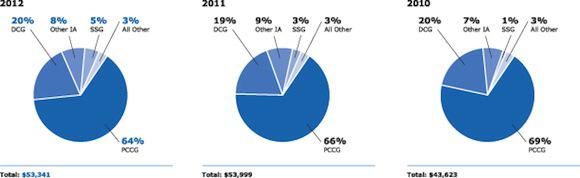
For better or for worse, Intel‘s bread and butter is still the PC market. As much progress as the company has made diversifying into servers and, to a much lesser extent, mobile chips, the top line still lives and dies by the PC right now. PCs used to be 69% of the business. That figure has come down to “just” 64% of the business in 2012, but that’s still a lot of leaning on a form factor seeing no growth these days.

Intel revenue breakdown by segment

Source: Intel 10-K. PCCG = PC Client Group. DCG = Data Center Group. SSG = Software and services. Other IA = Other Intel architecture.

With that computing market still stagnating, so do Intel’s prospects. Recent data from market researchers suggest that as bad as the PC market is faring, things are getting worse before they get better.

Sorry, PC
IDC was expecting global PC shipments to drop by 7.7% in the first quarter. The switch to Microsoft Windows 8 has not been an easy one for PC players, and that will inevitably weigh on Chipzilla. That predicted decline is actually one of the better possible outcomes in the first quarter, as shipments could even reach double-digit negative territory if current trends hold up. The Chinese PC market in particular has been soft, and as the biggest PC market in the world, that weakness has a big impact on the big picture.

The only bright spot within the PC market is Apple , which is seeing Mac shipments roar back as it overcomes supply constraints related to the newly redesigned iMacs. NPD data showed domestic Mac shipments jumping 14% for the first two months of the year. Apple is still a relatively small player in the global PC market (roughly 5% market share), so strength there won’t fully compensate for weakness from everywhere else.

Word on the Street
The data has now caused two Street analysts to recently trim estimates on Intel in the first quarter.

Piper Jaffray analyst Gus Richard, who rates Intel as “neutral” alongside a $21 price target, is dropping his first-quarter revenue estimate to $12.4 billion, down from $12.8 billion. That’s well below Intel’s own guidance, which calls for $12.7 billion in sales, with $500 million of wiggle room. Servers are expected to be strong, but slow PC sales will outweigh any server upside.

One small silver lining is that as the product mix shifts towards servers, gross margins will benefit. The data center group generating an operating margin of 47% last year, easily topping the PC segment’s 38%. Richard thinks that it’s a little “too early” to predict a PC rebound later this year, since he believes Ultrabook prices are still too high relative to their functionality.

Citigroup analyst Glen Yeung feels similarly about Intel. The analyst also has Intel at “neutral,” but recently reduced his price target from $25 to $23. Yeung points to poor sell-through in …read more
Source: FULL ARTICLE at DailyFinance
Germany: State ban on far-right party enough

Germany‘s top security official says the government will support a bid by the country’s 16 states to ban the country’s biggest far-right party but will not file a separate request for a ban itself.

Interior Minister Hans-Peter Friedrich says the Cabinet decided Wednesday it was “not necessary” to file its own request to ban the National Democratic Party, or NPD, with the Federal Constitutional Court.

He says “we will support the activities of the states in this question.”

Germany‘s security services say the party promotes a racist, xenophobic and anti-Semitic agenda that’s unconstitutional. An attempt a decade ago to ban it failed, and the NPD gained support in the aftermath.

Though marginalized nationally, with seats in two state parliaments the NPD receives some 1 million euros annually in public funding.

…read more
Source: FULL ARTICLE at Fox World News

The Mac Is Roaring Back While the PC Gets Weaker

By Evan Niu, CFA, The Motley Fool

Filed under:

Last quarter, there was no sugarcoating it: Apple‘s Mac shipments were surprisingly weak. Mac units came in well below anyone’s best guesses, and the shortfall was primarily related to the redesigned iMacs that were being faced with supply constraints related to full display lamination. Even as the broader PC market has been rather weak lately, the Mac dramatically underperformed the overall market.

This quarter, things might be about to change, as the Mac is roaring back while the PC gets even weaker.

The Mac is back
According to estimates from market researcher NPD last month, Apple’s domestic Mac shipments soared by an impressive 31% year-over-year in January alone. Now NPD is pegging the Mac maker’s U.S. unit shipments as growing 14% year-over-year throughout the first two months of the year. Piper Jaffray analyst Gene Munster is sharing the data alongside a recent research note, noting that the comeback is thanks to easing iMac constraints.

The figures only relate to U.S. shipments. Prior to the recent reporting changes, Apple used to disclose Mac units shipped to each geographical region, with Americas and retail comprising the bulk of unit sales.

Source: SEC filings. Calendar quarters shown.

Munster is modeling for an overall 5% drop in Mac sales during the March quarter. That may not initially strike investors are “roaring back,” but remember that Apple posted an underwhelming 22% decline last quarter, breaking its multi-year streak of outperforming the PC market, so a negative 5% would be quite an improvement sequentially. The analyst’s estimate puts Mac units in the neighborhood of 3.8 million this quarter, following an expected seasonal decline coming off the holidays.

It’s also worth mentioning that a negative 5% result this quarter would allow Apple to return to its PCmarket-beating ways, since new data shows the broader PC market performing even worse than initial expectations.

The PC is slacking
IDC now believes first quarter PC shipments in China are going extremely slow, in part due to government budget cuts and anti-corruption measures that are putting a drag on sales. China represented 21% of global PC shipments last year, so any softness in that region will weight on the broader market.

The transition to Microsoft Windows 8 has been tough on OEMs and suppliers (and Microsoft, too), and that isn’t expected to ease up any time soon. IDC predicts first quarter PC units to fall by 7.7%, with any possible surprises more likely on the downside than the upside, according to its supply chain data. The drop could even touch double-digit territory in Q1, with a mid-single-digit fall next quarter. The only way that the PC market will rebound during the latter half of the year is if new designs are introduced at competitive pricing relative to tablets.

A mixed opinion
The PC pessimism echoes sentiment from Nomura Equity analyst Rick Sherlund. Last week, Sherlund said Windows 8 has been “awkward” so far and that the …read more
Source: FULL ARTICLE at DailyFinance

German gov't backs off banning far-right party

German officials say the government will hold off seeking a ban on the country’s biggest far-right party.

Chancellor Angela Merkel’s Cabinet had been split over whether to back a legal bid by Germany‘s 16 state governments to ban the National Democratic Party, or NPD.

A government official told The Associated Press on Monday that the Cabinet won’t make a separate request to Germany‘s top court. The official spoke on condition of anonymity because the decision won’t be formally announced until Wednesday.

Ten years ago the Federal Constitutional Court rejected a ban of the NPD.

Germany‘s security services say the party promotes a racist, xenophobic and anti-Semitic agenda that’s unconstitutional.

The NPD receives more than €1 million ($1.33 million) in public funding annually because it has seats in two state parliaments.

…read more
Source: FULL ARTICLE at Fox World News

2013 Wii U Sales Look Dismal

Wii U sales hit a low in January and February this year, according to the latest NPD data.

Nintendo’s console sold just 57,000 units in January, managing to up that number to 64,000 in February. This is worse than any recorded week for the current-generation consoles (Wii, Xbox 360 and PS3). The Xbox was top of the hardware chart with 302,000.

Wii U sold 3 million by the end of December – a decent launch that outpaced most others in recent history – but sales have since fallen off a cliff as the console has suffered an almost total absence of new releases. Next week (the week after in Europe), Lego City Undercover will be the first significant game to be released for the console in four months.

Continue reading…

…read more
Source: FULL ARTICLE at IGN Video Games

Video Game Industry Continues to Face Headwinds

By 24/7 Wall St.

Wii U Nintendo OK

Filed under:

Research firm NPD has released its monthly data for video game sales. The industry continues to face consumer preferences for using tablets and smartphones instead of consoles as platforms. And the number of inexpensive games that can be download from app stores has risen. Some of the most popular sources of these games are free.

This movement has pressured both console makers Microsoft Corp. (NASDAQ: MSFT) and Sony Corp. (NYSE: SNE) and has eroded revenue at game creators and marketers, particularly Electronic Arts Inc. (NASDAQ: EA).

According to Edge Online:

The software charts saw an overall year-on-year decline in unit sales of 30% compared to February 2012, though there were a similar number of new releases. Total video game software sales at retail amounted to $352 million in February 2013, compared to $484 million the previous year.

Shares of Electronic Arts closed yesterday at $19.34, in a 52-week range of $10.77 to $19.51.

Filed under: 24/7 Wall St. Wire, Video Games Tagged: EA, MSFT, SNE

Read | Permalink | Email this | Linking Blogs | Comments

…read more
Source: FULL ARTICLE at DailyFinance

What's Important in the Financial World (3/15/2013)

By 24/7 Wall St.

nat-gas-truck

Filed under:

Boeing 787 Ready to Fly?

Boeing Co. (NYSE: BA) has said, once again, that its deeply trouble 787 will take to the air again soon. Battery problems with the plane have kept it grounded for two months. Regulators in Japan, and particularly the United States, have combed through the mechanics of the plane but have not found root causes. Boeing recently was cleared to make test flights. While Boeing expects a quick resolution, the FAA has said more than once that there may be no quick resolution. According to Reuters:

Boeing, which has Federal Aviation Administration (FAA) approval to test its new battery for certification, said Friday it will encase the redesigned power pack in a steel box, pack it with added insulation, heat-resistant material and spacers, drill drain holes to remove moisture, and vent any gases from overheating directly to the atmosphere outside the aircraft.

“If we look at the normal process and the way in which we work with the FAA, and we look at the testing that’s ahead of us, it is reasonable to expect we could be back up and going in weeks, not months,” the 787′s chief engineer, Mike Sinnett, said at a briefing in Tokyo.

Refurbished iPads

In what could be another bad sign for the demand for Apple Inc. (NASDAQ: AAPL) products, the company has begun to sell some refurbished iPads and iPad minis. Several of these products have only been in the market for few months. Either Apple has found that people have dropped the products because they do not like themo or perhaps these customers anticipate another iPad launch soon and just want to clear their desks, homes and offices of old inventory. According to Apple Insider:

The refurbished mini and fourth-gen iPad are now available in Apple’s online store. Customers can pick up a black 16GB iPad mini with Wi-Fi + Cellular for $429 or a White 32GB Wi-Fi only model for $389.

Customers looking for a full-size iPad can pick up the fourth-generation iPad, which features an improved processor and compatibility with Apple’s new Lightning connector standard. Refurbished fourth-generation models run from $449 for a white 16GB Wi-Fi only model to $679 for a black 32GB Wi-Fi + Cellular model.

More Video Game Headwinds

Research firm NPD has released its monthly data for video game sales. The industry continues to face consumer preferences for using tablets and smartphones instead of consoles as platforms. And the number of inexpensive games that can be download from app stores has risen. Some of the most popular sources of these games are free. This movement has pressured both console makers Microsoft Corp. (NASDAQ: MSFT) and Sony Corp. (NYSE: SNE) and has eroded revenue at game creators and marketers, particularly Electronic Arts (NASDAQ: EA). According to Edge Online:

The software charts saw an overall year-on-year decline in unit sales of 30% compared to February 2012, though there were a similar number of new releases. Total video game software sales at retail amounted to $352 million in February 2013, compared to $484 million …read more
Source: FULL ARTICLE at DailyFinance

1 Acquisition Apple Doesn't Want to See: Samsung Buying Pandora

By Eric Bleeker, CFA, The Motley Fool

Filed under:

When Apple first conceived the iPhone, one concept was to use the cumbersome iPod click wheel as the central control of the phone. After using the touchscreen interface that Apple finally decided upon, that idea seems ludicrous. However, it does show how intertwined the iPod and the iPhone have long been. 

When the iPhone was first launched, Steve Jobs stood in front of a sign that had three soon-to-be iconic buttons behind him: “iPod, Phone, Internet.” The inclusion of the iPod was just as important as an access point to holding a full-featured and easy-to-use Internet in your hand. 

Yet the nature of how music is consumed is changing. Streaming services such as Pandora  and Spotify might struggle to become profitable, but they’re more and more popular with users. Apple has taken note of the trend and is reportedly working on a Spotify competitor. Yet while Apple works on its homegrown competitor in the space, the cagiest move of all could be Samsung making a move for Pandora. Let’s take a look at the digital music space and see why a Samsung and Pandora tie-up could make sense. 

Digital music: Apple’s domain
Apple rode booming iPhone sales to more success in the digital-music world. While gaudy numbers about the billions of apps downloaded began to steal the show at Apple’s presentations, its dominance of music continued expanding. Competition over digital-music sales has increased markedly in recent years, with Amazon.com aggressively pricing digital music and building out its cloud player. Likewise, after relying on third-party music services such as Amazon when Android first launched, Google  unveiled Google Music in 2011 to better compete with iTunes as a central music hub.

Yet this increased investment in the digital-music space from competitors hasn’t done much to dent Apple’s dominance. Asymco’s Horace Dediu recently pegged Apple’s iTunes as paying out $3.4 billion in digital payments to publishers in 2012 — 60% of industry totals. That’s consistent with past research from NPD, which has shown iTunes maintaing roughly 66% of U.S. digital sales. 

With Android now controlling roughly 70% of worldwide smartphone sales, it’d be easy to conclude it’ll begin chipping away at Apple’s music dominance. Yet market-share figures don’t always tell the full tale. Apple’s iOS has higher market share in countries like the United States, where legal digital-music sales are much higher. Not only that, but getting the right licensing to sell music globally is a time-consuming affair. Google Music launched as U.S.-only, finally moving to Europe just last November. Apple has a large head-start in setting up global music sales. 

Not only that, but Apple has a dominant grasp on peripherals such as sound bars and alarm clocks to turn smartphones into music systems. Walk into a Bose store, and you’ll find nearly every piece of audio equipment working in conjunction with an iPod or iPhone. 

Music matters beyond music sales
While Apple probably collected roughly a billion in sales for its cut of iTunes music sales last year, that’s …read more
Source: FULL ARTICLE at DailyFinance

Report: German gov't backs ban on far-right party

Germany‘s federal government plans to back legal efforts to ban the country’s biggest far-right party.

German news agency dpa reports that Interior Minister Hans-Peter Friedrich told lawmakers Monday that the government would follow Germany‘s 16 states in asking for a ban on the National Democratic Party.

Interior Ministry officials couldn’t immediately be reached for comment.

The government has accused the NPD of promoting a racist, xenophobic and anti-Semitic agenda in violation of the country’s constitution.

Germany‘s Federal Constitutional Court rejected a request by the federal government to ban the party a decade ago after learning some of the evidence came from paid government informants within the NPD.

Because it holds seats in two state parliaments, the NPD receives more than €1 million ($1.33 million) in public funding annually.

…read more
Source: FULL ARTICLE at Fox World News

NPD: Black Ops 2, Far Cry 3 Sell Big in January

The NPD Group has revealed the top ten best-selling games in the United States for the month of January.

The best-selling titles in the United States for the period between December 30, 2012 and February 2, 2013 were the following:

  • Call of Duty: Black Ops II (360, PS3, Wii U, PC)**
  • Far Cry 3 (360, PS3, PC)
  • Just Dance 4 (Wii, 360, PS3, Wii U)
  • NBA 2K13 (360, PS3, Wii, Wii U, PSP, PC)**
  • Madden NFL 13 (360, PS3, Wii, PSV, Wii U)
  • DMC: Devil May Cry (PS3, 360)
  • Halo 4 (360)**
  • Assassin’s Creed III (360, PS3, Wii U, PC)**
  • Skylander Giants (Wii, 360, PS3, 3DS, Wii U)**
  • Continue reading…

    …read more
    Source: FULL ARTICLE at IGN Video Games

    Why Dell's private future will mirror its public present

    It’s official: Dell (the man) is taking Dell (the company) private once again, with the help of a significant investment by the Silver Lake investment group and a $2 billion—with a “B”—loan from Microsoft. Aside from bankers, though, who cares about the financial details? Titanic events aren’t titanic because of the nuts and bolts. It’s their impact that’s earth-shaking.

    This morning, I spoke to several analysts to get a feel for what Dell’s privatization could mean for me, you, and the PC ecosystem as a whole. Hint: Microsoft’s involvement isn’t as portentous as it seems at first glance.

    Why go private? It’s the cost of doing business

    Simply put, Dell’s in the midst of a complex restructuring, realigning its focus to become more of a full-featured, enterprise-oriented company—think IBM if IBM hadn’t sold off its PC business. The wisdom of that transition won’t be fully known for years to come, but in the short term, Dell isn’t likely to generate the constantly increasing profits demanded by public stockholders. So the company’s going private.

    “Dell wants the opportunity to finish its ‘remake’ without being bothered by the public markets,” Stephen Baker, NPD‘s vice president of industry analysis, told PCWorld. “The market won’t let go of the fact that it sees sales declines in PCs. Dell has to go back and build out its enterprise, cloud, and software services, and that’s going to take some time and money. In the short term, that [restructuring] is not going to turn the overall trend of the company around, and it’s kind of tough to do all that with the Wall Street guys breathing down your neck.”

    To read this article in full or to leave a comment, please click here

    Source: FULL ARTICLE at PCWorld

    NPD: Black Ops 2 Leads Monthly, Yearly U.S. Sales

    The NPD Group has revealed the top ten best-selling games in the United States for the month of December, plus the top 10 for all of 2012.

    The best-selling titles in the United States for the period between November 25th and December 29th were:

  • Call of Duty: Black Ops II (360, PS3, Wii U, PC)**
  • Just Dance 4 (Wii, 360, Wii U, PS3)
  • Halo 4 (360)**
  • Assassin’s Creed III (360, PS3, PC, Wii U)**
  • Madden NFL 13 (360, PS3, Wii, PSV, Wii U)
  • Far Cry 3 (360, PS3, PC)
  • NBA 2K13 (360, PS3, Wii, Wii U, PSP, PC)**
  • Skylander Giants (Wii, 360, PS3, 3DS, Wii U)**
  • Continue reading…

    Source: FULL ARTICLE at IGN Video Games

    Windows 8 license sales hit 60 million

    Microsoft has sold 60 million Windows 8 licenses, a sales bump of 20 million units since late November when Windows 8 hit 40 million licenses sold. Microsoft’s sales number includes upgrades and sales to its manufacturing partners since it introduced the new touch-centric operating system 10 weeks ago, the company said at an event during CES Tuesday. Microsoft says the sales trajectory is similar to Windows 7. Microsoft in 2010 called Windows 7 the fastest-selling operating system in history after it sold more than 60 million licenses within the first 74 days of sales.

    While the Windows 8 sales numbers sound impressive, it’s not clear whether Windows 8 licensing sales are translating into computer and tablet purchases at computer shops and big box stores across the country. Except for the Surface tablet, Microsoft’s sales include licensing deals with computer manufacturers. Microsoft, for example, will sell Windows 8 licenses to Samsung that the computer maker installs on devices like the Samsung Ativ PC, and those licenses count as sales for Microsoft. The same goes for licensing sales to Dell, Hewlett-Packard, Sony, and every other computer manufacturer. It’s then up to those companies, with some marketing support from Microsoft, to get new Windows 8 devices in the hands of customers.

    And that may not be happening quite yet. Windows 8 did little to boost holiday sales for notebooks, according to market research firm NPD, which tracks point-of-sale transactions across the U.S. In November, NPD also noted that Windows 8 was not boosting PC sales overall. Other critics are also arguing that Windows 8 is off to a slow start, and some reports claim that internally Microsoft is disappointed about the adoption rate of Windows 8 thus far.

    To read this article in full or to leave a comment, please click here

    Source: FULL ARTICLE at PCWorld

    Tablets to dominate laptops in 2013, but not without a fight

    Asus , Lenovo, Intel and Nvidia are using CES to show off their latest tablet and PC innovations headed to store shelves later in 2013. But gadget makers would be better off focusing on slates rather than notebook PCs, one market research firm suggests.

    Tablets in 2013 will become more popular than ever blowing past worldwide shipments of notebook PCs for the first time. Leading the tablet charge will be one-panel touch slates with 7- to 8-inch screen sizes. That’s the bullish prediction from NPD DisplaySearch in its Quarterly Mobile PC Shipment and Forecast report. The market research firm says that tablet shipments will reach 240 million units worldwide in 2013 followed by notebook PCs at 207 million units. The gadget predictors are also betting that by 2017 tablet shipments will account for nearly 75 percent of all tablet and notebook PC shipments combined.

    NPD DisplaySearch

    NPD did not specify what it considered a tablet (what it calls tablet PCs) so it’s not clear where new Windows 8 hybrid laptops and tablets with keyboard docks fit in to the forecast.

    NPD‘s predictions feel bullish considering tablets in their current form have only been around since 2010, with the introduction of the original iPad. Compared to notebooks, slates are still maturing in terms of computing power and functionality for business and home use.

    To read this article in full or to leave a comment, please click here

    Source: FULL ARTICLE at PCWorld