Tag Archives: Glen Yeung

1 Important Storyline to Watch for in Apple Earnings

By Evan Niu, CFA, The Motley Fool

Filed under:

Investors are now exactly two weeks away from Apple‘s fiscal second quarter earnings release. The Mac maker’s March quarter has now closed, and now it’s up to the bean counters to do their thing before releasing the numbers to investors.

Some called last quarter the most important earnings release in years, and investors were none too happy about the figures. For the upcoming earnings report, there’s one important storyline for investors to watch for.

For the second half of March, Chinese state-owned media was running an all-out anti-Apple campaign, stemming from perceptions that the company’s warranty policies put Chinese consumers at a disadvantage to their counterparts in other parts of the world.

Cook addressed the concerns head on with an apology and some policy tweaks, but only after two weeks of sustained Apple bashing. That’s nearly one-sixth of the entire quarter, which has the potential to put a dent in Apple’s results in the region.

Source: SEC filings and conference calls. Calendar quarters shown. TTM = trailing-12-month sales.

Back in 2010, the Chinese media ran a similar campaign against Hewlett-Packard , which led to the PC giant losing roughly half of its market share in the country. HP‘s business in China has never recovered, while local rivals like Lenovo, Acer, and Asus have been more than happy to pick up the slack. Earlier in the month, Citigroup analyst Glen Yeung estimated that if Apple saw a similar fate, it could translate into revenue losses of up to $13.1 billion. The comparison was an overgeneralization, but Apple’s results could have definitely been affected to some extent by the campaign.

Apple now reports “Greater China” as a separate geographical segment, which primarily includes just direct online sales. When including its retail segment (11 stores currently in Greater China), Apple is up to $26.6 billion in trailing-12-month sales in the Middle Kingdom. Cook typically provides the total figure including retail on the conference call.

Investors should keep a close eye to see if Apple’s Greater China revenue took a hit as a result of the anti-Apple campaign.

There is a debate raging as to whether Apple remains a buy. The Motley Fool’s senior technology analyst and managing bureau chief, Eric Bleeker, is prepared to fill you in on both reasons to buy and reasons to sell Apple, and what opportunities are left for the company (and your portfolio) going forward. To get instant access to his latest thinking on Apple, simply click here now.

var FoolAnalyticsData = FoolAnalyticsData || []; …read more

Source: FULL ARTICLE at DailyFinance

Apple's China Snafu: Epic Fail, or No Big Deal?

By Adam Levine-Weinberg, The Motley Fool

Filed under:

Apple CEO Tim Cook recently issued an apology to Chinese consumers after state-run media outlets (most notably China Central Television) subjected the iPhone maker to withering criticism about its warranty policies in China. The controversy centered around Apple’s policy of repairing broken products rather than replacing them, as Apple does in many other markets. Media outlets claimed that Apple was therefore taking advantage of Chinese consumers, and Apple was accused of “unparalleled arrogance.” In his apology to Chinese customers, Cook vowed to improve customer service and reiterated the company’s concern for customer satisfaction.

China is a very important market for Apple. “Greater China,” which includes Taiwan and Hong Kong, is Apple’s second-largest market, and revenue has been growing rapidly there. In January, Tim Cook stated that he expects China to eventually surpass the U.S. as Apple’s top market by revenue. However, if the recent media campaign against Apple gives rise to a full-blown consumer backlash against the company, it could severely disrupt Apple’s growth trajectory there. Fortunately, I believe that Chinese consumers are by and large savvy enough to see through this “scandal,” which has been completely manufactured by the state-run media. Moreover, the media appear to be toning down their rhetoric in light of Cook’s apology.

How big is the risk?
On Monday morning, analyst Glen Yeung of Citigroup (a prominent Apple bear on Wall Street) compared Apple’s recent troubles in China to a similar campaign three years ago that targeted Hewlett-Packard . In that case, numerous consumers complained of overheating problems in their HP laptops. While HP offered extended warranties for some of the affected models in China, it was offering superior warranties in the U.S. This provoked complaints of discrimination in the media. According to Yeung, HP lost 42% of its market share in China in the 12 months following this fiasco. Yeung suggested that a similar backlash against Apple (if it materializes) could knock as much as $3.62 off Apple’s EPS.

Is the risk real?
However, many Chinese consumers seem to be taking a skeptical view of the media’s criticism of Apple. Numerous (Western) news reports have quoted Chinese citizens who believe that state-run media outlets are criticizing Apple in order to divert attention from the government‘s failings. This viewpoint was supported by the revelation that various celebrities had been recruited to criticize the company on Weibo, a Chinese microblogging site. Others in China speculated that CCTV may have been trying to extort ad revenue from Apple. Many citizens also pointed to much more serious consumer rights violations by state monopolies that are ignored by the state-run media.

By Tuesday, Chinese media seemed to be ending their attack on Apple, praising the company for its quick apology and its promise to improve its warranty policies. Media outlets rightly noted that Apple is incredibly customer-friendly compared to other American companies operating in China (not to mention Chinese-owned companies).

Catastrophe averted — …read more
Source: FULL ARTICLE at DailyFinance
Why Apple Initially Rallied Despite a Goldman Cut

By Evan Niu, CFA, The Motley Fool

Filed under:

Here’s something you don’t see everyday: Apple shares initially rallied today despite analyst pessimism, though they ultimately gave up most of those gains. In recent times, the slightest inkling of analyst skepticism has been enough to trigger relentless selling, yet today Apple bucked that trend even after Goldman Sachs trimmed its models for the Mac maker.

No conviction
Analyst Bill Shope has taken Apple off of Goldman’s Conviction Buy list, although Apple is still a “buy” in his book. Shope also knocked down his price target on the Mac maker from $660 to $575. Apple wasn’t alone, as Shope has become negative on the broader tech sector, in part due to deteriorating conditions in the PC market.

Schope downgraded Hewlett-Packard from “sell” to “neutral” on the belief that shares have gotten frothy. HP had doubled from its November lows on investor hopes that the turnaround is progressing swimmingly, but Schope has pegged just a $16 price target on the PC giant.

Apple needs upcoming products to reinvigorate momentum, and Schope doesn’t believe the recent upgrades are driving market share gains as previously expected. The analyst acknowledges that Apple’s business model makes its cash flows “far more resilient,” but is still becoming less optimistic.

The downgrade is peculiar for a number of reasons. Just one and a half months ago, Goldman went to bat for Apple after Tim Cook spoke at the investment bank’s Technology and Internet Conference. Schope came out with some bullish comments, reiterating its Conviction Buy rating and $660 price target right before Valentine’s Day.

A couple weeks later, Goldman dubbed Apple the most undervalued stock within its coverage universe, based on prices and price targets at the time. How much can change in less than two months? Evidently, conviction doesn’t go a long way at Goldman.

A Chinese change of heart
Instead of focusing on the Goldman trim, investors are being encouraged today by reports that Cook’s apology to Chinese consumers has immediately begun paying dividends.

Over the past couple weeks, state-controlled media outlets in China have embarked upon a smear campaign, bashing Apple’s warranty and repair policies and (inaccurately) alleging that Apple’s policies put Chinese consumers at a service disadvantage relative to their U.S. counterparts.

The Chinese government has launched smear campaigns in the past against foreign companies, and Citigroup analyst Glen Yeung used HP as a proxy to estimate how much damage Apple could be facing. Back in 2010, China undermined HP in favor of local PC vendors, and HP ended up losing roughly half of their PC market share. By the same rationale, if Apple were to lose half of its China market, Yeung estimated that could amount to $13.1 billion in lost revenue.

That estimate made for some gloomy headlines yesterday that contributed to Apple’s 3% sell-off, but ultimately the figure is an incredibly broad overgeneralization. Apple’s trailing-12-month “Greater China” revenue (including retail) is currently $26.6 billion, so simply cutting that …read more
Source: FULL ARTICLE at DailyFinance

Prepare for an Intel Miss

By Evan Niu, CFA, CFA, The Motley Fool

Filed under:

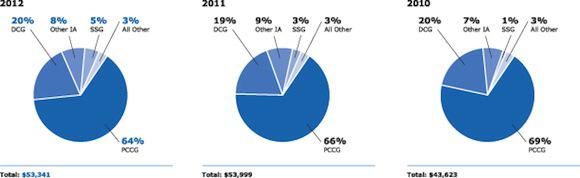
For better or for worse, Intel‘s bread and butter is still the PC market. As much progress as the company has made diversifying into servers and, to a much lesser extent, mobile chips, the top line still lives and dies by the PC right now. PCs used to be 69% of the business. That figure has come down to “just” 64% of the business in 2012, but that’s still a lot of leaning on a form factor seeing no growth these days.

Intel revenue breakdown by segment

Source: Intel 10-K. PCCG = PC Client Group. DCG = Data Center Group. SSG = Software and services. Other IA = Other Intel architecture.

With that computing market still stagnating, so do Intel’s prospects. Recent data from market researchers suggest that as bad as the PC market is faring, things are getting worse before they get better.

Sorry, PC
IDC was expecting global PC shipments to drop by 7.7% in the first quarter. The switch to Microsoft Windows 8 has not been an easy one for PC players, and that will inevitably weigh on Chipzilla. That predicted decline is actually one of the better possible outcomes in the first quarter, as shipments could even reach double-digit negative territory if current trends hold up. The Chinese PC market in particular has been soft, and as the biggest PC market in the world, that weakness has a big impact on the big picture.

The only bright spot within the PC market is Apple , which is seeing Mac shipments roar back as it overcomes supply constraints related to the newly redesigned iMacs. NPD data showed domestic Mac shipments jumping 14% for the first two months of the year. Apple is still a relatively small player in the global PC market (roughly 5% market share), so strength there won’t fully compensate for weakness from everywhere else.

Word on the Street
The data has now caused two Street analysts to recently trim estimates on Intel in the first quarter.

Piper Jaffray analyst Gus Richard, who rates Intel as “neutral” alongside a $21 price target, is dropping his first-quarter revenue estimate to $12.4 billion, down from $12.8 billion. That’s well below Intel’s own guidance, which calls for $12.7 billion in sales, with $500 million of wiggle room. Servers are expected to be strong, but slow PC sales will outweigh any server upside.

One small silver lining is that as the product mix shifts towards servers, gross margins will benefit. The data center group generating an operating margin of 47% last year, easily topping the PC segment’s 38%. Richard thinks that it’s a little “too early” to predict a PC rebound later this year, since he believes Ultrabook prices are still too high relative to their functionality.

Citigroup analyst Glen Yeung feels similarly about Intel. The analyst also has Intel at “neutral,” but recently reduced his price target from $25 to $23. Yeung points to poor sell-through in …read more
Source: FULL ARTICLE at DailyFinance