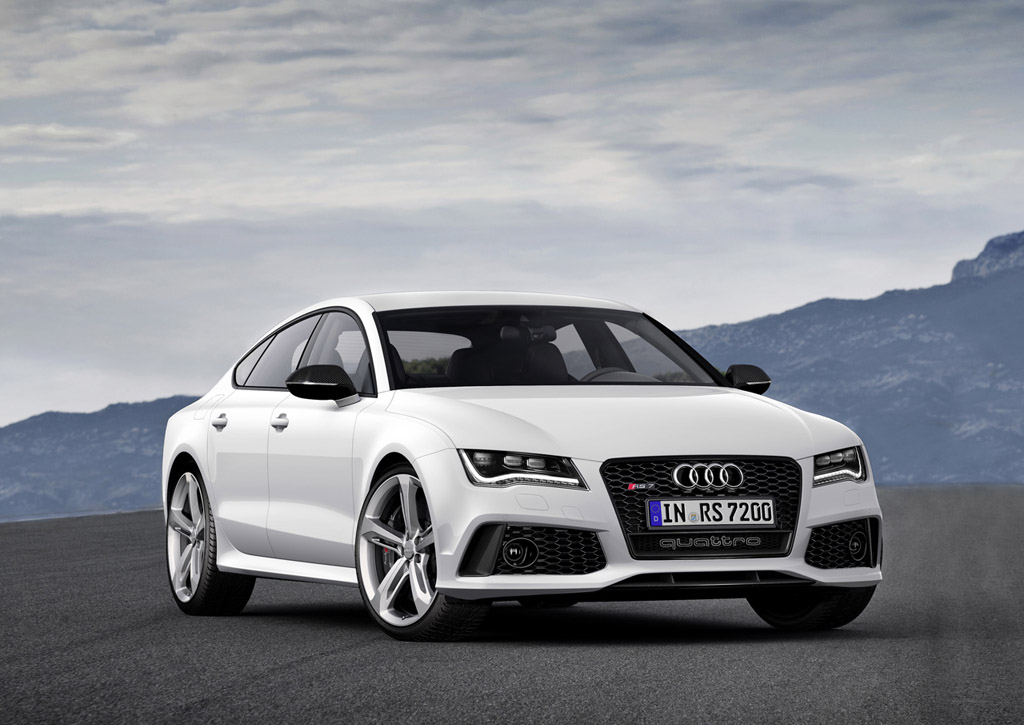
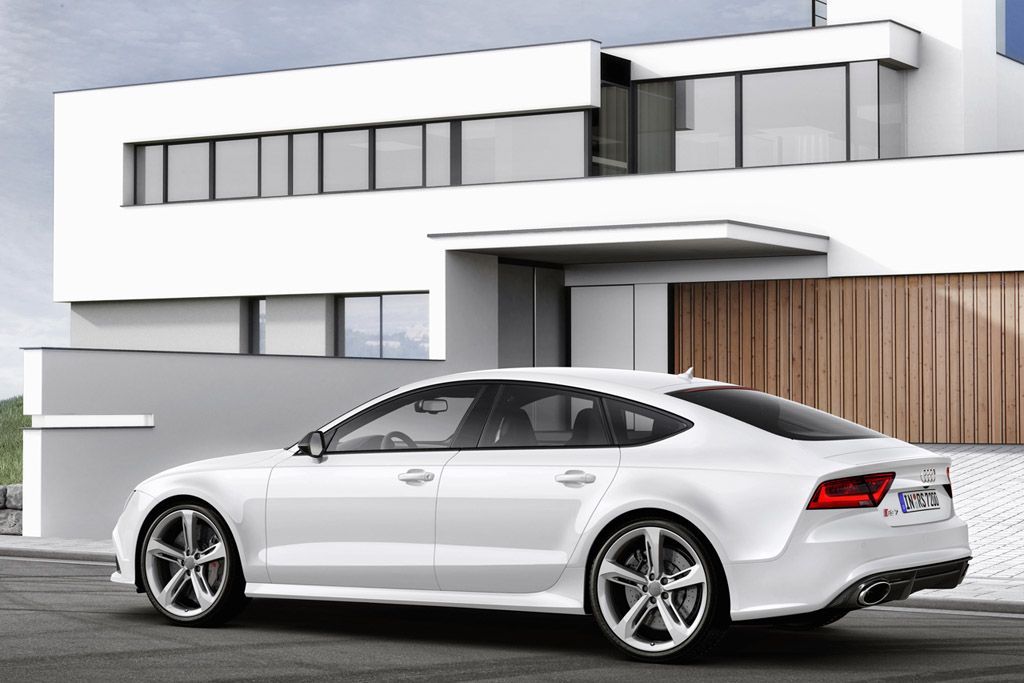
Although there are many introductions and reveals of new vehicles during this year’s International Auto Auto Show in Detroit, not many of the vehicles on display come packing a coupe-look with 4 doors, a rear hatch and a potent 560 force-fed V8 engine under the hood – In the all-new 2014 Audi RS7.
The new Audi RS7 is not only poised in shear performance but it is also relatively efficient getting up to 25 mpg by means of a cylinder-on-demand system where the V8 engine deactivates up to 4 cylinders by closing corresponding valves.
We welcome you to hit up the images and full press release below to get more information on the new 2014 Audi RS7 due to launch later this year on US shores.
Dynamics at their most beautiful – the Audi RS 7
Audi is expanding its RS model lineup: The RS 7 Sportback, which is making its debut at the North American International Auto Show 2013 in Detroit, stands for dynamics at their most beautiful. The large five-door coupe uses a 4.0 TFSI engine producing 412 kW (560 hp). The sprint from zero to 100 km/h (62.14 mph) takes just 3.9 seconds, and the speed governor can be deactivated upon customer request to permit a top speed of up to 305 km/h (189.52 mph). Despite this superior performance, the Audi RS 7 Sportback consumes on average just 9.8 liters of fuel per 100 km (24.00 US mpg).
Aesthetic design, innovative technology and impressive sportiness: The RS 7 Sportback, the large five-door coupe from Audi, combines many strengths to produce a fascinating character. Its strong heart is the 4.0 TFSI, which takes Audi’s downsizing strategy to the high-end category. The twin-turbo V8 displaces 3,993 cc and develops awesome power, with 412 kW (560 hp) available between 5,700 and 6,700 rpm. A constant 750 Nm (553.17 lb-ft) of torque are available between 1,750 and 5,500 rpm.
Because the high-revving four-cylinder engine has been rigorously designed for low load-change and flow losses, it develops this power quickly and spontaneously. The cylinder heads have the exhaust side on the inside and the intake side on the outside. The two twin-scroll turbochargers, which produce up to 1.2 bars of relative boost pressure, are located together with the intercooler in the inside V of the cylinder banks. Consequently, the gas paths are very short and response very good. The RS-specific engine management and unthrottled intake system also contribute to the dynamic character of the twin-turbo V8. Switchable flaps in the exhaust system make the engine sound even fuller at the push of a button or under strong acceleration. Audi also offers an optional sport exhaust system.
The RS 7 Sportback sprints from 0 to 100 km/h (62.14 mph) in just 3.9 seconds. Audi limits the top speed in the standard configuration to 250 km/h (155.34 mph). Top speed with the optional dynamic package is 280 km/h (173.98 mph) and
305 km/h (189.52 mph) with the dynamic package plus.
Yet the new top model of the model series consumes on average just 9.8 liters of fuel per 100 km (24.00 US mpg). This top value is due in part to the standard start-stop system and innovative thermal management.
The most innovative efficiency technology in the new Audi RS 7 Sportback is the cylinder on demand (COD) system. At low to medium loads and engine speeds, it deactivates cylinders 2, 3, 5 and 8 by closing their valves via electromechanical actuators. The 4.0 TFSI then runs as a four-cylinder engine until the driver accelerates more strongly again. The operating points in the active cylinders are displaced toward higher loads, increasing efficiency.
All of these operations take just a few hundredths of a second and occur so smoothly and quickly that they can hardly be felt or heard. Active engine bearings, another high-end solution from Audi, use out-of-phase counter-oscillations to compensate for the slight vibrations that occur during four-cylinder operation. The COD technology reduces NEDC fuel consumption by roughly five percent, and even greater savings of approximately 10 percent are possible when driving at moderate speeds.
The standard eight-speed tiptronic is specially tuned to the sporty character of the Audi RS 7 Sportback. Drivers can choose between the modes D and S or change gears themselves using the shift paddles on the steering wheel or the selector lever, which sports a unique RS design. While the lower gears of the tiptronic are closely spaced for sporty response, eighth gear is tall like an overdrive to reduce fuel consumption.
The Audi RS 7 Sportback comes standard with quattro permanent all-wheel drive for its decisive advantage in traction and driving safety compared with its two-wheel-drive competitors. At the heart of the quattro system is a center differential with a high locking rate and a separate oil cooler to regulate its temperature. It distributes the power as needed within a wide range between the front and rear axles. In the standard configuration, 60 percent flows to the rear and 40 percent to the front.
An intelligent software solution called torque vectoring supports the work of the differential at the cornering limit with minimal braking of the wheels that are under a reduced load. Audi also offers the optional sport differential for the rear axle, which uses two superposition gears to actively distribute the power between the wheels.
The Audi RS 7 Sportback comes standard with polished, 20-inch forged lightweight wheels in a seven twin-spoke design. The five-door high-performance coupe also rolls on optional 21-inch cast wheels in a choice of three designs.
Powerful brakes are located behind the large wheels. The four internally vented discs feature a weight-saving wave design and measure 390 millimeters (15.35 in) in diameter up front. Pins decouple the steel friction rings from the aluminum brake caps. Black painted six-piston calipers – optionally available in red – grip the discs. Audi also offers optional 420 millimeter (16.54 in) carbon fiber ceramic discs with anthracite gray calipers. The electronic stabilization control (ESC) has a Sport mode and can also be deactivated entirely.
Equipped with the air suspension, which harmonizes perfectly with the dynamic character of a sport coupe, the new RS 7 Sportback is sporty, yet still comfortable. The RS 7 adaptive air suspension lowers the body by 20 millimeters (0.79 in). Adaptive damping, another of the system’s features, adjusts the suspension’s response to the condition of the road, the driver’s style and the mode selected in the Audi drive select system, with which the driver can alter the function of key components in multiple steps.
Audi offers the taut sport suspension plus with dynamic ride control (DRC) as an alternative to the air suspension. It uses steel springs and three-stage adjustable dampers that are connected to one another via diagonal oil lines and a central valve. Another option, which can also be integrated into Audi drive select, is the dynamic steering with its steplessly variable steering boost and ratio. As with the standard electromechanical steering, its characteristics are specially tailored for the RS 7 Sportback.
The body of the Audi RS 7 Sportback includes up to 20 percent aluminum and includes many parts of high-strength and ultra high-strength steels. Its high rigidity is the foundation for the precise handling, excellent workmanship and quiet cabin free of intrusive noise.
The character of the Audi RS 7 Sportback is immediately obvious. A series of specific design details give a sporty edge to its flowing coupe design. These include the distinctive bumpers and high-gloss black protective grille with honeycomb structure at the front of the car as well as add-on parts in matt aluminum. At the rear of the car, which features a power extending spoiler, the diffuser and the two large, elliptical tailpipe trims of the exhaust system catch the eye.
The RS 7 Sportback is available in a choice of ten exterior colors, including the new shade Nardo gray and the exclusive finish Daytona gray, matt effect. Two styling packages – matt aluminum and carbon – further customize the appearance. With these, the front center air inlet also sports a quattro badge. With the carbon styling package, the front splitter and the diffuser are somewhat more boldly shaped. Other options include the exterior mirrors with exposed carbon housings and the all-LED headlights, whose designer trims are tinted for a unique look.
The elegant dynamics carry over to the cockpit of the Audi RS 7 Sportback. The dial instruments have black faces, white scales and red needles. A 3D RS 7 logo in the tachometer is a further accent. The key, the flat-bottomed, three-spoke leather steering wheel, the illuminated door entry sills and the displays for the MMI and driver information system also sport RS badges. The driver information system includes a shift light, which indicates when the rev limit is reached. Displays for boost pressure and oil temperature plus a lap timer round out the RS 7-specific menu.
Colors and materials provide for further differentiation. The footrest, pedals and soft keys in the standard MMI navigation plus terminal shine in an aluminum-look finish. The decorative trim below the retractable monitor sports a piano finish.
6/21 www.audi-mediaservices.com
Carbon inlays are standard, with four additional materials available as options. The headlining comes standard in black cloth, with options for lunar silver or black Alcantara. Of course, the Audi RS 7 Sportback can also be personalized using the Audi exclusive program.
RS sport seats with pronounced side bolsters, integrated head restraints and RS 7 logos are standard. They are covered in a combination of black Alcantara and leather, and the center sections feature diamond quilting. The seats can also be covered alternatively in high-grade, honeycomb-quilted Valcona leather in either black or lunar silver. Audi offers optional power-adjustable comfort seats with memory function. The two rear seats are powerfully contoured. Luggage capacity ranges from 535 to 1,390 liters (18.89 to 49.09 cu ft) depending on the position of the rear seat backs.
The Audi RS 7 Sportback comes with a generous list of standard equipment, including xenon plus headlights, a tire pressure monitoring system, the parking system plus, three-zone automatic air conditioning, cruise control and the Audi sound system in addition to features mentioned previously. High-end options include a head-up display, a comfort package, the dynamic package and the dynamic package plus.
The Bluetooth online car phone is an ideal complement to the standard MMI navigation plus. Its UMTS module delivers the tailored Audi connect services to the on-board monitor, and a WLAN hotspot connects the passengers’ mobile devices. Topping the range of audio modules is the Advanced Sound System from Bang & Olufsen.
The Audi RS 7 Sportback also leads the pack when it comes to driver assistance systems. One of these is the adaptive cruise control with stop & go function including Audi pre sense front. This keeps the powerful coupe at the proper distance from the car ahead and in many situations can help to avoid accidents or mitigate their consequences.
Audi active lane assist helps the driver to keep the RS 7 Sportback on course. The park assist handles the steering when parking. The night vision assistant with highlighting of detected persons reduces the stress of driving in the dark. Audi side assist and the speed limit display round out the list.