Tag Archives: Dow Chemical

Dow Chemical: We Don't Need No LNG

By David Smith, The Motley Fool

Filed under:

Chemical giant Dow Chemical has joined its peers, DuPont and Monsanto in making agricultural hay. With its chemicals businesses attempting to fight through economic quicksand in much of the world, especially Europe, Dow was able to turn out a robust quarter in part because of steadiness in its agricultural sciences segment.

Of course, Dow remains far more tied to its traditional roots than are the other two companies. While Monsanto, which once operated under the slogan “Better Living Through Chemistry,” now obtains virtually all its revenues from the production of seeds, pesticides, and related products. DuPont, by comparison, is approaching the point where half its revenues are agriculture-based. At Dow, farm-related products still make up only about 15% of the top line, but the unit is expanding steadily.

As CEO Andrew Liveris told Reuters following his company’s earnings release: “Two-thirds of the increase in revenues and profits came from agricultural science products. That will continue to set records for us this year, and the next several years.”

Of the company’s six segments, only two were in positive growth territory on the revenue line. Agricultural sciences’ revenues climbed by 14%, and electronic and functional materials saw its revenues increase by 2%.

A better beat through chemistry
At the corporate level, excluding items, earnings per share were $0.69, 13% above both last year’s figure and the pre-release consensus expectation, both of which were at $0.61. Revenues for the quarter were down 2.3% year over year to $14.38 billion.

As an inveterate “management freak,” I’ve been an admirer of Liveris and his team at least since 2009, when they were able to pull off a $16.3 billion acquisition of rival chemical maker Rohm & Haas, despite having their financing fall apart at the eleventh hour. A Kuwaiti state-owned company had left Dow standing at the proverbial altar by abruptly pulling out of a planned joint venture. The partnership was to have put more than $9.5 billion in Dow’s kitty.

Liveris et al. were able to raise the necessary funds by quickly issuing $7 billion in preferred stock and taking down a $9.23 short-term loan. They subsequently paid down most of the debt by selling various assets, beginning with Rohm & Haas’ Morton salt unit, which they unloaded in about two shakes.

“For sale” signs abound
Now, amid the world’s economic jitters, the company is continuing to selectively pare its properties. As Liveris said on his conference call:

[S]ince 2009, we have divested non-core businesses representing about $8 billion in revenue. At our investment forum in December, we announced the near-term divestiture goal of $1 billion. And in March, we accelerated this target moving to $1.5 billion of proceeds within 18 months. This demonstrates our bias to achieve more sooner.

In just the first quarter of this year, management sold the stabilizers portion of its plastic additives business and stated an agreement

Source: FULL ARTICLE at DailyFinance

The U.S. Natural Gas Supply Just Got 26% Larger

By Matt DiLallo, The Motley Fool

Filed under:

When an oil and natural gas exploration company books its energy reserves, it’s really using its best guess based on the currently available data. As with most guesses based on limited data, they tend not to be as accurate as we’d like. Sometimes that’s a good thing, as in the case of our nation’s future natural gas supply.

A recent study by the Potential Gas Committee shows that the U.S. now has 26% more recoverable gas than the group estimated we had at the end of 2010. The total now comes to 2,383.9 trillion cubic feet, or Tcf. That’s really good news both for producers and for current and future end users.

Thanks to the Marcellus Shale, the Atlantic portion of the country has the highest ceiling, at an estimated 741.3 Tcf of recoverable natural gas. That means decades of production coming from the likes of Range Resources and Chesapeake Energy , which have large acreage positions in the Marcellus and in the region as a whole. 

Chesapeake is already the nation’s second largest natural gas producer. The company pumps out 4% of our total production, and if gas prices rise, it has the potential to produce even more gas in the future. The company is the largest leaseholder in both the Utica, at 1 million net acres, and the Marcellus, at 1.8 million net acres. If gas prices are high enough, Chesapeake has plenty of room to expand its drilling budget and increase its production.

Range Resources, which was the top producer in the Marcellus last year, also has a large acreage position in the play. The company has 700,000 net acres in the Marcellus as well as another 231,000 net acres in its Southern Appalachia division. Overall, the company believes it controls 54 Tcfe of resource potential in its acreage just in the Atlantic potion of the country. As one of the lowest-cost producers of natural gas in the country, Range can profit even in a low-price environment.

Knowing that we have a larger supply of natural gas is great; however, it won’t do a whole lot for profits if prices don’t head higher. The good news here is that more demand is on the way. Overall, there should be enough room so that everyone can profit as more natural gas comes out of the ground.

One area to watch is liquefied natural gas exports. Currently, Cheniere Energy is first in line to begin exporting natural gas. Its Sabine Pass terminal is scheduled to come online in 2015. There’s a boatload of projects in various stages of the approval process that would like to join Cheniere.

The problem here is that chemical companies such as Dow Chemical have vowed to vigorously fight an increase in natural gas exports. With more than $4 billion in projects coming online over the next few years that use natural gas as a feedstock, you can understand why the company wants the

From: http://www.dailyfinance.com/2013/04/14/the-us-natural-gas-supply-just-got-26-larger/

Why Global Oil Demand Could Soon Peak

By Arjun Sreekumar, The Motley Fool

Filed under:

Citigroup stoked a major debate when it argued earlier this year that America would become energy independent by 2020. Now the bank is out with another bold new call. In a research paper titled “Global Oil Demand Growth — The End Is Nigh,” Citigroup argues that global oil demand is “approaching a tipping point.”

The bank suggests there are two factors underpinning this expected trend. Let’s take a closer look at both of them, as well as the shocking conclusion Citi draws about the future of oil prices.

Shift toward natural gas
The first factor is a transition away from oil and toward natural gas as a fuel source. The shale gas revolution has already provided American consumers and companies with cheap and abundant supplies of the clean-burning fuel. It has even ushered in a so-called “renaissance” for domestic manufacturers, including chemical manufacturer Dow Chemical and steelmaker Nucor, which have moved or are planning to move plants that were previously relocated abroad back to the United States.

In addition, several U.S. truck manufacturers are capitalizing on cheap natural gas by equipping new vehicles to run on nat gas instead of diesel. For instance, Navistar reckons that over the next two years, a third of all its new trucks will be powered by natural gas instead of diesel.

Natural gas engine manufacturers such as Cummins and Westport Innovations will play a major role in driving this shift. In February, the two companies said their joint venture, Cummins Westport, is providing engines for two of the biggest natural gas transit fleet orders ever filled in North America.  

Both see massive potential in the North American long-haul trucking market, especially as companies such as Clean Energy Fuels develop the natural gas refueling infrastructure necessary to support the transition toward gas-powered vehicles. Having already built dozens of new LNG truck fueling stations, Clean Energy plans on completing an additional 70 to 80 LNG fueling stations adjacent to long-haul trucking routes and key warehouse distribution centers across North America.

If the price of natural gas remains cheap compared with diesel, projects such as these should continue to flourish.

Improving fuel economy
The second major factor that points to a peak in global oil demand, according to Citigroup, is improving fuel efficiency among new vehicles. According to Citi’s estimates, fuel efficiency among new cars and trucks is improving at an annual rate of 3%-4% and 1%-2%, respectively. Combining the two, the bank suggests new vehicles’ fuel economy is improving by around 2.5% every year — an estimate it deems conservative.  

Since the U.S. passed the Energy Independence and Security Act of 2007, which enforced higher Corporate Average Fuel Economy standards, vehicle fuel efficiency has improved drastically. The trend also appears to be catching on in other parts of the world, with the European Union, Japan, and Canada having passed similar mandates.

Though Citi …read more

Source: FULL ARTICLE at DailyFinance

One Step Closer to Exporting Natural Gas

By Dan Dzombak, The Motley Fool

Filed under:

Dow Chemical and other chemicals companies have been leading the fight against exporting liquefied natural gas, or LNG, as they want to take advantage of constrained natural gas prices.

They are especially worried of the U.S. exporting to Asia where LNG prices are tied to the price of oil. This week, though, Japan announced that the country is planning futures contracts for LNG in an effort to unlink the price of LNG from oil. This should alleviate one of the big fears of opponents of exporting natural gas from the U.S.

In the below video Motley Fool contributor Dan Dzombak explains why and how this situation brings the U.S. closer to exporting natural gas.

Only time will tell what will happen with exports in the U.S. natural gas market. No matter what happens, it’s easy to forget the necessity of midstream operators that seamlessly transport oil and gas throughout the United States. Kinder Morgan is one of these operators, and one that investors should commit to memory due to its sheer size – it’s the third-largest energy company in the U.S. – not to mention its enormous potential for profits. In The Motley Fool‘s premium research report on Kinder Morgan, we break down the company’s growing opportunity – as well as the risks to watch out for – in order to uncover whether it’s a buy or a sell. To determine whether this dividend giant is right for your portfolio, simply click here now to claim your copy of this invaluable investor’s resource.

var FoolAnalyticsData = FoolAnalyticsData || []; FoolAnalyticsData.push({ eventType: “TickerReportPitch”, contentByline: “Dan Dzombak“, contentId: “cms.29988”, contentTickers: “NYSE:XOM, NYSE:CHK, NYSE:DOW, NYSE:SD, NYSEMKT:LNG“, …read more

Source: FULL ARTICLE at DailyFinance

Debate Over U.S. LNG Exports Heats Up

By Arjun Sreekumar, The Motley Fool

Filed under:

The debate over whether or not the U.S. should export its glut of natural gas – in a liquefied form known as LNG – is heating up.

The main beneficiaries would be the companies exporting LNG abroad, as well as U.S. natural gas producers. So far, only Cheniere Energy‘s Sabine Pass terminal has been green-lighted to ship LNG to countries that don’t have a free trade agreement with the U.S. But many more companies are restlessly vying for permits.

The main losers would include various manufacturing firms, especially those whose operations are highly energy intensive. Over the past couple of years, America’s shale gas boom has spurred a domestic “manufacturing renaissance,” as U.S. companies including chemical manufacturers and steelmakers have reaped the rewards of cheap and plentiful natural gas.

The argument against LNG exports
According to America’s Energy Advantage, an industry group supported by major industrial firms such as Dow Chemical , Huntsman , and Alcoa, allowing large-scale LNG exports from the U.S. would almost inevitably drive up the price of domestic natural gas and threaten to erode the competitive advantage U.S. manufactures have recently developed on the back of cheap natural gas.  

Higher gas prices, the group argues, could lead to a substantial loss of jobs, as well as reduced investment, in the U.S. manufacturing sector.  

Huntsman chemicals’ CEO Peter Huntsman suggests that if all the proposed export projects were green-lighted, it would cause the price of domestic natural gas to “skyrocket.” And Dow’s George Blitz argues that fears of a future spike in U.S. gas prices could seriously threaten the roughly $100 billion of new investment the company calculates has been planned to capitalize on cheap and plentiful domestic natural gas.  

America’s Energy Advantage is instead advocating a “balanced” approach, suggesting that only a few more companies should be approved to export U.S. natural gas to countries that don’t have free trade agreements with the U.S.  

The argument in favor of LNG exports
On the other hand, the Center for LNG – an industry group advocating unfettered LNG exports – and foreign countries eager to secure new supplies of relatively cheap U.S. natural gas are up in arms about the idea of restricting LNG exports from the U.S.

The Center for LNG argues that limiting gas exports would amount to unwarranted interference in energy markets, while some foreign countries are desperate for any chance to improve their energy situations.  

Japan, in particular, continues to be plagued by high fuel import costs, which have worsened markedly following the yen’s recent decline. The Japanese currently pay nearly $17 per MMBtu for imported natural gas, a little over four times the price of gas in the U.S.

Yes or no to LNG exports?
To date, 21 applications requesting LNG export licenses have been filed with the Department of Energy (DOE). If all of them were approved, it would amount to exports totaling 28.3 billion cubic feet of gas per day …read more
Source: FULL ARTICLE at DailyFinance

ExxonMobil Wins Either Way With Natural Gas Exports

By Tyler Crowe, The Motley Fool

Filed under:

The funny thing about the natural gas export debate is that both sides are claiming the exact same thing — that they will help create more American jobs and bring down the trade deficit through more exports. So how can we tell which side offers the better argument? Dow Chemical and ExxonMobil , have been two of the most vocal advocates on opposite sides of the debate, and have recently taken a couple of shots across each others’ bows.

What makes this story even more interesting, though, is that ExxonMobil is poised to do well no matter what side wins this debate. Let’s take a look at why these two sides of the argument are claiming the same benefits for the U.S. and how ExxonMobil could come out on top no matter what.

The debate
Thanks to the recent surge in natural gas production, many have debated the merit of exporting liquified natural gas, or LNG. Certainly a market opportunity exists, but is this market opportunity in the best interests of the nation? On the side for exporting LNG is ExxonMobil, which claims that it would spur an even further increase in natural gas production, and in turn create more jobs and lower the country’s trade deficit. Exxon isn’t the only one on this side of the debate, either. Over 17 different sites in the U.S. have been identified as potential locations for LNG export, and 10 of them have gone to the Federal Energy Regualtory Commission for an export license.

As of right now, Cheniere Energy has the only approved license to export to countries that are not members of a free trade agreement. The license allows them to export at a rate of about 2 billion cubic feet per day, or about 3% of the total current U.S. production. While it is difficult to determine how much production would increase if more of these proposed facilities were to come online, certainly we can assume that the percentage of production going to exports would increase significantly.

On the other side of the coin, we have a large base of manufacturers in the U.S. that claim by not exporting natural gas, we would be able to use this advantaged feedstock to power the manufacturing industry in the U.S. This would in turn create American jobs and decrease our trade deficit by exporting finished goods.

Dow Chemical is one of the first companies that comes to mind on this side of the debate because chemical manufacturing has seen some of the most immediate effect from cheap natural gas as a chemical feedstock. Other sectors that also see major advantages from not exporting natural gas are energy intensive endeavors like power generation and aluminum and steel manufacturing.

Atlantic Power generates almost 66% of its power exclusively from natural gas, and the cheaper cost of generating power could potentially inspire power hungry industries to consider the U.S. Also, steelmaker Nucor has plans to resurrect one of its steel mills in Louisiana …read more
Source: FULL ARTICLE at DailyFinance
The Resurgent Dollar Could Hurt S&P 500 Earnings

By The Associated Press

Hundred dollar bills

Filed under: , , , ,

(Alamy)

By STEVE ROTHWELL

NEW YORK — The dollar is rising again.

After a drop last autumn, the U.S. dollar has climbed 5 percent against other currencies over the past two months, reaching the highest level since August.

The main reason is the recovery in the U.S. economy. Although growth is still weak, the outlook for the U.S. is better than elsewhere in the developed world. Europe is stuck in a recession and struggling to control its debt. Japan is trying to push down the value of the yen to boost exports and end deflation.

A strong dollar helps Americans by making imports cheaper and curbing inflation, but it can also hurt U.S. companies. Technology companies have become increasingly reliant on overseas sales, and a stronger dollar reduces the value of their overseas earnings.

The impact of the dollar’s appreciation is starting to show up in earnings reports. The insurer Aflac, which does much of its business in Japan, says its earnings were hurt as the yen fell against the U.S. currency. Procter & Gamble, which makes Gillette razors and Crest toothpaste, said the stronger dollar was holding back its sales growth.

Many analysts predict that the dollar will continue to rise. Here’s a look at what a stronger dollar means for investors.

Tough for Tech and Materials Makers

A rising dollar could spell trouble for U.S. companies that make software and gadgets, as well as companies that make basic materials like aluminum.

The tech industry relies heavily on foreign sales for growth. About 56 percent of its revenue comes from outside the U.S., according to research by RBC Capital Markets. As the dollar strengthens, U.S. goods become more expensive overseas, discouraging buyers.

Investors worry that could slow business — and profits. As a result, technology companies are tied with materials makers as the worst industry in the S&P 500 this year, rising just 4.2 percent, compared with 10 percent for the overall market. Business software giant Oracle said its most recent earnings report on March 20 that the rising dollar lowered its earnings by about two percent.

The materials industry, which includes Dow Chemical and miner Cliffs Natural Resources, also gets more than half of its sales overseas.

“We would be wary of sectors that derive a lot of their sales overseas, given that fact that we expect the dollar’s strength to remain,” says Kristen Scarpa, an investment strategist at Barclays Wealth and Investment Management.

Commodity Concerns

When the dollar appreciates, it makes commodities like oil and metals — which are priced only in dollars — more expensive for customers who buy them with other currencies like the euro and the yen.

That can weaken demand for commodities, hurting the profits of the companies that produce them, like oil producers Exxon Mobil, …read more
Source: FULL ARTICLE at DailyFinance

3 Companies That Could Be Hurt by Rising Natural Gas Prices

By Matthew DiLallo, The Motley Fool

Filed under:

Winter just doesn’t seem to want to give way to spring this year. Where I live, we’ve been hit with more snow and a continuation of this cold winter. Frustrations with the late spring are beginning to boil over and cabin fever has gotten so bad that our beloved Punxsutawney Phil has been indicted after a botched forecast of an early spring.

Not only has the late spring caused a lot of ire among those ready for winter’s end, it’s also causing natural gas prices to head higher. While that’s a welcome sight for producers, heavy users of natural gas are not as thrilled. While these companies have enjoyed the profits made while using cheap natural gas, if prices keep going higher the situation will reverse. Here are three companies that could feel an impact if natural gas prices keep going higher.

CF Industries
The fertilizer maker is a heavy user of natural gas as a feedstock in fertilizer production. It has benefited handsomely from cheap natural gas, which drove record sales and earnings last year. It’s also betting big that natural gas prices will stay low by investing $3.8 billion to expand its operations.

The company is anticipating a very positive operating environment for the year ahead, highlighted by favorable natural gas costs. However, as of its last earnings report it had only hedged its natural gas needs through April of this year. A steady rise in price could affect its bottom line, and the same can be said for its publicly traded subsidiary Terra Nitrogen . The volatility of natural gas prices is a big risk to its results and has a real effect on the bottom line: The company’s net earnings last year jumped to $560.8 million from $508 million in 2011, with a 23% realized decrease in natural gas prices. 

Dow Chemical
Dow also has big plans for cheap natural gas. The company has committed more than $4 billion to expand nat-gas use as a feedstock for the production of chemicals and plastics. Among its planned expenditures is a world-scale ethane cracker plant that comes with a $1.7 billion price tag.

For Dow, it sees the potential for these projects to deliver $2.5 billion in annual EBITDA when everything is up and running in 2017. The key to hitting that target is continued low natural gas prices. While Dow has been vocal in its disapproval of increased liquefied natural gas exports, which would raise gas prices, there’s not much it can do to stop Mother Nature from driving prices higher. 

Nucor
Steelmaker Nucor will see a big increase in its use of natural gas when it completes construction of its direct reduced iron, or DRI, facility. The company also uses a lot of gas throughout its U.S. steel manufacturing operations. Low natural gas prices are critical to its success; if they continue to stay low, the company could add to …read more
Source: FULL ARTICLE at DailyFinance

Don't Export More LNG Exports Anytime Soon

By Dan Dzombak, The Motley Fool

Filed under:

On Tuesday, the Department of Energy’s (DOE) assistant secretary for fossil energy, Christopher Smith, testified before a congressional committee on liquefied natural gas, or LNG, exports. While he acknowledged the opportunities natural gas provides, he said that the DOE would not rush to any decisions on exporting natural gas.

Natural gas boom
Natural gas is a massive opportunity for the United States. However the opportunity is being curtailed as low prices have caused companies to stop drilling for natural gas and switch their focus to oil. SandRidge Energy was one of the first natural gas drillers to switch its focus from natural gas to oil back in 2008. The rest of the industry has been following the shift with even natural gas leader Chesapeake Energy now concentrating on drilling for oil. The natural gas production boom has only lasted because drilling for oil yields some associated natural gas which has kept the level of natural gas production in the U.S. stable.

While natural gas prices are low in the U.S., they are two to four times higher around the world. Natural gas companies would like to take advantage of the price disparity, but currently the U.S. does not have the capacity to export LNG. Chenierre Energy got permission from the DOE in 2011 to export LNG to countries that are not members of the free trade agreement; however, after approving the proposal the DOE decided to hold off on approving any more until studies could be completed on the macroeconomic effects of LNG exports and to make sure that LNG exports did not “subsequently lead to a reduction in the supply of natural gas needed to meet essential domestic needs.”

Natural gas companies would like to export as soon as possible as they are losing money on natural gas. Opposing natural gas exports are Dow Chemical and other manufacturers that use significant amounts of natural gas, for exports will raise the price they must pay for natural gas.

Yesterday, the DOE‘s Smith testified that the department is committed to the publicly transparent process it has set out for export application reviews. In his statement, Smith emphasized that “DOE is committed to moving this process forward as expeditiously as possible. DOE understands the significance of this issue — as well as the importance of getting it right.”

In the question and answer session that followed, Smith went on to recognize that the issue is contentious and that the DOE will not hurry the export reviews. According to Politico, Smith said: “We’re moving forward in a way that’s open, transparent and which yields a decision that’s going to withstand the scrutiny it’s going to receive. A decision that doesn’t withstand scrutiny is not going to be useful for the concerns you have and will be the wrong decision for the country.”

The DOE is right to not hurry the export reviews, but hopefully the government sticks with its timelines and …read more
Source: FULL ARTICLE at DailyFinance

3 Shares That Beat the FTSE 100 Today

By Alan Oscroft, The Motley Fool

Filed under:

LONDON — After closing last week just short of the 6,500 level, the FTSE 100 dropped a bit today, falling 32 points to close at 6,458. The controversial planned bailout of Cyprus, involving a one-off tax of up to 10% on bank deposits, has led to a fresh wave of fears and driven stock markets down across Europe.

But which individual companies within the various indexes beat the market? Here are three that outpaced the FTSE 100 today.

Berkeley
Berkeley Group shares picked up 3% to 2,036 pence, taking them about 45% higher over the past 12 months. Today’s jump was prompted by a management statement that said the firm was still on target to return 568 million pounds to shareholders, with an interim dividend of 15 pence per share payable on April 19 covering some 20 million pounds.

Even after the past year’s share price appreciation, forecasts put the shares on a P/E of 14 for the year to April, falling to 12 on 2014 estimates, which does not seem unduly stretching. And the dividend is also on the way back after the firm’s restructuring, with a yield of 1.6% expected this year and 2% next.

Nanoco
Interim results sent shares in Nanoco up 3.7% to 190 pence, adding to a 150% rise over the past year. The nanotechnology company revealed that it had signed a deal with Dow Chemical to manufacture and sell “cadmium-free quantum dots” for the display industry. Nanoco chairman Peter Rowley described the agreement as “transformational.”

At the end of the group’s financial year, on 31 January, Nanoco had cash and equivalents of £12.5 million, down £3 million from six months previously. Profits aren’t expected for at least another couple of years, but the group seems to have enough cash for now.

FastJet
The shares of FastJet climbed 2.3% to 2.7 pence today following news that the airline could acquire low-cost South African rival 1 Time. FastJet filed a letter of intent with 1 Time’s liquidators in Johannesburg, which is hoped will help cement a deal with creditors. FastJet’s chief executive, Ed Winter, described the move as “a very significant step” toward serving South Africa.

The AIM-traded company is not yet profitable, and there are no forecasts currently available, but could this be a nice opportunity for the bold? That’s for you to decide.

When we see stock markets becoming bullish, attention must surely turn to investing in growth possibilities (though a side helping of dividends is always a welcome addition). But finding companies that have not yet achieved their full potential is not always easy, which is why the Motley Fool‘s best analysts have put their heads together to bring you their top growth selection for 2013. You can find out what the selection is completely free of charge, but the report will be available for a limited period only. So click here to enjoy your copy today.

…read more
Source: FULL ARTICLE at DailyFinance

Is Corning Still a Great Investment?

By Rich Duprey, The Motley Fool

GLW Chart

Filed under:

It looks like one of those leaps in technology that puts you right in the middle of Tom Cruise’s “Minority Report” movie: glass so flexible you can roll it up and tuck it in your shirt pocket.

Corning unveiled the next-generation development last June and many believed it would drive innovation in completely new directions. A new Apple iWatch, for example, with a glass face that matched the curvature of your wrist, would be a perfect complement to the technology. Unfortunately, the glassmaker doused the enthusiasm with cold water last month, saying it might be as long as three years before consumer product manufacturers really adopted it as their own. There might still be a wristband in the works, but it’s not likely to feature the new flexible Willow glass.

The 800-pound gorilla
Up until now, investor focus has primarily been on Corning’s Gorilla Glass, the tough-as-nails glass that is featured on some 1.2 billion devices from 33 brands across 900 different products. And it will still be the centerpiece of the glassmaker’s immediate future as its third iteration proves to be the strongest yet. However, as the Fool’s tech guru Eric Bleeker notes, despite the incredible achievements Gorilla Glass has already delivered, because smartphones have such a small footprint, relatively speaking, even large-volume sales tend not to move the needle as much as you’d expect.

Were those billion GG devices all big screen, flat-panel TVs, Corning would likely have banked a heckuva lot more than the $1 billion in segment revenues it did in 2012. As it was, the LCD division saw revenues tumble 7.5%. Fortunately, that was offset by double-digit growth in Gorilla Glass as the specialty materials division’s revenues surged 25% over the year-ago period.

Hemlock society
What many investors might not realize is the collapse in polysilicon pricing that’s wreaking havoc in the solar industry is also taking its toll on Corning. The glassmaker’s Hemlock Semiconductor subsidiary produces polysilicon through a 50% joint venture with Dow Chemical and revenues at Dow Corning fell 5% last year. Worse, gross profits plunged 30% and net income lost three-quarters of its value.

As a result, its biggest moneymaker is failing to gain traction and its supplemental businesses are seeing profits plummet, leading Corning’s shares to essentially flatline over the past year.

Source: GLW data by YCharts.

Despite the challenges, though, Corning’s future still looks crystal clear. Yes, the solar industry is covered by storm clouds and Corning has taken some writedowns related to Hemlock — and may do so again this year — but the rest of the business is shaping up as a strong competitor. Even in the LCD glass division, “less bad” results really mean things are getting better.

Corning predicts LCD glass volume will grow in 2013; telecom sales of fiber optic cable are expected to advance; Gorilla Glass will swing from the trees as smartphones and tablets continue to fly off the shelves; heavy-duty diesel …read more
Source: FULL ARTICLE at DailyFinance

Dow Chemical to Divest Nearly $1.5 Billion of Assets in Next 18 Months

By Eric Volkman, The Motley Fool

Filed under:

Dow Chemical is to unload nearly $1.5 billion worth of assets over the next year and a half. The company said it is “targeting an increased divestiture list” in an ongoing and comprehensive set of portfolio reviews. It has already marked two of its businesses for sale — the polypropylene licensing and catalysts, and plastics additives units.

The announcement comes after the company pledged an “ongoing commitment to aggressive portfolio management,” most recently detailed at an investor forum it held last December. It aims to boost its presence in high-margin businesses that are growing robustly.

Dow Chemical pointed out that, since 2009, it has divested itself of non-core units representing around $8 billion in revenue.

The article Dow Chemical to Divest Nearly $1.5 Billion of Assets in Next 18 Months originally appeared on Fool.com.

Fool contributor Eric Volkman has no position in Dow Chemical. The Motley Fool has no position in Dow Chemical. Try any of our Foolish newsletter services free for 30 days. We Fools may not all hold the same opinions, but we all believe that considering a diverse range of insights makes us better investors. The Motley Fool has a disclosure policy.

Copyright © 1995 – 2013 The Motley Fool, LLC. All rights reserved. The Motley Fool has a disclosure policy.

(function(c,a){window.mixpanel=a;var b,d,h,e;b=c.createElement(“script”);
b.type=”text/javascript”;b.async=!0;b.src=(“https:”===c.location.protocol?”https:”:”http:”)+
‘//cdn.mxpnl.com/libs/mixpanel-2.2.min.js’;d=c.getElementsByTagName(“script”)[0];
d.parentNode.insertBefore(b,d);a._i=[];a.init=function(b,c,f){function d(a,b){
var c=b.split(“.”);2==c.length&&(a=a[c[0]],b=c[1]);a[b]=function(){a.push([b].concat(
Array.prototype.slice.call(arguments,0)))}}var g=a;”undefined”!==typeof f?g=a[f]=[]:
f=”mixpanel”;g.people=g.people||[];h=[‘disable’,’track’,’track_pageview’,’track_links’,
‘track_forms’,’register’,’register_once’,’unregister’,’identify’,’alias’,’name_tag’,
‘set_config’,’people.set’,’people.increment’];for(e=0;e<h.length;e++)d(g,h[e]);
a._i.push([b,c,f])};a.__SV=1.2;})(document,window.mixpanel||[]);
mixpanel.init("9659875b92ba8fa639ba476aedbb73b9");

function addEvent(obj, evType, fn, useCapture){
if (obj.addEventListener){
obj.addEventListener(evType, fn, useCapture);
return true;
} else if (obj.attachEvent){
var r = obj.attachEvent("on"+evType, fn);
return r;
}
}

addEvent(window, "load", function(){new FoolVisualSciences();})
addEvent(window, "load", function(){new PickAd();})

var themeName = 'dailyfinance.com';
var _gaq = _gaq || [];
_gaq.push(['_setAccount', 'UA-24928199-1']);
_gaq.push(['_trackPageview']);

(function () {

var ga = document.createElement('script');
ga.type = 'text/javascript';
ga.async = true;
ga.src = ('https:' == document.location.protocol ? 'https://ssl' : 'http://www') + '.google-analytics.com/ga.js';

var s = document.getElementsByTagName('script')[0];
s.parentNode.insertBefore(ga, s);
})();

Read | Permalink | Email this | Linking Blogs | Comments

…read more
Source: FULL ARTICLE at DailyFinance

Industry Pundits Vocal About Manufacturing Renaissance

By Matt DiLallo, The Motley Fool

Filed under:

The manufacturing industry is starting to become a bit more vocal about the reality of its renaissance here in the U.S. In order to protect these green shoots, and its investment dollars, many in the industry are openly opposing any increase in liquefied natural gas exports. Instead, the industry sees vast potential to turn our natural gas resources into value-added products that it believes would be worth far more on the export market than simply selling our natural gas to the highest bidder.

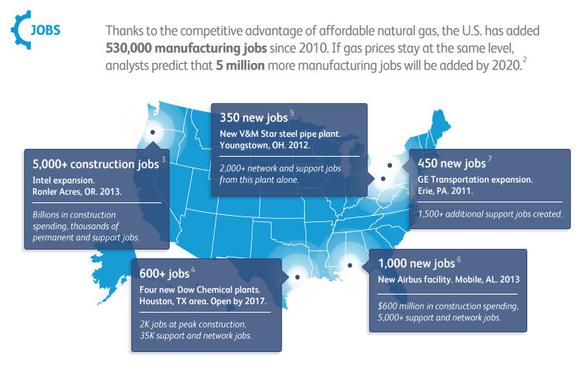
At issue here is the fact that low-cost sources of natural gas form a competitive advantage to heavy users, an advantage that until recently was found outside our borders. Natural gas isn’t just a fuel source for these companies, it’s an important feedstock to a multitude of industries. While the petrochemical industry has been the most vocal, the expanded use of natural gas has the potential to create thousands of manufacturing jobs as companies invest to expand operations. Just last month the manufacturing industry added 29,000 jobs, more than double the rate from the past two months. It sees the potential for more jobs as its renaissance kicks into high gear.      

Source: America’s Energy Advantage 

One of the most vocal opponents of increasing the availability of natural gas exports is Dow Chemical . According to CEO Andrew Liveris: “Rushing to sell natural gas to Europe and Asia risks damage to the U.S. economy.” His company has $4 billion in planned investments on the U.S. Gulf Coast geared toward consuming low-cost natural gas with more likely in the future. Dow’s fears are that as these projects come online between 2015 and 2017 too much natural gas will be making its way out of the country, which will increase the cost of the gas that flows into new plants.   

Natural gas is critically important to Dow as a feedstock to make the basic building blocks for plastics. As you might imagine, plastics have an array of uses, and as the largest consumer of plastics in the world, there are a lot of synergies to be gained by producing more of them within our borders. Not only that, but these value-added products can later be exported at a higher net economic benefit, which is very good for Dow’s bottom line and our economy as a whole. That’s why the company is not alone in its quest to put a limit on how much gas can be exported. 

Huntsman CEO Peter Huntsman has warned that we can’t allow “our nation’s natural gas advantage to be stripped and sent overseas to build a new manufacturing base that would otherwise be built here in the U.S.” Instead he says that “real, sustained and broad-based growth in the U.S. economy will come from a balanced approach that considers the needs of American manufactures and consumers.” In his view “completely unfettered U.S. exports many enrich a few LNG exporters in the short term.” So, while …read more
Source: FULL ARTICLE at DailyFinance

Bemis Company Elects William Jackson as Vice President and Chief Technology Officer

By Business Wirevia The Motley Fool

Filed under:

Bemis Company Elects William Jackson as Vice President and Chief Technology Officer

NEENAH, Wis.–(BUSINESS WIRE)– Bemis Company, Inc. (NYS: BMS) announced today that its Board of Directors has elected William E. Jackson, PhD as Vice President and Chief Technology Officer of Bemis Company, Inc., reporting to Henry Theisen, Bemis’ President and Chief Executive Officer. As Bemis’ Chief Technology Officer, Dr. Jackson will be responsible for leveraging Bemis’ research and development capabilities across our global operations and diversified applications.

“Bill brings extensive global research and product development expertise to our leadership team, and I look forward to his contributions to the future growth of Bemis Company,” said Henry Theisen, President and Chief Executive Officer of Bemis Company.

Dr. Jackson joins Bemis from Dow Chemical where he participated on Dow’s technology leadership team and held the position of Vice President, Global Research & Development – Dow Building and Construction, a $2 Billion global polymer business. Prior to Dow, he spent 16 years with GE, in Plastics, Lighting, and Appliances in leadership R&D, market development, and application engineering roles. In addition, Jackson serves as Chairman of the US Industrial Advisory Board to the Department of Energy US/China Clean Energy Research Center. He received his BS in Geology from the College of Wooster and received his MS and Ph.D. from Stanford University in Geology, with an emphasis in Material Science and Geochemistry.

ABOUT BEMIS COMPANY, INC.

Bemis Company, Inc. is a major supplier of packaging and pressure sensitive materials used by leading food, consumer products, healthcare, and other companies worldwide. Founded in 1858, Bemis Company is included in the S&P 500 index of stocks and reported 2012 net sales of $5.1 billion. Bemis has a strong technical base in polymer chemistry, film extrusion, coating and laminating, printing, and converting. Headquartered in Neenah, Wisconsin, Bemis employs approximately 20,000 individuals worldwide. More information about Bemis is available at our website, www.bemis.com.

Bemis Company, Inc.
Melanie E. R. Miller, 920-527-5045
Vice President, Investor Relations and Treasurer

KEYWORDS:   United States  North America  Indiana  Minnesota  Ohio  Wisconsin

INDUSTRY KEYWORDS:

The article Bemis Company Elects William Jackson as Vice President and Chief Technology Officer originally appeared on Fool.com.

Try any of our Foolish newsletter services …read more
Source: FULL ARTICLE at DailyFinance

Dow Gets Additional Award in Arbitration Case

By Eric Volkman, The Motley Fool

Filed under:

Dow Chemical has received additional monies in an arbitration case against a Kuwaiti firm. The American chemical giant will be granted $318 million. Last May, Dow was given a partial award of $2.16 billion, bringing the total to $2.48 billion.

The dispute, presided over by the International Court of Arbitration of the International Chamber of Commerce, centered on an abandoned joint venture the company was to operate in collaboration with Kuwait’s Petrochemical Industries Co. The new award closes the case, and is final and not subject to appeal. 

Dow quoted its CEO Andrew Liveris as saying that “payment of these damages of nearly $2.5 billion will allow Dow to accelerate its priority uses for cash by further strengthening our balance sheet.”

The article Dow Gets Additional Award in Arbitration Case originally appeared on Fool.com.

Fool contributor Eric Volkman has no position in Dow Chemical, and neither does The Motley Fool. Try any of our Foolish newsletter services free for 30 days. We Fools may not all hold the same opinions, but we all believe that considering a diverse range of insights makes us better investors. The Motley Fool has a disclosure policy.

Copyright © 1995 – 2013 The Motley Fool, LLC. All rights reserved. The Motley Fool has a disclosure policy.

(function(c,a){window.mixpanel=a;var b,d,h,e;b=c.createElement(“script”);
b.type=”text/javascript”;b.async=!0;b.src=(“https:”===c.location.protocol?”https:”:”http:”)+
‘//cdn.mxpnl.com/libs/mixpanel-2.2.min.js’;d=c.getElementsByTagName(“script”)[0];
d.parentNode.insertBefore(b,d);a._i=[];a.init=function(b,c,f){function d(a,b){
var c=b.split(“.”);2==c.length&&(a=a[c[0]],b=c[1]);a[b]=function(){a.push([b].concat(
Array.prototype.slice.call(arguments,0)))}}var g=a;”undefined”!==typeof f?g=a[f]=[]:
f=”mixpanel”;g.people=g.people||[];h=[‘disable’,’track’,’track_pageview’,’track_links’,
‘track_forms’,’register’,’register_once’,’unregister’,’identify’,’alias’,’name_tag’,
‘set_config’,’people.set’,’people.increment’];for(e=0;e<h.length;e++)d(g,h[e]);
a._i.push([b,c,f])};a.__SV=1.2;})(document,window.mixpanel||[]);
mixpanel.init("9659875b92ba8fa639ba476aedbb73b9");

function addEvent(obj, evType, fn, useCapture){
if (obj.addEventListener){
obj.addEventListener(evType, fn, useCapture);
return true;
} else if (obj.attachEvent){
var r = obj.attachEvent("on"+evType, fn);
return r;
}
}

addEvent(window, "load", function(){new FoolVisualSciences();})
addEvent(window, "load", function(){new PickAd();})

var themeName = 'dailyfinance.com';
var _gaq = _gaq || [];
_gaq.push(['_setAccount', 'UA-24928199-1']);
_gaq.push(['_trackPageview']);

(function () {

var ga = document.createElement('script');
ga.type = 'text/javascript';
ga.async = true;
ga.src = ('https:' == document.location.protocol ? 'https://ssl' : 'http://www') + '.google-analytics.com/ga.js';

var s = document.getElementsByTagName('script')[0];
s.parentNode.insertBefore(ga, s);
})();

Read | Permalink | Email this | Linking Blogs | Comments

…read more
Source: FULL ARTICLE at DailyFinance

Jury orders Dow Chemical to pay $400 million in price-fixing case

(Reuters) – Dow Chemical Co on Wednesday was ordered by a federal jury to pay $400 million in a price-fixing case over chemicals used to make a wide range of foam products found in cars, furniture and packaging, according to court documents. Dow was one of several chemical company defendants named in a class action lawsuit alleging a conspiracy to fix urethane chemical prices. But Dow was the only defendant not to settle. Last month, it went to trial in Kansas City, Kansas federal court. The plaintiffs, purchasers of urethane chemicals, had sought more than $1 billion in damages. … …read more
Source: FULL ARTICLE at Yahoo Business