Tag Archives: DOE

Panel calls for unified proposal for ambitious X-ray laser

(Phys.org) —A panel of experts convened by the U.S. Department of Energy has suggested that the DOE fund just one laser, rather than the two that were expected to receive funds for a new type of research facility. In contention are Lawrence Berkeley National Laboratory (LBNL) and SLAC National Accelerator Laboratory in Menlo Park. Both are current DOE funded laboratories engaged in X-ray technology. …read more

Source: FULL ARTICLE at Phys.org

Revolving Door? Electric vehicle firm hires DOE official after receiving millions in federal funds

A former top Energy Department official has taken a position on the board of a company that received millions in taxpayer money from the department through a stimulus program that has come under criticism from Congress and independent watchdogs.

…read more

Source: FULL ARTICLE at Fox News – Politics

Report: House committee looks to cut auto tech loans to fight fires

By Brandon Turkus

Fighting wildfires

Filed under:

We’ve heard all about the wildfires that have been raging in the western US, and the lengths that normal citizens are going to to fight them. Now, Congress is finally stepping in to deliver some aid of its own. The funds, though, could come at the expense of the auto industry.

The Republican House Appropriations Committee is working on a $24.3-billion spending bill, with $1.5 billion earmarked to help the smoldering west. But in this cash-strapped environment, where will the funds come from? The answer, despite previous reports, is the Advanced Technology Vehicle Manufacturing loan program, which was approved for $25 billion by Congress in 2008.

With funds managed by the Department of Energy, the ATVM program was meant to spark production of high-mileage and alternative-energy vehicles in the US auto industry. Tesla, along with efforts from Ford and Nissan, have been the only notable successes in a sea of failures.

The high-profile collapse of Fisker, and a certain gun-shy attitude after the Solyndra fiasco, has seemingly led to a lack of loans from the fund. With over $25 billion promised, the DOE has only doled about a bit less than $9 billion, having rejected over 100 companies’ requests for funds. As The Detroit News points out, there also haven’t been any new loans in two years.

House committee looks to cut auto tech loans to fight fires originally appeared on Autoblog on Wed, 24 Jul 2013 08:28:00 EST. Please see our terms for use of feeds.

Permalink | Email this | Comments

…read more

Source: FULL ARTICLE at Autoblog

Warren Buffett's Green Energy Profit

By Doug Ehrman, The Motley Fool

Filed under:

In a recent letter to shareholders, Warren Buffett wrote: “We will keep our foot to the floor and will almost certainly set still another record for capital expenditures in 2013. Opportunities abound in America.” The legendary investor was largely referring to Berkshire Hathaway‘s tradition of using profits to drive growth through the acquisition of additional assets or profitable businesses. Over the past few weeks, several environmentally friendly developments have had an impact on two of Buffett’s most critical businesses: Burlington Northern Santa Fe and MidAmerican Energy Holdings.

The railroad announced a pilot program that will investigate the use of natural-gas-powered locomotives, while energy efficiency improvements are expected to outpace organic rises in demand. BNSF is the second-largest consumer of diesel fuel in the U.S., second only to the Navy, meaning that the potential cost savings are significant. On the electricity side, weakening demand means that the company can target its own efficiency for growth and respond to actual customer needs.

The potential of LNG
To stress the importance of shifting locomotives from diesel to liquefied natural gas, or LNG: In 2012 the average price for a gallon of fuel was $3.97 relative to less than $0.50 for a comparable quantity of LNG. The cost of converting a single engine to use LNG is estimated at $1 million dollar, although the company hopes to achieve some economies of scale when it looks to convert the bulk of its 6900 locomotives. The upfront cost of such an undertaking is significant, but the ultimate savings potential is dramatic.

Companies like Clean Energy are already working hard to make LNG available across the U.S. for a number of consumer and industrial uses. In a recent press release, the company estimated that LNG reduces greenhouse gas emission between 23% and 30%, depending on vehicle type; the U.S. Department of Energy, or DOE, estimates that as much as 98% of LNG consumption is sourced in North America. The overall stability offered by LNG is significant.

The electrical shakeup
PacifiCorp’s Rocky Mountain Power projects a 0.6% decline in energy demand this year. Power companies including American Electric Power and Xcel Energy have seen similar pressure on sales as a result of efficiency improvements to everything from appliances to light bulbs. Xcel, which carries a dividend yield of 3.6%, recently touched a new 52-week high; despite the sales pressure, the stock has been strong. American Electric is behaving similarly and showing few signs of slowing. The DOE expects only a 0.4% increase in electricity usage for the year, also driven by improving efficiency. These types of improvements are behind the expectation for MidAmerican that capital spending will end up being $2.4 billion less by 2021 than had been expected.

The combined impact
Last year, these two businesses accounted for $9.8 billion of capital spending by Berkshire, making them the two largest uses of capital in Buffett’s empire. Where PacifiCorp is expected to slow …read more

Source: FULL ARTICLE at DailyFinance

USEC Completes Construction Phase of Demonstration Cascade

By Business Wirevia The Motley Fool

Filed under:

USEC Completes Construction Phase of Demonstration Cascade

BETHESDA, Md.–(BUSINESS WIRE)– USEC Inc. (NYS: USU) has completed construction of its American Centrifuge commercial demonstration cascade. The 120-machine cascade is the centerpiece of a cooperative research, development and demonstration program (RD&D) with the U.S. Department of Energy (DOE). This program is intended to reduce technical risks and improve the future prospects of commercial deployment of the American Centrifuge technology.

USEC Inc. has completed construction of its American Centrifuge commercial demonstration cascade including installation of 120 centrifuges. (Photo: USEC Inc.)

“Completing construction of the demonstration cascade is a major step toward achieving the objectives of the RD&D program,” said Glenn Strausser, director of engineering, procurement and construction for the American Centrifuge project. “We completed cascade construction with an outstanding safety record, and the RD&D program remains on schedule and within budget. The experience we gained will be invaluable as we move forward with deployment of the full commercial plant.”

“This was a complete team effort between all project areas,” said Dan Rogers, general manager of American Centrifuge Plant operations. “We look forward to completing systems testing and beginning operations to confirm the technical readiness of the American Centrifuge technology.”

Construction activities included preparing the cascade for machine installation, making physical improvements to the facilities, removing existing cascade support equipment and installing new infrastructure systems. The plant operations group has also populated the cascade with its full complement of 120 centrifuges. With cascade construction complete, the project team will continue system testing in preparation for formal integrated systems testing required before the cascade becomes operational later this year.

Cascade construction involved more than 300 workers, including many local union tradesmen who worked more than 150,000 man-hours without a recordable injury or lost-time accident. The RD&D program as a whole supports more than 1,100 jobs and utilizes more than 160 companies from 28 states.

Workers completed more than 700 structural welds, many of which were classified as “Quality Level 1,” requiring rigorous effort and oversight. Electricians installed 4,000 feet of cable tray, more than 5 miles of conduit and more than 60 miles of cables.

Background

USEC and DOE are executing a $350 million cooperative RD&D program to confirm the technical readiness of the American Centrifuge technology, the next-generation U.S. uranium …read more
Source: FULL ARTICLE at DailyFinance

Fluor Settles Hanford Lawsuit; Denies Any Wrongdoing

By Business Wirevia The Motley Fool

Filed under:

Fluor Settles Hanford Lawsuit; Denies Any Wrongdoing

IRVING, Texas–(BUSINESS WIRE)– Today, Fluor Corporation (NYS: FLR) settled a lawsuit brought by a qui tam relator under the False Claims Act arising from Fluor’s management of the Hazardous Materials Management and Emergency Response (HAMMER) facility. The U.S. Department of Energy (DOE) commissioned HAMMER for the training of emergency first responders. Fluor Hanford, Inc., a Fluor subsidiary, managed the HAMMER facility under a 1996 – 2009 DOE contract. The lawsuit alleged that Fluor improperly billed the Department for costs incurred to market the HAMMER facility for training of other government agencies.

Fluor maintains that the Company did nothing wrong nor unlawful: no false claims were submitted to the government and no lobbying or other laws were violated. To the contrary, Fluor Hanford‘s contract with the Department of Energy obligated the Company to encourage other government agencies to use the HAMMER facility to “increase economies of scale and promote more cost-effective operation and maintenance” and to promote HAMMER‘s use by these additional agencies to reduce the facility’s funding requirements (thereby reducing costs to taxpayers). Fluor was prepared to prove that the use of consultants to contact other government agencies to market the HAMMER facility was fully known to and overseen by ranking Department of Energy officials, who themselves were involved in meetings and communications with the consultants, and other government agencies, and that there was nothing improper about these marketing efforts by either DOE or Fluor.

Fluor takes pride in the fact that the company is well regarded in both government and commercial contracting for its leadership stance on ethical business conduct. Although Fluor strongly disagrees with the lawsuit’s allegations and the government‘s position in this matter (and Fluor specifically denies any illegal or improper conduct in the settlement agreement), Fluor’s management nevertheless elected to accept the government‘s proposed settlement of this case for the payment of $1.1 million, in the belief that the avoidance of the expense and distraction of litigation is in the Company’s best interests.


About Fluor Corporation

For more than 100 years, Fluor Corporation (NYS: FLR) has partnered with its clients to design, build and maintain many of the world’s most challenging and complex capital projects. Through its global network of offices on six continents, more than 40,000 employees provide …read more
Source: FULL ARTICLE at DailyFinance

5 "Buy Now" Stocks From Motley Fool Analysts

By Brian Stoffel, The Motley Fool

Filed under:

It’s not often that you get to see, in real time, how some of the analysts you follow are performing. With our CAPS system, that’s now possible. Even more rare is the ability to get real-time updates on what analysts are buying and selling — all for free.

But that’s exactly what we offer at The Motley Fool, through our Real-Money Stock Picking program. Eleven of the Fool’s in-house analysts are making real purchases with the Fool’s money. I’ve highlighted five of those buys made in March, and the reasoning behind them. At the end, I’ll offer up access to a special free report on one company Warren Buffett wishes he could buy… but can’t.

Two energy plays
When Superstorm Sandy hit last year, millions of Americans were left without power for days. It offered a humbling reminder of how reliant so many of us are on the nation’s power grid. Though my wife and I live in the Midwest and avoided the worst of the storm, we have family that lives in the Northeast and was right in the middle of it.

One prescient uncle in particular became a neighborhood hero when his not one but two generators were lent out to neighbors when they were needed. It’s that type of thinking that led analyst Jim Mueller to buy shares of Generac Holdings .

The company, which makes generators of all sizes, has been around for nearly 50 years, and has a 70% market share of home standby generators. As Jim rightly points out, our nation’s electrical grid isn’t getting any younger; and even though improvements will surely be made, it won’t be without delays and political grandstanding.

As it is, outages are becoming all the more commonplace, meaning that Generac’s products could be in increasing demand.

Source:  Electric Disturbance Event annual reports, Office of Electricity Delivery & Energy Reliability, DOE

The other energy company on our analysts’ radar was Apache , a natural gas and crude oil company. Fool analyst Paul Chi, after carefully considering what he heard from Apache’s analyst day presentations, thinks now is the time to buy shares

Specifically, Paul is excited that the company has signaled, in no uncertain terms, that it is going to start drilling more wells across the swath of its balanced worldwide portfolio.

This build-out will help the company achieve its goal of 1 million barrels of oil per day by 2016. While I think that’s encouraging — as is the fact that the company is trading for a cheap seven times forward earnings — I tend to stay away from investments that are so prone to commodity price swings.

Time to buy into banks
Along with the energy sector, our analysts were busy buying up shares of bank stocks as well. But if you’re looking for big-name banks, you’re out of luck. Our analysts are digging much deeper to find their favorites.

Fool analyst Anand Chokkavelu recently discussed …read more
Source: FULL ARTICLE at DailyFinance

NuScale Power Submits Letter Of Intent To Compete for U.S. Department Of Energy's Funding Opportunit

By Business Wirevia The Motley Fool

Filed under:


NuScale Power Submits Letter Of Intent To Compete for U.S. Department Of Energy’s Funding Opportunity Announcement

PORTLAND, Ore.–(BUSINESS WIRE)– NuScale Power LLC announced today that it has submitted a Letter of Intent to respond to the recent Department of Energy (DOE) Funding Opportunity Announcement (FOA) to accelerate the deployment of the company’s small modular reactor technology.

“We are eager to be a part of DOE‘s important effort to provide assistance for design certification and ultimate deployment of SMR technology,” stated John Hopkins, NuScale’s Chairman and CEO. “This program would provide the groundwork for full domestic and international commercialization of the NuScale SMR technology, and in doing so, would help rejuvenate a U.S. nuclear supply chain.”

As the only U.S.-based company established solely for the deployment and commercialization of its SMR technology, NuScale has developed unique and proprietary break-through technology for an innovative, simple, safe, economic, and scalable small modular reactor. Using proven light water reactor (LWR) technology, the NuScale Power Module is cooled by natural circulation, is entirely self-contained and installed underwater and underground to maximize safety.

The NuScale design also represents 100 percent factory-fabricated modules, including containment, and is fully transportable by truck or rail to deployment sites. It takes advantage of the “economies of small,” enhancing potential market acceptance through improved safety, efficient operation, and attractive economics. At 45 MWe per operating module, the NuScale SMR design is attractive to markets that no other LWR SMR design can reach. A NuScale power plant can include as many as 12 NuScale Power Modules to produce as much as 540 MWe.

NuScale’s design development began in 2000 under a DOE-funded research program and reflects 13 years of advancement and refinement—validated through comprehensive testing in a one-third scale prototype test facility since 2003.

NuScale was the first US-based SMR vendor to begin discussions with the U.S. Nuclear Regulatory Commission beginning in 2008 and has been engaged in pre-application discussions since that time. With a DOE submittal deadline of July 1, NuScale’s application in response to the FOA will fully detail its approach to achieve a U.S. NRC Certification in a timeframe that would support commercial operation by 2025.

Backed by a proven delivery model, NuScale Power has the support and technical assistance of Fluor Corporation, the majority equity partner and exclusive EPC contractor to NuScale, as well as a variety of specialty contractors, providing best-in-class project management systems, processes, …read more
Source: FULL ARTICLE at DailyFinance

Don't Export More LNG Exports Anytime Soon

By Dan Dzombak, The Motley Fool

Filed under:

On Tuesday, the Department of Energy’s (DOE) assistant secretary for fossil energy, Christopher Smith, testified before a congressional committee on liquefied natural gas, or LNG, exports. While he acknowledged the opportunities natural gas provides, he said that the DOE would not rush to any decisions on exporting natural gas.

Natural gas boom
Natural gas is a massive opportunity for the United States. However the opportunity is being curtailed as low prices have caused companies to stop drilling for natural gas and switch their focus to oil. SandRidge Energy was one of the first natural gas drillers to switch its focus from natural gas to oil back in 2008. The rest of the industry has been following the shift with even natural gas leader Chesapeake Energy now concentrating on drilling for oil. The natural gas production boom has only lasted because drilling for oil yields some associated natural gas which has kept the level of natural gas production in the U.S. stable.

While natural gas prices are low in the U.S., they are two to four times higher around the world. Natural gas companies would like to take advantage of the price disparity, but currently the U.S. does not have the capacity to export LNG. Chenierre Energy got permission from the DOE in 2011 to export LNG to countries that are not members of the free trade agreement; however, after approving the proposal the DOE decided to hold off on approving any more until studies could be completed on the macroeconomic effects of LNG exports and to make sure that LNG exports did not “subsequently lead to a reduction in the supply of natural gas needed to meet essential domestic needs.”

Natural gas companies would like to export as soon as possible as they are losing money on natural gas. Opposing natural gas exports are Dow Chemical and other manufacturers that use significant amounts of natural gas, for exports will raise the price they must pay for natural gas.

Yesterday, the DOE‘s Smith testified that the department is committed to the publicly transparent process it has set out for export application reviews. In his statement, Smith emphasized that “DOE is committed to moving this process forward as expeditiously as possible. DOE understands the significance of this issue — as well as the importance of getting it right.”

In the question and answer session that followed, Smith went on to recognize that the issue is contentious and that the DOE will not hurry the export reviews. According to Politico, Smith said: “We’re moving forward in a way that’s open, transparent and which yields a decision that’s going to withstand the scrutiny it’s going to receive. A decision that doesn’t withstand scrutiny is not going to be useful for the concerns you have and will be the wrong decision for the country.”

The DOE is right to not hurry the export reviews, but hopefully the government sticks with its timelines and …read more
Source: FULL ARTICLE at DailyFinance

U.S. Department of Energy Honors PPG Scientists for Advances in OLED Lighting

By Business Wirevia The Motley Fool

Filed under:

U.S. Department of Energy Honors PPG Scientists for Advances in OLED Lighting

PPG develops low-cost integrated glass substrate for commercial OLED lighting

PITTSBURGH–(BUSINESS WIRE)– PPG Industries (NYS: PPG) has been recognized by the U.S. Department of Energy (DOE) for “significant achievements” in advancing organic light-emitting diode (OLED) lighting technology. Dennis O’Shaughnessy, Ph.D., PPG associate director for flat glass research and development, accepted the award on behalf of the PPG team during the 2013 Solid-State Lighting (SSL) R&D (Research and Development) Workshop in Long Beach, Calif.

PPG‘s advances are the result of a two-year project initiated with the DOE in 2010 to promote the commercialization and mass production of OLED lighting. The PPG team led by Abhinav Bhandari, Ph.D., project engineer, has demonstrated a float glass-based integrated substrate with scalable light-extraction technologies and transparent conductive films for OLED lighting applications.

The results indicate significant cost and performance advantages over conventional indium tin oxide (ITO)-coated display-grade glass substrates. PPG‘s light-extraction technologies are compatible with the conventional float glass manufacturing process and result in significant enhancement of device efficiencies, according to O’Shaughnessy.

Dick Beuke, PPG vice president, flat glass, said the new glass substrate is one of several major initiatives PPG is advancing to reduce energy use in the U.S. “At PPG, we are proud to be developing glass technologies to make OLED lighting more viable for mass use,” he said. “This research enhances and complements the work our scientists are doing in architectural glass and coatings to make homes and buildings more energy efficient, and in solar technology to help that industry achieve grid parity.”

Mehran Arbab, Ph.D., PPG director, glass science and technology, said, “OLED lights have the potential to emit four times as much light per watt as incandescent bulbs. Widespread commercial use of this technology could significantly reduce energy use in homes, buildings and workplaces.”

PPG was the only company honored in the OLED lighting area at the three-day workshop, which brought together nearly 300 researchers, manufacturers and industry insiders who are promoting and monitoring the latest developments in SSL technology. The DOE supports SSL R&D efforts to accelerate market introduction of high-efficiency, high-performance SSL products. Its mission for the SSL R&D portfolio is to “create a new, U.S.-led market for high efficiency, general illumination products through the advancement of semiconductor technologies, to save energy, reduce costs and enhance the quality of the lighted environment.”

PPG: BRINGING …read more
Source: FULL ARTICLE at DailyFinance

USEC Provides American Centrifuge Update

By Business Wirevia The Motley Fool

Filed under:

USEC Provides American Centrifuge Update


  • Research, development and demonstration program on schedule, on budget

  • DOE provides $44.4 million as next increment of funding

  • Installation of plant support systems and AC100 machines for RD&D commercial cascade nears completion

  • RD&D program employment exceeds 1100 with more than 300 workers added

BETHESDA, Md.–(BUSINESS WIRE)– USEC Inc. (NYS: USU) today provided an update on the American Centrifuge project and the ongoing cooperative research, development and demonstration (RD&D) program. USEC is successfully executing the RD&D program with the Department of Energy (DOE) to reduce the technical risks and improve the future prospects of commercial deployment of the American Centrifuge technology.

During the RD&D program we have built plant control systems, assembled AC100 centrifuge machines and conditioned the machines with uranium gas in our existing lead cascade. Importantly, the RD&D program continues to operate on schedule and on budget. The company has taken a non-cash charge of approximately $1.1 billion for previously capitalized costs related to the American Centrifuge project during the period of 2007 through late 2011. This action has no effect on the RD&D program or the assets that have been transferred to DOE. More information on the non-cash charge is contained in our annual report on Form 10-K filed with the Securities and Exchange Commission and posted on our website.

“We’ve seen solid performance from our team working on …read more
Source: FULL ARTICLE at DailyFinance

USEC Reports Financial Results for the Fourth Quarter and Full Year 2012

By Business Wirevia The Motley Fool

Filed under:

USEC Reports Financial Results for the Fourth Quarter and Full Year 2012


  • $1.1 billion non-cash charge involving previously capitalized costs related to American Centrifuge project results in net loss of $1.2 billion for 2012

  • Charge to expense does not affect DOE assets, RD&D program or future investment in American Centrifuge project

  • Operations generated revenue of $1.9 billion, gross profit of $138 million and positive cash flow from operations of $143 million; year-end cash balance of $293 million

  • Credit facility amended; $83 million term loan repaid; $110 million revolving facility extended through September 2013

  • Sale of subsidiary NAC International closes

BETHESDA, Md.–(BUSINESS WIRE)– USEC Inc. (NYS: USU) today reported a net loss of $1.2 billion or $9.84 per basic and diluted share for the year ended December 31, 2012, reflecting the impact of $1.1 billion expense of previously capitalized costs associated with the American Centrifuge project. This compares to a net loss of $491.1 million or $4.07 per basic and diluted share for 2011 that was primarily due to American Centrifuge expenses, including a $146.6 million expense of previously capitalized costs associated with American Centrifuge machines, and a tax valuation allowance of $319.5 million recorded against our net deferred tax assets.

…read more
Source: FULL ARTICLE at DailyFinance

Fisker fails to draw Geely bid after all

By Sebastian Blanco

Fisker logo on sheetmetal

Filed under:

Last week, Fisker Automotive lost its namesake and co-founder Henrik Fisker because of “several major disagreements” between the designer-turned-automaker and other executives. After that blow, could there be any more bad news out there? Maybe, if you consider the mooted takeover of the California-based plug-in luxury automaker by the Chinese Zhejiang Geely Holding Group a good thing.

Geely is reportedly no longer interested in buying up a majority stake in Fisker, according to Reuters, which cites “two sources familiar with the matter.” Just a few weeks ago, Geely was considered the favored bidder, with the Chinese state-owned Dongfeng Motor Group Co. the other major contender. Geely purchased Sweden’s Volvo brand from Ford in 2010.

Reuters now reports that Dongfeng’s final offer was submitted last week and that Geely will pass on making an offer at all. This doesn’t necessarily mean that Dongfeng’s bid to take over the stricken automaker will be accepted, but it would seem to have a better shot if it’s the sole serious offer on the table.

As with the sale of A123 (Fisker’s battery supplier) to Chinese company Wanxiang, not everyone is happy about Fisker potentially being sold to a Chinese company. Earlier, US Senator Chuck Grassley (R-IA) said, “Technology developed with American taxpayer subsidies should not be sold off to China.” Fisker was given a $528.7-million loan from the Department of Energy in 2009, but most of that money (all but around $200 million) was frozen because of problems at Fisker. According to an Automotive News report, Geely is walking away from the deal because it doesn’t want the hassle of dealing with the complex nature of the DOE loan’s conditions.

Fisker fails to draw Geely bid after all originally appeared on Autoblog Green on Mon, 18 Mar 2013 10:15:00 EST. Please see our terms for use of feeds.

Permalink | Email this | Comments

…read more
Source: FULL ARTICLE at Autoblog

New York principal backs off threat to cancel prom over graduation rate

A New York high school principal was forced to back off her threat that the senior prom would be canceled unless every student was eligible to graduate, the New York Post reported.

Shadia Alvarez, principal of the Collegiate Institute for Math and Science in the Bronx, put a poster up at the school saying the senior prom was off unless every senior — nearly 140 students — graduates, MyFoxNY reported.

“It was a scare tactic basically for seniors to get their butts in gear,” said Jose Abreu, a senior at the school.

According to the Post, Alvarez told the Department of Education that there was no such ultimatum, saying the school has high expectations and she only told students the prom would be canceled if they did not try.

The prom is not canceled, DOE said.

The school is on track to have a 90 percent graduation rate, higher than the city average of 66 percent, according to the Post.

Click for more from MyFoxNY.

Click for more from the New York Post.

…read more
Source: FULL ARTICLE at Fox US News

Cooper Tire and Consortium Partners Update Progress on $6.9 Million USDA Grant to Develop Guayule Po

By Business Wirevia The Motley Fool

Filed under:

Cooper Tire and Consortium Partners Update Progress on $6.9 Million USDA Grant to Develop Guayule Polymer for Tire Applications

FINDLAY, Ohio–(BUSINESS WIRE)– Consortium partners Cooper Tire & Rubber Company, Yulex Corporation, Arizona State University (ASU), and the Agricultural Research Service (ARS) of the U.S. Department of Agriculture (USDA) met recently at the Cooper Tire & Vehicle Test Center near San Antonio to review initial progress on their $6.9 million Biomass Research and Development Initiative (BRDI) grant from the USDA and the U.S. Department of Energy (DOE). The BRDI is a joint effort between the USDA and the DOE to promote the development and analysis of feed stocks, biofuels and biobased products.

The consortium partnersreceived the four-year BRDI grant in June 2012. The grant focuses on research efforts aimed at developing enhanced manufacturing processes for the production of guayule solid rubber as a biomaterial for tire applications, as well as evaluating the plant’s residualbiomass for biofuel applications. The consortium membersaim to harness biopolymers extracted from guayule as a replacement for petroleum-based synthetics and tropical-based natural rubber used in the manufacture of tires. If successful, new jobs in the growing and processing of guayule would be created for American workers.

Cooper Tire is leading the overall grant program along with developing all related tire technology.Yulex is taking the lead on developing commercial processes to produce guayule natural rubber for the tire industry. ARS is leading the genomic and agronomic development of guayule while ASU is evaluating the sustainability impact these biomaterial and bioenergy industries have on the American Southwest, where guayule is grown.

The consortium partner meeting highlighted significant progress being made in several areas, including guayule plant genome sequencing needed for future breeding tools, irrigation studies to maximize rubber content in the plant, and completing laboratory testing to develop a guayule tire-grade polymer specification for future commercialization.

Guayule is an industrial crop and a natural source of rubber that can replace petroleum-based synthetics and does not compete against food or fiber crops. Through agronomic development, materials science, and sustainable biorefinery extraction processes, 100 percent of the guayule plant can be used to produce consumer, industrial, medical and energy products, including tires and advanced biofuels.

“This is the first major report-out from the BRDI team on the status of grant milestones,” said Chuck Yurkovich, Cooper’s Vice President of Global Research and Development. “These meetings serve to foster dialogue and strengthen ties between the partners and allow us to continue to scale up our efforts collectively in order to achieve grant targets. We have everything …read more
Source: FULL ARTICLE at DailyFinance

Don't Be Left in the Dark — Generac Holdings Is Underpriced

By Jim Mueller, The Motley Fool

Filed under:

This article is part of our

real-money portfolios series

.

Were you among the millions who lost power thanks to Superstorm Sandy ? Maybe you were among millions who lost power from the derecho storm that moved from the Midwest to the mid-Atlantic last summer. Or maybe you’ve been prey to a local power outage caused by a tree getting blown over in a summer thunderstorm?

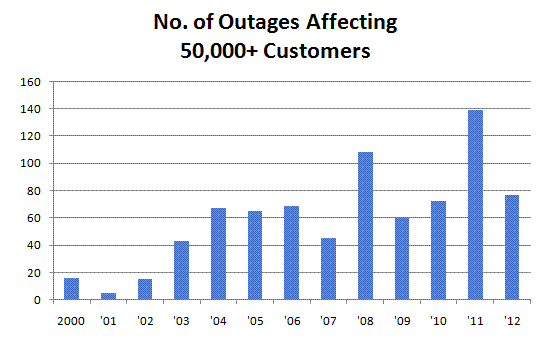
Regardless, you are almost certainly among the many who have, at one time or another, experienced a loss of electrical power lasting anywhere from a few hours to many days. And, you may even realize that this has been increasing in frequency over the past several years. Below is a graph showing the number of outages affecting 50,000 or more customers in the United States since 2000.

Source: Electric Disturbance Event annual reports, Office of Electricity Delivery & Energy Reliability, DOE.

One thing that will certainly improve that situation is for us to rebuild the electrical power infrastructure in this country. But that will likely take years (and lots of arguments). In the meantime, many will buy backup generators. And the leading company in that space is Generac Holdings .

What it does
Generac’s been around for over 50 years, but it’s only been a public company since early 2010 . It manufacturers backup power generators for homes, RVs, and commercial and industrial customers. Its portable generators are used to bring power and light to places that need it temporarily (e.g., nighttime road construction). And it can connect its permanent generators to a natural gas line and use that as fuel, automatically switching on when you lose power. Currently, it owns about 70% market share for home standby generators.

Not only is keeping your home powered important to you, but keeping the power on is a necessity for businesses. For example, restaurants, grocers, and convenience stores all need to store food at controlled temperatures and can lose thousands of dollars if their power is off for too long. Hospitals need to keep critical equipment running. This is an underserved market that Generac is going after. 

The opportunity
Even if we were just talking about an aging electric grid, the opportunity for the company is quite large. Add in the fact that we’re experiencing more severe weather and how that affects electrical power reliability, and the opportunity expands just a bit.

Further, with the housing recovery finally gaining traction — and thus homeowners more willing to invest in their homes — and with cheap and plentiful natural gas to hook into the generators, the timing for investing in this company looks pretty good. Finally, the company just acquired Ottomotores , which gives it a foothold in Latin America as it moves internationally.

Dark clouds
Of course, …read more
Source: FULL ARTICLE at DailyFinance

Green Fuel Company Awarded $23 Million In 2010, Shutting Doors In 2013

By Breaking News

Dollar Bills SC Green Fuel Company Awarded $23 Million in 2010, Shutting Doors in 2013

Rentech Incorporated received $23 million from the DOE for a Colorado refinery for its green fuel technology in 2010. On Feb. 28, 2013, Rentech announced it will cease operations, reduce staff, and “mothball its research and development Product Demonstration Unit” at the site in Colorado.

This means the company will “eliminate 65 employee and contractor positions in [its] alternative energy segment during the first half of 2013.”

It also means Rentech will forego plans for an expansion into Nachez, Miss., and will sell the 450 acres it purchased there.

This is part of larger pattern for alternative fuel sites and companies into which our government has been dumping millions upon million of dollars for years, only to be disappointed by the end product.

Consider the the cellulosic ethanol facility launched under Gov. Jennifer Granholm (D-Mich.) in Alpena, Mich. in 2010. The federal government provided $18 million in funding for that facility, and the state of Mich. threw in another $4 million.

Read More at breitbart.com . By AWR Hawkins.

…read more
Source: FULL ARTICLE at Western Journalism

Americans Will Pay An Average Of $3.55 Per Gallon Of Gas In 2013

This year, you may end up paying more for gas than you’d thought — at least, if the Department of Energy’s projections hold true. Last month, the DOE predicted that Americans would pay an average of $3.44 per gallon of unleaded regular gasoline over the course of 2013. Now, that figure has crept up 11 cents to $3.55. Why the change? For starters… …read more
Source: FULL ARTICLE at The Car Connection