By AK Fielding

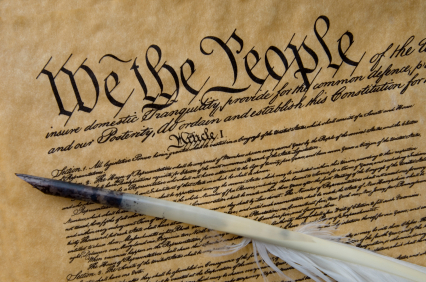
Degrading the United States Constitution seems to be the latest fad in our country. Most recently, in a debate with author Ben Shapiro, British journalist Piers Morgan attacked the Constitution and called it a “little book.” Morgan lives and works in the United States but is clearly unaware that the United States Constitution is not a “little book” but the supreme law of the land. Morgan is not alone in his berating of the Constitution; the current administration continuously tries to bend the law to its will at every opportunity. The latest attack against the Second Amendment is hardly a response to a new situation but an outcome of years of planning to eradicate the Constitutional rights of law-abiding Americans. Ironically, those attacking the Second Amendment unhesitatingly hide behind the First Amendment to cover their disparaging remarks about the same Constitution they despise. For people such as Morgan, clearly unfamiliar with United States history, a short lesson on the Constitution is in order.
On May 14, 1787, the Federal Convention met at the Independence Hall in Philadelphia. The plan was to correct errors in the loosely tied Articles of the Confederation. By June, it was evident that the Articles of Confederation was incapable of supporting the form of government required by the new Republic. Hence, the delegates worked methodically to create an entirely new type of document that represented the co-operation of all.
Lest someone feel the process involved in writing the Constitution and ratification was an easy one, a few points are worth noting. To begin with, the delegates to the Convention arrived in Philadelphia under the steady onslaught of daily rain. Unfortunately, far from cooling the city, the rain simply added in making it more humid and unbearable. It may seem a minor problem to us today because of the advent of air-conditioning but for delegates of the Constitutional Convention, the heat, humidity, and flies alone created a nettlesome atmosphere often leading to escalated tensions in the meetings.
Despite the heat, 55 of the appointed 74 delegates arrived in Philadelphia. Many of them remained in the city, the others traveled back and forth from their respective states to attend the sessions. Yes, it required more than one session because they did not automatically agree on all terms of the Constitution. Indeed, it took four long months to convince enough of the delegates to sign the Constitution. The opposition was heavy from the beginning. Alexander Hamilton, for example, arrived from the dissenting state of New York straddled with two other delegates, both anti-federalists. Many of them favored one possibility over another and it would take several gruesome hours daily to convince all to agree upon one resolution. For instance, James Madison and George Washington favored the Virginia Plan that called for a bicameral legislative branch, an executive branch led by a single person, and a judicial branch headed by a supreme court. Others such as Benjamin Franklin, John Lansing and William Paterson backed the New Jersey Plan that suggested a unicameral legislative branch, and an executive council. After giving an uninterrupted six-hour long speech on an alternative plan, Hamilton retired to New York, leaving the delegates behind with a milder opinion of the Virginia Plan.
Even after Hamilton’s grandiose speech, far from reaching common ground immediately, the delegates fought over the specifics and only came to an agreement on September 17, 1787 to sign the new Constitution. The signatures secured a new Constitution at the convention but it still needed ratification to become law. Anti-federalists such as Patrick Henry and George Clinton worked diligently to undermine the ratification process. In response, Hamilton, Madison, and John Jay fired away in support of ratification of the Constitution in a series of essays and articles noted for the magnitude of their literary and political beauty. The Federalist Papers have long become a masterpiece in political discourse and should be on the bookshelf of every American citizen. The final ratified Constitution included a Bill of Rights that carefully laid out the rights of individuals without which we may never have had the final product we see today.
The Constitution stands as the lifeblood of our great nation. To undermine its authority is to undermine the intelligence, wisdom, hard work, dedication, and sacrifices of the Founders who worked against all odds to create a law to safeguard the natural rights of people. Therefore, We the People must respect the Constitution for through its provisions our rights remain protected against those who tread upon us. It is our duty as Americans and patriots to honor the supreme law of our land and to correct those who ridicule it or try to minimize its relevance. It is true that we no longer live in the eighteenth century, but our Founding Fathers had the foresight to devise the Constitution to last beyond their time; and for over 200 years, it has done so remarkably well.
Follow on Twitter: @AKFielding
BLOG: http://akfielding.blogspot.com/
Source: FULL ARTICLE at Western Journalism