Tag Archives: Uncle Sam

1 Thing Worth Watching at Carlisle Companies

By Seth Jayson, The Motley Fool
Filed under:

Although business headlines still tout earnings numbers, many investors have moved past net earnings as a measure of a company’s economic output. That’s because earnings are very often less trustworthy than cash flow, since earnings are more open to manipulation based on dubious judgment calls.

Earnings’ unreliability is one of the reasons Foolish investors often flip straight past the income statement to check the cash flow statement. In general, by taking a close look at the cash moving in and out of the business, you can better understand whether the last batch of earnings brought money into the company, or merely disguised a cash gusher with a pretty headline.

Calling all cash flows

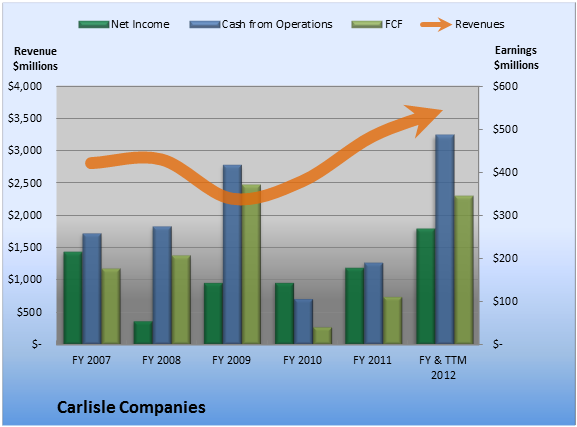
When you are trying to buy the market’s best stocks, it’s worth checking up on your companies’ free cash flow once a quarter or so, to see whether it bears any relationship to the net income in the headlines. That’s what we do with this series. Today, we’re checking in on Carlisle Companies (NYS: CSL) , whose recent revenue and earnings are plotted below.

Source: S&P Capital IQ. Data is current as of last fully reported fiscal quarter. Dollar values in millions. FCF = free cash flow. FY = fiscal year. TTM = trailing 12 months.

Over the past 12 months, Carlisle Companies generated $345.5 million cash while it booked net income of $270.2 million. That means it turned 9.5% of its revenue into FCF. That sounds OK.

All cash is not equal
Unfortunately, the cash flow statement isn’t immune from nonsense, either. That’s why it pays to take a close look at the components of cash flow from operations, to make sure that the cash flows are of high quality. What does that mean? To me, it means they need to be real and replicable in the upcoming quarters, rather than being offset by continual cash outflows that don’t appear on the income statement (such as major capital expenditures).

For instance, cash flow based on cash net income and adjustments for non-cash income-statement expenses (like depreciation) is generally favorable. An increase in cash flow based on stiffing your suppliers (by increasing accounts payable for the short term) or shortchanging Uncle Sam on taxes will come back to bite investors later. The same goes for decreasing accounts receivable; this is good to see, but it’s ordinary in recessionary times, and you can only increase collections so much. Finally, adding stock-based compensation expense back to cash flows is questionable when a company hands out a lot of equity to employees and uses cash in later periods to buy back those shares.

So how does the cash flow at Carlisle Companies look? Take a peek at the …read more
Source: FULL ARTICLE at DailyFinance

Why American Public Education's Earnings May Not Be So Hot

By Seth Jayson, The Motley Fool

Filed under:

Although business headlines still tout earnings numbers, many investors have moved past net earnings as a measure of a company’s economic output. That’s because earnings are very often less trustworthy than cash flow, since earnings are more open to manipulation based on dubious judgment calls.

Earnings’ unreliability is one of the reasons Foolish investors often flip straight past the income statement to check the cash flow statement. In general, by taking a close look at the cash moving in and out of the business, you can better understand whether the last batch of earnings brought money into the company, or merely disguised a cash gusher with a pretty headline.

Calling all cash flows

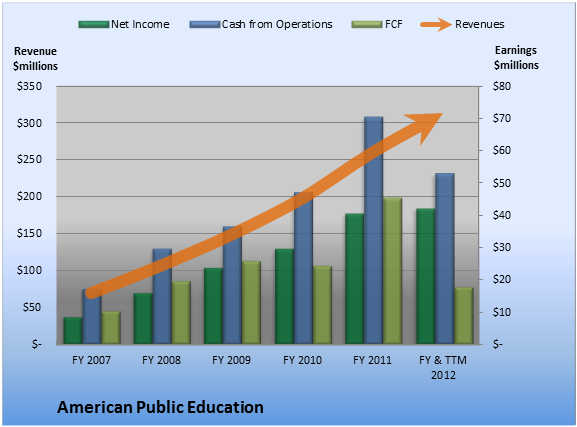
When you are trying to buy the market’s best stocks, it’s worth checking up on your companies’ free cash flow once a quarter or so, to see whether it bears any relationship to the net income in the headlines. That’s what we do with this series. Today, we’re checking in on American Public Education (NAS: APEI) , whose recent revenue and earnings are plotted below.

Source: S&P Capital IQ. Data is current as of last fully reported fiscal quarter. Dollar values in millions. FCF = free cash flow. FY = fiscal year. TTM = trailing 12 months.

Over the past 12 months, American Public Education generated $17.9 million cash while it booked net income of $42.3 million. That means it turned 5.7% of its revenue into FCF. That sounds OK. However, FCF is less than net income. Ideally, we’d like to see the opposite.

All cash is not equal
Unfortunately, the cash flow statement isn’t immune from nonsense, either. That’s why it pays to take a close look at the components of cash flow from operations, to make sure that the cash flows are of high quality. What does that mean? To me, it means they need to be real and replicable in the upcoming quarters, rather than being offset by continual cash outflows that don’t appear on the income statement (such as major capital expenditures).

For instance, cash flow based on cash net income and adjustments for non-cash income-statement expenses (like depreciation) is generally favorable. An increase in cash flow based on stiffing your suppliers (by increasing accounts payable for the short term) or shortchanging Uncle Sam on taxes will come back to bite investors later. The same goes for decreasing accounts receivable; this is good to see, but it’s ordinary in recessionary times, and you can only increase collections so much. Finally, adding stock-based compensation expense back to cash flows is questionable when a company hands out a lot of equity to employees and uses cash in later periods to buy back …read more
Source: FULL ARTICLE at DailyFinance

Are Resources Connection's Earnings Better Than They Look?

By Seth Jayson, The Motley Fool

Filed under:

Although business headlines still tout earnings numbers, many investors have moved past net earnings as a measure of a company’s economic output. That’s because earnings are very often less trustworthy than cash flow, since earnings are more open to manipulation based on dubious judgment calls.

Earnings’ unreliability is one of the reasons Foolish investors often flip straight past the income statement to check the cash flow statement. In general, by taking a close look at the cash moving in and out of the business, you can better understand whether the last batch of earnings brought money into the company, or merely disguised a cash gusher with a pretty headline.

Calling all cash flows

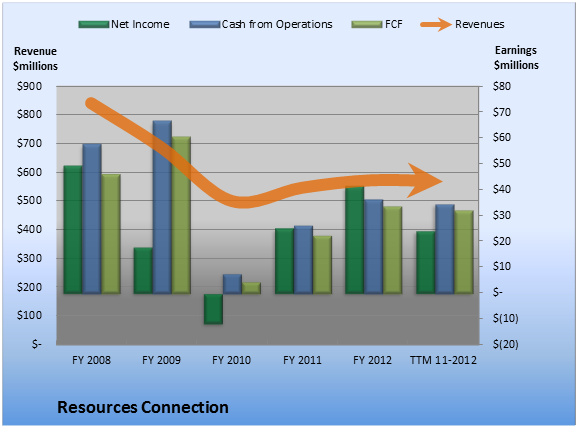
When you are trying to buy the market’s best stocks, it’s worth checking up on your companies’ free cash flow once a quarter or so, to see whether it bears any relationship to the net income in the headlines. That’s what we do with this series. Today, we’re checking in on Resources Connection (NAS: RECN) , whose recent revenue and earnings are plotted below.

Source: S&P Capital IQ. Data is current as of last fully reported fiscal quarter. Dollar values in millions. FCF = free cash flow. FY = fiscal year. TTM = trailing 12 months.

Over the past 12 months, Resources Connection generated $31.9 million cash while it booked net income of $23.9 million. That means it turned 5.6% of its revenue into FCF. That sounds OK.

All cash is not equal
Unfortunately, the cash flow statement isn’t immune from nonsense, either. That’s why it pays to take a close look at the components of cash flow from operations, to make sure that the cash flows are of high quality. What does that mean? To me, it means they need to be real and replicable in the upcoming quarters, rather than being offset by continual cash outflows that don’t appear on the income statement (such as major capital expenditures).

For instance, cash flow based on cash net income and adjustments for non-cash income-statement expenses (like depreciation) is generally favorable. An increase in cash flow based on stiffing your suppliers (by increasing accounts payable for the short term) or shortchanging Uncle Sam on taxes will come back to bite investors later. The same goes for decreasing accounts receivable; this is good to see, but it’s ordinary in recessionary times, and you can only increase collections so much. Finally, adding stock-based compensation expense back to cash flows is questionable when a company hands out a lot of equity to employees and uses cash in later periods to buy back those shares.

So how does the cash flow at Resources Connection look? Take a peek at the …read more
Source: FULL ARTICLE at DailyFinance
1 Thing to Watch at CLARCOR

By Seth Jayson, The Motley Fool

Filed under:

Although business headlines still tout earnings numbers, many investors have moved past net earnings as a measure of a company’s economic output. That’s because earnings are very often less trustworthy than cash flow, since earnings are more open to manipulation based on dubious judgment calls.

Earnings’ unreliability is one of the reasons Foolish investors often flip straight past the income statement to check the cash flow statement. In general, by taking a close look at the cash moving in and out of the business, you can better understand whether the last batch of earnings brought money into the company, or merely disguised a cash gusher with a pretty headline.

Calling all cash flows

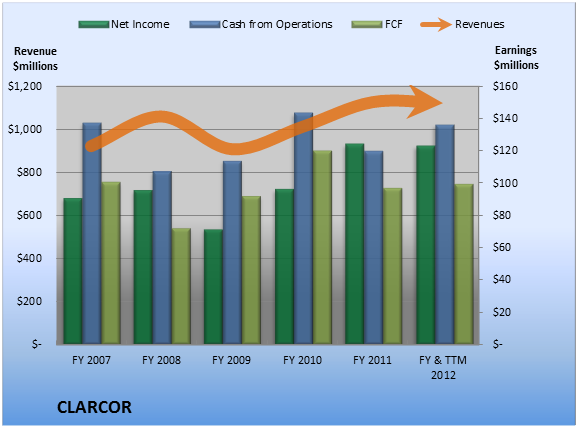
When you are trying to buy the market’s best stocks, it’s worth checking up on your companies’ free cash flow once a quarter or so, to see whether it bears any relationship to the net income in the headlines. That’s what we do with this series. Today, we’re checking in on CLARCOR (NYS: CLC) , whose recent revenue and earnings are plotted below.

Source: S&P Capital IQ. Data is current as of last fully reported fiscal quarter. Dollar values in millions. FCF = free cash flow. FY = fiscal year. TTM = trailing 12 months.

Over the past 12 months, CLARCOR generated $99.4 million cash while it booked net income of $123.0 million. That means it turned 8.9% of its revenue into FCF. That sounds OK. However, FCF is less than net income. Ideally, we’d like to see the opposite.

All cash is not equal
Unfortunately, the cash flow statement isn’t immune from nonsense, either. That’s why it pays to take a close look at the components of cash flow from operations, to make sure that the cash flows are of high quality. What does that mean? To me, it means they need to be real and replicable in the upcoming quarters, rather than being offset by continual cash outflows that don’t appear on the income statement (such as major capital expenditures).

For instance, cash flow based on cash net income and adjustments for non-cash income-statement expenses (like depreciation) is generally favorable. An increase in cash flow based on stiffing your suppliers (by increasing accounts payable for the short term) or shortchanging Uncle Sam on taxes will come back to bite investors later. The same goes for decreasing accounts receivable; this is good to see, but it’s ordinary in recessionary times, and you can only increase collections so much. Finally, adding stock-based compensation expense back to cash flows is questionable when a company hands out a lot of equity to employees and uses cash in later periods to buy back those shares.

So how does …read more
Source: FULL ARTICLE at DailyFinance

Are the Earnings at Premiere Global Services Hiding Something?

By Seth Jayson, The Motley Fool

Filed under:

Although business headlines still tout earnings numbers, many investors have moved past net earnings as a measure of a company’s economic output. That’s because earnings are very often less trustworthy than cash flow, since earnings are more open to manipulation based on dubious judgment calls.

Earnings’ unreliability is one of the reasons Foolish investors often flip straight past the income statement to check the cash flow statement. In general, by taking a close look at the cash moving in and out of the business, you can better understand whether the last batch of earnings brought money into the company, or merely disguised a cash gusher with a pretty headline.

Calling all cash flows

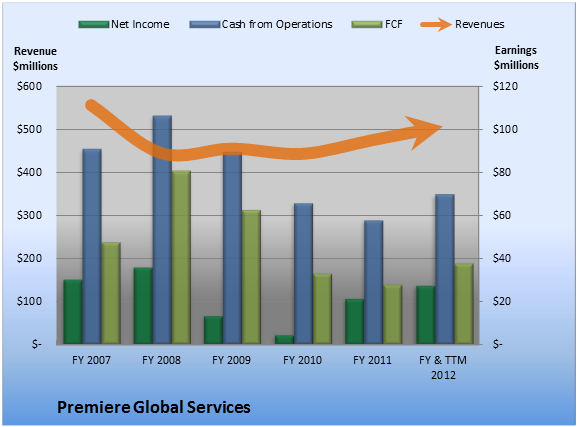
When you are trying to buy the market’s best stocks, it’s worth checking up on your companies’ free cash flow once a quarter or so, to see whether it bears any relationship to the net income in the headlines. That’s what we do with this series. Today, we’re checking in on Premiere Global Services (NYS: PGI) , whose recent revenue and earnings are plotted below.

Source: S&P Capital IQ. Data is current as of last fully reported fiscal quarter. Dollar values in millions. FCF = free cash flow. FY = fiscal year. TTM = trailing 12 months.

Over the past 12 months, Premiere Global Services generated $37.5 million cash while it booked net income of $27.6 million. That means it turned 7.4% of its revenue into FCF. That sounds OK.

All cash is not equal
Unfortunately, the cash flow statement isn’t immune from nonsense, either. That’s why it pays to take a close look at the components of cash flow from operations, to make sure that the cash flows are of high quality. What does that mean? To me, it means they need to be real and replicable in the upcoming quarters, rather than being offset by continual cash outflows that don’t appear on the income statement (such as major capital expenditures).

For instance, cash flow based on cash net income and adjustments for non-cash income-statement expenses (like depreciation) is generally favorable. An increase in cash flow based on stiffing your suppliers (by increasing accounts payable for the short term) or shortchanging Uncle Sam on taxes will come back to bite investors later. The same goes for decreasing accounts receivable; this is good to see, but it’s ordinary in recessionary times, and you can only increase collections so much. Finally, adding stock-based compensation expense back to cash flows is questionable when a company hands out a lot of equity to employees and uses cash in later periods to buy back those shares.

So how does the cash flow at Premiere Global Services look? Take a …read more
Source: FULL ARTICLE at DailyFinance
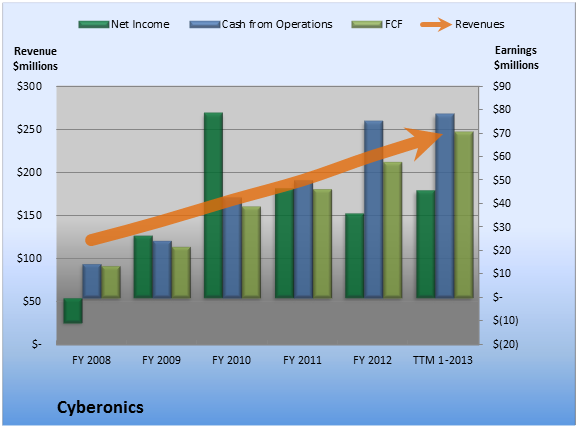
Here's How Cyberonics Is Making You So Much Cash

By Seth Jayson, The Motley Fool

Filed under:

Although business headlines still tout earnings numbers, many investors have moved past net earnings as a measure of a company’s economic output. That’s because earnings are very often less trustworthy than cash flow, since earnings are more open to manipulation based on dubious judgment calls.

Earnings’ unreliability is one of the reasons Foolish investors often flip straight past the income statement to check the cash flow statement. In general, by taking a close look at the cash moving in and out of the business, you can better understand whether the last batch of earnings brought money into the company, or merely disguised a cash gusher with a pretty headline.

Calling all cash flows

When you are trying to buy the market’s best stocks, it’s worth checking up on your companies’ free cash flow once a quarter or so, to see whether it bears any relationship to the net income in the headlines. That’s what we do with this series. Today, we’re checking in on Cyberonics (NAS: CYBX) , whose recent revenue and earnings are plotted below.

Source: S&P Capital IQ. Data is current as of last fully reported fiscal quarter. Dollar values in millions. FCF = free cash flow. FY = fiscal year. TTM = trailing 12 months.

Over the past 12 months, Cyberonics generated $70.6 million cash while it booked net income of $45.5 million. That means it turned 29.0% of its revenue into FCF. That sounds pretty impressive.

All cash is not equal
Unfortunately, the cash flow statement isn’t immune from nonsense, either. That’s why it pays to take a close look at the components of cash flow from operations, to make sure that the cash flows are of high quality. What does that mean? To me, it means they need to be real and replicable in the upcoming quarters, rather than being offset by continual cash outflows that don’t appear on the income statement (such as major capital expenditures).

For instance, cash flow based on cash net income and adjustments for non-cash income-statement expenses (like depreciation) is generally favorable. An increase in cash flow based on stiffing your suppliers (by increasing accounts payable for the short term) or shortchanging Uncle Sam on taxes will come back to bite investors later. The same goes for decreasing accounts receivable; this is good to see, but it’s ordinary in recessionary times, and you can only increase collections so much. Finally, adding stock-based compensation expense back to cash flows is questionable when a company hands out a lot of equity to employees and uses cash in later periods to buy back those shares.

So how does the cash flow at Cyberonics look? Take a peek at the chart below, …read more
Source: FULL ARTICLE at DailyFinance

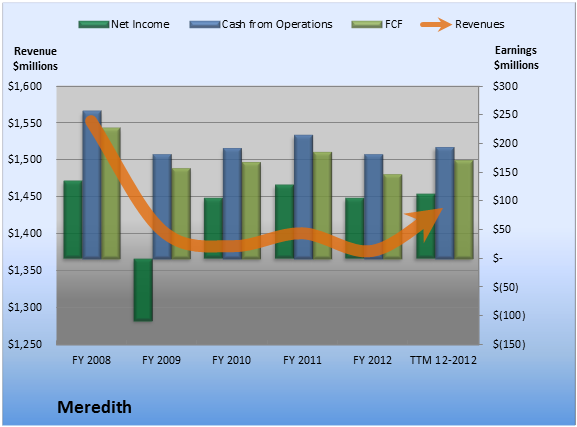
Here's How Meredith Is Making You So Much Cash

By Seth Jayson, The Motley Fool

Filed under:

Although business headlines still tout earnings numbers, many investors have moved past net earnings as a measure of a company’s economic output. That’s because earnings are very often less trustworthy than cash flow, since earnings are more open to manipulation based on dubious judgment calls.

Earnings’ unreliability is one of the reasons Foolish investors often flip straight past the income statement to check the cash flow statement. In general, by taking a close look at the cash moving in and out of the business, you can better understand whether the last batch of earnings brought money into the company, or merely disguised a cash gusher with a pretty headline.

Calling all cash flows

When you are trying to buy the market’s best stocks, it’s worth checking up on your companies’ free cash flow once a quarter or so, to see whether it bears any relationship to the net income in the headlines. That’s what we do with this series. Today, we’re checking in on Meredith (NYS: MDP) , whose recent revenue and earnings are plotted below.

Source: S&P Capital IQ. Data is current as of last fully reported fiscal quarter. Dollar values in millions. FCF = free cash flow. FY = fiscal year. TTM = trailing 12 months.

Over the past 12 months, Meredith generated $170.8 million cash while it booked net income of $111.6 million. That means it turned 11.9% of its revenue into FCF. That sounds pretty impressive.

All cash is not equal
Unfortunately, the cash flow statement isn’t immune from nonsense, either. That’s why it pays to take a close look at the components of cash flow from operations, to make sure that the cash flows are of high quality. What does that mean? To me, it means they need to be real and replicable in the upcoming quarters, rather than being offset by continual cash outflows that don’t appear on the income statement (such as major capital expenditures).

For instance, cash flow based on cash net income and adjustments for non-cash income-statement expenses (like depreciation) is generally favorable. An increase in cash flow based on stiffing your suppliers (by increasing accounts payable for the short term) or shortchanging Uncle Sam on taxes will come back to bite investors later. The same goes for decreasing accounts receivable; this is good to see, but it’s ordinary in recessionary times, and you can only increase collections so much. Finally, adding stock-based compensation expense back to cash flows is questionable when a company hands out a lot of equity to employees and uses cash in later periods to buy back those shares.

So how does the cash flow at Meredith look? Take a peek at the chart below, …read more
Source: FULL ARTICLE at DailyFinance
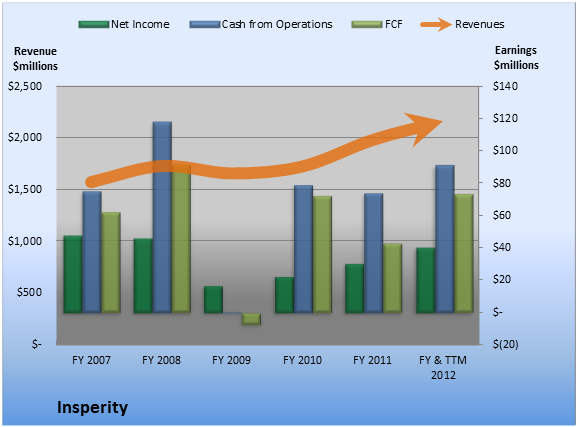
Has Insperity Made You Any Real Money?

By Seth Jayson, The Motley Fool

Filed under:

Although business headlines still tout earnings numbers, many investors have moved past net earnings as a measure of a company’s economic output. That’s because earnings are very often less trustworthy than cash flow, since earnings are more open to manipulation based on dubious judgment calls.

Earnings’ unreliability is one of the reasons Foolish investors often flip straight past the income statement to check the cash flow statement. In general, by taking a close look at the cash moving in and out of the business, you can better understand whether the last batch of earnings brought money into the company, or merely disguised a cash gusher with a pretty headline.

Calling all cash flows

When you are trying to buy the market’s best stocks, it’s worth checking up on your companies’ free cash flow once a quarter or so, to see whether it bears any relationship to the net income in the headlines. That’s what we do with this series. Today, we’re checking in on Insperity (NYS: NSP) , whose recent revenue and earnings are plotted below.

Source: S&P Capital IQ. Data is current as of last fully reported fiscal quarter. Dollar values in millions. FCF = free cash flow. FY = fiscal year. TTM = trailing 12 months.

Over the past 12 months, Insperity generated $73.2 million cash while it booked net income of $40.4 million. That means it turned 3.4% of its revenue into FCF. That sounds OK.

All cash is not equal
Unfortunately, the cash flow statement isn’t immune from nonsense, either. That’s why it pays to take a close look at the components of cash flow from operations, to make sure that the cash flows are of high quality. What does that mean? To me, it means they need to be real and replicable in the upcoming quarters, rather than being offset by continual cash outflows that don’t appear on the income statement (such as major capital expenditures).

For instance, cash flow based on cash net income and adjustments for non-cash income-statement expenses (like depreciation) is generally favorable. An increase in cash flow based on stiffing your suppliers (by increasing accounts payable for the short term) or shortchanging Uncle Sam on taxes will come back to bite investors later. The same goes for decreasing accounts receivable; this is good to see, but it’s ordinary in recessionary times, and you can only increase collections so much. Finally, adding stock-based compensation expense back to cash flows is questionable when a company hands out a lot of equity to employees and uses cash in later periods to buy back those shares.

So how does the cash flow at Insperity look? Take a peek at the chart below, which …read more
Source: FULL ARTICLE at DailyFinance

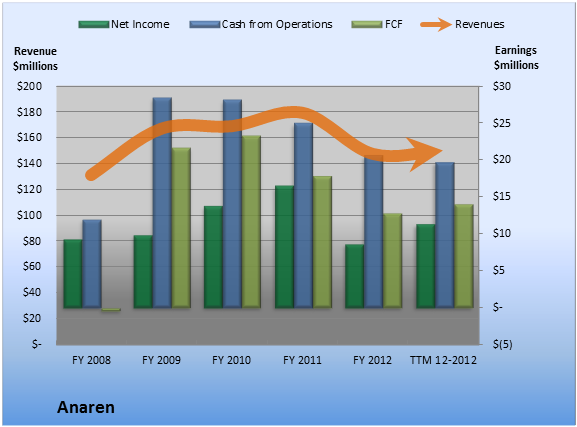
Show Me the Money, Anaren

By Seth Jayson, The Motley Fool

Filed under:

Although business headlines still tout earnings numbers, many investors have moved past net earnings as a measure of a company’s economic output. That’s because earnings are very often less trustworthy than cash flow, since earnings are more open to manipulation based on dubious judgment calls.

Earnings’ unreliability is one of the reasons Foolish investors often flip straight past the income statement to check the cash flow statement. In general, by taking a close look at the cash moving in and out of the business, you can better understand whether the last batch of earnings brought money into the company, or merely disguised a cash gusher with a pretty headline.

Calling all cash flows

When you are trying to buy the market’s best stocks, it’s worth checking up on your companies’ free cash flow once a quarter or so, to see whether it bears any relationship to the net income in the headlines. That’s what we do with this series. Today, we’re checking in on Anaren (NAS: ANEN) , whose recent revenue and earnings are plotted below.

Source: S&P Capital IQ. Data is current as of last fully reported fiscal quarter. Dollar values in millions. FCF = free cash flow. FY = fiscal year. TTM = trailing 12 months.

Over the past 12 months, Anaren generated $14.1 million cash while it booked net income of $11.3 million. That means it turned 9.4% of its revenue into FCF. That sounds OK.

All cash is not equal
Unfortunately, the cash flow statement isn’t immune from nonsense, either. That’s why it pays to take a close look at the components of cash flow from operations, to make sure that the cash flows are of high quality. What does that mean? To me, it means they need to be real and replicable in the upcoming quarters, rather than being offset by continual cash outflows that don’t appear on the income statement (such as major capital expenditures).

For instance, cash flow based on cash net income and adjustments for non-cash income-statement expenses (like depreciation) is generally favorable. An increase in cash flow based on stiffing your suppliers (by increasing accounts payable for the short term) or shortchanging Uncle Sam on taxes will come back to bite investors later. The same goes for decreasing accounts receivable; this is good to see, but it’s ordinary in recessionary times, and you can only increase collections so much. Finally, adding stock-based compensation expense back to cash flows is questionable when a company hands out a lot of equity to employees and uses cash in later periods to buy back those shares.

So how does the cash flow at Anaren look? Take a peek at the chart below, which …read more
Source: FULL ARTICLE at DailyFinance
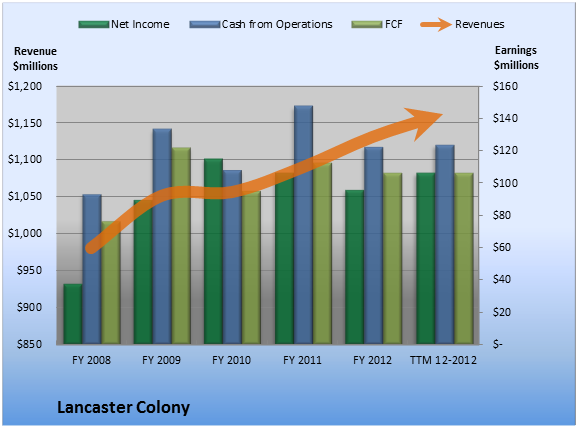
Has Lancaster Colony Made You Any Real Money?

By Seth Jayson, The Motley Fool

Filed under:

Although business headlines still tout earnings numbers, many investors have moved past net earnings as a measure of a company’s economic output. That’s because earnings are very often less trustworthy than cash flow, since earnings are more open to manipulation based on dubious judgment calls.

Earnings’ unreliability is one of the reasons Foolish investors often flip straight past the income statement to check the cash flow statement. In general, by taking a close look at the cash moving in and out of the business, you can better understand whether the last batch of earnings brought money into the company, or merely disguised a cash gusher with a pretty headline.

Calling all cash flows

When you are trying to buy the market’s best stocks, it’s worth checking up on your companies’ free cash flow once a quarter or so, to see whether it bears any relationship to the net income in the headlines. That’s what we do with this series. Today, we’re checking in on Lancaster Colony (NAS: LANC) , whose recent revenue and earnings are plotted below.

Source: S&P Capital IQ. Data is current as of last fully reported fiscal quarter. Dollar values in millions. FCF = free cash flow. FY = fiscal year. TTM = trailing 12 months.

Over the past 12 months, Lancaster Colony generated $106.0 million cash while it booked net income of $106.1 million. That means it turned 9.1% of its revenue into FCF. That sounds OK. However, FCF is less than net income. Ideally, we’d like to see the opposite.

All cash is not equal
Unfortunately, the cash flow statement isn’t immune from nonsense, either. That’s why it pays to take a close look at the components of cash flow from operations, to make sure that the cash flows are of high quality. What does that mean? To me, it means they need to be real and replicable in the upcoming quarters, rather than being offset by continual cash outflows that don’t appear on the income statement (such as major capital expenditures).

For instance, cash flow based on cash net income and adjustments for non-cash income-statement expenses (like depreciation) is generally favorable. An increase in cash flow based on stiffing your suppliers (by increasing accounts payable for the short term) or shortchanging Uncle Sam on taxes will come back to bite investors later. The same goes for decreasing accounts receivable; this is good to see, but it’s ordinary in recessionary times, and you can only increase collections so much. Finally, adding stock-based compensation expense back to cash flows is questionable when a company hands out a lot of equity to employees and uses cash in later periods to buy back those shares.

So …read more
Source: FULL ARTICLE at DailyFinance

Has Measurement Specialties Made You Any Real Money?

By Seth Jayson, The Motley Fool

Filed under:

Although business headlines still tout earnings numbers, many investors have moved past net earnings as a measure of a company’s economic output. That’s because earnings are very often less trustworthy than cash flow, since earnings are more open to manipulation based on dubious judgment calls.

Earnings’ unreliability is one of the reasons Foolish investors often flip straight past the income statement to check the cash flow statement. In general, by taking a close look at the cash moving in and out of the business, you can better understand whether the last batch of earnings brought money into the company, or merely disguised a cash gusher with a pretty headline.

Calling all cash flows

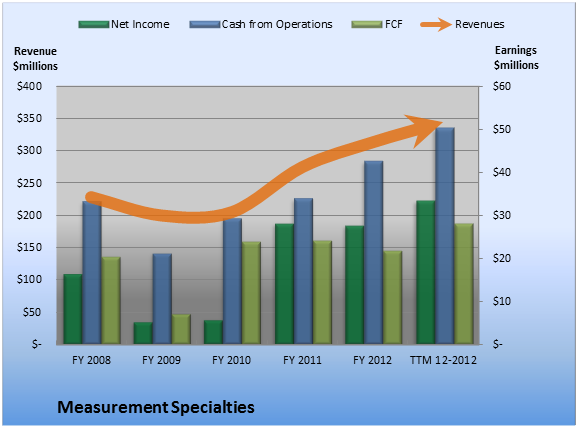
When you are trying to buy the market’s best stocks, it’s worth checking up on your companies’ free cash flow once a quarter or so, to see whether it bears any relationship to the net income in the headlines. That’s what we do with this series. Today, we’re checking in on Measurement Specialties (NAS: MEAS) , whose recent revenue and earnings are plotted below.

Source: S&P Capital IQ. Data is current as of last fully reported fiscal quarter. Dollar values in millions. FCF = free cash flow. FY = fiscal year. TTM = trailing 12 months.

Over the past 12 months, Measurement Specialties generated $28.1 million cash while it booked net income of $33.4 million. That means it turned 8.1% of its revenue into FCF. That sounds OK. However, FCF is less than net income. Ideally, we’d like to see the opposite.

All cash is not equal
Unfortunately, the cash flow statement isn’t immune from nonsense, either. That’s why it pays to take a close look at the components of cash flow from operations, to make sure that the cash flows are of high quality. What does that mean? To me, it means they need to be real and replicable in the upcoming quarters, rather than being offset by continual cash outflows that don’t appear on the income statement (such as major capital expenditures).

For instance, cash flow based on cash net income and adjustments for non-cash income-statement expenses (like depreciation) is generally favorable. An increase in cash flow based on stiffing your suppliers (by increasing accounts payable for the short term) or shortchanging Uncle Sam on taxes will come back to bite investors later. The same goes for decreasing accounts receivable; this is good to see, but it’s ordinary in recessionary times, and you can only increase collections so much. Finally, adding stock-based compensation expense back to cash flows is questionable when a company hands out a lot of equity to employees and uses cash in later periods to buy back those shares.

So …read more
Source: FULL ARTICLE at DailyFinance
Why Roper Industries's Earnings Are Outstanding

By Seth Jayson, The Motley Fool

Filed under:

Although business headlines still tout earnings numbers, many investors have moved past net earnings as a measure of a company’s economic output. That’s because earnings are very often less trustworthy than cash flow, since earnings are more open to manipulation based on dubious judgment calls.

Earnings’ unreliability is one of the reasons Foolish investors often flip straight past the income statement to check the cash flow statement. In general, by taking a close look at the cash moving in and out of the business, you can better understand whether the last batch of earnings brought money into the company, or merely disguised a cash gusher with a pretty headline.

Calling all cash flows

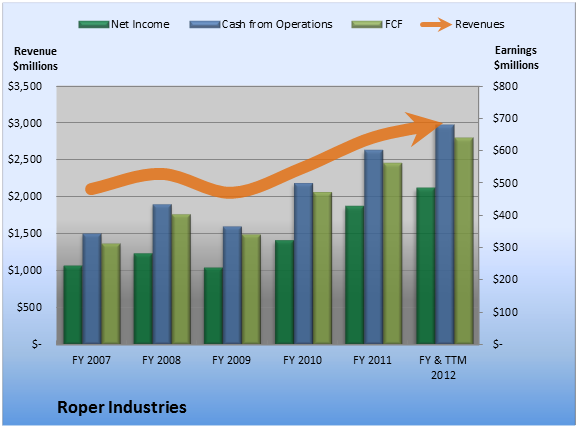
When you are trying to buy the market’s best stocks, it’s worth checking up on your companies’ free cash flow once a quarter or so, to see whether it bears any relationship to the net income in the headlines. That’s what we do with this series. Today, we’re checking in on Roper Industries (NYS: ROP) , whose recent revenue and earnings are plotted below.

Source: S&P Capital IQ. Data is current as of last fully reported fiscal quarter. Dollar values in millions. FCF = free cash flow. FY = fiscal year. TTM = trailing 12 months.

Over the past 12 months, Roper Industries generated $639.4 million cash while it booked net income of $483.4 million. That means it turned 21.4% of its revenue into FCF. That sounds pretty impressive.

All cash is not equal
Unfortunately, the cash flow statement isn’t immune from nonsense, either. That’s why it pays to take a close look at the components of cash flow from operations, to make sure that the cash flows are of high quality. What does that mean? To me, it means they need to be real and replicable in the upcoming quarters, rather than being offset by continual cash outflows that don’t appear on the income statement (such as major capital expenditures).

For instance, cash flow based on cash net income and adjustments for non-cash income-statement expenses (like depreciation) is generally favorable. An increase in cash flow based on stiffing your suppliers (by increasing accounts payable for the short term) or shortchanging Uncle Sam on taxes will come back to bite investors later. The same goes for decreasing accounts receivable; this is good to see, but it’s ordinary in recessionary times, and you can only increase collections so much. Finally, adding stock-based compensation expense back to cash flows is questionable when a company hands out a lot of equity to employees and uses cash in later periods to buy back those shares.

So how does the cash flow at Roper Industries look? Take a peek at …read more
Source: FULL ARTICLE at DailyFinance

Don't Get Too Worked Up Over Franklin Electric's Earnings

By Seth Jayson, The Motley Fool

Filed under:

Although business headlines still tout earnings numbers, many investors have moved past net earnings as a measure of a company’s economic output. That’s because earnings are very often less trustworthy than cash flow, since earnings are more open to manipulation based on dubious judgment calls.

Earnings’ unreliability is one of the reasons Foolish investors often flip straight past the income statement to check the cash flow statement. In general, by taking a close look at the cash moving in and out of the business, you can better understand whether the last batch of earnings brought money into the company, or merely disguised a cash gusher with a pretty headline.

Calling all cash flows

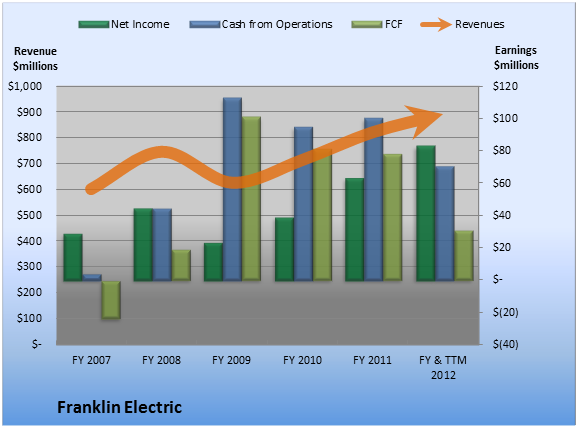
When you are trying to buy the market’s best stocks, it’s worth checking up on your companies’ free cash flow once a quarter or so, to see whether it bears any relationship to the net income in the headlines. That’s what we do with this series. Today, we’re checking in on Franklin Electric (NAS: FELE) , whose recent revenue and earnings are plotted below.

Source: S&P Capital IQ. Data is current as of last fully reported fiscal quarter. Dollar values in millions. FCF = free cash flow. FY = fiscal year. TTM = trailing 12 months.

Over the past 12 months, Franklin Electric generated $30.9 million cash while it booked net income of $82.9 million. That means it turned 3.5% of its revenue into FCF. That sounds OK. However, FCF is less than net income. Ideally, we’d like to see the opposite.

All cash is not equal
Unfortunately, the cash flow statement isn’t immune from nonsense, either. That’s why it pays to take a close look at the components of cash flow from operations, to make sure that the cash flows are of high quality. What does that mean? To me, it means they need to be real and replicable in the upcoming quarters, rather than being offset by continual cash outflows that don’t appear on the income statement (such as major capital expenditures).

For instance, cash flow based on cash net income and adjustments for non-cash income-statement expenses (like depreciation) is generally favorable. An increase in cash flow based on stiffing your suppliers (by increasing accounts payable for the short term) or shortchanging Uncle Sam on taxes will come back to bite investors later. The same goes for decreasing accounts receivable; this is good to see, but it’s ordinary in recessionary times, and you can only increase collections so much. Finally, adding stock-based compensation expense back to cash flows is questionable when a company hands out a lot of equity to employees and uses cash in later periods to buy back those shares.

So …read more
Source: FULL ARTICLE at DailyFinance
Kudlow: No Sequester Catastrophe

By Breaking News

Larry Kudlow SC Kudlow: No Sequester Catastrophe

President Obama may be backing away from his doomsday spending-cut predictions as the sequester goes into place. But the new party line is that while there will be no impact in the first few days, there’ll be a slow, downward slump after that.

What, are we to believe that lower spending and smaller government damage the economy? Doesn’t that run counter to virtually every reasonably objective study in recent years — including ones from a number of U.S. academics and the Organization for Economic Cooperation and Development in Europe — that describe how countries with lower government spending grow more, and how countries with higher government spending grow less?

However you calculate the sequester spending cuts, and however uneven they may be, the reality is that the sequester at least moves the ball in the right direction. I maintain that by reducing the government spending share of gross domestic product, the sequester is pro-growth.

The White House and the Congressional Budget Office are predicting a 0.5 percent to 0.7 percent decline in GDP, post-sequester, and a loss of 750,000 jobs. All this from a spending reduction of roughly 2.4 percent over the next 10 years, in which Uncle Sam’s spending growth will be $44.8 trillion rather than $46 trillion.

Fed chairman Ben Bernanke and other demand-siders have called for a slow, gradual federal-spending reduction. Well, that’s exactly what they’re going to get. The first fiscal year of sequester will see $44 billion in spending cuts, which is about one quarter of 1 percent of GDP. That’s pretty gradual.

Read More at Human Events . By Lawrence Kudlow.

Photo Credit: CNBC (Creative Commons)

…read more
Source: FULL ARTICLE at Western Journalism

Obama’s Lopsided Education Policy

By Breaking News

Barack Obama between flags SC Obamas Lopsided Education Policy

President Obama has repeatedly promised to use an “evidence-based approach” for social policy—and when it comes to education, he has been true to his word: He has systematically promoted programs such as universal pre-school with little evidence of success and panned ones such as school vouchers with lots.

In his recent State of the Union address, the president—not for the first time—hectored Congress to “make high-quality preschool available to every single child in America.” “Study after study shows that the sooner a child begins learning, the better he or she does down the road,” he insisted.

Actually, “study after study” has shown the exact opposite—that publicly funded preschool programs make no lasting difference in a child’s life.

Consider Head Start, the nearly half-a-century old early learning program targeted at low-income toddlers. About a million kids are enrolled in the program every year and Uncle Sam spends about $8,000 on each, not exactly chump change. Yet a majority of studies have found that while these kids show initial cognitive gains that make them more “school ready,” these gains disappear once they enter regular school. Pre-K believers have pooh-poohed these studies on methodological grounds arguing that they did not track the kids long enough and weren’t based on random assignment with a valid control group.

None of these objections apply to the Department of Health and Human Services’ December Head Start Impact study. It is the most ambitious and expensive evaluation of the program that the administration did its best to bury by releasing it on the Friday before Christmas.

Read More at reason.com . By Shikha Dalmia and Lisa Snell.

…read more
Source: FULL ARTICLE at Western Journalism

Is IDEX's Cash Machine Shutting Down?

By Seth Jayson, The Motley Fool

Filed under:

Although business headlines still tout earnings numbers, many investors have moved past net earnings as a measure of a company’s economic output. That’s because earnings are very often less trustworthy than cash flow, since earnings are more open to manipulation based on dubious judgment calls.

Earnings’ unreliability is one of the reasons Foolish investors often flip straight past the income statement to check the cash flow statement. In general, by taking a close look at the cash moving in and out of the business, you can better understand whether the last batch of earnings brought money into the company, or merely disguised a cash gusher with a pretty headline.

Calling all cash flows

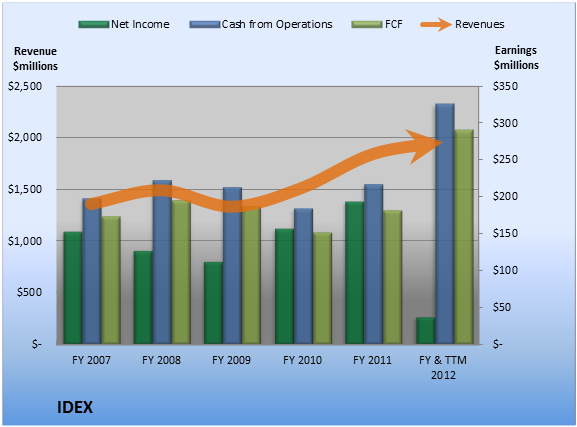
When you are trying to buy the market’s best stocks, it’s worth checking up on your companies’ free cash flow once a quarter or so, to see whether it bears any relationship to the net income in the headlines. That’s what we do with this series. Today, we’re checking in on IDEX (NYS: IEX) , whose recent revenue and earnings are plotted below.

Source: S&P Capital IQ. Data is current as of last fully reported fiscal quarter. Dollar values in millions. FCF = free cash flow. FY = fiscal year. TTM = trailing 12 months.

Over the past 12 months, IDEX generated $290.4 million cash while it booked net income of $37.6 million. That means it turned 14.9% of its revenue into FCF. That sounds pretty impressive.

All cash is not equal
Unfortunately, the cash flow statement isn’t immune from nonsense, either. That’s why it pays to take a close look at the components of cash flow from operations, to make sure that the cash flows are of high quality. What does that mean? To me, it means they need to be real and replicable in the upcoming quarters, rather than being offset by continual cash outflows that don’t appear on the income statement (such as major capital expenditures).

For instance, cash flow based on cash net income and adjustments for non-cash income-statement expenses (like depreciation) is generally favorable. An increase in cash flow based on stiffing your suppliers (by increasing accounts payable for the short term) or shortchanging Uncle Sam on taxes will come back to bite investors later. The same goes for decreasing accounts receivable; this is good to see, but it’s ordinary in recessionary times, and you can only increase collections so much. Finally, adding stock-based compensation expense back to cash flows is questionable when a company hands out a lot of equity to employees and uses cash in later periods to buy back those shares.

So how does the cash flow at IDEX look? Take a peek at the chart below, …read more
Source: FULL ARTICLE at DailyFinance

Why Advent Software's Earnings Are Outstanding

By Seth Jayson, The Motley Fool

Filed under:

Although business headlines still tout earnings numbers, many investors have moved past net earnings as a measure of a company’s economic output. That’s because earnings are very often less trustworthy than cash flow, since earnings are more open to manipulation based on dubious judgment calls.

Earnings’ unreliability is one of the reasons Foolish investors often flip straight past the income statement to check the cash flow statement. In general, by taking a close look at the cash moving in and out of the business, you can better understand whether the last batch of earnings brought money into the company, or merely disguised a cash gusher with a pretty headline.

Calling all cash flows

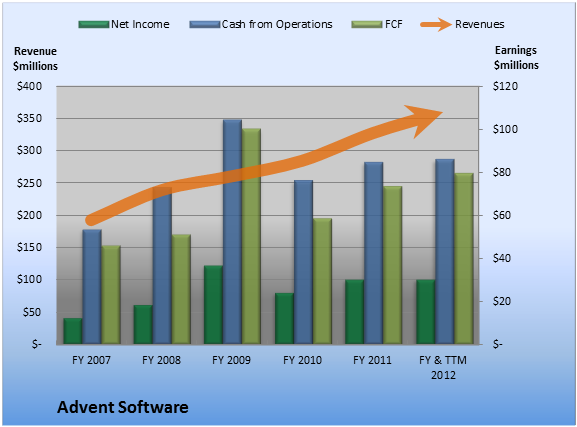
When you are trying to buy the market’s best stocks, it’s worth checking up on your companies’ free cash flow once a quarter or so, to see whether it bears any relationship to the net income in the headlines. That’s what we do with this series. Today, we’re checking in on Advent Software (NAS: ADVS) , whose recent revenue and earnings are plotted below.

Source: S&P Capital IQ. Data is current as of last fully reported fiscal quarter. Dollar values in millions. FCF = free cash flow. FY = fiscal year. TTM = trailing 12 months.

Over the past 12 months, Advent Software generated $79.7 million cash while it booked net income of $30.4 million. That means it turned 22.2% of its revenue into FCF. That sounds pretty impressive.

All cash is not equal
Unfortunately, the cash flow statement isn’t immune from nonsense, either. That’s why it pays to take a close look at the components of cash flow from operations, to make sure that the cash flows are of high quality. What does that mean? To me, it means they need to be real and replicable in the upcoming quarters, rather than being offset by continual cash outflows that don’t appear on the income statement (such as major capital expenditures).

For instance, cash flow based on cash net income and adjustments for non-cash income-statement expenses (like depreciation) is generally favorable. An increase in cash flow based on stiffing your suppliers (by increasing accounts payable for the short term) or shortchanging Uncle Sam on taxes will come back to bite investors later. The same goes for decreasing accounts receivable; this is good to see, but it’s ordinary in recessionary times, and you can only increase collections so much. Finally, adding stock-based compensation expense back to cash flows is questionable when a company hands out a lot of equity to employees and uses cash in later periods to buy back those shares.

So how does the cash flow at Advent Software look? Take a peek at …read more
Source: FULL ARTICLE at DailyFinance
1 Thing Worth Watching at Ericsson

By Seth Jayson, The Motley Fool

Filed under:

Although business headlines still tout earnings numbers, many investors have moved past net earnings as a measure of a company’s economic output. That’s because earnings are very often less trustworthy than cash flow, since earnings are more open to manipulation based on dubious judgment calls.

Earnings’ unreliability is one of the reasons Foolish investors often flip straight past the income statement to check the cash flow statement. In general, by taking a close look at the cash moving in and out of the business, you can better understand whether the last batch of earnings brought money into the company, or merely disguised a cash gusher with a pretty headline.

Calling all cash flows

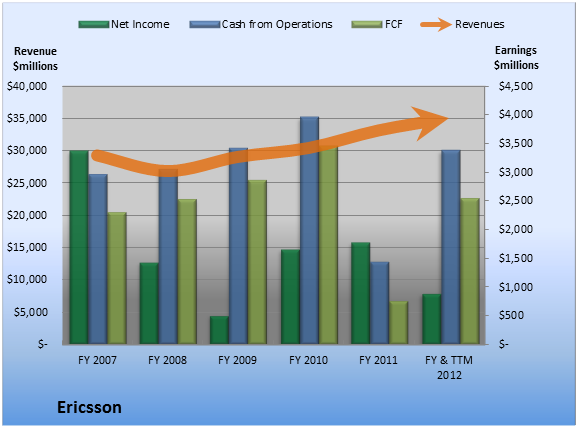
When you are trying to buy the market’s best stocks, it’s worth checking up on your companies’ free cash flow once a quarter or so, to see whether it bears any relationship to the net income in the headlines. That’s what we do with this series. Today, we’re checking in on Ericsson (OM: ERIC B), whose recent revenue and earnings are plotted below.

Source: S&P Capital IQ. Data is current as of last fully reported fiscal quarter. Dollar values in millions. FCF = free cash flow. FY = fiscal year. TTM = trailing 12 months.

Over the past 12 months, Ericsson generated $2,549.7 million cash while it booked net income of $886.9 million. That means it turned 7.3% of its revenue into FCF. That sounds OK.

All cash is not equal
Unfortunately, the cash flow statement isn’t immune from nonsense, either. That’s why it pays to take a close look at the components of cash flow from operations, to make sure that the cash flows are of high quality. What does that mean? To me, it means they need to be real and replicable in the upcoming quarters, rather than being offset by continual cash outflows that don’t appear on the income statement (such as major capital expenditures).

For instance, cash flow based on cash net income and adjustments for non-cash income-statement expenses (like depreciation) is generally favorable. An increase in cash flow based on stiffing your suppliers (by increasing accounts payable for the short term) or shortchanging Uncle Sam on taxes will come back to bite investors later. The same goes for decreasing accounts receivable; this is good to see, but it’s ordinary in recessionary times, and you can only increase collections so much. Finally, adding stock-based compensation expense back to cash flows is questionable when a company hands out a lot of equity to employees and uses cash in later periods to buy back those shares.

So how does the cash flow at Ericsson look? Take a peek at the chart below, which flags questionable cash flow sources with …read more
Source: FULL ARTICLE at DailyFinance

Are Huntington Ingalls Industries's Earnings Better Than They Look?

By Seth Jayson, The Motley Fool

Filed under:

Although business headlines still tout earnings numbers, many investors have moved past net earnings as a measure of a company’s economic output. That’s because earnings are very often less trustworthy than cash flow, since earnings are more open to manipulation based on dubious judgment calls.

Earnings’ unreliability is one of the reasons Foolish investors often flip straight past the income statement to check the cash flow statement. In general, by taking a close look at the cash moving in and out of the business, you can better understand whether the last batch of earnings brought money into the company, or merely disguised a cash gusher with a pretty headline.

Calling all cash flows

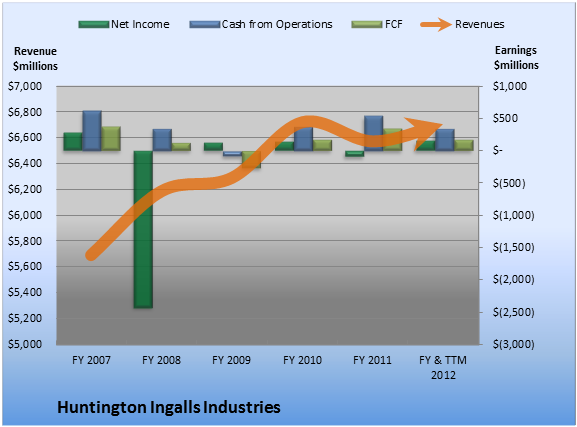
When you are trying to buy the market’s best stocks, it’s worth checking up on your companies’ free cash flow once a quarter or so, to see whether it bears any relationship to the net income in the headlines. That’s what we do with this series. Today, we’re checking in on Huntington Ingalls Industries (NYS: HII) , whose recent revenue and earnings are plotted below.

Source: S&P Capital IQ. Data is current as of last fully reported fiscal quarter. Dollar values in millions. FCF = free cash flow. FY = fiscal year. TTM = trailing 12 months.

Over the past 12 months, Huntington Ingalls Industries generated $170.0 million cash while it booked net income of $146.0 million. That means it turned 2.5% of its revenue into FCF. That doesn’t sound so great.

All cash is not equal
Unfortunately, the cash flow statement isn’t immune from nonsense, either. That’s why it pays to take a close look at the components of cash flow from operations, to make sure that the cash flows are of high quality. What does that mean? To me, it means they need to be real and replicable in the upcoming quarters, rather than being offset by continual cash outflows that don’t appear on the income statement (such as major capital expenditures).

For instance, cash flow based on cash net income and adjustments for non-cash income-statement expenses (like depreciation) is generally favorable. An increase in cash flow based on stiffing your suppliers (by increasing accounts payable for the short term) or shortchanging Uncle Sam on taxes will come back to bite investors later. The same goes for decreasing accounts receivable; this is good to see, but it’s ordinary in recessionary times, and you can only increase collections so much. Finally, adding stock-based compensation expense back to cash flows is questionable when a company hands out a lot of equity to employees and uses cash in later periods to buy back those shares.

So how does the cash flow at Huntington Ingalls Industries look? …read more
Source: FULL ARTICLE at DailyFinance
Here's How EPIQ Systems Is Making You So Much Cash

By Seth Jayson, The Motley Fool

Filed under:

Although business headlines still tout earnings numbers, many investors have moved past net earnings as a measure of a company’s economic output. That’s because earnings are very often less trustworthy than cash flow, since earnings are more open to manipulation based on dubious judgment calls.
Earnings’ unreliability is one of the reasons Foolish investors often flip straight past the income statement to check the cash flow statement. In general, by taking a close look at the cash moving in and out of the business, you can better understand whether the last batch of earnings brought money into the company, or merely disguised a cash gusher with a pretty headline.

Calling all cash flows

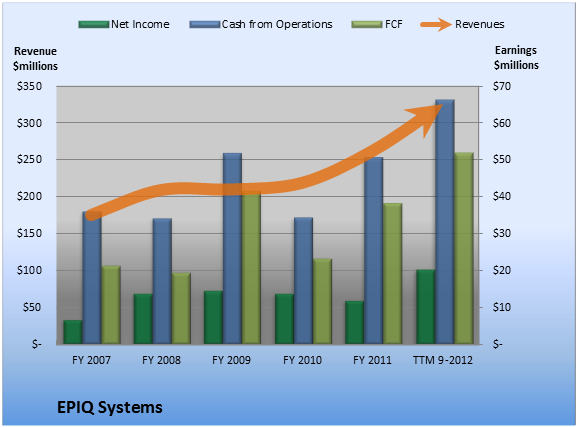
When you are trying to buy the market’s best stocks, it’s worth checking up on your companies’ free cash flow once a quarter or so, to see whether it bears any relationship to the net income in the headlines. That’s what we do with this series. Today, we’re checking in on EPIQ Systems (NAS: EPIQ) , whose recent revenue and earnings are plotted below.

Source: S&P Capital IQ. Data is current as of last fully reported fiscal quarter. Dollar values in millions. FCF = free cash flow. FY = fiscal year. TTM = trailing 12 months.

Over the past 12 months, EPIQ Systems generated $51.9 million cash while it booked net income of $20.4 million. That means it turned 16.0% of its revenue into FCF. That sounds pretty impressive.

All cash is not equal
Unfortunately, the cash flow statement isn’t immune from nonsense, either. That’s why it pays to take a close look at the components of cash flow from operations, to make sure that the cash flows are of high quality. What does that mean? To me, it means they need to be real and replicable in the upcoming quarters, rather than being offset by continual cash outflows that don’t appear on the income statement (such as major capital expenditures).

For instance, cash flow based on cash net income and adjustments for non-cash income-statement expenses (like depreciation) is generally favorable. An increase in cash flow based on stiffing your suppliers (by increasing accounts payable for the short term) or shortchanging Uncle Sam on taxes will come back to bite investors later. The same goes for decreasing accounts receivable; this is good to see, but it’s ordinary in recessionary times, and you can only increase collections so much. Finally, adding stock-based compensation expense back to cash flows is questionable when a company hands out a lot of equity to employees and uses cash in later periods to buy back those shares.

So how does the cash flow at EPIQ Systems look? Take a peek at …read more
Source: FULL ARTICLE at DailyFinance