Tag Archives: Uncle Sam

Where's the Cash Coming From at Ryman Hospitality Properties?

By Seth Jayson, The Motley Fool
Filed under:

Although business headlines still tout earnings numbers, many investors have moved past net earnings as a measure of a company’s economic output. That’s because earnings are very often less trustworthy than cash flow, since earnings are more open to manipulation based on dubious judgment calls.

Earnings’ unreliability is one of the reasons Foolish investors often flip straight past the income statement to check the cash flow statement. In general, by taking a close look at the cash moving in and out of the business, you can better understand whether the last batch of earnings brought money into the company, or merely disguised a cash gusher with a pretty headline.

Calling all cash flows

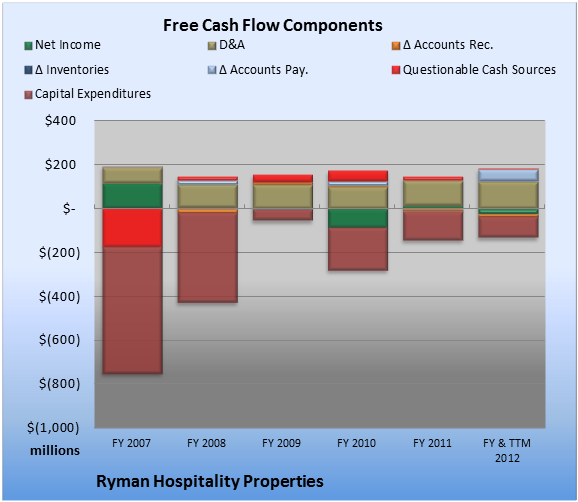
When you are trying to buy the market’s best stocks, it’s worth checking up on your companies’ free cash flow once a quarter or so, to see whether it bears any relationship to the net income in the headlines. That’s what we do with this series. Today, we’re checking in on Ryman Hospitality Properties (NYS: RHP) , whose recent revenue and earnings are plotted below.

Source: S&P Capital IQ. Data is current as of last fully reported fiscal quarter. Dollar values in millions. FCF = free cash flow. FY = fiscal year. TTM = trailing 12 months.

Over the past 12 months, Ryman Hospitality Properties generated $81.2 million cash while it booked a net loss of $26.6 million. That means it turned 8.2% of its revenue into FCF. That sounds OK.

All cash is not equal
Unfortunately, the cash flow statement isn’t immune from nonsense, either. That’s why it pays to take a close look at the components of cash flow from operations, to make sure that the cash flows are of high quality. What does that mean? To me, it means they need to be real and replicable in the upcoming quarters, rather than being offset by continual cash outflows that don’t appear on the income statement (such as major capital expenditures).

For instance, cash flow based on cash net income and adjustments for non-cash income-statement expenses (like depreciation) is generally favorable. An increase in cash flow based on stiffing your suppliers (by increasing accounts payable for the short term) or shortchanging Uncle Sam on taxes will come back to bite investors later. The same goes for decreasing accounts receivable; this is good to see, but it’s ordinary in recessionary times, and you can only increase collections so much. Finally, adding stock-based compensation expense back to cash flows is questionable when a company hands out a lot of equity to employees and uses cash in later periods to buy back those shares.

So how does the cash flow at Ryman Hospitality Properties look? Take …read more
Source: FULL ARTICLE at DailyFinance

Why the Street Should Love CoStar Group's Earnings

By Seth Jayson, The Motley Fool

Filed under:

Although business headlines still tout earnings numbers, many investors have moved past net earnings as a measure of a company’s economic output. That’s because earnings are very often less trustworthy than cash flow, since earnings are more open to manipulation based on dubious judgment calls.

Earnings’ unreliability is one of the reasons Foolish investors often flip straight past the income statement to check the cash flow statement. In general, by taking a close look at the cash moving in and out of the business, you can better understand whether the last batch of earnings brought money into the company, or merely disguised a cash gusher with a pretty headline.

Calling all cash flows

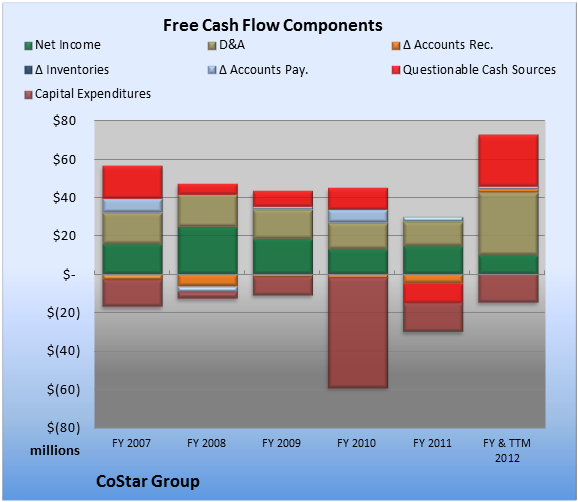
When you are trying to buy the market’s best stocks, it’s worth checking up on your companies’ free cash flow once a quarter or so, to see whether it bears any relationship to the net income in the headlines. That’s what we do with this series. Today, we’re checking in on CoStar Group (NAS: CSGP) , whose recent revenue and earnings are plotted below.

Source: S&P Capital IQ. Data is current as of last fully reported fiscal quarter. Dollar values in millions. FCF = free cash flow. FY = fiscal year. TTM = trailing 12 months.

Over the past 12 months, CoStar Group generated $71.3 million cash while it booked net income of $9.9 million. That means it turned 20.4% of its revenue into FCF. That sounds pretty impressive.

All cash is not equal
Unfortunately, the cash flow statement isn’t immune from nonsense, either. That’s why it pays to take a close look at the components of cash flow from operations, to make sure that the cash flows are of high quality. What does that mean? To me, it means they need to be real and replicable in the upcoming quarters, rather than being offset by continual cash outflows that don’t appear on the income statement (such as major capital expenditures).

For instance, cash flow based on cash net income and adjustments for non-cash income-statement expenses (like depreciation) is generally favorable. An increase in cash flow based on stiffing your suppliers (by increasing accounts payable for the short term) or shortchanging Uncle Sam on taxes will come back to bite investors later. The same goes for decreasing accounts receivable; this is good to see, but it’s ordinary in recessionary times, and you can only increase collections so much. Finally, adding stock-based compensation expense back to cash flows is questionable when a company hands out a lot of equity to employees and uses cash in later periods to buy back those shares.

So how does the cash flow at CoStar Group look? Take a peek at …read more
Source: FULL ARTICLE at DailyFinance

Are VCA Antech's Earnings Worse Than They Look?

By Seth Jayson, The Motley Fool

Filed under:

Although business headlines still tout earnings numbers, many investors have moved past net earnings as a measure of a company’s economic output. That’s because earnings are very often less trustworthy than cash flow, since earnings are more open to manipulation based on dubious judgment calls.

Earnings’ unreliability is one of the reasons Foolish investors often flip straight past the income statement to check the cash flow statement. In general, by taking a close look at the cash moving in and out of the business, you can better understand whether the last batch of earnings brought money into the company, or merely disguised a cash gusher with a pretty headline.

Calling all cash flows

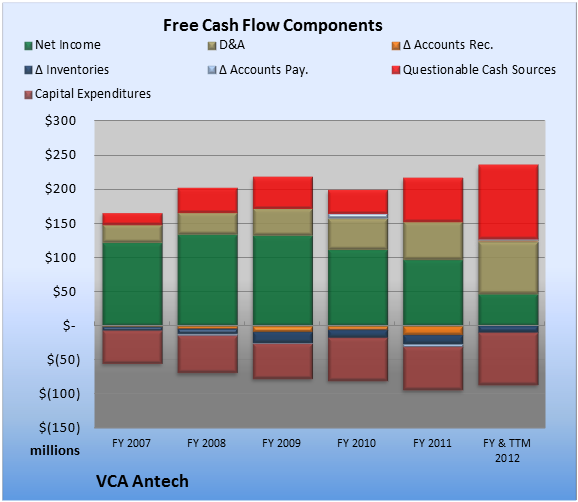
When you are trying to buy the market’s best stocks, it’s worth checking up on your companies’ free cash flow once a quarter or so, to see whether it bears any relationship to the net income in the headlines. That’s what we do with this series. Today, we’re checking in on VCA Antech (NAS: WOOF) , whose recent revenue and earnings are plotted below.

Source: S&P Capital IQ. Data is current as of last fully reported fiscal quarter. Dollar values in millions. FCF = free cash flow. FY = fiscal year. TTM = trailing 12 months.

Over the past 12 months, VCA Antech generated $160.4 million cash while it booked net income of $45.6 million. That means it turned 9.4% of its revenue into FCF. That sounds OK.

All cash is not equal
Unfortunately, the cash flow statement isn’t immune from nonsense, either. That’s why it pays to take a close look at the components of cash flow from operations, to make sure that the cash flows are of high quality. What does that mean? To me, it means they need to be real and replicable in the upcoming quarters, rather than being offset by continual cash outflows that don’t appear on the income statement (such as major capital expenditures).

For instance, cash flow based on cash net income and adjustments for non-cash income-statement expenses (like depreciation) is generally favorable. An increase in cash flow based on stiffing your suppliers (by increasing accounts payable for the short term) or shortchanging Uncle Sam on taxes will come back to bite investors later. The same goes for decreasing accounts receivable; this is good to see, but it’s ordinary in recessionary times, and you can only increase collections so much. Finally, adding stock-based compensation expense back to cash flows is questionable when a company hands out a lot of equity to employees and uses cash in later periods to buy back those shares.

So how does the cash flow at VCA Antech look? Take a peek at the …read more
Source: FULL ARTICLE at DailyFinance
Has Cigna Made You Any Real Money?

By Seth Jayson, The Motley Fool

Filed under:

Although business headlines still tout earnings numbers, many investors have moved past net earnings as a measure of a company’s economic output. That’s because earnings are very often less trustworthy than cash flow, since earnings are more open to manipulation based on dubious judgment calls.

Earnings’ unreliability is one of the reasons Foolish investors often flip straight past the income statement to check the cash flow statement. In general, by taking a close look at the cash moving in and out of the business, you can better understand whether the last batch of earnings brought money into the company, or merely disguised a cash gusher with a pretty headline.

Calling all cash flows

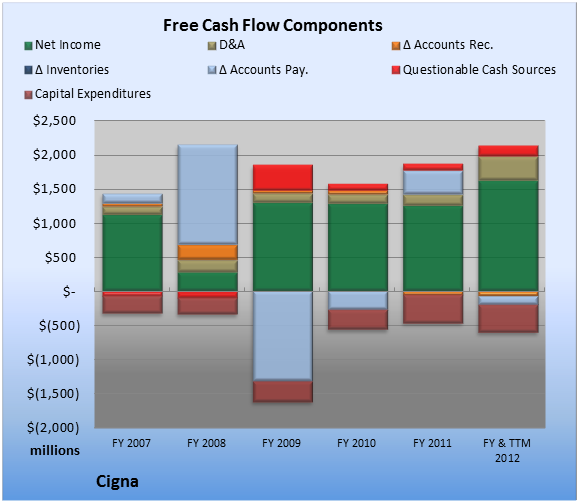
When you are trying to buy the market’s best stocks, it’s worth checking up on your companies’ free cash flow once a quarter or so, to see whether it bears any relationship to the net income in the headlines. That’s what we do with this series. Today, we’re checking in on Cigna (NYS: CI) , whose recent revenue and earnings are plotted below.

Source: S&P Capital IQ. Data is current as of last fully reported fiscal quarter. Dollar values in millions. FCF = free cash flow. FY = fiscal year. TTM = trailing 12 months.

Over the past 12 months, Cigna generated $1,942.0 million cash while it booked net income of $1,623.0 million. That means it turned 6.7% of its revenue into FCF. That sounds OK.

All cash is not equal
Unfortunately, the cash flow statement isn’t immune from nonsense, either. That’s why it pays to take a close look at the components of cash flow from operations, to make sure that the cash flows are of high quality. What does that mean? To me, it means they need to be real and replicable in the upcoming quarters, rather than being offset by continual cash outflows that don’t appear on the income statement (such as major capital expenditures).

For instance, cash flow based on cash net income and adjustments for non-cash income-statement expenses (like depreciation) is generally favorable. An increase in cash flow based on stiffing your suppliers (by increasing accounts payable for the short term) or shortchanging Uncle Sam on taxes will come back to bite investors later. The same goes for decreasing accounts receivable; this is good to see, but it’s ordinary in recessionary times, and you can only increase collections so much. Finally, adding stock-based compensation expense back to cash flows is questionable when a company hands out a lot of equity to employees and uses cash in later periods to buy back those shares.

So how does the cash flow at Cigna look? Take a peek at the chart below, which …read more
Source: FULL ARTICLE at DailyFinance

Can You Trust the Cash Flow at MAXIMUS?

By Seth Jayson, The Motley Fool

Filed under:

Although business headlines still tout earnings numbers, many investors have moved past net earnings as a measure of a company’s economic output. That’s because earnings are very often less trustworthy than cash flow, since earnings are more open to manipulation based on dubious judgment calls.

Earnings’ unreliability is one of the reasons Foolish investors often flip straight past the income statement to check the cash flow statement. In general, by taking a close look at the cash moving in and out of the business, you can better understand whether the last batch of earnings brought money into the company, or merely disguised a cash gusher with a pretty headline.

Calling all cash flows

When you are trying to buy the market’s best stocks, it’s worth checking up on your companies’ free cash flow once a quarter or so, to see whether it bears any relationship to the net income in the headlines. That’s what we do with this series. Today, we’re checking in on MAXIMUS (NYS: MMS) , whose recent revenue and earnings are plotted below.

Source: S&P Capital IQ. Data is current as of last fully reported fiscal quarter. Dollar values in millions. FCF = free cash flow. FY = fiscal year. TTM = trailing 12 months.

Over the past 12 months, MAXIMUS generated $74.3 million cash while it booked net income of $79.7 million. That means it turned 6.8% of its revenue into FCF. That sounds OK. However, FCF is less than net income. Ideally, we’d like to see the opposite.

All cash is not equal
Unfortunately, the cash flow statement isn’t immune from nonsense, either. That’s why it pays to take a close look at the components of cash flow from operations, to make sure that the cash flows are of high quality. What does that mean? To me, it means they need to be real and replicable in the upcoming quarters, rather than being offset by continual cash outflows that don’t appear on the income statement (such as major capital expenditures).

For instance, cash flow based on cash net income and adjustments for non-cash income-statement expenses (like depreciation) is generally favorable. An increase in cash flow based on stiffing your suppliers (by increasing accounts payable for the short term) or shortchanging Uncle Sam on taxes will come back to bite investors later. The same goes for decreasing accounts receivable; this is good to see, but it’s ordinary in recessionary times, and you can only increase collections so much. Finally, adding stock-based compensation expense back to cash flows is questionable when a company hands out a lot of equity to employees and uses cash in later periods to buy back those shares.

So how does …read more
Source: FULL ARTICLE at DailyFinance
Don't Get Too Worked Up Over Plains All American Pipeline's Earnings

By Seth Jayson, The Motley Fool

Filed under:

Although business headlines still tout earnings numbers, many investors have moved past net earnings as a measure of a company’s economic output. That’s because earnings are very often less trustworthy than cash flow, since earnings are more open to manipulation based on dubious judgment calls.

Earnings’ unreliability is one of the reasons Foolish investors often flip straight past the income statement to check the cash flow statement. In general, by taking a close look at the cash moving in and out of the business, you can better understand whether the last batch of earnings brought money into the company, or merely disguised a cash gusher with a pretty headline.

Calling all cash flows

When you are trying to buy the market’s best stocks, it’s worth checking up on your companies’ free cash flow once a quarter or so, to see whether it bears any relationship to the net income in the headlines. That’s what we do with this series. Today, we’re checking in on Plains All American Pipeline (NYS: PAA) , whose recent revenue and earnings are plotted below.

Source: S&P Capital IQ. Data is current as of last fully reported fiscal quarter. Dollar values in millions. FCF = free cash flow. FY = fiscal year. TTM = trailing 12 months.

Over the past 12 months, Plains All American Pipeline burned $8.0 million cash while it booked net income of $1,094.0 million. That means it burned through all its revenue and more. That doesn’t sound so great. FCF is less than net income. Ideally, we’d like to see the opposite.

All cash is not equal
Unfortunately, the cash flow statement isn’t immune from nonsense, either. That’s why it pays to take a close look at the components of cash flow from operations, to make sure that the cash flows are of high quality. What does that mean? To me, it means they need to be real and replicable in the upcoming quarters, rather than being offset by continual cash outflows that don’t appear on the income statement (such as major capital expenditures).

For instance, cash flow based on cash net income and adjustments for non-cash income-statement expenses (like depreciation) is generally favorable. An increase in cash flow based on stiffing your suppliers (by increasing accounts payable for the short term) or shortchanging Uncle Sam on taxes will come back to bite investors later. The same goes for decreasing accounts receivable; this is good to see, but it’s ordinary in recessionary times, and you can only increase collections so much. Finally, adding stock-based compensation expense back to cash flows is questionable when a company hands out a lot of equity to employees and uses cash in later periods …read more
Source: FULL ARTICLE at DailyFinance

Why Is Uncle Sam Punishing Natural Gas Producers?

By Joel South and Taylor Muckerman, The Motley Fool

Filed under:

Natural gas exploration and production companies continue to face considerable headwinds because of low natural gas prices. To stay solvent, natural gas producers such as Chesapeake Energy and Devon Energy were forced to move into liquids production in addition to creating joint ventures or selling assets to foreign national oil companies.

Oil and gas producers are now looking to the federal government to allow more LNG exportation permits so companies can sell natural gas to the highest bidder. Uncle Sam continues to drag its feet on making a decision for or against LNG exportation, forcing some natural gas producers to sell valuable assets and technology to foreign government-owned oil and gas companies. With record worldwide price disparities, the United States could profit handsomely from selling low-cost natural gas into high-end markets, but time is of the essence.

Energy investors would be hard-pressed to find another company trading at a deeper discount than Chesapeake Energy. Its share price depreciated after negative news surfaced concerning the company’s management and spiraling debt picture. While these issues still persist, giant steps have been taken to help mitigate the problems. To learn more about Chesapeake and its enormous potential, you’re invited to check out The Motley Fool’s brand-new premium report on the company. Simply click here now to access your copy.

var FoolAnalyticsData = FoolAnalyticsData || []; FoolAnalyticsData.push({ eventType: “TickerReportPitch”, contentByline: “Joel South and Taylor Muckerman“, contentId: “cms.22557”, contentTickers: “NYSE:CVX, NYSE:CHK, NYSE:DVN, NYSE:RDS-B, NYSEMKT:LNG“, contentTitle: “Why Is Uncle Sam Punishing Natural Gas Producers?”, hasVideo: “True”, …read more
Source: FULL ARTICLE at DailyFinance
Skepticism Surrounds Big Days on Wall Street

By Eamon Murphy

Hugo Chávez Wall Street

Filed under:

The past 36 hours should have been a moment of unbridled celebration for cheerleaders of American capitalism. The Dow Jones Industrial Average had two successive record-breaking closes, and Hugo Chávez, Uncle Sam‘s most prominent hemispheric antagonist, died after a two-year illness (which his vice president blamed on the machinations of enemies domestic and foreign).

And yet reactions have been muted, conflicted. As the Dow scaled previously unknown heights on Tuesday, “the record went largely uncelebrated,” the Wall Street Journal reports. “There’s no massive sense of euphoria,” one high-ranking trader told the paper. “Years ago, there was more excitement.”

It’s not a mystery why this should be so: The disparity between the bull market on Wall Street and the actual U.S. economy is awfully wide. On Tuesday morning the financial news site Zero Hedge posted a sobering then-and-now comparison entitled “The Last Time the Dow Was Here…,” looking back at where some key economic indicators stood on October 11, 2007. A few striking data points:

  • GDP Growth: then +2.5%; now +1.6%
  • Americans Unemployed (in Labor Force): then 6.7 million; now 13.2 million
  • Americans On Food Stamps: then 26.9 million; now 47.69 million
  • Size of Fed’s Balance Sheet: then $0.89 trillion; now $3.01 trillion

That last point helps explain what’s going on. The trillions of dollars of mortgage bond and U.S. Treasury purchases made by the Federal Reserve have artificially stimulated markets, boosting investor confidence even in the absence of fundamental economic recovery. And with interest rates near zero, people looking for a decent return on their money have been driven back into a market that burned them badly in very recent memory.

In the words of the editorial board of USA Today, stocks are acting as though they’re “on steroids,” and the withdrawal process could be painful indeed (drastically diminishing bond returns, for instance). Better start clarifying now how the Fed plans to extricate itself, the editors advise: “The longer the Fed’s easy-money policies go on, the greater the risk they will distort markets, create new bubbles and set the economy up for another fall.”

To some economists, the Dow’s record-breaking performance isn’t just asterisk-worthy because the market‘s been juiced, but because the actual high-water mark has yet to be topped. As CNNMoney points out,

The record that everyone is talking about is in nominal terms and doesn’t take into account the impact of inflation, which has increased more than 10% in the past five years, according to the government’s Consumer Price Index. If you factor that in, the blue chip index is actually still about 11% below its all-time inflation adjusted high, which was set in January 2000, according to data from Ned Davis Research.

And, as The New York Times notes, the companies that comprise the Dow have in fact fared unevenly since the index bottomed out four years ago (at 6,547.05): “12 of the 30 stocks in the Dow are still down from their peaks, some …read more
Source: FULL ARTICLE at DailyFinance

Back in the Barrel: AIG Investing in Mortgages

By 24/7 Wall St.

Stock Split Image

Filed under: , , , ,

If you don’t know the old punchline, “Hey, It’s your turn in the barrel today!” you might not fully understand how badly we view the news out of American International Group Inc. (NYSE: AIG) today. We applaud the insurance giant for paying back Uncle Sam and the taxpayers with a profit after its bailout. Unfortunately, the headline today is just not going to be received well by the public, even if it is really an opportunity to make money.

AIG released a press release showing that its Connective Mortgage Advisory Company is “drawing on the company’s investment expertise and United Guaranty‘s mortgage insight” for the purchase of residential mortgages for investments. The company said:

AIG announced today it has launched a new business unit called Connective Mortgage Advisory Company. The new company, which recently facilitated AIG‘s first correspondent mortgage purchase, draws upon AIG‘s investment expertise and the experience of its mortgage insurance subsidiary, United Guaranty Corporation, to identify and buy residential whole loan mortgages as investments.

The new Connective unit is focused on identifying residential first-mortgage loans to be purchased as long-term investments for AIG. As a part of the terms for the loans to purchased as investments, AIG will manage the loan-servicing component. The reality is that AIG can easily handle this. The public perception of this, however, is likely to be far different. The problem is that AIG effectively blew itself up and was a major contributor of what would have blown up so many other financial giants during the recession had it not been for the billions and billions of taxpayer bailout dollars.

AIG maintains in this release that direct investment in residential mortgage loans “offers attractive investment returns and enables a proactive approach to managing mortgage risk.” Again, our concern is not really whether AIG can manage this. Our concern is that the public will ask, “Isn’t that sort of why we bailed them out just a few years ago?” Whether the insurance giant created a hole worth endless of billions by insuring and participating in mortgages, CDOs and other securitizations may get lost in the shuffle here in what is, by and large, a liberal media that does not really like Wall St. and those who create wealth merely from financial dealings. Here is the supporting data offered by AIG:

Over the past several years, United Guaranty has been using a multivariate risk-assessment model to determine the quality of individual loans in the pricing of its mortgage insurance. United Guaranty is contributing deep knowledge of the residential mortgage landscape to the Connective project. “With the support of AIG, United Guaranty became the mortgage insurance market-share leader with risk-based pricing products,” said Donna DeMaio, United Guaranty‘s Chief Executive Officer. “United Guaranty‘s understanding of residential mortgage markets combined with AIG‘s investment expertise creates unique new investment opportunities for AIG.”

AIG said that the Connective unit will establish correspondent relationships with lenders and will underwrite loans, and that …read more
Source: FULL ARTICLE at DailyFinance
Is Ameristar Casinos's Cash Machine Shutting Down?

By Seth Jayson, The Motley Fool

Filed under:

Although business headlines still tout earnings numbers, many investors have moved past net earnings as a measure of a company’s economic output. That’s because earnings are very often less trustworthy than cash flow, since earnings are more open to manipulation based on dubious judgment calls.

Earnings’ unreliability is one of the reasons Foolish investors often flip straight past the income statement to check the cash flow statement. In general, by taking a close look at the cash moving in and out of the business, you can better understand whether the last batch of earnings brought money into the company, or merely disguised a cash gusher with a pretty headline.

Calling all cash flows

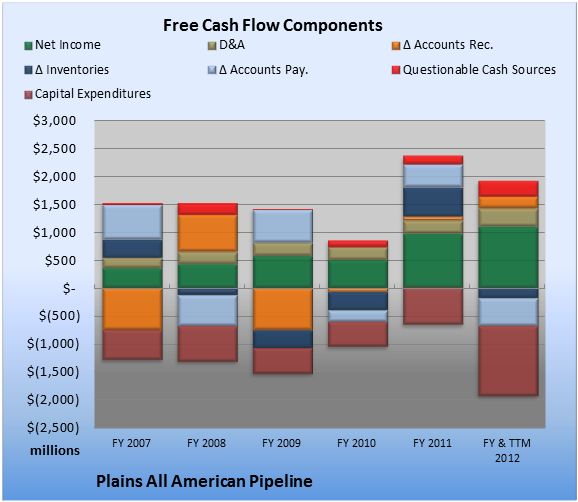
When you are trying to buy the market’s best stocks, it’s worth checking up on your companies’ free cash flow once a quarter or so, to see whether it bears any relationship to the net income in the headlines. That’s what we do with this series. Today, we’re checking in on Ameristar Casinos (NAS: ASCA) , whose recent revenue and earnings are plotted below.

Source: S&P Capital IQ. Data is current as of last fully reported fiscal quarter. Dollar values in millions. FCF = free cash flow. FY = fiscal year. TTM = trailing 12 months.

Over the past 12 months, Ameristar Casinos generated $90.8 million cash while it booked net income of $76.3 million. That means it turned 7.6% of its revenue into FCF. That sounds OK.

All cash is not equal
Unfortunately, the cash flow statement isn’t immune from nonsense, either. That’s why it pays to take a close look at the components of cash flow from operations, to make sure that the cash flows are of high quality. What does that mean? To me, it means they need to be real and replicable in the upcoming quarters, rather than being offset by continual cash outflows that don’t appear on the income statement (such as major capital expenditures).

For instance, cash flow based on cash net income and adjustments for non-cash income-statement expenses (like depreciation) is generally favorable. An increase in cash flow based on stiffing your suppliers (by increasing accounts payable for the short term) or shortchanging Uncle Sam on taxes will come back to bite investors later. The same goes for decreasing accounts receivable; this is good to see, but it’s ordinary in recessionary times, and you can only increase collections so much. Finally, adding stock-based compensation expense back to cash flows is questionable when a company hands out a lot of equity to employees and uses cash in later periods to buy back those shares.

So how does the cash flow at Ameristar Casinos look? Take a peek at the …read more
Source: FULL ARTICLE at DailyFinance

Show Me the Money, Greif

By Seth Jayson, The Motley Fool

Filed under:

Although business headlines still tout earnings numbers, many investors have moved past net earnings as a measure of a company’s economic output. That’s because earnings are very often less trustworthy than cash flow, since earnings are more open to manipulation based on dubious judgment calls.

Earnings’ unreliability is one of the reasons Foolish investors often flip straight past the income statement to check the cash flow statement. In general, by taking a close look at the cash moving in and out of the business, you can better understand whether the last batch of earnings brought money into the company, or merely disguised a cash gusher with a pretty headline.

Calling all cash flows

When you are trying to buy the market’s best stocks, it’s worth checking up on your companies’ free cash flow once a quarter or so, to see whether it bears any relationship to the net income in the headlines. That’s what we do with this series. Today, we’re checking in on Greif (NYS: GEF) , whose recent revenue and earnings are plotted below.

Source: S&P Capital IQ. Data is current as of last fully reported fiscal quarter. Dollar values in millions. FCF = free cash flow. FY = fiscal year. TTM = trailing 12 months.

Over the past 12 months, Greif generated $241.9 million cash while it booked net income of $129.3 million. That means it turned 5.6% of its revenue into FCF. That sounds OK.

All cash is not equal
Unfortunately, the cash flow statement isn’t immune from nonsense, either. That’s why it pays to take a close look at the components of cash flow from operations, to make sure that the cash flows are of high quality. What does that mean? To me, it means they need to be real and replicable in the upcoming quarters, rather than being offset by continual cash outflows that don’t appear on the income statement (such as major capital expenditures).

For instance, cash flow based on cash net income and adjustments for non-cash income-statement expenses (like depreciation) is generally favorable. An increase in cash flow based on stiffing your suppliers (by increasing accounts payable for the short term) or shortchanging Uncle Sam on taxes will come back to bite investors later. The same goes for decreasing accounts receivable; this is good to see, but it’s ordinary in recessionary times, and you can only increase collections so much. Finally, adding stock-based compensation expense back to cash flows is questionable when a company hands out a lot of equity to employees and uses cash in later periods to buy back those shares.

So how does the cash flow at Greif look? Take a peek at the chart below, which …read more
Source: FULL ARTICLE at DailyFinance

Why Innospec's Earnings May Not Be So Hot

By Seth Jayson, The Motley Fool

Filed under:

Although business headlines still tout earnings numbers, many investors have moved past net earnings as a measure of a company’s economic output. That’s because earnings are very often less trustworthy than cash flow, since earnings are more open to manipulation based on dubious judgment calls.

Earnings’ unreliability is one of the reasons Foolish investors often flip straight past the income statement to check the cash flow statement. In general, by taking a close look at the cash moving in and out of the business, you can better understand whether the last batch of earnings brought money into the company, or merely disguised a cash gusher with a pretty headline.

Calling all cash flows

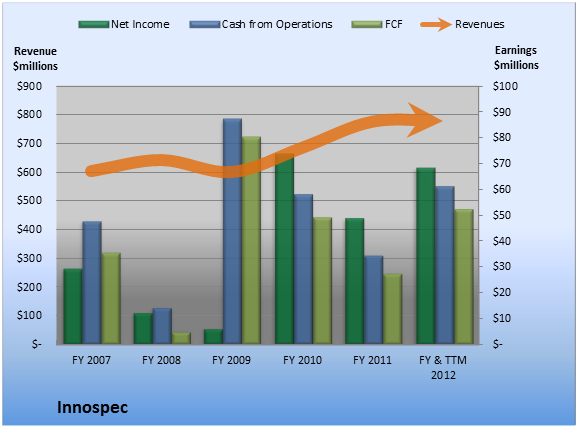
When you are trying to buy the market’s best stocks, it’s worth checking up on your companies’ free cash flow once a quarter or so, to see whether it bears any relationship to the net income in the headlines. That’s what we do with this series. Today, we’re checking in on Innospec (NAS: IOSP) , whose recent revenue and earnings are plotted below.

Source: S&P Capital IQ. Data is current as of last fully reported fiscal quarter. Dollar values in millions. FCF = free cash flow. FY = fiscal year. TTM = trailing 12 months.

Over the past 12 months, Innospec generated $52.5 million cash while it booked net income of $68.3 million. That means it turned 6.8% of its revenue into FCF. That sounds OK. However, FCF is less than net income. Ideally, we’d like to see the opposite.

All cash is not equal
Unfortunately, the cash flow statement isn’t immune from nonsense, either. That’s why it pays to take a close look at the components of cash flow from operations, to make sure that the cash flows are of high quality. What does that mean? To me, it means they need to be real and replicable in the upcoming quarters, rather than being offset by continual cash outflows that don’t appear on the income statement (such as major capital expenditures).

For instance, cash flow based on cash net income and adjustments for non-cash income-statement expenses (like depreciation) is generally favorable. An increase in cash flow based on stiffing your suppliers (by increasing accounts payable for the short term) or shortchanging Uncle Sam on taxes will come back to bite investors later. The same goes for decreasing accounts receivable; this is good to see, but it’s ordinary in recessionary times, and you can only increase collections so much. Finally, adding stock-based compensation expense back to cash flows is questionable when a company hands out a lot of equity to employees and uses cash in later periods to buy back those shares.

So how does …read more
Source: FULL ARTICLE at DailyFinance

Has Boulder Brands Made You Any Real Money?

By Seth Jayson, The Motley Fool

Filed under:

Although business headlines still tout earnings numbers, many investors have moved past net earnings as a measure of a company’s economic output. That’s because earnings are very often less trustworthy than cash flow, since earnings are more open to manipulation based on dubious judgment calls.

Earnings’ unreliability is one of the reasons Foolish investors often flip straight past the income statement to check the cash flow statement. In general, by taking a close look at the cash moving in and out of the business, you can better understand whether the last batch of earnings brought money into the company, or merely disguised a cash gusher with a pretty headline.

Calling all cash flows

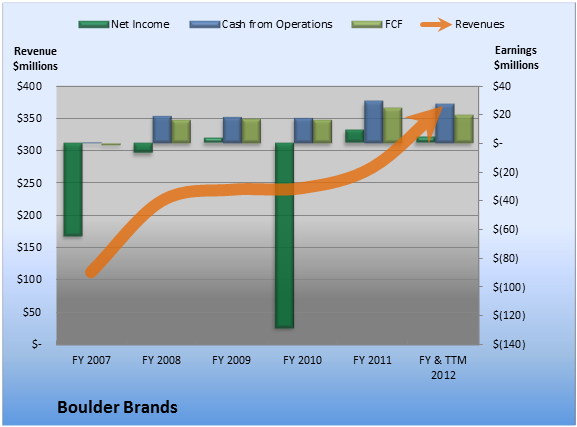
When you are trying to buy the market’s best stocks, it’s worth checking up on your companies’ free cash flow once a quarter or so, to see whether it bears any relationship to the net income in the headlines. That’s what we do with this series. Today, we’re checking in on Boulder Brands (NAS: BDBD) , whose recent revenue and earnings are plotted below.

Source: S&P Capital IQ. Data is current as of last fully reported fiscal quarter. Dollar values in millions. FCF = free cash flow. FY = fiscal year. TTM = trailing 12 months.

Over the past 12 months, Boulder Brands generated $19.6 million cash while it booked net income of $4.2 million. That means it turned 5.3% of its revenue into FCF. That sounds OK.

All cash is not equal
Unfortunately, the cash flow statement isn’t immune from nonsense, either. That’s why it pays to take a close look at the components of cash flow from operations, to make sure that the cash flows are of high quality. What does that mean? To me, it means they need to be real and replicable in the upcoming quarters, rather than being offset by continual cash outflows that don’t appear on the income statement (such as major capital expenditures).

For instance, cash flow based on cash net income and adjustments for non-cash income-statement expenses (like depreciation) is generally favorable. An increase in cash flow based on stiffing your suppliers (by increasing accounts payable for the short term) or shortchanging Uncle Sam on taxes will come back to bite investors later. The same goes for decreasing accounts receivable; this is good to see, but it’s ordinary in recessionary times, and you can only increase collections so much. Finally, adding stock-based compensation expense back to cash flows is questionable when a company hands out a lot of equity to employees and uses cash in later periods to buy back those shares.

So how does the cash flow at Boulder Brands look? Take a peek at the …read more
Source: FULL ARTICLE at DailyFinance

Has Freescale Semiconductor Made You Any Real Money?

By Seth Jayson, The Motley Fool

Filed under:

Although business headlines still tout earnings numbers, many investors have moved past net earnings as a measure of a company’s economic output. That’s because earnings are very often less trustworthy than cash flow, since earnings are more open to manipulation based on dubious judgment calls.

Earnings’ unreliability is one of the reasons Foolish investors often flip straight past the income statement to check the cash flow statement. In general, by taking a close look at the cash moving in and out of the business, you can better understand whether the last batch of earnings brought money into the company, or merely disguised a cash gusher with a pretty headline.

Calling all cash flows

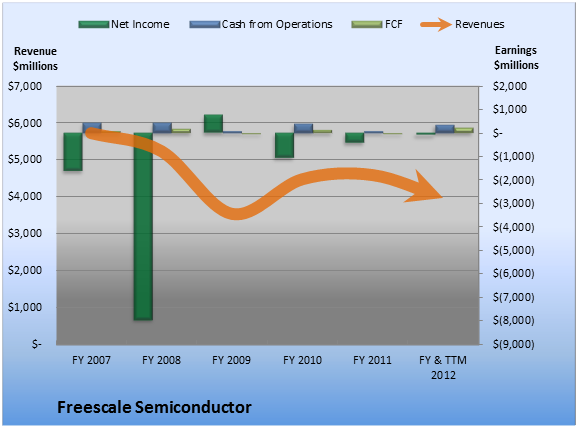
When you are trying to buy the market’s best stocks, it’s worth checking up on your companies’ free cash flow once a quarter or so, to see whether it bears any relationship to the net income in the headlines. That’s what we do with this series. Today, we’re checking in on Freescale Semiconductor (NYS: FSL) , whose recent revenue and earnings are plotted below.

Source: S&P Capital IQ. Data is current as of last fully reported fiscal quarter. Dollar values in millions. FCF = free cash flow. FY = fiscal year. TTM = trailing 12 months.

Over the past 12 months, Freescale Semiconductor generated $227.0 million cash while it booked a net loss of $102.0 million. That means it turned 5.8% of its revenue into FCF. That sounds OK.

All cash is not equal
Unfortunately, the cash flow statement isn’t immune from nonsense, either. That’s why it pays to take a close look at the components of cash flow from operations, to make sure that the cash flows are of high quality. What does that mean? To me, it means they need to be real and replicable in the upcoming quarters, rather than being offset by continual cash outflows that don’t appear on the income statement (such as major capital expenditures).

For instance, cash flow based on cash net income and adjustments for non-cash income-statement expenses (like depreciation) is generally favorable. An increase in cash flow based on stiffing your suppliers (by increasing accounts payable for the short term) or shortchanging Uncle Sam on taxes will come back to bite investors later. The same goes for decreasing accounts receivable; this is good to see, but it’s ordinary in recessionary times, and you can only increase collections so much. Finally, adding stock-based compensation expense back to cash flows is questionable when a company hands out a lot of equity to employees and uses cash in later periods to buy back those shares.

So how does the cash flow at Freescale Semiconductor look? Take a peek at …read more
Source: FULL ARTICLE at DailyFinance

Has MSC Industrial Direct Made You Any Real Money?

By Seth Jayson, The Motley Fool

Filed under:

Although business headlines still tout earnings numbers, many investors have moved past net earnings as a measure of a company’s economic output. That’s because earnings are very often less trustworthy than cash flow, since earnings are more open to manipulation based on dubious judgment calls.

Earnings’ unreliability is one of the reasons Foolish investors often flip straight past the income statement to check the cash flow statement. In general, by taking a close look at the cash moving in and out of the business, you can better understand whether the last batch of earnings brought money into the company, or merely disguised a cash gusher with a pretty headline.

Calling all cash flows

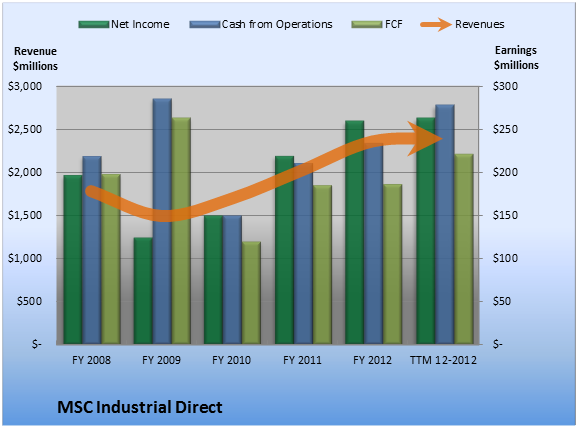
When you are trying to buy the market’s best stocks, it’s worth checking up on your companies’ free cash flow once a quarter or so, to see whether it bears any relationship to the net income in the headlines. That’s what we do with this series. Today, we’re checking in on MSC Industrial Direct (NYS: MSM) , whose recent revenue and earnings are plotted below.

Source: S&P Capital IQ. Data is current as of last fully reported fiscal quarter. Dollar values in millions. FCF = free cash flow. FY = fiscal year. TTM = trailing 12 months.

Over the past 12 months, MSC Industrial Direct generated $221.0 million cash while it booked net income of $262.4 million. That means it turned 9.3% of its revenue into FCF. That sounds OK. However, FCF is less than net income. Ideally, we’d like to see the opposite.

All cash is not equal
Unfortunately, the cash flow statement isn’t immune from nonsense, either. That’s why it pays to take a close look at the components of cash flow from operations, to make sure that the cash flows are of high quality. What does that mean? To me, it means they need to be real and replicable in the upcoming quarters, rather than being offset by continual cash outflows that don’t appear on the income statement (such as major capital expenditures).

For instance, cash flow based on cash net income and adjustments for non-cash income-statement expenses (like depreciation) is generally favorable. An increase in cash flow based on stiffing your suppliers (by increasing accounts payable for the short term) or shortchanging Uncle Sam on taxes will come back to bite investors later. The same goes for decreasing accounts receivable; this is good to see, but it’s ordinary in recessionary times, and you can only increase collections so much. Finally, adding stock-based compensation expense back to cash flows is questionable when a company hands out a lot of equity to employees and uses cash in later periods to buy back …read more
Source: FULL ARTICLE at DailyFinance
Has Viasystems Group Made You Any Real Money?

By Seth Jayson, The Motley Fool

Filed under:

Although business headlines still tout earnings numbers, many investors have moved past net earnings as a measure of a company’s economic output. That’s because earnings are very often less trustworthy than cash flow, since earnings are more open to manipulation based on dubious judgment calls.

Earnings’ unreliability is one of the reasons Foolish investors often flip straight past the income statement to check the cash flow statement. In general, by taking a close look at the cash moving in and out of the business, you can better understand whether the last batch of earnings brought money into the company, or merely disguised a cash gusher with a pretty headline.

Calling all cash flows

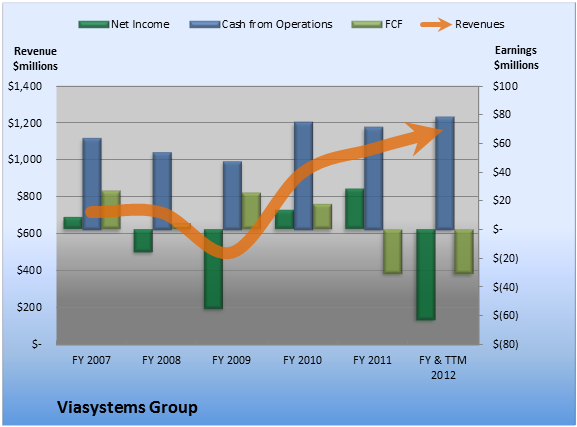
When you are trying to buy the market’s best stocks, it’s worth checking up on your companies’ free cash flow once a quarter or so, to see whether it bears any relationship to the net income in the headlines. That’s what we do with this series. Today, we’re checking in on Viasystems Group (NAS: VIAS) , whose recent revenue and earnings are plotted below.

Source: S&P Capital IQ. Data is current as of last fully reported fiscal quarter. Dollar values in millions. FCF = free cash flow. FY = fiscal year. TTM = trailing 12 months.

Over the past 12 months, Viasystems Group burned $30.6 million cash while it booked a net loss of $62.3 million. That means it burned through all its revenue and more. That doesn’t sound so great.

All cash is not equal
Unfortunately, the cash flow statement isn’t immune from nonsense, either. That’s why it pays to take a close look at the components of cash flow from operations, to make sure that the cash flows are of high quality. What does that mean? To me, it means they need to be real and replicable in the upcoming quarters, rather than being offset by continual cash outflows that don’t appear on the income statement (such as major capital expenditures).

For instance, cash flow based on cash net income and adjustments for non-cash income-statement expenses (like depreciation) is generally favorable. An increase in cash flow based on stiffing your suppliers (by increasing accounts payable for the short term) or shortchanging Uncle Sam on taxes will come back to bite investors later. The same goes for decreasing accounts receivable; this is good to see, but it’s ordinary in recessionary times, and you can only increase collections so much. Finally, adding stock-based compensation expense back to cash flows is questionable when a company hands out a lot of equity to employees and uses cash in later periods to buy back those shares.

So how does the cash flow at Viasystems Group look? Take a …read more
Source: FULL ARTICLE at DailyFinance

Why NiSource's Earnings May Not Be So Hot

By Seth Jayson, The Motley Fool

Filed under:

Although business headlines still tout earnings numbers, many investors have moved past net earnings as a measure of a company’s economic output. That’s because earnings are very often less trustworthy than cash flow, since earnings are more open to manipulation based on dubious judgment calls.

Earnings’ unreliability is one of the reasons Foolish investors often flip straight past the income statement to check the cash flow statement. In general, by taking a close look at the cash moving in and out of the business, you can better understand whether the last batch of earnings brought money into the company, or merely disguised a cash gusher with a pretty headline.

Calling all cash flows

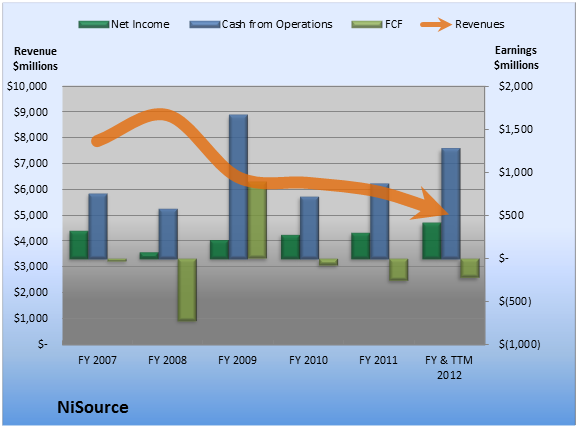
When you are trying to buy the market’s best stocks, it’s worth checking up on your companies’ free cash flow once a quarter or so, to see whether it bears any relationship to the net income in the headlines. That’s what we do with this series. Today, we’re checking in on NiSource (NYS: NI) , whose recent revenue and earnings are plotted below.

Source: S&P Capital IQ. Data is current as of last fully reported fiscal quarter. Dollar values in millions. FCF = free cash flow. FY = fiscal year. TTM = trailing 12 months.

Over the past 12 months, NiSource burned $223.3 million cash while it booked net income of $416.1 million. That means it burned through all its revenue and more. That doesn’t sound so great. FCF is less than net income. Ideally, we’d like to see the opposite.

All cash is not equal
Unfortunately, the cash flow statement isn’t immune from nonsense, either. That’s why it pays to take a close look at the components of cash flow from operations, to make sure that the cash flows are of high quality. What does that mean? To me, it means they need to be real and replicable in the upcoming quarters, rather than being offset by continual cash outflows that don’t appear on the income statement (such as major capital expenditures).

For instance, cash flow based on cash net income and adjustments for non-cash income-statement expenses (like depreciation) is generally favorable. An increase in cash flow based on stiffing your suppliers (by increasing accounts payable for the short term) or shortchanging Uncle Sam on taxes will come back to bite investors later. The same goes for decreasing accounts receivable; this is good to see, but it’s ordinary in recessionary times, and you can only increase collections so much. Finally, adding stock-based compensation expense back to cash flows is questionable when a company hands out a lot of equity to employees and uses cash in later periods to buy back those shares.

So how …read more
Source: FULL ARTICLE at DailyFinance
Don't Get Too Worked Up Over Bristow Group's Earnings

By Seth Jayson, The Motley Fool

Filed under:

Although business headlines still tout earnings numbers, many investors have moved past net earnings as a measure of a company’s economic output. That’s because earnings are very often less trustworthy than cash flow, since earnings are more open to manipulation based on dubious judgment calls.

Earnings’ unreliability is one of the reasons Foolish investors often flip straight past the income statement to check the cash flow statement. In general, by taking a close look at the cash moving in and out of the business, you can better understand whether the last batch of earnings brought money into the company, or merely disguised a cash gusher with a pretty headline.

Calling all cash flows

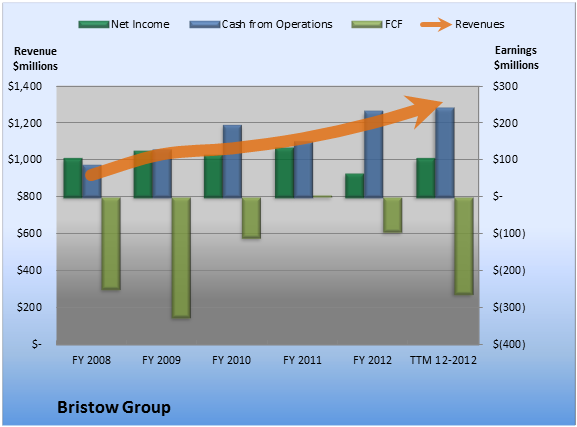
When you are trying to buy the market’s best stocks, it’s worth checking up on your companies’ free cash flow once a quarter or so, to see whether it bears any relationship to the net income in the headlines. That’s what we do with this series. Today, we’re checking in on Bristow Group (NYS: BRS) , whose recent revenue and earnings are plotted below.

Source: S&P Capital IQ. Data is current as of last fully reported fiscal quarter. Dollar values in millions. FCF = free cash flow. FY = fiscal year. TTM = trailing 12 months.

Over the past 12 months, Bristow Group burned $263.2 million cash while it booked net income of $104.0 million. That means it burned through all its revenue and more. That doesn’t sound so great. FCF is less than net income. Ideally, we’d like to see the opposite.

All cash is not equal
Unfortunately, the cash flow statement isn’t immune from nonsense, either. That’s why it pays to take a close look at the components of cash flow from operations, to make sure that the cash flows are of high quality. What does that mean? To me, it means they need to be real and replicable in the upcoming quarters, rather than being offset by continual cash outflows that don’t appear on the income statement (such as major capital expenditures).

For instance, cash flow based on cash net income and adjustments for non-cash income-statement expenses (like depreciation) is generally favorable. An increase in cash flow based on stiffing your suppliers (by increasing accounts payable for the short term) or shortchanging Uncle Sam on taxes will come back to bite investors later. The same goes for decreasing accounts receivable; this is good to see, but it’s ordinary in recessionary times, and you can only increase collections so much. Finally, adding stock-based compensation expense back to cash flows is questionable when a company hands out a lot of equity to employees and uses cash in later periods to buy back those …read more
Source: FULL ARTICLE at DailyFinance

Don't Get Too Worked Up Over Cubic's Earnings

By Seth Jayson, The Motley Fool

Filed under:

Although business headlines still tout earnings numbers, many investors have moved past net earnings as a measure of a company’s economic output. That’s because earnings are very often less trustworthy than cash flow, since earnings are more open to manipulation based on dubious judgment calls.

Earnings’ unreliability is one of the reasons Foolish investors often flip straight past the income statement to check the cash flow statement. In general, by taking a close look at the cash moving in and out of the business, you can better understand whether the last batch of earnings brought money into the company, or merely disguised a cash gusher with a pretty headline.

Calling all cash flows

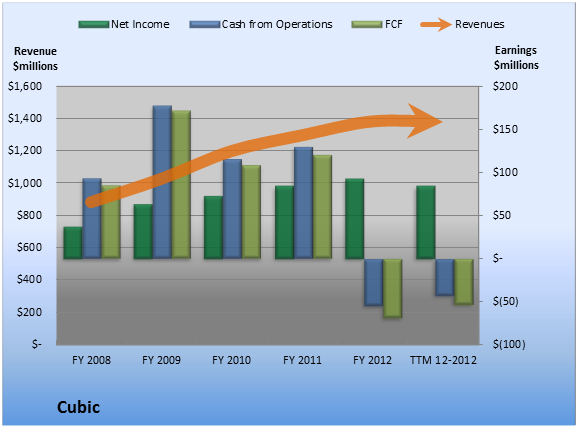
When you are trying to buy the market’s best stocks, it’s worth checking up on your companies’ free cash flow once a quarter or so, to see whether it bears any relationship to the net income in the headlines. That’s what we do with this series. Today, we’re checking in on Cubic (NYS: CUB) , whose recent revenue and earnings are plotted below.

Source: S&P Capital IQ. Data is current as of last fully reported fiscal quarter. Dollar values in millions. FCF = free cash flow. FY = fiscal year. TTM = trailing 12 months.

Over the past 12 months, Cubic burned $52.8 million cash while it booked net income of $83.7 million. That means it burned through all its revenue and more. That doesn’t sound so great. FCF is less than net income. Ideally, we’d like to see the opposite.

All cash is not equal
Unfortunately, the cash flow statement isn’t immune from nonsense, either. That’s why it pays to take a close look at the components of cash flow from operations, to make sure that the cash flows are of high quality. What does that mean? To me, it means they need to be real and replicable in the upcoming quarters, rather than being offset by continual cash outflows that don’t appear on the income statement (such as major capital expenditures).

For instance, cash flow based on cash net income and adjustments for non-cash income-statement expenses (like depreciation) is generally favorable. An increase in cash flow based on stiffing your suppliers (by increasing accounts payable for the short term) or shortchanging Uncle Sam on taxes will come back to bite investors later. The same goes for decreasing accounts receivable; this is good to see, but it’s ordinary in recessionary times, and you can only increase collections so much. Finally, adding stock-based compensation expense back to cash flows is questionable when a company hands out a lot of equity to employees and uses cash in later periods to buy back those shares.

So how …read more
Source: FULL ARTICLE at DailyFinance
Why Woodward's Earnings May Not Be So Hot

By Seth Jayson, The Motley Fool

Filed under:

Although business headlines still tout earnings numbers, many investors have moved past net earnings as a measure of a company’s economic output. That’s because earnings are very often less trustworthy than cash flow, since earnings are more open to manipulation based on dubious judgment calls.

Earnings’ unreliability is one of the reasons Foolish investors often flip straight past the income statement to check the cash flow statement. In general, by taking a close look at the cash moving in and out of the business, you can better understand whether the last batch of earnings brought money into the company, or merely disguised a cash gusher with a pretty headline.

Calling all cash flows

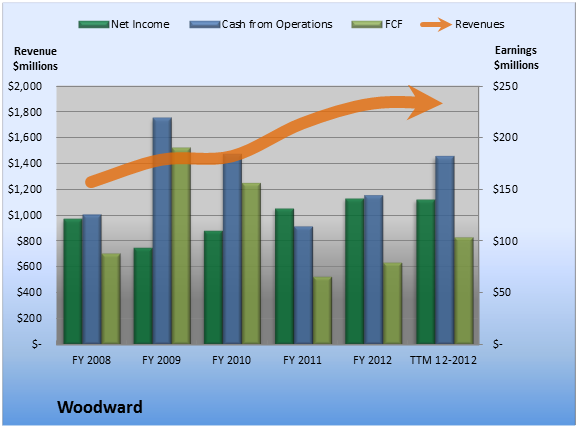
When you are trying to buy the market’s best stocks, it’s worth checking up on your companies’ free cash flow once a quarter or so, to see whether it bears any relationship to the net income in the headlines. That’s what we do with this series. Today, we’re checking in on Woodward (NAS: WWD) , whose recent revenue and earnings are plotted below.

Source: S&P Capital IQ. Data is current as of last fully reported fiscal quarter. Dollar values in millions. FCF = free cash flow. FY = fiscal year. TTM = trailing 12 months.

Over the past 12 months, Woodward generated $104.2 million cash while it booked net income of $140.5 million. That means it turned 5.6% of its revenue into FCF. That sounds OK. However, FCF is less than net income. Ideally, we’d like to see the opposite.

All cash is not equal
Unfortunately, the cash flow statement isn’t immune from nonsense, either. That’s why it pays to take a close look at the components of cash flow from operations, to make sure that the cash flows are of high quality. What does that mean? To me, it means they need to be real and replicable in the upcoming quarters, rather than being offset by continual cash outflows that don’t appear on the income statement (such as major capital expenditures).

For instance, cash flow based on cash net income and adjustments for non-cash income-statement expenses (like depreciation) is generally favorable. An increase in cash flow based on stiffing your suppliers (by increasing accounts payable for the short term) or shortchanging Uncle Sam on taxes will come back to bite investors later. The same goes for decreasing accounts receivable; this is good to see, but it’s ordinary in recessionary times, and you can only increase collections so much. Finally, adding stock-based compensation expense back to cash flows is questionable when a company hands out a lot of equity to employees and uses cash in later periods to buy back those shares.

So how does …read more
Source: FULL ARTICLE at DailyFinance