Tag Archives: Payout Ratio

How Lowe's Has Built Up Its Dividends

By Dan Caplinger, The Motley Fool

Filed under:

Investors have always been interested in stocks that pay dividends, but lately, low interest rates on bonds and other fixed-income investments have made solid dividend payers even more valuable. Among the most promising dividend stocks in the market is Lowe’s , and one big reason is that it’s one of the few exclusive companies to make the list of Dividend Aristocrats. In order to become a member of this elite group, a company must have raised its dividend payouts to shareholders every single year for at least a quarter-century. Only a few dozen stocks manage to make the cut, and those that do tend to stay there for a long time.

Lowe’s is one of the big two names in home improvement retail but, unlike its rival, it struggled for years during the extended slide in home prices. Even when things looked like they were improving in housing, they repeatedly gave way to even worse conditions, especially in certain hard-hit markets. But last year, the housing market finally started to hit bottom and, ever since, Lowe’s stock has found a new following among investors. Let’s take a closer look at Lowe’s to see whether it can sustain its long streak of rewarding dividend payouts to investors.

Dividend Stats on Lowe’s


Current Quarterly Dividend Per Share

$0.16

Current Yield

1.7%

Number of Consecutive Years With Dividend Increases

50 years

Payout Ratio

37%

Last Increase

July 2012

Source: Yahoo! Finance. Last increase refers to ex-dividend date.

How Lowe’s has put a roof over investors’ heads
In the home improvement space, it’s impossible to avoid comparisons between Lowe’s and rival Home Depot . Both companies have impressed investors in recent months, with Home Depot having reported a 14% jump in sales in its most recent quarter, and rewarding shareholders with a whopping 37% dividend increase. That leaves Lowe’s with a lot of catching up to do and, for its part, Lowe’s earnings were good, but not nearly as strong as Home Depot‘s — due, in part, to Lowe’s smaller size and less extensive store network. Moreover, Lowe’s guidance for 2013 was somewhat disappointing, even in the face of an improving housing market.

The big question for Lowe’s, though, is whether it can bolster same-store sales in its existing locations to nearly the extent that Home Depot has. In addition to having to deal with its larger rival, Lowe’s also faces the challenge of dealing with smaller niche players in the home-improvement space. Flooring specialist Lumber Liquidators and deck-materials maker Trex aren’t threats to take over Lowe’s entire business, but they’ve sought ways to capitalize on particularly lucrative segments and could force Lowe’s to rely more heavily on lower-margin goods like appliances.

Lowe’s Dividend data by YCharts.

With a relatively low payout ratio, Lowe’s has been able to sustain dividend increases even during tough times. What Lowe’s

From: http://www.dailyfinance.com/2013/04/11/how-lowes-has-built-up-its-dividends/

How Hormel Keeps Serving Up Strong Dividends

By Dan Caplinger, The Motley Fool

Filed under:

Investors have always been interested in stocks that pay dividends, but lately, low interest rates on bonds and other fixed-income investments have made solid dividend payers even more valuable. Among the most promising dividend stocks in the market is Hormel Foods , and one big reason is that it is one of the few exclusive companies to make the list of Dividend Aristocrats.

In order to become a member of this elite group, a company must have raised its dividend payouts to shareholders every single year for at least a quarter-century. Only a few dozen stocks manage to make the cut, and those that do tend to stay there for a long time.

Hormel is famous for Spam, but it offers a full line of meat and other food products, ranging from Chi-Chi’s salsa and tortillas to Dinty Moore beef stew. Like many consumer-oriented businesses, Hormel has built up a reliable customer base that gives it a dependable and predictable flow of cash that it can then funnel out to shareholders. Let’s take a closer look at Hormel to see whether it can sustain its long streak of rewarding dividend payouts to investors.

Dividend Stats on Hormel


Current Quarterly Dividend Per Share

$0.17

Current Yield

1.7%

Number of Consecutive Years With Dividend Increases

47 years

Payout Ratio

33%

Last Increase

January 2013

Source: Yahoo! Finance. Last increase refers to ex-dividend date.

What’s happening at Hormel?
Hormel has done a good job of handling the challenges it has faced recently. Despite pressures from high feed costs resulting from last summer’s drought, its most recent quarterly results included a 1% gain in net income on a 4% increase in revenue. Moreover, the company boosted its full-year guidance by $0.03 per share, citing improving margins in its pork segment and continued strong performance from its Grocery Products division. Even though grocery products represent a small piece of Hormel’s business, it’s becoming increasingly important, as the recent split of Kraft Foods has created more urgency among competitors like Hormel to defend their turf and seek ways to expand.

Along those lines, the biggest recent news from Hormel came at the beginning of the year, when it announced it would buy the Skippy peanut butter brand from Unilever for $700 million. Somewhat surprisingly, Skippy is a major player not just in the U.S. but in China as well, where it’s the No. 1 peanut butter brand. As a result, the deal helps bolster Hormel’s attempts to expand internationally, and investors have applauded it as the stock that has risen almost 30% in response.

But the key for Hormel remains pork, which still represents the bulk of its business. That industry has seen mixed results lately, as domestic pork consumption has been weak but exports have kept the business growing. Tyson Foods relies more on chicken than pork, but its pork

Source: FULL ARTICLE at DailyFinance

Can Dead Dividends Deliver Growth?

By Justin Loiseau, The Motley Fool

Filed under:

On Feb. 26, Atlantic Power did something responsible: It slashed its dividend by 66% in the name of long-term value creation. But the aftermath of its actions shows that dividend haircuts don’t always look good. Let’s dig deeper into Atlantic’s decision, peek into the past for some much-needed perspective, and check out the new look of another company that recently received a dividend haircut.

Dawn of the dead dividend
As part of Atlantic’s Q4 2012 earnings report, CEO Barry Welch noted that the utility’s board decided that “it was in the best interest of the company and its shareholders to establish a lower and more sustainable Payout Ratio that balances yield and growth and is at the same time consistent with our outlook for current and prospective projects under a range of scenarios.”

In real numbers, this announcement represented a 66% drop in the company’s monthly payouts, a move that would’ve devastated the utility’s 10.2% dividend yield – if not for its share price plummet.

Source: AT data by YCharts

But the cause for Atlantic’s crash didn’t come from its dividend cut. Since its announcement, three law firms have filed class action lawsuits against Atlantic for intentionally misleading investors about its current cash flow and the impending deadlines of key contracts. If the allegations turn out to be true, Atlantic’s dividend cut did nothing more than reveal an inevitable bald spot in the company’s receding hairline.

Look into the past…
Dividend cuts happen. This Friday, TECO Energy will celebrate the 10th anniversary of the day it dropped its dividend 46% to balance its books and refocus on its core businesses.

CEO Robert Fagan’s carefully chosen words during the announcement hint at what he was sure would amount to Wall Street suicide: “We recognize the greatest impact will be on our retail shareholders. However, we believe that it will be in their interests longer-term… This level of dividend positions TECO Energy to return to… long-term dividend growth when conditions improve.” But since that fateful day, TECO‘s stock has stepped up a respectable 66% alongside its growing dividend.

Source: TE data by YCharts

Beware the “Stairmaster”
Companies must decide for themselves whether dividends are the best method to return value to shareholders. Although it’s never inherently a bad idea to boost dividends, investors should beware the “Stairmaster.” A dividend stock that flexes its financial muscles quarter after quarter may not be using its resources intelligently. Step after step, Southern Company and Xcel Energy have pushed their dividends higher through the worst of the Great Recession.

Source: SO Dividend data by YCharts

Atlantic, why can’t you be more like Exelon?
Atlantic wasn’t the only utility to dice up its dividend this past quarter. Exelon announced on Feb. 7 that it would slash its dividend by a whopping 40%. But unlike Atlantic, Exelon’s stock has risen 12% since its earnings report. That’s 4.5 percentage …read more

Source: FULL ARTICLE at DailyFinance

ADP: A Smart Dividend Stock

By Dan Caplinger, The Motley Fool

Filed under:

Investors have always been interested in stocks that pay dividends, but lately, low interest rates on bonds and other fixed-income investments have made solid dividend payers even more valuable. Among the most promising dividend stocks in the market is Automatic Data Processing , and one big reason is that it is one of the few exclusive companies to make the list of Dividend Aristocrats. In order to become a member of this elite group, a company must have raised its dividend payouts to shareholders every single year for at least a quarter-century. Only a few dozen stocks manage to make the cut, and those that do tend to stay there for a long time.

ADP is a huge player in the payroll-processing and HR-services industry, with clients including some of the biggest corporations in the world. But with employment having been sluggish at best in recent years, how has ADP coped? Let’s take a closer look at ADP to see whether it can sustain its long streak of rewarding dividend payouts to investors.

Dividend Stats on ADP


Current Quarterly Dividend Per Share

$0.435

Current Yield

2.7%

Number of Consecutive Years With Dividend Increases

38 years

Payout Ratio

56%

Last Increase

December 2012

Source: Yahoo! Finance. Last increase refers to ex-dividend date.

The latest news from ADP
A big part of ADP‘s success comes simply from its being in an industry where the costs of switching to rival providers typically outweigh any prospective benefits. For the most part, ADP and rival Paychex have carved up the industry into two parts, with ADP having had success with many of the largest employers while Paychex tends to target the smaller and mid-sized employer market.

But recently, ADP and Paychex have seen a potential new competitor in the mix. Intuit has gotten its foot in the small-business door with its popular Quickbooks and TurboTax software, and the company sees plenty of opportunity in getting business customers who use its accounting and tax products to move their entire HR suite to Intuit. That arguably affects the smaller-focused Paychex more than ADP, but Intuit has a history of going after larger game once it consolidates its progress in a particular industry.

Source: ADP Dividend data by YCharts.

As you can see, ADP‘s dividend growth slowed slightly during the 2008 recession, as many companies that focused on serving business customers fell prey to the recession’s impact. But since then, ADP has started to boost its dividend more sharply again, with its most recent increase amounting to more than a 10% gain.

When will dividends rise again?
Since ADP‘s most recent dividend increase was back in December, investors will likely have to wait six months or longer for another jump in the payouts they receive. But with strong leadership at ADP’s helm and some signs of the economy growing again, …read more

Source: FULL ARTICLE at DailyFinance

Sysco Is a Smart Stock for Dividend Investors

By Dan Caplinger, The Motley Fool

SYY Dividend Chart

Filed under:

Investors have always been interested in stocks that pay dividends, but lately, low interest rates on bonds and other fixed-income investments have made solid dividend payers even more valuable. Among the most promising dividend stocks in the market is Sysco , and one big reason is that it is one of the few exclusive companies to make the list of Dividend Aristocrats. In order to become a member of this elite group, a company must have raised its dividend payouts to shareholders every single year for at least a quarter-century. Only a few dozen stocks manage to make the cut, and those that do tend to stay there for a long time.

Sysco dominates its industry, providing food products and services to hundreds of thousands of institutional clients. With its extensive distribution network, Sysco uses economies of scale to its advantage, holding off competitors by offering timely and efficient service wherever it’s needed. Let’s take a closer look at Sysco to see whether it can sustain its long streak of rewarding dividend payouts to investors.

Dividend Stats on Sysco

Current Quarterly Dividend Per Share

$0.28

Current Yield

3.3%

Number of Consecutive Years With Dividend Increases

43 years

Payout Ratio

59%

Last Increase

January 2013

Source: Yahoo! Finance. Last increase refers to ex-dividend date.

Has Sysco fed investors well lately?
Sysco’s strong position within the industry has left it without serious competition domestically. Other food distribution businesses do exist, but they’ve generally had to retreat to serve smaller niches within the industry. For instance, Core-Mark has found a profitable business serving convenience stores, with their unique needs for a mix of quick-serve snacks and other food products for travelers as well as necessities like milk for local customers. United Natural Foods has turned to the organic market for its specialty, taking advantage of increasing desires from consumers for healthier foods. Yet as long as these companies stay safely in their corners of the industry, Sysco will have a stranglehold as the food-services leader.

Yet Sysco isn’t invulnerable to headwinds affecting the entire food industry. Food-price inflation has been more prevalent lately, and although Sysco has enough pricing power to make its customers bear much of those added costs, its customers may nevertheless lack the financial wherewithal to be able to pay up when prices rise. Especially in the restaurant business, weakness even among high-growth eateries Buffalo Wild Wings and Chipotle has shown just how pervasive economic troubles are throughout the industry.

Sysco Dividend data by YCharts.

One could argue that these headwinds have led Sysco to be more conservative in its dividend growth. With the company having stuck with penny-per-share increases in its dividend in each of the past four years, Sysco has been spending more on acquisitions in an effort to expand more aggressively. In particular, international markets have great potential …read more

Source: FULL ARTICLE at DailyFinance

Archer Daniels Midland Is a Smart Dividend Buy

By Dan Caplinger, The Motley Fool

Filed under:

Investors have always been interested in stocks that pay dividends, but lately, low interest rates on bonds and other fixed-income investments have made solid dividend payers even more valuable. Among the most promising dividend stocks in the market is Archer Daniels Midland , and one big reason is that it’s one of the few exclusive companies to make the list of Dividend Aristocrats. To become a member of this elite group, a company must have raised its dividend payouts to shareholders every single year for at least a quarter-century. Only a few dozen stocks manage to make the cut, and those that do tend to stay there for a long time.

When it comes to the agricultural industry, Archer Daniels Midland is a giant, with operations throughout the food chain. From collecting and transporting crops to processing food products and animal feed as well as biodiesel and ethanol, ADM has a fully vertically integrated agricultural operation. With so much interest in the ag industry having come from high crop prices, the company has both had opportunities to profit and faced challenges to its growth. Let’s take a closer look at Archer Daniels Midland to see whether it can sustain its long streak of rewarding dividend payouts to investors.

Dividend Stats on Archer Daniels Midland

Current Quarterly Dividend Per Share

$0.19

Current Yield

2.3%

Number of Consecutive Years With Dividend Increases

38 years

Payout Ratio

34%

Last Increase

February 2013

Source: Yahoo! Finance. Last increase refers to ex-dividend date.

Has Archer Daniels Midland grown or wilted lately?
Even with generally favorable conditions in the agricultural markets, ADM has had its share of troubles lately. Last year’s drought crushed its agricultural service segment last year, seeing a 75% drop in profits as its grain elevators operated well below capacity because of heat-stricken farms that produced far less in crop yields than during normal years. Although improvement is seen coming this year for much of the Midwest and Great Plains, ongoing drought conditions could continue to pressure ADM.

Source: U.S. Seasonal Drought Outlook, National Weather Service.

ADM‘s renewable-fuel business grabs most of the attention from investors. The drought has also had a big impact in this segment as well, as ADM has had to idle ethanol production facilities because of low corn supplies following the drought. Moreover, with sugar-based ethanol competitors Bunge and Cosan already benefiting from pricing disparities between sugar and corn, prospects of potential tariffs on U.S. ethanol in Europe could give Brazilian sugar-based ethanol a competitive advantage, further hurting ADM.

Archer Daniels Midland Dividend data by YCharts.

Yet as you can see, none of these challenges has hurt ADM‘s ability to pay sizable dividends. In fact, the company just raised its payout in February, with a 9% jump in its quarterly dividend.

ADM has sought to grow by reaching out …read more

Source: FULL ARTICLE at DailyFinance

Pepsi Is a Top Dividend Stock

By Dan Caplinger, The Motley Fool

2012 Mini John Cooper Works Coupe - rear three-quarter view

Filed under:

Investors have always been interested in stocks that pay dividends, but lately, low interest rates on bonds and other fixed-income investments have made solid dividend payers even more valuable. Among the most promising dividend stocks in the market is PepsiCo , and one big reason is that it is one of the few exclusive companies to make the list of Dividend Aristocrats. In order to become a member of this elite group, a company must have raised its dividend payouts to shareholders every single year for at least a quarter-century. Only a few dozen stocks manage to make the cut, and those that do tend to stay there for a long time.

Some see PepsiCo only as an also-ran in the soft-drink market, perennially lagging behind Coca-Cola. But even though Coke has the No. 1 brand in the world and a much bigger presence in the pure beverage market, PepsiCo’s snack-foods division gives it a vital source of diversification and growth that fits extremely well with its extensive distribution network. Let’s take a closer look at PepsiCo to see whether it can sustain its long streak of rewarding dividend payouts to investors.

Dividend Stats on PepsiCo


Current Quarterly Dividend Per Share

$0.5375

Current Yield

2.7%

Number of Consecutive Years With Dividend Increases

41 years

Payout Ratio

54%

Last Increase

May 2012

Source: Yahoo! Finance. Last increase refers to ex-dividend date.

Has PepsiCo been perking investors up lately?
PepsiCo isn’t just a dividend giant; it also stands as one of the 25 best companies in America, with its dedication to workers, customers, and shareholders. A key driver for PepsiCo’s status among the nation’s industry leaders is its strategic vision, with CEO Indra Nooyi having been early to realize that trends toward greater awareness of health and nutrition would give PepsiCo an opportunity as an early adopter of healthier products. In light of the concerns about obesity and diabetes that have hit PepsiCo, Coke, and other players in the soft-drink industry, Nooyi’s foresight has proven invaluable in giving the company a head start on diversifying its product base, and responding proactively to changing demand.

In addition, PepsiCo has realized the importance of having an image as an innovative company. A big marketing push on its core brands helped boost sales substantially during the fourth quarter of 2012, and the company has positioned its new Kickstart sparkling caffeinated juice blend to go up against Monster Beverage and other big players in the energy-drink space. Expanding geographically has also been a key source of growth for Pepsi, with success in Russia and ongoing plans to bolster its presence in China and India representing important strategic moves for the company.

PepsiCo Dividend data by YCharts.

As you can see, PepsiCo has managed to keep its payouts strong over the years. Yet, like any company with a decades-long track …read more

Source: FULL ARTICLE at DailyFinance

Why Colgate-Palmolive Is a Top Dividend Stock

By Dan Caplinger, The Motley Fool

Filed under:

Investors have always been interested in stocks that pay dividends, but lately, low interest rates on bonds and other fixed-income investments have made solid dividend payers even more valuable. Among the most promising dividend stocks in the market is Colgate-Palmolive , and one big reason is that it is one of the few exclusive companies to make the list of Dividend Aristocrats. In order to become a member of this elite group, a company must have raised its dividend payouts to shareholders every single year for at least a quarter-century. Only a few dozen stocks manage to make the cut, and those that do tend to stay there for a long time.

Colgate-Palmolive is well-known for its impressive stable of consumer products. Doing business around the world, the company has delivered not only solid dividends for decades, but also the growth prospects that investors always like to see in a stock. Let’s take a closer look at Colgate-Palmolive to see whether it can sustain its long streak of rewarding dividend payouts to investors.

Dividend Stats on Colgate-Palmolive


Current Quarterly Dividend Per Share

$0.68*

Current Yield

2.3%

Number of Consecutive Years With Dividend Increases

50 years

Payout Ratio

47%

Last Increase

April 2013*

Source: Yahoo! Finance. Last increase refers to ex-dividend date. * Declared but not yet paid.

How has Colgate-Palmolive been treating shareholders lately?
As one of the best companies in America, Colgate has come from modest roots as a soap and toothpaste maker to become a global consumer-goods powerhouse. Even given the defensive nature of the sector, Colgate’s stock has performed extremely well, soaring to new all-time highs, and climbing more than 50% since early 2011.

Colgate’s overall growth strategy is largely behind the successful performance of its stock, as the company has tied its success to that of international markets across the globe. With a particular emphasis on Latin America, Colgate has prospered with strong financial results. By contrast, Procter & Gamble, the giant in the sector, has had trouble keeping its growth up in light of difficulties with product innovation, and a slowdown in its international growth. That has opened the door for Colgate to take a bigger role in the industry.

Yet, companies with strong track records of raising dividends for decades have generally had to overcome challenges along the way. Like many of its consumer-products peers, Colgate has had to face rising costs for some of the materials it needs to produce its goods. In order to keep its margins up, Colgate announced layoffs last fall amounting to about 6% of its workforce around the world. Despite those pressures, Colgate-Palmolive has managed to keep its payouts strong:

Colgate-Palmolive Dividend data by YCharts.

One big problem that hit Colgate recently was the devaluation of the Venezuelan bolivar currency. Colgate failed to be as proactive about the potential for a devaluation …read more

Source: FULL ARTICLE at DailyFinance

Why Aflac Is a Top Dividend Stock

By Dan Caplinger, The Motley Fool

Filed under:

Investors have always been interested in stocks that pay dividends, but lately, low interest rates on bonds and other fixed-income investments have made solid dividend payers even more valuable. Among the most promising dividend stocks in the market is Aflac , and one big reason is that it is one of the few exclusive companies to make the list of Dividend Aristocrats. In order to become a member of this elite group, a company must have raised its dividend payouts to shareholders every single year for at least a quarter-century. Only a few dozen stocks manage to make the cut, and those that do tend to stay there for a long time.

Aflac has a solid business that offers supplemental insurance products to U.S. customers, but many don’t know that much of Aflac’s business comes from Japan. Let’s take a closer look at Aflac to see whether it can sustain its long streak of rewarding dividend payouts to investors.

Dividend stats on Aflac


Current Quarterly Dividend Per Share

$0.35

Current Yield

2.7%

Number of Consecutive Years With Dividend Increases

30 years

Payout Ratio

22%

Last Increase

November 2012

Source: Yahoo! Finance. Last increase refers to ex-dividend date.

The latest on Aflac
Aflac has put together a record that makes it one of the best companies in America. With a reputation for fast and efficient customer service and unusually flexible coverage terms for an insurance provider, Aflac has done its best to serve its policyholders, employees, and investors well.

Unfortunately, the strong dollar in relation to the Japanese yen could well hurt Aflac’s results going forward. With roughly three-quarters of its revenue coming from the island nation, the currency impact of the yen’s recent weakening will reduce the value of its Japanese sales and income in U.S. dollar terms.

Still, the U.S. has been a bigger growth opportunity for Aflac. Last year, the company saw premium sales in the U.S. rise at a 31% clip, compared to just 1.5% in Japan. Moreover, Aflac’s ability to adjust premium rates to deal with changing loss experience lets it turn short-term setbacks into longer-term profit boosts.

Companies with strong track records of raising dividends for decades have generally had to overcome challenges along the way. Even in the face of the Japanese earthquake and tsunami back in 2011, Aflac has managed to keep its payouts strong:

Source: AFL Dividend data by YCharts.

The big unanswered question for Aflac is how Obamacare will affect its supplemental health policies. On one hand, by requiring traditional health insurers UnitedHealth and WellPoint to cover more people regardless of past medical histories, Aflac may see some customers move to more traditional policies that were formerly unavailable to them. Yet if health-care costs declines as a result of Obamacare, then Aflac’s policies should get more affordable, potentially raising interest among customers who want the flexibility and ease …read more
Source: FULL ARTICLE at DailyFinance

Can Pitney Bowes Remain a Top Dividend Stock?

By Dan Caplinger, The Motley Fool

Filed under:

Investors have always been interested in stocks that pay dividends, but lately low interest rates on bonds and other fixed-income investments have made solid dividend payers even more valuable. For years, Pitney Bowes was among the most promising dividend stocks in the market, as one of the few exclusive companies to make the list of Dividend Aristocrats. In order to become a member of this elite group, a company must have raised its dividend payouts to shareholders every single year for at least a quarter-century. Only a few dozen stocks manage to make the cut, and those that do tend to stay there for a long time.

With the company having had to make a massive shift to its business model in recent years in order to adapt to changing industry conditions, Pitney Bowes made many investors extremely nervous about whether it could remain among its Dividend Aristocrat peers. Last year, it finally got taken off the Dividend Aristocrats list, but not because it stopped increasing its payouts. Rather, it failed to meet Standard & Poor’s minimum market capitalization requirement of $3 billion. Let’s take a closer look at Pitney Bowes to see whether it can sustain its long streak of rewarding dividend payouts to investors.

Dividend Stats on Pitney Bowes


Current Quarterly Dividend Per Share

$0.375

Current Yield

10.1%

Number of Consecutive Years With Dividend Increases

30 years

Payout Ratio

68%

Last Increase

February 2012

Source: Yahoo! Finance. Last increase refers to ex-dividend date.

The latest on Pitney Bowes
Pitney Bowes was once the undisputed giant in the global mail-services industry. With huge market share in sales of its postage meters and other business mailing essentials, it was an integral part of how both large and small businesses reached out to their customers.

Lately, though, the company has realized that the writing was on the wall for its legacy mailing business. As more delivery services went online, upstart Stamps.com and Newell Rubbermaid‘s Endicia took away some of Pitney Bowes‘ dominant position in the industry.

In response, Pitney Bowes has turned to a dramatic restructuring, moving in the direction of broader-based business services, with a focus on business analytics and data management. That’s an extremely crowded industry, but it also has a lot more growth opportunities than its legacy business. With the rise of the Big Data initiative, Pitney Bowes has plenty of room to use assets like its geocoding software to open doors to new customers.

Looking at its most recent dividends, Pitney Bowes has been getting by on just token payout increases for a long time now:

Source: PBI Dividend data by YCharts.

Pitney Bowes has also been finding other uses for its free cash. Just last week, it said that it had accepted about $400 million in tendered notes from bondholders to retire debt due in the next three years. That may …read more
Source: FULL ARTICLE at DailyFinance

Why Walgreen Is a Top Dividend Stock

By Dan Caplinger, The Motley Fool

Hyundai Emblem

Filed under:

Investors have always been interested in stocks that pay dividends, but lately, low interest rates on bonds and other fixed-income investments have made solid dividend payers even more valuable. Among the most promising dividend stocks in the market is Walgreen , and one big reason is that it is one of the few exclusive companies to make the list of Dividend Aristocrats. In order to become a member of this elite group, a company must have raised its dividend payouts to shareholders every single year for at least a quarter-century. Only a few dozen stocks manage to make the cut, and those that do tend to stay there for a long time.

Walgreen has had its share of ups and downs over the past year, but things are starting to look up for the drugstore giant. Let’s take a closer look at Walgreen to see whether it can sustain its long streak of rewarding dividend payouts to investors.

Dividend Stats on Walgreen

Current Quarterly Dividend per Share

$0.275

Current Yield

2.3%

Number of Consecutive Years With Dividend Increases

37 years

Payout Ratio

47%

Last Increase

May 2012

Source: Yahoo! Finance. Last increase refers to ex-dividend date.

The latest on Walgreen
Walgreen suffered a lot during 2012, as its dispute with pharmacy benefits manager Express Scripts led to an exodus of customers to rival drugstore chains. Even after Walgreen and Express Scripts came to a resolution, Walgreen has had a tough time bringing those customers back.

Still, companies that manage to raise their dividends for decades all go through their share of challenges. So far, Walgreen has managed to keep its payouts strong:

WAG Dividend data by YCharts.

Moreover, Walgreen has taken some big steps to bolster growth. Its purchase of a 45% stake in Europe’s Alliance Boots drug chain last summer was part of its larger strategy to expand across the globe as it seeks to diversify and take advantage of better growth opportunities abroad. More recently, Walgreen’s move to replace Cardinal Health as its drug distributor in favor of a 10-year agreement with rival AmerisourceBergen will enhance its global distribution capacity, and Walgreen and Alliance will take an equity position in AmerisourceBergen as well to cement the partnership.

When will dividends rise again?
Last year, Walgreen raised its dividend during the spring, so investors should prepare for another increase in the near future. What’s more important in the long run, though, is whether its major strategic moves will lead to a return to stronger growth. If so, then Walgreen should remain a Dividend Aristocrat for a long, long time.

Walgreen’s dispute with Express Scripts shows just how important pharmacy-benefits management has become in a health care landscape dominated by searching for ways to control costs. Find out how Express Scripts is part of the solution by reading our premium research …read more
Source: FULL ARTICLE at DailyFinance

Atlantic Power Earnings: Can It Get Any Worse?

By Justin Loiseau, The Motley Fool

AT Revenue Annual Chart

Filed under:

Atlantic Power‘s shares plummeted 30% last week when the utility reported dismal earnings and slashed its dividend in half. With bargain bin prices, now might seem like the perfect time for a value grab, but the company’s dreary quarter could be the first of many. Here’s what you need to know.

Number crunching
There’s no beating around the bush: Atlantic had an absolute mess of a quarter. On the top line, its $114 million in sales came up 27% short of analyst estimates, and 9.3% lower than Q4 2011’s GAAP reported sales.

But falling sales were a common trend for utilities this quarter — the real trouble comes from the company’s bottom line. The utility reported GAAP EPS of -$0.50, a whopping $0.45 below Mr. Market’s expectations and almost double the loss Atlantic reported for 2011’s fourth quarter. This most recent news marks the sixth straight quarter that the utility has underwhelmed Wall Street.

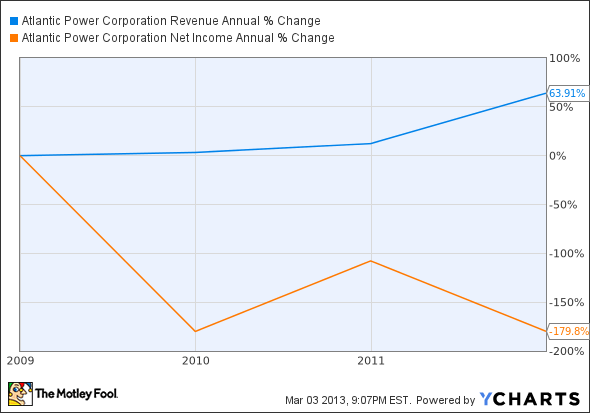
Atlantic is tiny compared to many of its competitors, and its acquisition-based strategy  has pushed sales higher even as profit has plummeted. Revenue has rocketed 64% over the last five years, while net income fell into the red in 2009 and has dropped 180% in the same time period.

Source: AT Revenue Annual data by YCharts.

The dividend drop
Corporations use shareholders’ money to create value in three main ways:

  • Invest in the company itself (maintenance, acquisitions, etc.), thereby increasing the inherent value of the company and its stock
  • Buy back shares, thereby directly increasing the stock price
  • Distribute dividends, thereby directly returning cash to shareholders

Atlantic has historically had one of the “best” dividend yields around, estimated at 10.2% before last week. But the utility’s payout was highly unsustainable, and Atlantic just announced that it will slash its dividend 66% from Cdn$0.096 to Cdn$0.033 per month starting in March.

As energy overhauls put the squeeze on many companies’ seemingly stalwart profits, dividends don’t always offer investors the best bang for their bucks. Exelon also dropped its dividend 40% this past quarter to keep its books balanced and free up cash flow for capital expenditures.

Speaking to shareholders, Atlantic CEO Barry Welch noted that:

In evaluating our financial position, cost of capital and updated financial projections, and how they fit with our growth strategy and ability to deliver attractive total return to shareholders, the board, supported by management’s recommendation, determined that it was in the best interest of the company and its shareholders to establish a lower and more sustainable Payout Ratio that balances yield and growth and is at the same time consistent with our outlook for current and prospective projects under a range of scenarios. We believe a lower Payout Ratio will improve our financial flexibility in order to deliver on our objective of providing a combination of sustainable income and solid growth from accretive acquisitions, construction ready and development projects, which we believe will enhance shareholder value over …read more
Source: FULL ARTICLE at DailyFinance