Tag Archives: CDS

You'll Never See The Next Crisis Coming

By David Hanson, The Motley Fool

Filed under:

The desire to forecast and predict future events is human nature. Whether a gambler, investor, or sports fan, humans tirelessly attempt to emulate Shakepeare’s Soothsayer from “Julius Caesar” and accurately foretell the unexpected.

Prideful predictions
Every March, we pour over historical data and past schedules in hopes of picking the eventual champion of the NCAA Men’s basketball tournament so we may have the chance to gloat and stick out our chests. Inherently, investing involves attempting to pinpoint opportunities but, more importantly, avoid blatant risks. Investors often take more pride in identifying the next crisis rather than discovering the subsequent boom business or industry.

As a result of the continuous flow of financial news and data available to investors today, many market participants, particularly retail investors, spend more time forecasting the next crisis rather than accepting the notion that the catalysts of crises and catastrophic losses can be nearly impossible to foresee. While some may consider using the word “impossible” too extreme, AIG‘s drastic downward spiral during the 2008 financial crisis serves as an appropriate example.

How could we be so clueless?
Sitting here in 2013, every investor associates AIG‘s downfall with its incredible exposure to credit default swaps (CDS). We wonder how investors were so blind to the danger and risk of investing in a company that would ultimately bring the financial world to its knees. While those managing the insurance behemoth at the time may have understood the potential risks of their internal operations, investors’ only glimpse into the company was through the window of SEC filings and annual reports. These public documents are intended to communicate the explicit risks associated with the business.

In 2007, AIG‘s CDS portfolio began to turn sour when it posted an unrealized loss of more than $11 billion on contracts written for super senior tranches of multisector collateralized debt obligations. Despite the market deterioration, in AIG‘s 2007 annual report, the company reassured investors:

“Based upon its most current analysis, AIG believes any losses that are realized over time on the super senior credit default swap portfolio of AIGFP will not be material to AIG‘s consolidated results of operations for an individual reporting period.”

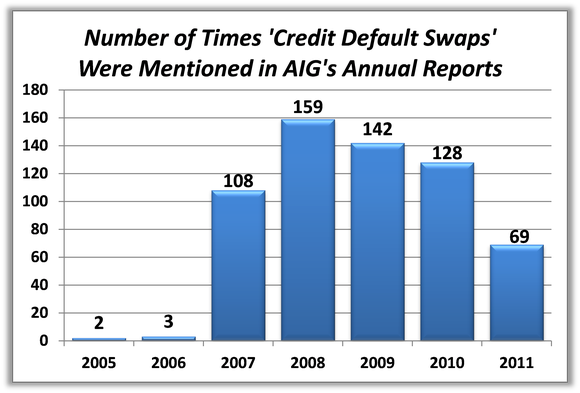
Ultimately, the company posted another $28.6 billion loss for that portfolio in 2008 and a net loss of $99.2 billion for the year. How could investors not have anticipated this? The answer is simple; AIG did not provide any detail in its 2005 and 2006 annual reports about the risk associated with its CDS portfolio. The number of times the company even mentioned credit default swaps in those two reports is five.

Source: AIG annual reports.

Long-term investors have to realize that predicting the next crisis is a futile effort. Devastating losses and shocking events will undoubtedly happen. Those interested in sleeping at night and building a strong, long-term portfolio should wisely spend their time on identifying valuable companies and …read more
Source: FULL ARTICLE at DailyFinance

B&W Awarded Environmental Equipment Contract for Iowa Power Plant

By Business Wirevia The Motley Fool

Filed under:

B&W Awarded Environmental Equipment Contract for Iowa Power Plant

CHARLOTTE, N.C.–(BUSINESS WIRE)– The Babcock & Wilcox Company (B&W) (NYS: BWC) announced today that its subsidiary Babcock & Wilcox Power Generation Group, Inc. (B&W PGG) has been awarded a contract to deliver, erect and commission a dry flue gas desulfurization system for Interstate Power and Light Company’s (IPL) 270 megawatt coal-fired Lansing Generating Station in Lansing, Iowa. IPL is a subsidiary of Alliant Energy Corporation (NYS: LNT) .

Under contract to Burns & McDonnell, B&W will deliver and erect a circulating dry scrubber (CDS) with a lime and byproduct solids handling system for the reduction of emissions, including sulfur dioxide (SO2). B&W will also supply new bags for the plant’s existing pulse jet fabric filter. Babcock & Wilcox Construction Co., Inc. will erect the environmental equipment.

CDS technology – also known as Circulating Fluid Bed Flue Gas Desulfurization (CFB-FGD) – is applicable to a wide range of unit sizes and fuel sulfur content, but is ideally suited for smaller units that fire medium to high sulfur coals. In conjunction with the pulse jet fabric filter, the CDS reduces an array of emissions with low capital and operating costs, and no waste water production.

“We’ve enjoyed an outstanding professional relationship with Interstate Power and Light Company and Burns & McDonnell on past projects, and we appreciate this opportunity to work with these two outstanding companies again,” B&W PGG President and Chief Operating Officer J. Randall Data said. “A CDS system supplied by B&W is an ideal solution for many customers who are looking to reduce a plant’s SO2 emissions while minimizing capital cost.”

Construction on the Lansing project is scheduled to begin in 2014 and to be completed in 2015. Commissioning and startup will also occur in 2015.


About B&W


Headquartered in Charlotte, N.C., The Babcock & Wilcox Company is a leader in clean energy technology and services, primarily for the nuclear, fossil and renewable power markets, as well as a premier advanced technology and mission critical defense contractor. B&W has locations worldwide and employs approximately 14,000 people, in addition to approximately 10,400 joint venture employees. Learn more at www.babcock.com .


…read more
Source: FULL ARTICLE at DailyFinance
The Unintended Consequences of The Greatest Economic Experiment

By Robert Lenzner, Forbes Staff As you must realize the central banks of “advanced market economies,” the U.S., Great Britain, Western Europe and Japan, for starters, have for the past 5 years consistently lowered interest rates to zero and swollen their balance sheets quite enormously– a coordinated and unprecedented policy on which the stability of the global economy rests. The intended consequence of this deliberation was to stimulate asset prices, household wealth and consumer activity such as to restore a semblance of economic growth. And indeed this desirable short term effect has performed well as stock prices and residential home prices rebounded. Lurking in the background, suggests economist William White is the “undesirable longer run effects” like “negative feedback mechanisms” that will weaken growth, threaten the health of financial institutions and “encourage imprudent behavior on the part of governments.” One of the unintended consequences is the “shadow banking system,” which has the inherent quality of being non transparent, of being opaque. of in effect being hidden from view from regulators, from the media, and from most of the financial system. As a recent report by the Financial Stability Board had it “shadow banking” is in effect a long chain “of interactions involving collateral, rehypothecation, large offsetting position in CDS(credit default swaps) and other derivatives, exposure to counterparty risk became almost impossible to estimate.” Get that? “exposure to counterparty risk became almost impossible to estimate.” No wonder the Financial Stability Board believes “the opacity of the system proved a substantial impediment to supervisory oversight.” So, the danger is no supervision available when excessive risk is being taken– and excessive risk may be taken as what’s actually happening behind the scenes is not transparent. Non transparent means we are living in the dark. Another unintended consequence of easing and zero interest rates is the huge pension deficits in the U.K. where the Pension Protection Fund is only 70% funded– and part of the overall underfundedness of over $1 trillion. Actuarilly speaking pension funds are short the income stream required maintain stability of retirement income. Zero cost of money has a price that makes the promise of a fixed income in retirement an impossibility.
Source: FULL ARTICLE at Forbes Latest