Tag Archives: Cardinal Health

Pentagon Announces Contracts With Dell, Cardinal Health, Raytheon

By Rich Smith, The Motley Fool

Filed under:

Judging by the contract announcements coming out of the Department of Defense these past few days, Pentagon spending is drying up faster than a Midwest cornfield in July.

Yesterday, the Pentagon announced awards of just $347 million in new contracts to contractors. Some were not the kind of companies you’d expect. For example:

  • Dell landed a $9.6 million contract to supply the U.S. Army with desktop computers and tablets.
  • Cardinal Health won $18.6 million as a contract modification exercising an option year on a contract to supply various Army, Navy, Air Force, and Marine Corps locations, and federal civilian agencies, with laboratory supplies through April 12, 2014.

On the other hand, traditional defense contractors are still earning money by working for the Pentagon. On Tuesday, Raytheon was awarded a $35.2 million order for AN/ALE-50 towed decoys, which aircraft can deploy to distract incoming missiles. Raytheon is expected to complete deliveries on this contract by March 31, 2015.


link

The article Pentagon Announces Contracts With Dell, Cardinal Health, Raytheon originally appeared on Fool.com.

Fool contributor Rich Smith has no position in any stocks mentioned. The Motley Fool owns shares of Raytheon Company. Try any of our Foolish newsletter services free for 30 days. We Fools may not all hold the same opinions, but we all believe that considering a diverse range of insights makes us better investors. The Motley Fool has a disclosure policy.

Copyright © 1995 – 2013 The Motley Fool, LLC. All rights reserved. The Motley Fool has a disclosure policy.

(function(c,a){window.mixpanel=a;var b,d,h,e;b=c.createElement(“script”);
b.type=”text/javascript”;b.async=!0;b.src=(“https:”===c.location.protocol?”https:”:”http:”)+
‘//cdn.mxpnl.com/libs/mixpanel-2.2.min.js’;d=c.getElementsByTagName(“script”)[0];
d.parentNode.insertBefore(b,d);a._i=[];a.init=function(b,c,f){function d(a,b){
var c=b.split(“.”);2==c.length&&(a=a[c[0]],b=c[1]);a[b]=function(){a.push([b].concat(
Array.prototype.slice.call(arguments,0)))}}var g=a;”undefined”!==typeof f?g=a[f]=[]:
f=”mixpanel”;g.people=g.people||[];h=[‘disable’,’track’,’track_pageview’,’track_links’,
‘track_forms’,’register’,’register_once’,’unregister’,’identify’,’alias’,’name_tag’,
‘set_config’,’people.set’,’people.increment’];for(e=0;e<h.length;e++)d(g,h[e]);
a._i.push([b,c,f])};a.__SV=1.2;})(document,window.mixpanel||[]);
mixpanel.init("9659875b92ba8fa639ba476aedbb73b9");

function addEvent(obj, evType, fn, useCapture){
if (obj.addEventListener){
obj.addEventListener(evType, fn, useCapture);
return true;
} else if (obj.attachEvent){
var r = obj.attachEvent("on"+evType, fn);
return r;
}
}

addEvent(window, "load", function(){new FoolVisualSciences();})
addEvent(window, "load", function(){new PickAd();})

var themeName = 'dailyfinance.com';
var _gaq = _gaq || [];
_gaq.push(['_setAccount', 'UA-24928199-1']);
_gaq.push(['_trackPageview']);

(function () {

var ga = document.createElement('script');
ga.type = 'text/javascript';
ga.async = true;
ga.src = ('https:' == document.location.protocol ? 'https://ssl' : 'http://www') + '.google-analytics.com/ga.js';

var s = document.getElementsByTagName('script')[0];
s.parentNode.insertBefore(ga, s);
})();

Read | <a target=_blank href="http://www.dailyfinance.com/2013/04/10/pentagon-announces-contracts-with-dell-cardinal-he/"

Source: FULL ARTICLE at DailyFinance

Why Walgreen Is a Top Dividend Stock

By Dan Caplinger, The Motley Fool

Hyundai Emblem

Filed under:

Investors have always been interested in stocks that pay dividends, but lately, low interest rates on bonds and other fixed-income investments have made solid dividend payers even more valuable. Among the most promising dividend stocks in the market is Walgreen , and one big reason is that it is one of the few exclusive companies to make the list of Dividend Aristocrats. In order to become a member of this elite group, a company must have raised its dividend payouts to shareholders every single year for at least a quarter-century. Only a few dozen stocks manage to make the cut, and those that do tend to stay there for a long time.

Walgreen has had its share of ups and downs over the past year, but things are starting to look up for the drugstore giant. Let’s take a closer look at Walgreen to see whether it can sustain its long streak of rewarding dividend payouts to investors.

Dividend Stats on Walgreen

Current Quarterly Dividend per Share

$0.275

Current Yield

2.3%

Number of Consecutive Years With Dividend Increases

37 years

Payout Ratio

47%

Last Increase

May 2012

Source: Yahoo! Finance. Last increase refers to ex-dividend date.

The latest on Walgreen
Walgreen suffered a lot during 2012, as its dispute with pharmacy benefits manager Express Scripts led to an exodus of customers to rival drugstore chains. Even after Walgreen and Express Scripts came to a resolution, Walgreen has had a tough time bringing those customers back.

Still, companies that manage to raise their dividends for decades all go through their share of challenges. So far, Walgreen has managed to keep its payouts strong:

WAG Dividend data by YCharts.

Moreover, Walgreen has taken some big steps to bolster growth. Its purchase of a 45% stake in Europe’s Alliance Boots drug chain last summer was part of its larger strategy to expand across the globe as it seeks to diversify and take advantage of better growth opportunities abroad. More recently, Walgreen’s move to replace Cardinal Health as its drug distributor in favor of a 10-year agreement with rival AmerisourceBergen will enhance its global distribution capacity, and Walgreen and Alliance will take an equity position in AmerisourceBergen as well to cement the partnership.

When will dividends rise again?
Last year, Walgreen raised its dividend during the spring, so investors should prepare for another increase in the near future. What’s more important in the long run, though, is whether its major strategic moves will lead to a return to stronger growth. If so, then Walgreen should remain a Dividend Aristocrat for a long, long time.

Walgreen’s dispute with Express Scripts shows just how important pharmacy-benefits management has become in a health care landscape dominated by searching for ways to control costs. Find out how Express Scripts is part of the solution by reading our premium research …read more
Source: FULL ARTICLE at DailyFinance

3 Health Care Stories You Probably Missed

By Brandy Betz, The Motley Fool

Filed under:

This year, health care stocks are leading the S&P 500 for the first time in well over a decade.
It’s a vote of confidence in a landscape that’s changing around the Affordable Care Act. While the more speculative biotech industry gets attention from The Fool

elsewhere

, here’s a look at the top stories from the less-sung parts of health care.

As we begin the last mini-week of the month, the news was as mixed as the Northeast weather. A drug store made a distribution power play. An insurer fell on Medicare nervousness. And a health care information technology company branched out with a new acquisition.

Walgreen  announced that it was signing a 10-year contract with drug distributor AmerisourceBergen , and had an option of buying a 7% stake. That left its former primary distributor Cardinal Health out in the cold, and shares dropped accordingly. The move will increase the drugstore chain’s prices on both branded and generic drugs, which should lead to higher profit margins.

Also coming along for the ride was European chain Alliance Boots, which Walgreen’s partially acquired last year. Combined, the moves will improve Walgreen’s market position and perhaps its bargaining power with pharmacy benefit managers such as Express Scripts .

Turning towards the health plan side of things…

Humana closed the week down almost 4% after a Susquehanna analyst lowered the company’s rating from “Positive” to “Neutral,” citing concerns with potential Medicare Advantage rate cuts. The company’s shares had dropped 10% last month when the Centers for Medicare and Medicaid Services’ announced its proposed rates, which could lead to losses of $11 billion across Advantage providers. Humana is one of the segment leaders, with 2 million Advantage customers. Expect further volatility in health care plans this week since the final rate decision is due next Monday.

And rounding out the week’s review, Cerner Corporation acquired Labotix Automation, which provides automation solutions in clinical testing environments. The details weren’t disclosed. It’s the latest in a string of acquisitions for Cerner, which is diversifying its business as the spending boost from the 2009 stimulus winds down and the ACA kicks in. Cerner finished the week up less than 1%, but this is a stock meant for the long haul.

Do lower costs = profits for your portfolio?
In 2011, a massive shift began. With the first of the baby-boomer generation reaching Medicare age, America’s health care landscape was forever changed. Combine the aging population with the impact of Obamacare, and the need for innovative solutions for skyrocketing health care costs is as clear as ever. Express Scripts is part of that solution, and in this brand new premium …read more
Source: FULL ARTICLE at DailyFinance

Why the Health Care Arms Race Hurts This Stock

By Brenton Flynn, The Motley Fool

Filed under:

From revolutionary science to the impact of Obamacare, every week The Motley Fool’s health care team sits down to discuss the most fascinating developments across the health care industry and their implications for long-term investors. In this week’s edition, the team talks about the disruptive potential of a new iPhone app, as well as an FDA inquiry that could have negative implications for some of the pharmaceutical industry’s biggest players. In addition, our analysts dive into some of the stocks making big moves over the past week and discuss companies on their radar for the near future.

In the following segment, health care bureau chief Brenton Flynn discusses a big customer loss for medical distributor Cardinal Health  and why it doesn’t worry him as much as another ongoing development — industry consolidation.

We know what’s eating at companies like Cardinal Health, but what macro trend was Warren Buffett referring to when he said “this is the tapeworm that’s eating at American competitiveness”? Find out in our free report: “What’s Really Eating At America’s Competitiveness.” You’ll also discover an idea to profit as companies work to eradicate this efficiency-sucking tapeworm. Just click here for free, immediate access.

The relevant video segment can be found between 10:55 and 12:42.

The article Why the Health Care Arms Race Hurts This Stock originally appeared on Fool.com.


Brenton FlynnDavid Williamson, and Max Macaluso, Ph.D. has no position in any stocks mentioned. The Motley Fool recommends Express Scripts. The Motley Fool owns shares of Express Scripts. Try any of our Foolish newsletter services free for 30 days. We Fools may not all hold the same opinions, but we all believe that considering a diverse range of insights makes us better investors. The Motley Fool has a disclosure policy.

Copyright © 1995 – 2013 The Motley Fool, LLC. All rights reserved. The Motley Fool has a disclosure policy.

(function(c,a){window.mixpanel=a;var b,d,h,e;b=c.createElement(“script”);
b.type=”text/javascript”;b.async=!0;b.src=(“https:”===c.location.protocol?”https:”:”http:”)+
‘//cdn.mxpnl.com/libs/mixpanel-2.2.min.js’;d=c.getElementsByTagName(“script”)[0];
d.parentNode.insertBefore(b,d);a._i=[];a.init=function(b,c,f){function d(a,b){
var c=b.split(“.”);2==c.length&&(a=a[c[0]],b=c[1]);a[b]=function(){a.push([b].concat(
Array.prototype.slice.call(arguments,0)))}}var g=a;”undefined”!==typeof f?g=a[f]=[]:
f=”mixpanel”;g.people=g.people||[];h=[‘disable’,’track’,’track_pageview’,’track_links’,
‘track_forms’,’register’,’register_once’,’unregister’,’identify’,’alias’,’name_tag’,
‘set_config’,’people.set’,’people.increment’];for(e=0;e<h.length;e++)d(g,h[e]);
a._i.push([b,c,f])};a.__SV=1.2;})(document,window.mixpanel||[]);
mixpanel.init("9659875b92ba8fa639ba476aedbb73b9");

function addEvent(obj, evType, fn, useCapture){
if (obj.addEventListener){
obj.addEventListener(evType, fn, useCapture);
return true;
} else if (obj.attachEvent){
var r = obj.attachEvent("on"+evType, fn);
return r;
}
}

addEvent(window, "load", function(){new FoolVisualSciences();})
addEvent(window, "load", function(){new PickAd();})

var themeName = 'dailyfinance.com';
var _gaq = _gaq …read more
Source: FULL ARTICLE at DailyFinance

Why Cardinal Health Dropped

By Brandy Betz, The Motley Fool

Filed under:

Cardinal Health shares dropped more than 10% this week after Walgreen announced it wouldn’t renew its contract with the drug distributor. The nonrenewal will slice into Cardinal’s revenues, but bad news could get worse if CVS Caremark follows suit.

How bad?
Walgreen was Cardinal’s second largest customer, accounting for 21% of fiscal 2012 revenues. The retail chain left to buy a stake in AmerisourceBergen  — the same competitor that gained Express Scripts last summer. Express Scripts had been Cardinal’s third largest customer, but it decided to go elsewhere following its multibillion-dollar acquisition of Medco.

So it hasn’t been a great year for Cardinal. CVS remains as the largest customer, representing 22% of revenues, but that contract expires this summer. Will CVS opt for nonrenewal? It’s possible, but CVS has caught Cardinal vulnerable — and that’s a good time for bargaining.

What can Cardinal do to fight back? There’s the possibility of pursuing smaller pharmacies for contracts. And the medical segment recently grew with the $2.1 billion acquisition of AssuraMed. That gave Cardinal a foot in the home medical supply market with a company that had a million patients and about $1 billion in 2012 revenues.

It’s better than nothing, but doesn’t seem likely to replace these big league losses.

Financial impact
Walgreen’s existing contract doesn’t expire until after the end of fiscal 2013. Right now, Cardinal’s putting the 2014 forecast in line with this year’s EPS range of $3.42 to $3.50. But expect revisions in the near future, particularly if CVS leaves.

Foolish final thoughts
I’ve backed my doubts with a CAPScall of underperform for Cardinal Health.

Cardinal claims it has plans in place to mitigate Walgreen’s loss, but didn’t provide any details. If CVS does leave, Cardinal shares will plummet. But even if CVS stays, the distributor will have to try to redefine itself in a lower market position.

The company’s best chance is to rebid on the deserting companies once the replacement contracts expire. Express Scripts only had a three-year contract, but it’ll be a decade before Walgreen’s deal with AmerisourceBergen expires.

Do lower costs = profits for your portfolio?
In 2011, a massive shift began. With the first of the baby-boomer generation reaching Medicare age, America’s health care landscape was forever changed. Combine the aging population with the impact of Obamacare, and the need for innovative solutions for skyrocketing health care costs is as clear as ever. Express Scripts is part of that solution, and in this brand new premium report on the company, we clearly lay out the opportunity in front of this misunderstood stock. Claim your copy by clicking here now.

var FoolAnalyticsData …read more
Source: FULL ARTICLE at DailyFinance
Walgreen's Names New Distribution Partner

By 24/7 Wall St.

Walgreens_logo

Filed under:

The nation’s largest drugstore chain, Walgreen Co. (NYSE: WAG) this morning announced that it and its European partner Alliance Boots have entered into a 10-year contract with drug distributor AmeriSourceBergen Corp. (NYSE: ABC) that includes the right for Walgreen and Alliance Boots to acquire up to 23% of AmeriSourceBergen. According to AmeriSourceBergen the value of the contract in 2014 period is $28 billion. Cardinal Health Inc. (NYSE: CAH), Walgreen’s former distributor, is the odd-man out when its distribution contract with Walgreen’s ends in August.

The equity ownership part of the deal is perhaps most interesting. Under the terms revealed today, Walgreen may purchase up to 7% of AmeriSourceBergen stock on the open market. Walgreen also received warrants to purchase up to a total of 16% of the distributor’s stock. The open market purchases may begin in May 2016 at a strike price of $51.50, about 6.6% above AmeriSourceBergen’s closing price last night. The second round of purchases, amounting to 16% of AmeriSourceBergen total equity, begins in May 2017 and lasts for six months at a strike price of $52.50.

Once Walgreen accumulates a 5% stake in the company, Walgreen’s will appoint one of its executives to AmeriSourceBergen’s board. Once the full equity position is wrapped up, Alliance Boots will name a second director. The two new directors are additions, not replacements, to AmeriSourceBergen’s board. Walgreen owns 45% of Alliance Boots.

Walgreen’s shares are up about 4.4% in the early afternoon, at $44.30 in a 52-week range of $28.53 to $45.80. AmeriSourceBergen’s shares are up 5.7% at $51.07 in a 52-week range of $35.48 to $52.15.

Cardinal Health is watching its share price dive nearly 7% to $42.96 in a 52-week range of $36.91 to $47.23.

Filed under: 24/7 Wall St. Wire, Retail Tagged: ABC, CAH, WAG

Read | Permalink | Email this | Linking Blogs | Comments

…read more
Source: FULL ARTICLE at DailyFinance

Why Bank of America's Pushing the Dow Up Again

By Dan Caplinger, The Motley Fool

Filed under:

Investors’ attention routinely vacillates between domestic and international events, and today’s stock market action shows that dynamic clearly. Even though news from Cyprus is still at the forefront of investors’ minds, attention returned to the domestic front today, as a positive report on housing starts and permits helped lift the Dow Jones Industrials 15 points by 10:55 a.m. EDT. Broader markets posted modest losses, however, reflecting investors’ concerns about what the Federal Reserve may do with interest rates as it meets today and tomorrow.

Within the Dow, Bank of America is the biggest gainer, up 2%. Clearly, positive news on the housing front has a big impact on B of A and its substantial presence in the mortgage-lending industry. But the bank will also be looking closely at what happens in Cyprus as negotiations move forward that could protect small depositors from a bank deposit tax in favor of pinning larger depositors with more of the loss burden. Bank of America needs the world financial system to stay healthy for it to keep recovering.

Elsewhere, Hovnanian has jumped 4.2% on the favorable news from the housing market. Hovnanian in particular has seen impressive share-price gains over the past year as the housing recovery has strengthened, but at some point the homebuilder will need to start working its way back to profitability amid better conditions. Otherwise, investors will conclude that the stock has gotten ahead of itself, and it will give up some of its huge recent gains.

Finally, Walgreen has soared 5.9% on a positive earnings report, with generic-drug sales helping the drugstore chain beat analyst estimates. In addition, Walgreen has decided to change drug-distribution companies. Until now, the drugstore chain had used Cardinal Health, but this morning Walgreen said it would take an initial 7% stake in competing firm AmerisourceBergen , with warrants that would allow Walgreen to build its position in the company to 23% in the future. For its part, Amerisource soared 7% on the news, while Cardinal took a 7% hit.

Is B of A a buy?
Today’s gains only add to Bank of America’s impressive performance over the past year, with the stock having doubled in 2012. Is there more yet to come? With significant challenges still ahead, it’s critical to have a solid understanding of this megabank before adding it to your portfolio. In The Motley Fool’s premium research report on B of A, analyst Anand Chokkavelu, CFA, and Financials bureau chief Matt Koppenheffer lift the veil on the bank’s operations, detailing three reasons to buy and three reasons to sell. Click here now to claim your copy.

var FoolAnalyticsData = FoolAnalyticsData …read more
Source: FULL ARTICLE at DailyFinance

Do You Trust the Earnings at Cardinal Health?

By Seth Jayson, The Motley Fool

Filed under:

Although business headlines still tout earnings numbers, many investors have moved past net earnings as a measure of a company’s economic output. That’s because earnings are very often less trustworthy than cash flow, since earnings are more open to manipulation based on dubious judgment calls.

Earnings’ unreliability is one of the reasons Foolish investors often flip straight past the income statement to check the cash flow statement. In general, by taking a close look at the cash moving in and out of the business, you can better understand whether the last batch of earnings brought money into the company, or merely disguised a cash gusher with a pretty headline.

Calling all cash flows

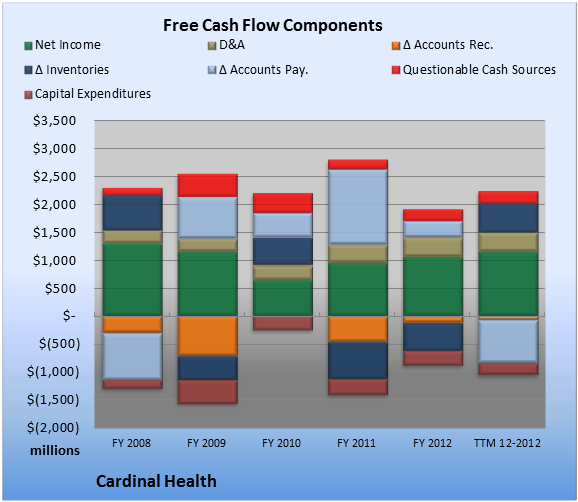
When you are trying to buy the market’s best stocks, it’s worth checking up on your companies’ free cash flow once a quarter or so, to see whether it bears any relationship to the net income in the headlines. That’s what we do with this series. Today, we’re checking in on Cardinal Health (NYS: CAH) , whose recent revenue and earnings are plotted below.

Source: S&P Capital IQ. Data is current as of last fully reported fiscal quarter. Dollar values in millions. FCF = free cash flow. FY = fiscal year. TTM = trailing 12 months.

Over the past 12 months, Cardinal Health generated $1,000.0 million cash while it booked net income of $1,145.0 million. That means it turned 1.0% of its revenue into FCF. That doesn’t sound so great. FCF is less than net income. Ideally, we’d like to see the opposite.

All cash is not equal
Unfortunately, the cash flow statement isn’t immune from nonsense, either. That’s why it pays to take a close look at the components of cash flow from operations, to make sure that the cash flows are of high quality. What does that mean? To me, it means they need to be real and replicable in the upcoming quarters, rather than being offset by continual cash outflows that don’t appear on the income statement (such as major capital expenditures).

For instance, cash flow based on cash net income and adjustments for non-cash income-statement expenses (like depreciation) is generally favorable. An increase in cash flow based on stiffing your suppliers (by increasing accounts payable for the short term) or shortchanging Uncle Sam on taxes will come back to bite investors later. The same goes for decreasing accounts receivable; this is good to see, but it’s ordinary in recessionary times, and you can only increase collections so much. Finally, adding stock-based compensation expense back to cash flows is questionable when a company hands out a lot of equity to employees and uses cash in later periods to buy back those …read more
Source: FULL ARTICLE at DailyFinance

Down 12%: Navidea's Post-Approval Plunge

By Brian Orelli, The Motley Fool

Filed under:

Navidea Biopharmaceuticals is experiencing a case of “sell the news” today.

The company got a mid-day Food and Drug Administration approval for its lymph node diagnostic Lymphoseek. The approval comes a month and a half before the PDUFA date, the goal the FDA sets to complete its review by.

I called Navidea one stock to buy in March, figuring that the stock would run up as investors got excited about the binary event, but I also warned that investors might sell the launch. Half-right, I guess.

In retrospect, the early approval shouldn’t have been that big of a surprise. Lymphoseek was rejected last year, but the only thing the FDA seemed to want fixed as an issue at a third-party manufacturer. Apparently it didn’t take long to confirm the manufacturer had crossed all its Ts and dotted all its Is in its Good Manufacturing Practices documents.

Lymphoseek is designed to identify lymph nodes that contain tumor cells that have moved away from their primary tumor site. The lymph nodes are then biopsied to determine if the cancer has spread, which determines the cancer treatment. Lymphoseek is currently approved to detect melanoma (skin cancer) and breast cancer, two big cancers that often drain into the lymph nodes.

The diagnostic will be sold by Cardinal Health . How much marketing muscle the distributor puts into Lymphoseek will determine how well the diagnostic sells. Doctors currently use a die called isosulfan blue to map lymph nodes. It isn’t really clear that doctors are looking for a new diagnostic, so Cardinal has its work cut out for itself.

Eli Lilly finds itself in a similar situation needing to educate doctors about Amyvid, its diagnostic for identifying Alzheimer’s disease. Initial sales are low enough that Lilly didn’t bother breaking out sales in its fourth quarter earnings release.

“If you build it, they will come” may work for baseball diamonds in the middle of corn fields, but not for new diagnostics.

Is Eli Lilly a buy or sell?
With two of its top three drugs poised to lose patent protection this year, is Eli Lilly a dividend stock headed nowhere fast? In a new premium report, The Motley Fool’s senior pharmaceuticals analyst breaks down all of Lilly’s moving parts, including an in-depth analysis of the company’s must-know opportunities and reasons to buy and sell today. To find out more click here to claim your copy today.

var FoolAnalyticsData = FoolAnalyticsData || []; FoolAnalyticsData.push({ …read more
Source: FULL ARTICLE at DailyFinance

Are Short Sellers On to Something at Navidea Biopharmaceuticals?

By Rich Duprey, The Motley Fool

Filed under:

Since everyone loves a winner, it’s reasonable to assume that everyone hates a loser — everyone but short sellers, at least. These contrarian investors bet that hot stocks are primed to fall, aiming to turn their pessimism into profits.

Below, we take a look at biotech Navidea Biopharmaceuticals , whose shares sold short, according to The Wall Street Journal, jumped 6%. That amounts to more than 17% of its float so its short interest ratio is 18 days to cover, or the number of days it would take to completely buy back all the shares sold short. The Motley Fool thinks seven days is a lot so it’s always possible we could see a short squeeze, but let’s see if the specialty pharma still has the power to make short work of short sellers.

Navidea Biopharmaceuticals snapshot


Market Cap

$361 million

Revenues (TTM)

>$1 million

1-Year Stock Return

4.7%

Estimated 5-Year EPS Growth

N/A

Return on Investment

(164.8%)

Dividend and Yield

N/A

Recent Price

$3.15

Shares Short Feb. 15

19.3 million

Shares Short Jan. 31

18.2 million 

% Change

6.2%

CAPS Rating

**

Sources: wsj.com, FinViz.com. N/A = not available; Navidea does not pay a dividend.

Just because the shorts are piling in doesn’t mean you should, too. Such stocks could have serious problems that warrant their short interest, but they might also just be stricken by short-term troubles. Only Foolish due diligence will tell you for certain.

The short story
Navidea’s lead product is Lymphoseek, a marker used to determine the spread of certain solid-tumor cancers into the lymphatic system, which has the potential to be a top-tier targeted imaging agent for lymphatic mapping. Following the disappointment associated with receiving a complete response letter from the FDA last September, Navidea finally has a PDUFA date at the end of next month that should determine once and for all whether it has addressed the regulatory agency’s concerns.

Fortunately, those issues centered on its contract manufacturing partners and not the imaging agent’s efficacy or safety, so considering it also filed a marketing authorization application with the European EMA, there might be some sense behind investors feeling confident that it has.

If the FDA does give Lymphoseek its imprimatur, Navidea and its U.S. marketing partner, Cardinal Health , plan to hit the ground running. There’s a worldwide market opportunity approaching $450 million, depending on who’s doing the counting, with the U.S. representing almost half of it at $200 million. The EU is second with $70 million, according to Navidea, and the rest of the world comes in at $180 million.

Of course, Navidea won’t recognize all that revenue because that’s just the addressable market. It’s going to have to split the proceeds with Cardinal, which also has the responsibility for determining what price to sell the agent (analysts have pegged it at around $400 per treatment ). As …read more
Source: FULL ARTICLE at DailyFinance