

Sharon Stone and Cat Stevens will take part in a musical in September honouring an environmental group founded by former Soviet leader Mikhail Gorbachev, organisers said Wednesday. …read more
Source: FULL ARTICLE at Fox World News
Sharon Stone and Cat Stevens will take part in a musical in September honouring an environmental group founded by former Soviet leader Mikhail Gorbachev, organisers said Wednesday. …read more
Source: FULL ARTICLE at Fox World News
By Paul Roderick Gregory, Contributor The most significant geopolitical events of the past half century have been unanticipated. Not that we did not expect them, but they were supposed to happen in the distant future, not now. The North Korean regime could collapse in the same unexpected way, leaving shocked politicians, diplomats, and pundits to fend with its consequences. While it is comforting to believe that predictable rational calculation and self interest determine the course of human events, the most significant changes in the world order are heavily influenced by chance, personalities, emotions, and miscalculations. We expect the two Koreas to muddle along in a shaky equilibrium that will result in the end of the Hermit Kingdom in the distant future. A collapse of the North Korean regime in the near term would send pundits in vain searches of past writings for hints they saw it coming. Unfolding events in the Koreas and their respective mentor states, the United States and China, resemble the run ups to the collapse of communism in the USSR and Central and Southeastern Europe and the reunification of the two Germanys. Few foresaw that both would collapse as abruptly as a house of cards. The intelligence community did not foresee the end of the USSR – an intelligence failure greater than its weapons-of-mass-destruction fiasco. Likewise, it will likely categorize the near-term collapse of the North Korean regime as a “highly unlikely” outcome. The “fundamentals” explain why regimes change and collapse, but they tell us less about the all-crucial “when.” If the Soviet and East Germany political and economic systems had been sound, they would be with us today. The North Korean fundamentals could not be more terrible – a closed society unable to provide its population with subsistence, but it has survived as such for decades. Mikhail Gorbachev had no intention of setting in motion events that would lead to the collapse of the USSR and its client states. His goal was to repair the Soviet system not end it. Gorbachev would not have begun Perestroika had he known its consequences – one of history’s great miscalculations. Reagan was the first American President who believed that a near-term Soviet collapse was possible, and he did not hesitate to say so. It fell to Reagan’s successor, George Bush, to actually manage the disintegration of the Soviet Union, after his first incredulity wore off. The leadership of the German Democratic Republic also intended to save East-German communism with salami-sliced concessions, which kept growing larger and larger to their dismay. The East German politburo had German Chancellor Helmut Kohl as their counterpart. When the opportunity presented itself, Kohl was there with instantaneous and irreversible reunification. Kohl did not dither when the opportunity presented itself. The two Koreas represent a tinder box in search of a random spark. Both have new and untested leaders, each intent on reshaping the relationship between the two countries in their own way. Both appear unwilling to ramp down the rhetoric or be seen as caving to the
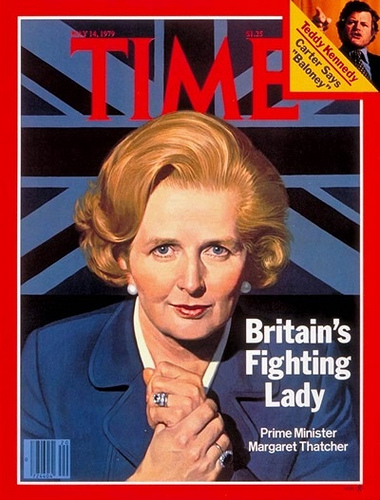
Margaret Thatcher, who served as prime minister of Britain from 1979 to 1990, is most famous for teaming up with my father Ronald Reagan and Pope John Paul II to peacefully end the Cold War and bring about the collapse of the Soviet Union.
But at home, the “Iron Lady’s” intellect, political will, and love of freedom and capitalism also saved Britain from its long, slow death by socialism.
Prime Minister Thatcher freed up Britain’s economy by deregulating business, privatizing government-owned industries, and breaking the back of the powerful unions that were smothering her country to death.
Not that The New York Times can bring itself to give Lady Thatcher much credit for any of this in its coverage of her death from a stroke on Monday at age 87.
Paul Krugman, the pathetic Times’ in-house apologist for the serial failures of the Obama Economy, dug out some arcane data that he said raises doubts that Thatcher’s pro-capitalist policies actually did anything to turn around Britain’s economy.
Meanwhile, a so-called news article in the Times on Wednesday about the debate over Thatcher’s legacy in the British Parliament is the latest example of how the Paper of Record’s liberal bias is always at work.
Two Times writers — John F. Burns and Alan Cowell — said, “The Thatcher era is generally recalled as a time when a capitalist revolution crushed labor unions, decimated staid industries that had once formed the nation’s economic base, and inaugurated a period of robust economic growth that sanctified a generation’s acquisitiveness.”
No bias there, right?
I think Burns and Cowell spent more time describing what nasty things Thatcher’s left-wing critics in the Labor Party had to say about her than mentioning her triumphs.
But Lady Thatcher doesn’t need the support of The New York Times or Hollywood to make it into the history books. Her accomplishments on the world stage will speak for themselves forever.
I’ll never forget meeting Lady Thatcher several times in London and in the United States. But my greatest memory of her occurred in 2004 when, despite being very ill, she attended my father’s funeral at the Reagan Library.
The morning after the funeral, as I was eating at the hotel with my family, I greeted Lady Thatcher when she came in for breakfast.
“Oh, Michael,” she said in that great accent of hers. “Think of how much we could have accomplished if your father had been elected in 1976, not 1980.”
“Lady Thatcher,” I said with the greatest respect, “I think God chooses the time for many of the things that happen in the world. And 1976 wasn’t that time; 1980 in fact was.”
“Why would you say that?” she said.
“Simply because I look at 1976 and I say, ‘Where was Margaret Thatcher? Where was Pope John Paul II? Where was Lech Walesa and Helmut Kohl and Mikhail Gorbachev?’ In 1976, none of you were in positions of power to do anything.
“But 1980 was the right time,” I said to Lady Thatcher.
“You were prime minister. Pope John Paul was pope. And you had
From: http://www.westernjournalism.com/remembering-margaret-thatcher/
Russia on Thursday decreed a national park in its remote Far Eastern Chukotka region, paving the way for a joint US-Russian nature reserve spanning the Bering Strait, an idea first proposed by the last Soviet leader Mikhail Gorbachev.
Source: FULL ARTICLE at Phys.org
