Tag Archives: Lady Thatcher

Remembering Margaret Thatcher

By Michael Reagan

Margaret Thatcher SC Remembering Margaret Thatcher

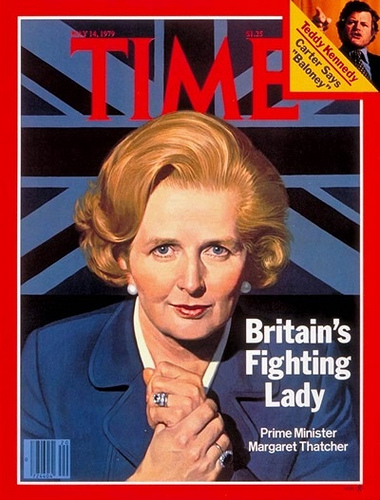
Margaret Thatcher, who served as prime minister of Britain from 1979 to 1990, is most famous for teaming up with my father Ronald Reagan and Pope John Paul II to peacefully end the Cold War and bring about the collapse of the Soviet Union.

But at home, the “Iron Lady’s” intellect, political will, and love of freedom and capitalism also saved Britain from its long, slow death by socialism.

Prime Minister Thatcher freed up Britain’s economy by deregulating business, privatizing government-owned industries, and breaking the back of the powerful unions that were smothering her country to death.

Not that The New York Times can bring itself to give Lady Thatcher much credit for any of this in its coverage of her death from a stroke on Monday at age 87.

Paul Krugman, the pathetic Times’ in-house apologist for the serial failures of the Obama Economy, dug out some arcane data that he said raises doubts that Thatcher’s pro-capitalist policies actually did anything to turn around Britain’s economy.

Meanwhile, a so-called news article in the Times on Wednesday about the debate over Thatcher’s legacy in the British Parliament is the latest example of how the Paper of Record’s liberal bias is always at work.

Two Times writers — John F. Burns and Alan Cowell — said, “The Thatcher era is generally recalled as a time when a capitalist revolution crushed labor unions, decimated staid industries that had once formed the nation’s economic base, and inaugurated a period of robust economic growth that sanctified a generation’s acquisitiveness.”

No bias there, right?

I think Burns and Cowell spent more time describing what nasty things Thatcher’s left-wing critics in the Labor Party had to say about her than mentioning her triumphs.

But Lady Thatcher doesn’t need the support of The New York Times or Hollywood to make it into the history books. Her accomplishments on the world stage will speak for themselves forever.

I’ll never forget meeting Lady Thatcher several times in London and in the United States. But my greatest memory of her occurred in 2004 when, despite being very ill, she attended my father’s funeral at the Reagan Library.

The morning after the funeral, as I was eating at the hotel with my family, I greeted Lady Thatcher when she came in for breakfast.

“Oh, Michael,” she said in that great accent of hers. “Think of how much we could have accomplished if your father had been elected in 1976, not 1980.”

Lady Thatcher,” I said with the greatest respect, “I think God chooses the time for many of the things that happen in the world. And 1976 wasn’t that time; 1980 in fact was.”

“Why would you say that?” she said.

“Simply because I look at 1976 and I say, ‘Where was Margaret Thatcher? Where was Pope John Paul II? Where was Lech Walesa and Helmut Kohl and Mikhail Gorbachev?’ In 1976, none of you were in positions of power to do anything.

“But 1980 was the right time,” I said to Lady Thatcher.

“You were prime minister. Pope John Paul was pope. And you had

From: http://www.westernjournalism.com/remembering-margaret-thatcher/

The Stocks That Margaret Thatcher Gave Us

By Tony Reading, The Motley Fool

Filed under:

LONDON — Baroness Thatcher will be remembered for many reforms, but one of enduring legacy for investors is that she gave us the stock market we know today.

Privatization became a key plank of economic policy, and nine of the firms in the FTSE 100 are the direct descendants of state-owned companies privatized during her time as prime minister.

Thirty five years ago, the precursors to BP , BAE , International Consolidated Airlines , BT , Rolls-Royce , BGCentrica, Severn Trent and United Utilities were all state-owned enterprises. Today. they are successful blue-chip firms with a combined market capitalization of over £200 billion.

1. BP
Privatization had started in 1977 when the Labor government of James Callaghan sold a 32% stake as part of the conditions of the country’s IMF bailout. Under Margaret Thatcher‘s watch the remaining stake was sold, with two big sales in 1979 and 1987. The 1987 offering coincided with a stock market crash and the stock was left with underwriters, costing them billions.

BP subsequently grew to become the FTSE‘s biggest dividend payer, but the U.S. Deepwater Horizon disaster put paid to that. With a new alliance with Russia‘s state-owned oil company, it’s set to resume its former upwards trajectory.

2. BAE
British Aerospace (BAE) was sold off in two chunks in 1981 and 1985. BAE struggled in the 1990s and merged in 1999 with Marconi to become BAE Systems. BAE sold its 20% of Airbus to EADS in 2006 to concentrate on defense, only for new management to seek a merger with EADs in 2012 to regain exposure to commercial aerospace.

Poor strategic management may have been a counterweight to superb engineering, but a 5% yield in a — literally — defensive sector makes the company an attractive investment.

3. BT
Half of British Telecom was privatized under Margaret Thatcher in 1984, with the remaining shares sold off in 1991 and 1993. It was the first of the blockbuster utility privatizations, with the company at the time enjoying a virtual monopoly (a consortium, Mercury Communications, provided nominal competition).

Shareholders have had a roller-coaster time, with the changing structure of the industry and the technology bubble. More recently, a push into broadband has given the company a new lease of life.

4. IAG
British Airways was fully privatized in 1987, in an offer that was 11-times oversubscribed. It grew in scale with the acquisition of British Caledonian, and then in profit under CEO Willie Walsh, who did some union-wrestling of his own.

IAG was formed from the merger of British Airways and Iberia in 2010, to enjoy greater global scale. However, management is now hampered by Spanish union intransigence.

5. Rolls-Royce
Rolls-Royce is an oddity in the privatization program. It had been nationalized by Lady Thatcher‘s predecessor Edward Heath in 1971 to save it from administration after cost over-runs on the RB211 engine. The Thatcher government returned it to the private sector in 1987, since when it has prospered to be one of three global manufacturers of big engines.

In a companion piece, I’ll cover the four utility stocks.

Margaret Thatcher believed in individuals taking

Source: FULL ARTICLE at DailyFinance

Margaret Thatcher Predicted The Failure of the Euro in Forbes, October, 1992

By Robert Lenzner, Forbes Staff Margaret Thatcher was indomitably outspoken against submerging all the European nationalities into a single superstate some 21 years ago when I interviewed her for a Forbes magazine article entitled “It just won’t do. It’s not big enough minded.” The Iron Lady had a grander scheme in mind; a free trade area between and among North America and the European Community. What did we just elect our own Parliament for, she insisted sardonically; “Just to be a talking show?” On this score she was indomitable, ferociously scathing at the willingness of independent European nations giving up their autonomy to a bunch of bureaucrats in Brussels. She did not exactly predict the descent of the Euro, the financial crisis in Cyprus or the meltdown in most European sovereign securities or the need to bailout the banks of Italy, Spain and France. But, in a scathing tone, Lady Thatcher insisted to me that a single currency was impossible. It would never work. “Every single fixed exchange rate has cracked in the end. We’re all at different levels of development of our economies. Some countries simply couldn’t live up to a single currency… We should each of us be proud to be separate countries cooperating together.” The turmoil in European currency markets that fall of 1992 was proof for Thatcher that a united Europe was meant to crumble. And indeed her prophecy 21 years ago has been borne out lately. The grand experiment of a single monetary system, a single economic policy, working towards a common defense policy, even a common foreign policy meant to her that “80% of Britain’s economic decisions will be made in Brussels.” Actually, it has been more the need of the European Central Bank and Germany to prop up the staggering debt-laden economies of Greece, Spain, Italy, France and try to devise stability for Cyprus. Imagine having banks in Cyprus become an Achilles heel for Europe. Thatcher would have been furious. And she doesn’t exactly look wrong in her worry over the prospect of German domination of Europe— though “domination” today means the helping hand of the giant strong economy of Europe. Thatcher was going to be damned if she made Britain subservient to Germany. Finally came this prediction; ” Europe cannot do in the world without American leadership. There is no substitute for this great land sand the clear lead it can give.” I walked out of the Carlyle Hotel that fall afternoon into the clear bracing air, knowing that I had just spent an hour with Margaret Thacher, one of the world’s most indomitable personalities. She knew her mind more certainly than any other politician I had ever met or heard. …read more

Source: FULL ARTICLE at Forbes Latest