Tag Archives: Microsoft Bing

Is Google's Facebook Nightmare Beginning?

By Eric Bleeker, CFA, The Motley Fool

Filed under:

In April 2011, Google  CEO Larry Page made a move that left no doubt how serious the company thought of social media as a threat. He sent out a companywide memo announcing that 25% of the bonus for all employees, no matter their department, was based on the company’s success in mobile. 

Google clearly sees social and Facebook  as one of the great threats facing the company. With Facebook launching its Facebook Home user interface, which sits on top Android, how threatened should Google feel? While Facebook Home still operates on Android, it also makes Facebook the center of mobile devices. The scary thought for Google is that early versions of Facebook Home are just examples of “toeing the water,” and future releases could go deeper into minimizing Google’s own services while featuring Facebook’s. 

Facebook Home in action. 

Is Facebook becoming the realization of what Larry Page fears? Is search even the main battleground that will emerge between these companies in the next couple years? Let’s take a look at Facebook Home and the threats facing Google today. 

Google’s best weapon: being the best
Back in 2011, when Page went all hands on deck in the battle against Facebook, Google was scared. It was scared because the identity and user habits provided by all the actions taken within Facebook has the potential to be such a strong determinant of search quality. While many see Google now as an entrenched habit of users — it’s not uncommon to say “just Google it” when referring to broad search — the threat is twofold. 

First, if social search could better tap into user habits to offer more relevant results, the company is more susceptible than ever to competitors. The most common threat mentioned when it comes to Google is Microsoft‘s Bing, but that threat might be too obvious.

Instead, consider the recent reports from The Wall Street Journal that Apple  is in negotiations with Yahoo! to feature its content in more iOS applications. The reports note that Yahoo! has been contemplating ways to strengthen a search alliance with Apple, but one of the major sticking points is that leaving Google would “sacrifice the quality of search results.” Google’s greatest threat right now isn’t necessarily Microsoft; it’s the frayed relationship it has with Apple.

Apple is a company that would love to abandon Google from a strategic standpoint but doesn’t have options to do so. Google’s greatest weapon remains not its brand, but its quality and lead in search. 

The early innings of Facebook and search
A second idea that’s connected to the first is how much time users spend on Facebook. Not only does that allow Facebook to collect excellent data on user habits, but it also means Facebook can offer search or other products without needing to boot Google out of being the default search on a browser. If a user is frequently on Facebook and the company offered a unique search offering, it could display a search box prominently within the content

From: http://www.dailyfinance.com/2013/04/14/is-googles-facebook-nightmare-beginning/

Should Apple Just Buy Yahoo!?

By Rick Munarriz, The Motley Fool

Filed under:

Apple and Yahoo! are reportedly discussing expanding their relationship.

Wouldn’t it be wild if Apple’s next move was to put a ring on it?

Let’s be frank. The chances of Apple and Yahoo! hooking up are slim. Yahoo! turned down Microsoft at a much higher price point several years ago, and the stock‘s been a market darling since Google executive Marissa Mayer took the helm after a long line of unsuccessful CEOs.

However, each company would have plenty to gain by warming up to the other.

Folks “briefed on the matter” are telling The Wall Street Journal that the two companies are discussing ways to prominently integrate more of Yahoo!’s services on Apple’s iPhone and iPad devices.

That’s a no-brainer. Yahoo! already provides some of the default iOS apps for stock quotes and weather. Perhaps more importantly, Yahoo! isn’t Microsoft or Google.

Mr. Softy and Big G are Apple’s two biggest rivals, though these days Google has become the bigger enemy as Android conquers the smartphone and now tablet markets. Apple tried to distance itself from Google last year, going with a homegrown default solution to Apple Maps.

Right. We know how badly that played out for Apple. Any bone that Apple could throw Yahoo! is one less bone that it would either throw out to Google or possibly mess up on its own.

Yahoo! could also use Apple. Forget Yahoo!’s recent buoyant stock price. Ever since Yahoo! struck a deal to outsource its flagship search business to Microsoft Bing, revenue growth has been stagnant and Yahoo!’s been shedding market share. There isn’t a lot that Yahoo! can do to change that. It struck a deal for its search portal to be Bing’s trophy wife for the next 10 years, and folks will naturally wean themselves off of Yahoo! to get their results directly from the source. Yahoo! knows this. It lived through it when Google powered its queries.

Let’s cut to the chase: Apple may find itself offering a search product to remain competitive with Google without assisting the enemy. Why not dust off Yahoo!’s cobwebbed yet once-effective search technology? This would likely violate the terms of Yahoo!’s deal with Bing, but obviously there has to be a way out — and a shotgun wedding with Apple may do exactly that.

Apple would benefit from nearly every aspect of Yahoo!’s wide array of online properties and Asian investments. Yahoo! would benefit from being a part of the world’s most popular mobile operating system outside of Android.

Don’t run off to check the bridal registry. A deal isn’t really likely to happen. However, under different circumstances, Apple and Yahoo! would’ve looked so good walking down the aisle at a point when Apple investors need a spark and Yahoo! investors need growth.

It’s a battle for the crown
It’s incredible to think just how much of our digital and technological lives are almost entirely shaped and molded by just

Source: FULL ARTICLE at DailyFinance

Microsoft Throws Down the Search Engine Gauntlet

By Chris Neiger, The Motley Fool

Filed under:

Yesterday, Microsoft  published a blog post about how search engine results can help or hinder a website’s page results (shocking!). The post wasn’t published to enhance the world of search engine optimization, but rather to take another jab at Google . And we all thought the Scroogled ad campaign was enough.

The post came from Susan Athey, a professor of economics at Stanford University Graduate School of Business and a “long-time” Microsoft consultant. She paired up with Microsoft’s Bing team to study how website traffic is affected by where the page ranks on search engine results. Over the course of a few weeks, she and the Bing team played with the algorithms in the U.S. and overseas to test the change to search results. Here’s what she found:

  • When a page falls from No. 1 spot to No. 3 spot on the search results page, its traffic plummets about 50%.
  • When a page goes from the No. 1 sport to the No. 10 spot, site traffic goes down by 85%.
  • A site that moves from the No. 5 spot up to the No. 1 spot sees a traffic increase of about 340%.
     

Source: Microsoft.

This is where it gets interesting. After laying out the data, Athey explains that a search engine company could increase a business‘ website exposure if that business was promoting the search engine’s affiliate site. She writes, “In fact, the manipulation of results to preference a search engine’s own products and services is one of four areas of concern identified by competition authorities investigating Google’s business practices in Europe, where the world’s largest Internet company controls more than 90 percent of the search market.”

Oh yes, she did.

Athey is a consultant for Microsoft, posting on the company’s site, so it’s not surprising she points the finger at the search engine giant. Google is currently being investigated by the European Commission to determine whether it manipulated search results. A similar U.S. investigation by the Federal Trade Commission ended a few months ago, with no rulings issued against Google. If Google didn’t respond to the Commission’s complaint and was found guilty (an unlikely scenario) it could face fines up to $4 billion.

Searching for more market share
According to a comScore report released last month, Google holds 67% of the explicit core search market share. Microsoft trails in second with just 16.5%, followed by Yahoo! with 12.5%. Search engine advertising is a huge business and Microsoft wants to grab a bigger piece of that pie. Attacking Google has been Microsoft’s main strategy, and after this blog post it seems the company is sticking with that plan.

Microsoft’s online services division, which includes Bing, typically loses almost half a billion dollars each quarter. But this past quarter the division only lost $289 million and revenues were up almost 11% year over year. That’s a good start, but investors need to see more improvement. If Bing can take more market share, then it may …read more
Source: FULL ARTICLE at DailyFinance

How Facebook Graph Search will ignite a search revolution

Facebook’s Graph Search is the future of search. Even before Google was a verb, the search engine Holy Grail was to deliver you the most relevant search results despite not knowing who you were and what exactly you were looking for. Now Facebook can stop guessing who you are—because it already knows you—and start serving up hyper-personalized answers tailored to you and based on the Facebook social universe.

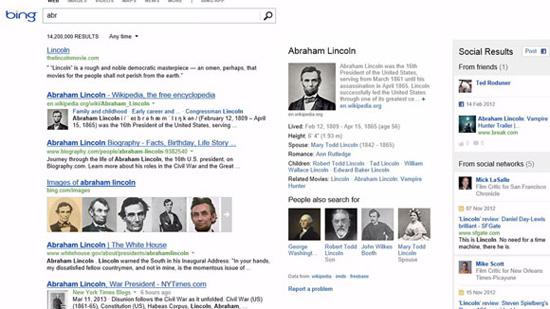
Search leaders haven’t been sitting idly by. Google’s own hyper-personal search tool is called Google Now and landed on desktop search just last month. Microsoft’s Bing has woven what it calls Social Search deep into its search engine. The hyper-personal search race has already been sparked; Facebook’s Graph Search ignites the revolution.

[[See also “Hands on with Facebook Graph Search: Interesting, but disappointing”]]

Getting personal

google logo

Personalized search is nothing new. We’ve gotten whiffs of the benefits of personalized search over time. Netflix has spent years honing its recommendation engine designed to keep you coming back to watch more movies and TV shows. Amazon recommends books, music, and numerous other products based on your past purchases. Pandora developed an algorithm that can generate playlists based on songs you tell it you like.

To read this article in full or to leave a comment, please click here

Source: FULL ARTICLE at PCWorld