Tag Archives: Omnicom Group

Report: Proposed advertising merger will bring competing auto brands under one roof

By Brandon Turkus

Publicis Omnicom merger sign goes up at stock exchange

Filed under:

Publicis Groupe SA and Omnicom Group are a pair of major marketing companies that are on the brink of merging, a move that will form the largest advertising company on the planet. Naturally, this effects the automotive world, as the two companies count a number of ad houses that service the industry under their respective umbrellas, including BBDO Worldwide, Goodby Silverstein and Partners and Saatchi & Saatchi.

According to a report on Automotive News, the pending merger will bring a number of brands’ advertising efforts under one very large roof, and could lead to a shakeup in how auto marketing functions. With Chevrolet, Cadillac, Toyota, Lexus, Nissan and Mercedes-Benz all run by the same group of agencies, the potential for conflicts of interest is obvious.

What this means in the short term isn’t entirely clear. As AN states, one agency managing multiple auto clients isn’t unheard of. It’s merely the scale of the Publicis/Omnicom merger that has people concerned. In the long term, the joining could lead to some realignment, although Ian Beavis, executive vice president of the Nielsen Company’s global automotive group, told AN, “I wouldn’t expect any wholesale changes,” as any movement is, “going to take a while.”

Still, the deal hasn’t received approval from regulators. According to Automotive News, if the deal is given the go-ahead, the agency would have a combined revenue of $22.7 billion in 2012.

Proposed advertising merger will bring competing auto brands under one roof originally appeared on Autoblog on Tue, 30 Jul 2013 08:59:00 EST. Please see our terms for use of feeds.

Permalink | Email this | Comments

…read more

Source: FULL ARTICLE at Autoblog

Show Me the Money, Omnicom Group

By Seth Jayson, The Motley Fool

Filed under:

Although business headlines still tout earnings numbers, many investors have moved past net earnings as a measure of a company’s economic output. That’s because earnings are very often less trustworthy than cash flow, since earnings are more open to manipulation based on dubious judgment calls.

Earnings’ unreliability is one of the reasons Foolish investors often flip straight past the income statement to check the cash flow statement. In general, by taking a close look at the cash moving in and out of the business, you can better understand whether the last batch of earnings brought money into the company, or merely disguised a cash gusher with a pretty headline.

Calling all cash flows

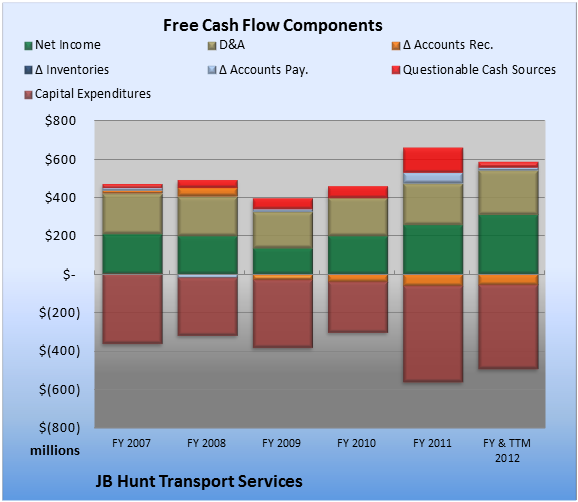
When you are trying to buy the market’s best stocks, it’s worth checking up on your companies’ free cash flow once a quarter or so, to see whether it bears any relationship to the net income in the headlines. That’s what we do with this series. Today, we’re checking in on Omnicom Group (NYS: OMC) , whose recent revenue and earnings are plotted below.

Source: S&P Capital IQ. Data is current as of last fully reported fiscal quarter. Dollar values in millions. FCF = free cash flow. FY = fiscal year. TTM = trailing 12 months.

Over the past 12 months, Omnicom Group generated $1,225.0 million cash while it booked net income of $998.3 million. That means it turned 8.6% of its revenue into FCF. That sounds OK.

All cash is not equal
Unfortunately, the cash flow statement isn’t immune from nonsense, either. That’s why it pays to take a close look at the components of cash flow from operations, to make sure that the cash flows are of high quality. What does that mean? To me, it means they need to be real and replicable in the upcoming quarters, rather than being offset by continual cash outflows that don’t appear on the income statement (such as major capital expenditures).

For instance, cash flow based on cash net income and adjustments for non-cash income-statement expenses (like depreciation) is generally favorable. An increase in cash flow based on stiffing your suppliers (by increasing accounts payable for the short term) or shortchanging Uncle Sam on taxes will come back to bite investors later. The same goes for decreasing accounts receivable; this is good to see, but it’s ordinary in recessionary times, and you can only increase collections so much. Finally, adding stock-based compensation expense back to cash flows is questionable when a company hands out a lot of equity to employees and uses cash in later periods to buy back those shares.

So how does the cash flow at Omnicom Group look? Take a peek at the …read more

Source: FULL ARTICLE at DailyFinance

Omnicom Group Passes This Key Test

By Seth Jayson, The Motley Fool

Filed under:

There’s no foolproof way to know the future for Omnicom Group (NYS: OMC) or any other company. However, certain clues may help you see potential stumbles before they happen — and before your stock craters as a result.

A cloudy crystal ball
In this series, we use accounts receivable and days sales outstanding to judge a company’s current health and future prospects. It’s an important step in separating the pretenders from the market’s best stocks. Alone, AR — the amount of money owed the company — and DSO — the number of days’ worth of sales owed to the company — don’t tell you much. However, by considering the trends in AR and DSO, you can sometimes get a window onto the future.

Sometimes, problems with AR or DSO simply indicate a change in the business (like an acquisition), or lax collections. However, AR that grows more quickly than revenue, or ballooning DSO, can, at times, suggest a desperate company that’s trying to boost sales by giving its customers overly generous payment terms. Alternately, it can indicate that the company sprinted to book a load of sales at the end of the quarter, like used-car dealers on the 29th of the month. (Sometimes, companies do both.)

Why might an upstanding firm like Omnicom Group do this? For the same reason any other company might: to make the numbers. Investors don’t like revenue shortfalls, and employees don’t like reporting them to their superiors.

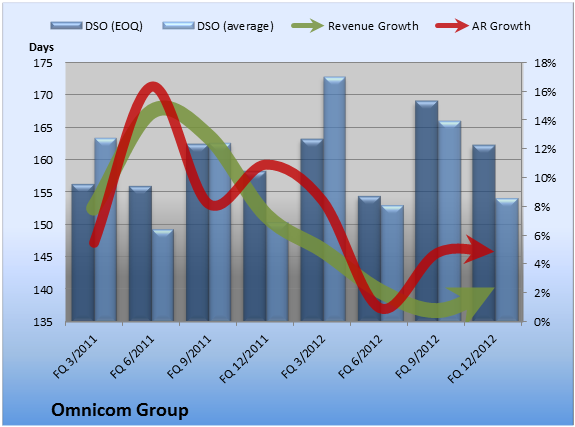
Is Omnicom Group sending any potential warning signs? Take a look at the chart below, which plots revenue growth against AR growth, and DSO:

Source: S&P Capital IQ. Data is current as of last fully reported fiscal quarter. FQ = fiscal quarter.

The standard way to calculate DSO uses average accounts receivable. I prefer to look at end-of-quarter receivables, but I’ve plotted both above.

Watching the trends
When that red line (AR growth) crosses above the green line (revenue growth), I know I need to consult the filings. Similarly, a spike in the blue bars indicates a trend worth worrying about. Omnicom Group‘s latest average DSO stands at 154.1 days, and the end-of-quarter figure is 162.3 days. Differences in business models can generate variations in DSO, and business needs can require occasional fluctuations, but all things being equal, I like to see this figure stay steady. So, let’s get back to our original question: Based on DSO and sales, does Omnicom Group look like it might miss its numbers in the next quarter or two?

I don’t think so. AR and DSO look healthy. For the last fully reported fiscal quarter, Omnicom Group‘s year-over-year revenue …read more
Source: FULL ARTICLE at DailyFinance

Is Omnicom Group Earning Enough for You?

By Seth Jayson, The Motley Fool

Filed under:

Margins matter. The more Omnicom Group (NYS: OMC) keeps of each buck it earns in revenue, the more money it has to invest in growth, fund new strategic plans, or (gasp!) distribute to shareholders. Healthy margins often separate pretenders from the best stocks in the market. That’s why we check up on margins at least once a quarter in this series. I’m looking for the absolute numbers, so I can compare them to current and potential competitors, and any trend that may tell me how strong Omnicom Group‘s competitive position could be.

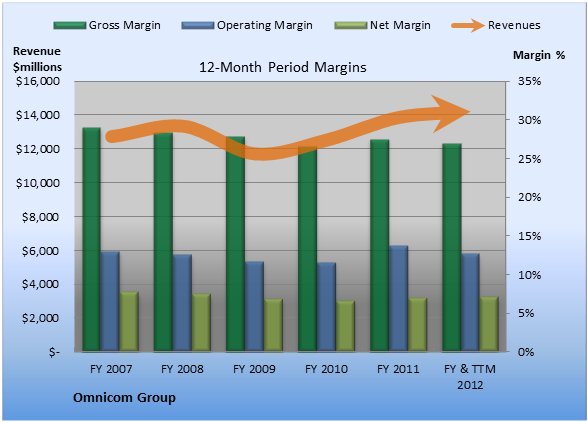
Here’s the current margin snapshot for Omnicom Group over the trailing 12 months: Gross margin is 27.0%, while operating margin is 12.7% and net margin is 7.0%.

Unfortunately, a look at the most recent numbers doesn’t tell us much about where Omnicom Group has been, or where it’s going. A company with rising gross and operating margins often fuels its growth by increasing demand for its products. If it sells more units while keeping costs in check, its profitability increases. Conversely, a company with gross margins that inch downward over time is often losing out to competition, and possibly engaging in a race to the bottom on prices. If it can’t make up for this problem by cutting costs — and most companies can’t — then both the business and its shares face a decidedly bleak outlook.

Of course, over the short term, the kind of economic shocks we recently experienced can drastically affect a company’s profitability. That’s why I like to look at five fiscal years’ worth of margins, along with the results for the trailing 12 months, the last fiscal year, and last fiscal quarter (LFQ). You can’t always reach a hard conclusion about your company’s health, but you can better understand what to expect, and what to watch.

Here’s the margin picture for Omnicom Group over the past few years.

Source: S&P Capital IQ. Dollar amounts in millions. FY = fiscal year. TTM = trailing 12 months.

Because of seasonality in some businesses, the numbers for the last period on the right — the TTM figures — aren’t always comparable to the FY results preceding them. To compare quarterly margins to their prior-year levels, consult this chart.

Source: S&P Capital IQ. Dollar amounts in millions. FQ = fiscal quarter.

Here’s how the stats break down:

  • Over the past five years, gross margin peaked at 28.4% and averaged 27.5%. Operating margin peaked at 13.8% and averaged 12.5%. Net margin peaked at 7.5% and averaged 6.9%.
  • TTM gross margin is 27.0%, 50 basis points worse than the five-year average. TTM operating margin is 12.7%, 20 basis points better than the five-year …read more
    Source: FULL ARTICLE at DailyFinance