By Richard Green Gretchen Morgenson complains that Fannie Mae and Freddie Mac did a lousy job of pricing mortgage risk. She consequently argues that any successor entity that looks remotely like them, such as the mortgage utility proposed by the Bipartisan Policy Center, will inevitably leave taxpayers on the hook. Given that part of Ms. Morgenson’s problem with the BPC is that it has members who worked for Fannie and Freddie, before I move on I should disclose that I worked for Freddie for about 16 months in 2002-2003. I am not sure when the statute of limitations on such things expires. I also am credited for doing some work for BPC, but that work actually had nothing to do with the future of mortgage securitization. …read more
Source: FULL ARTICLE at Forbes Markets
Tag Archives: Bipartisan Policy Center

Should We Get Rid of Fannie Mae and Freddie Mac?

Filed under: Mortgages, Banking, Securities, Home Buying, Home Loans
What if the two government-owned housing agencies that backstop so many of the nation’s mortgages ceased to exist? A new report from an influential think tank says that’s what should happen.
But while the plan isn’t quite as radical as it first sounds, if implemented it would mean a significant change if another housing bubble builds and bursts — a change that would have more of the risk falling onto individual homeowners instead of the federal government.
“Housing America’s Future: New Directions for National Policy” was authored by the Bipartisan Policy Center, a Washington, D.C.-based group founded by former Senate luminaries Howard Baker, Tom Daschle, Bob Dole, and George Mitchell.
Among other things, the report recommends slowly winding down Fannie Mae and Freddie Mac — the government-owned housing agencies that had to be bailed out at great taxpayer expense after the most recent real-estate bust — and replacing them with what the report’s authors call the “Public Guarantor.”
Taking the heat off taxpayers and putting it on homeowners
As the name suggests, the Public Guarantor would serve a similar function as Fannie and Freddie, but with a twist that would take the heat off the taxpayer in the event of another catastrophic housing-market event, like the one we saw in 2007.
Right now, Fannie and Freddie buy mortgages originated by the nation’s banks, package them up into mortgage-backed securities, and sell them to investors. In return, Fannie and Freddie pay interest on the securities back to the investors.
But unlike Fannie and Freddie, the Public Guarantor wouldn’t buy mortgages or issue mortgage-backed securities. The private sector would now handle that. And in the event of another burst housing bubble, the Public Guarantor would only guarantee investors their interest payments and the return of their initial investments.
This guarantee would only be triggered after the private capital in line ahead of it had been exhausted. Specifically, the government would be fourth in line to take a loss, which means, of course, the taxpayer is also fourth in line.
Mission accomplished, right? Yes, but it’s a double-edged sword.
Goliath Wins This Match, for David’s Own Good
While it’s great that the taxpayer is less on the hook for mortgage-market trouble, that default risk has to land somewhere.
Sponsored Linksadsonar_placementId=1505951;adsonar_pid=1990767;adsonar_ps=-1;adsonar_zw=242;adsonar_zh=252;adsonar_jv=’ads.tw.adsonar.com’;
With this new plan, part of that somewhere is back onto the borrower, who would be first in line to take the hit if the Public Guarantor guarantee is ever triggered. Next in line after borrowers are private-credit enhancers and finally the corporate resources of mortgage issuers and servicers.
So in the end, under this proposed plan the government would only be giving an ironclad guarantee to investors in privately issued mortgage-backed securities.
Why favor the big investor over the little homeowner? …read more
Source: FULL ARTICLE at DailyFinance
Congress Sends Obama Bill To Raise Debt Ceiling
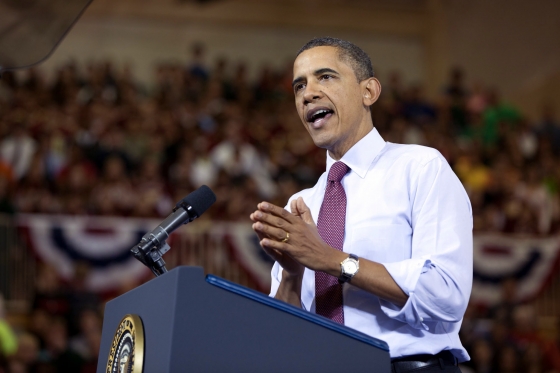
WASHINGTON (OfficialWire) — Congress passed must-do legislation Thursday to permit the government to borrow hundreds of billions of dollars more to meet its obligations, averting a first-ever government default that had loomed as early as mid-February.
The 64-34 vote in the Democratic-controlled Senate sent the measure to President Barack Obama, who has said he will sign it. The Republican-led House passed the legislation last week.
The legislation would temporarily suspend the $16.4 trillion limit on federal borrowing, which experts say would allow the government to borrow about $450 billion to meet interest payments and obligations like Social Security benefits and government salaries.
The deadline for Congress to act again to prevent default would likely not come until August, according to calculations by the Bipartisan Policy Center, a Washington-based think tank.