Tag Archives: Sporting Goods

Show Me the Money, Big 5 Sporting Goods

By Seth Jayson, The Motley Fool
Filed under:

Although business headlines still tout earnings numbers, many investors have moved past net earnings as a measure of a company’s economic output. That’s because earnings are very often less trustworthy than cash flow, since earnings are more open to manipulation based on dubious judgment calls.

Earnings’ unreliability is one of the reasons Foolish investors often flip straight past the income statement to check the cash flow statement. In general, by taking a close look at the cash moving in and out of the business, you can better understand whether the last batch of earnings brought money into the company, or merely disguised a cash gusher with a pretty headline.

Calling all cash flows

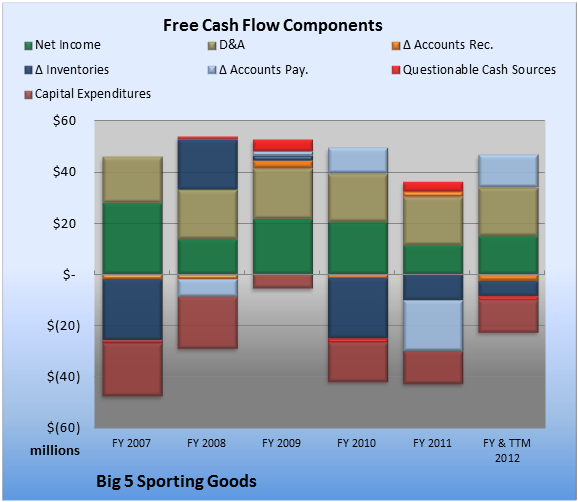
When you are trying to buy the market’s best stocks, it’s worth checking up on your companies’ free cash flow once a quarter or so, to see whether it bears any relationship to the net income in the headlines. That’s what we do with this series. Today, we’re checking in on Big 5 Sporting Goods (NAS: BGFV) , whose recent revenue and earnings are plotted below.

Source: S&P Capital IQ. Data is current as of last fully reported fiscal quarter. Dollar values in millions. FCF = free cash flow. FY = fiscal year. TTM = trailing 12 months.

Over the past 12 months, Big 5 Sporting Goods generated $26.7 million cash while it booked net income of $14.9 million. That means it turned 2.8% of its revenue into FCF. That doesn’t sound so great.

All cash is not equal
Unfortunately, the cash flow statement isn’t immune from nonsense, either. That’s why it pays to take a close look at the components of cash flow from operations, to make sure that the cash flows are of high quality. What does that mean? To me, it means they need to be real and replicable in the upcoming quarters, rather than being offset by continual cash outflows that don’t appear on the income statement (such as major capital expenditures).

For instance, cash flow based on cash net income and adjustments for non-cash income-statement expenses (like depreciation) is generally favorable. An increase in cash flow based on stiffing your suppliers (by increasing accounts payable for the short term) or shortchanging Uncle Sam on taxes will come back to bite investors later. The same goes for decreasing accounts receivable; this is good to see, but it’s ordinary in recessionary times, and you can only increase collections so much. Finally, adding stock-based compensation expense back to cash flows is questionable when a company hands out a lot of equity to employees and uses cash in later periods to buy back those shares.

So how does the cash flow at Big 5 …read more
Source: FULL ARTICLE at DailyFinance

Big 5 Hits Home Run As Sales Boom

By Zacks.com

Big 5 Sporting Goods Corporation (BGFV) recently delivered its third consecutive positive earnings surprise on the back of its largest same-store sales increase in over 10 years. Despite a relatively modest earnings beat, analysts revised their estimates significantly higher for both 2013 and 2014, sending the stock to a ZacksRank #1 (Strong Buy).
The company also announced a 33% increase in its quarterly dividend. It now yields a solid 2.6%. And valuation looks reasonable too with shares trading below the industry median.
Company Description
Big 5 is a sporting goods retailer in the western United States with 414 stores in 12 states. It operates under the “Big 5 Sporting Goods” name. The company was founded in 1955 and is headquartered in El Segundo, California. It has a market cap of $334 million.
Strong Fourth Quarter Results
Big 5 delivered better than expected fourth quarter results on February 26. Earnings per share came in at 19 cents, beating the Zacks Consensus Estimate by a penny. It was the company’s third straight positive earnings surprise.
Net sales increased 7.4% to $243.6 million, ahead of the Zacks Consensus Estimate of $242.0 million. This was driven by a 6.5% increase in same-store sales, which was its largest increase in over 10 years. Meanwhile, the gross profit margin expanded 100 basis points to 32.2% of net sales. On top of this, the company leveraged its selling and administrative expenses, which declined 210 basis points to 29.2% of net sales.
In the press release, the company also announced a 33% increase in its quarterly dividend to 10 cents per share. It now yields a solid 2.6%.
Estimates Surging Higher
Despite a relatively modest EPS beat, analysts revised their estimates significantly higher for both 2013 and 2014, sending the stock to a Zacks Rank #1 (Strong Buy). Over the last 30 days, the 2013 consensus has surged from $0.88 to $1.07. Meanwhile, the 2014 consensus has increased from $1.09 to $1.23.
Based on current consensus estimates, analysts project 47% EPS growth this year and 15% growth next year. The company currently anticipates opening approximately 15-20 new stores in 2013, including three relocations, and closing approximately three relocated stores.
Special Offer: This special report zeroes in on some huge money-making opportunities as well as some urgent sell alerts that could save you from devastating losses in the year ahead. Get nearly 100 buy and sell calls from almost four dozen of the world’s most successful investing experts all in one place in Forbes’ Best Ideas for 2013.
Reasonable Valuation
Given Big 5’s strong growth projections, you might expect a sky-high P/E multiple. But that’s not the case. Shares trade a relatively modest 14x 12-month forward earnings, a discount to the industry multiple of 16x. And its price to book ratio of 2.0 is well below the 3.3 median for its peers. …read more
Source: FULL ARTICLE at Forbes Markets

Here's 1 Reason Big 5 Sporting Goods Looks Weak

By Seth Jayson, The Motley Fool

Filed under:

Margins matter. The more Big 5 Sporting Goods (NAS: BGFV) keeps of each buck it earns in revenue, the more money it has to invest in growth, fund new strategic plans, or (gasp!) distribute to shareholders. Healthy margins often separate pretenders from the best stocks in the market. That’s why we check up on margins at least once a quarter in this series. I’m looking for the absolute numbers, so I can compare them to current and potential competitors, and any trend that may tell me how strong Big 5 Sporting Goods‘s competitive position could be.

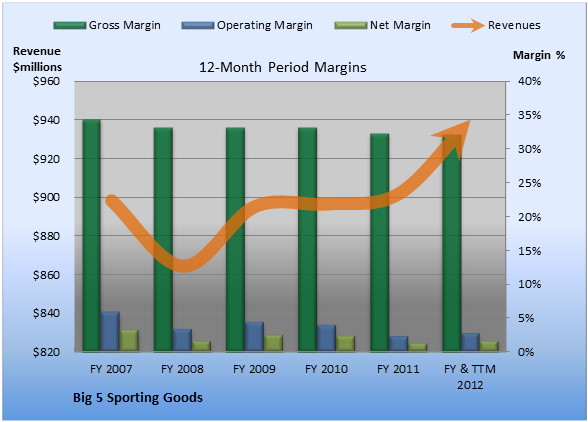
Here’s the current margin snapshot for Big 5 Sporting Goods over the trailing 12 months: Gross margin is 32.2%, while operating margin is 2.8% and net margin is 1.6%.

Unfortunately, a look at the most recent numbers doesn’t tell us much about where Big 5 Sporting Goods has been, or where it’s going. A company with rising gross and operating margins often fuels its growth by increasing demand for its products. If it sells more units while keeping costs in check, its profitability increases. Conversely, a company with gross margins that inch downward over time is often losing out to competition, and possibly engaging in a race to the bottom on prices. If it can’t make up for this problem by cutting costs — and most companies can’t — then both the business and its shares face a decidedly bleak outlook.

Of course, over the short term, the kind of economic shocks we recently experienced can drastically affect a company’s profitability. That’s why I like to look at five fiscal years’ worth of margins, along with the results for the trailing 12 months, the last fiscal year, and last fiscal quarter (LFQ). You can’t always reach a hard conclusion about your company’s health, but you can better understand what to expect, and what to watch.

Here’s the margin picture for Big 5 Sporting Goods over the past few years.

Source: S&P Capital IQ. Dollar amounts in millions. FY = fiscal year. TTM = trailing 12 months.

Because of seasonality in some businesses, the numbers for the last period on the right — the TTM figures — aren’t always comparable to the FY results preceding them. To compare quarterly margins to their prior-year levels, consult this chart.

Source: S&P Capital IQ. Dollar amounts in millions. FQ = fiscal quarter.

Here’s how the stats break down:

  • Over the past five years, gross margin peaked at 33.2% and averaged 32.8%. Operating margin peaked at 4.3% and averaged 3.4%. Net margin peaked at 2.4% and averaged 1.8%.
  • TTM gross margin is 32.2%, 60 basis points worse than the five-year average. TTM operating …read more
    Source: FULL ARTICLE at DailyFinance