Tag Archives: NHTSA

NHTSA: Under 18 mph, electric vehicles will need to make "alert sound"

By Sebastian Blanco

Filed under: , , ,

2011 toyota prius

It’s been a long time coming – remember the Pedestrian Safety Enhancement Act of 2010? – but the proposed rules for the noises that electric or hybrid vehicles have to make at low speeds have been released (get them here in PDF). The National Highway Traffic Safety Administration announced the proposed rules today in response to some requests for the noises to be generated to alert vision-impaired pedestrians.

Most current plug-in vehicles have a sound that can be triggered by the driver to alert people, but the rules would require vehicles that don’t have their liquid-burning engine running to emit a sound that will “enable pedestrians to discern vehicle presence, direction, location and operation” when traveling at speeds under 18 miles per hour. NHTSA estimates that 2,800 pedestrian injuries will be avoided because of the rule, which represents “35 equivalent lives saved.”

The proposed rules affect hybrid and electric vehicles, but the agency thinks that only hybrid vehicles will really be affected with actual cost and technology, since manufacturers are already putting sounds into EVs (and upcoming hydrogen fuel cell vehicles). NHTSA thus figures that, “the incremental number of light vehicles that have to add an alert sound system for costing purposes for MY 2016 is … 671,300.” The average cost per vehicle, NHTSA says, would be around $30.

Each manufacturer will be able to choose the sounds its cars make, as long as it follows the rules. That means it needs to change based on vehicle speed and the vehicle needs to make noise when idling, too. You can hear sample sounds from NHTSA here and read the official announcement below. A 60-day comment period starts today, and if everything goes smoothly, a three-year phase-in period might start in September 2015.

Continue reading NHTSA: Under 18 mph, electric vehicles will need to make “alert sound”

NHTSA: Under 18 mph, electric vehicles will need to make “alert sound” originally appeared on Autoblog Green on Mon, 07 Jan 2013 17:45:00 EST. Please see our terms for use of feeds.

Permalink | Email this | Comments

Source: FULL ARTICLE at Autoblog

Report: NHTSA delays backup camera rules… again

By Chris Tutor

Filed under: , ,

Audi backup cam with

The National Highway Traffic Safety Administration has again delayed adoption of rear visibility rules that would require backup cameras in all passenger vehicles sold in the US. It’s the fourth delay in a string of setbacks dating to 2007. That’s the year Congress passed legislation intended to improve rear visibility in new vehicles.

NHTSA legislation had previously required automakers outfit at least 10 percent of their cars with backup cameras by 2012, 40 percent by 2013 and 100 percent by 2014. Those deadlines will likely be changed now. Delays have been blamed largely on automakers’ arguments that the new requirements will be too costly. Estimates suggest that MSRPs on vehicles already outfitted with display screens would need to increase an estimated $58-88, while models without would see price bumps of between $159 and $203.

The agency estimates that the new regulations could have cost the industry between $700 million and $1.6 billion by 2014. According to The Detroit News, “NHTSA uses a statistical figure of $6.1 million as the value of a human life and says under a best-case scenario, the proposal will cost between $11.8 million and $19.7 million per life saved.”

The government agency has not yet announced if or when a new deadline will be set.

NHTSA delays backup camera rules… again originally appeared on Autoblog on Thu, 03 Jan 2013 15:45:00 EST. Please see our terms for use of feeds.

Permalink | Email this | Comments

Source: FULL ARTICLE at Autoblog

Subaru recalling almost 634,000 CUVs, sedans for possible puddle light short

By Jeffrey N. Ross

Filed under: , , ,

The National Highway Traffic Safety Administration announced a massive recall campaign today for some of the more popular Subaru models due to defective puddle lights that could short out and possibly lead to smoke and/or fire. While the recall notice lists a total of 633,842 Forester, Legacy, Outback and Tribeca models from various model years, Automotive News is reporting that there are only 53,999 units actually equipped with the defective lights, but Subaru is having to make the massive recall since it is unable identify which vehicles have the lights.

The problem with the 2009 through 2012 Forester, 2006 through 2012 Tribeca and the 2010 through 2011 Legacy and Outback is that the puddle lights mounted under the door mirrors can collect water or moisture, which can lead to the short. To fix the problem, Subaru is adding an extra fuse to the wiring harness as a part of the recall that will go into effect next month. For Forester owners, this is the second major recall in less than a year following the 275,000 units that were afflicted with faulty rear seatbelts.

For more information about the recall or to see if your vehicle applies, scroll down for the official NHTSA recall notice.

Continue reading Subaru recalling almost 634,000 CUVs, sedans for possible puddle light short

Subaru recalling almost 634,000 CUVs, sedans for possible puddle light short originally appeared on Autoblog on Thu, 03 Jan 2013 09:15:00 EST. Please see our terms for use of feeds.

Permalink | Email this | Comments

Source: FULL ARTICLE at Autoblog

Mandatory Rearview Cameras Shelved – For Now

By Kurt Ernst

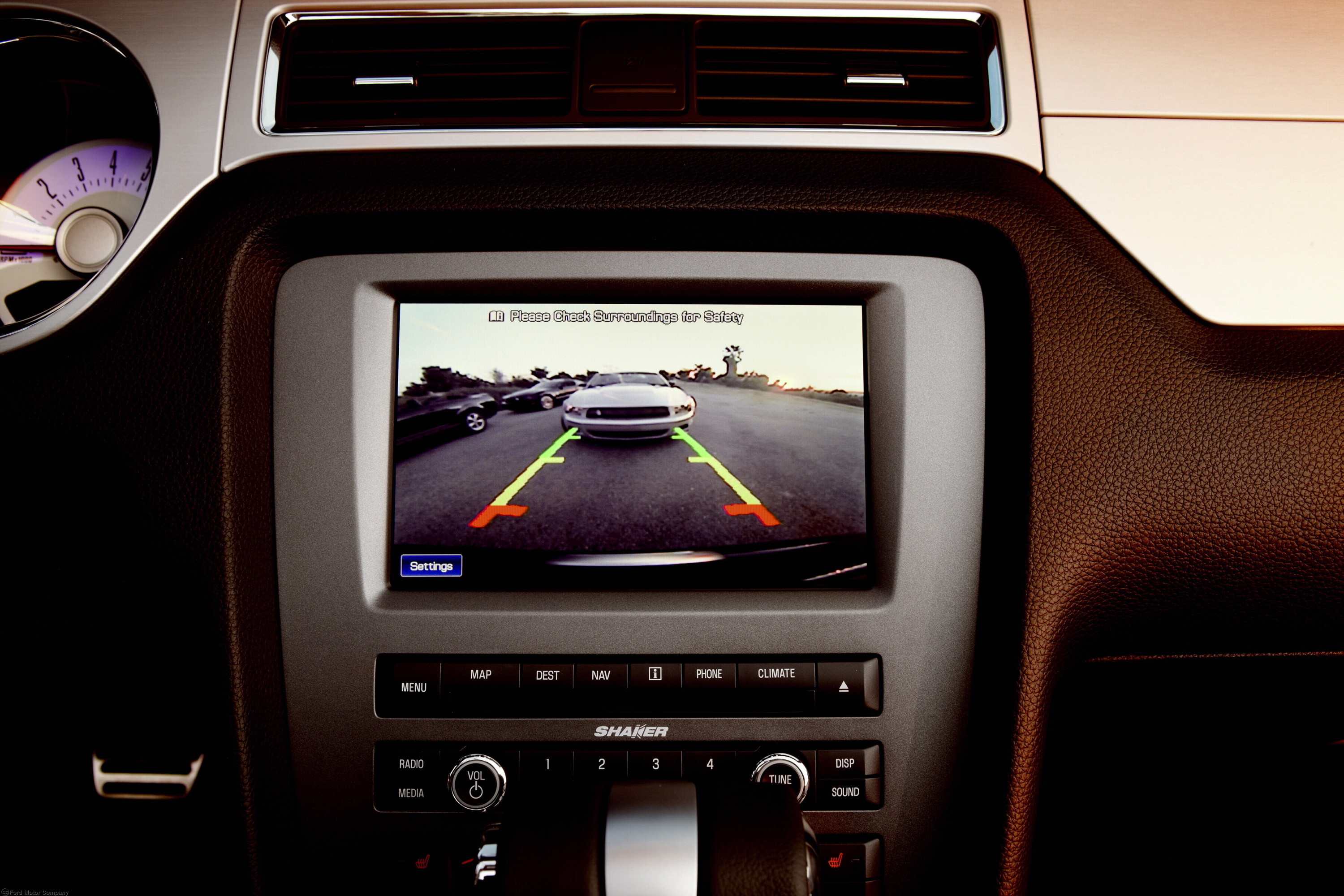
The rear view camera system in a 2013 Ford Mustang – image: Ford Motor Company

The National Highway Traffic Safety Administration (NHTSA) missed a December 31 deadline to establish rules requiring rear vision camera systems for all new cars. Congress approved a plan to set rear visibility standards in new cars, which would likely require the adoption of rearview camera systems, back in 2007, so why has the NHTSA avoided setting guidelines?

As The Detroit News (via Left Lane News) points out, there are likely two reasons behind the delay, with the first being the cost of implementation. As unsettling as this may sound, the “value” of a human life is $6.1 million according to the NHTSA; implementation of mandatory rear-view camera systems would cost between $11.8 million and $19.7 million per life saved. Put another way, there isn’t exactly an epidemic of vehicular deaths caused by rear-visibility issues.

Given that most of the deaths involve children under the age of five, the agency is willing to look beyond the cost of implementation, but the question is can consumers? Rear-vision systems add an average of $181 to cars lacking an infotainment display, or $73 to cars equipped with a display screen. It’s not clear if consumers would be willing to spend this amount of money for a safety system that isn’t perceived to add significant benefit.

The real reason for the delay, however, may be tied to the fact that most new car models already offer the technology bundled with other systems. By the time the NHTSA got around to making rear-vision systems mandatory, most manufacturers would be in compliance anyway.

Do we even need to point out that rear-vision camera systems themselves won’t solve the problem, or that a distracted driver is a distracted driver no matter how much technology his car is packing?

Source: FULL ARTICLE at Automotive Addicts

More Than 400 Chevrolet Dealers Opt Out of Selling Volt Due to Higher Cost of Service Tools

By Alexander Stoklosa

2013 Chevrolet Volt

It might seem like an odd concept, but dealerships are not obligated to sell every model an automaker produces—if a model isn’t popular or profitable, dealers can decide to drop it altogether. This phenomenon, first reported by Automotive News and confirmed to us by a Chevrolet spokesperson, currently is being acted out in more than 400 Chevy dealerships nationwide where the Volt plug-in hybrid is being dropped from showrooms. The reason? Chevrolet is requiring that Volt-certified dealers equip their service departments with $5100 worth of new tools this year, and some stores just don’t feel like coughing up the dough.

Each year, Chevrolet allows its dealers to opt out of selling certain vehicles, so this year, when Chevy raised the service-tool costs for the Volt from $2800 to $5100, some stores decided the Volt wasn’t worth it. (Chevy annually updates its service requirements for its models—the Volt included—and so even though the newly required tools this year cost more, dealers only have to buy them once.) Now before you go ballyhooing the Volt as some kind of failure, a Chevy spokesperson told us that the dealerships that dropped the Volt accounted for less than one percent of the car’s annual sales. Imagine, if you will, that you sell Volts. If you sell 100 Volts a year, spending $5100 on equipment specifically for servicing that particular vehicle doesn’t cut into profit margins too greatly; if you sell only a handful, well, your per-car profit is more deeply affected.


So why the huge year-over-year increase in service tool costs? According to Chevrolet, a large chunk of the increase comes from a new battery-depowering tool that allows service departments to power down the Volt’s battery pack so that pieces of the pack may be sent back to Chevy for maintenance rather than the entire unit. Such equipment likely would have prevented the NHTSA’s famous Volt crash-test fires, we’re told by outside sources.

Source: FULL ARTICLE at Car & Driver

Toyota Announces $1.1 Billion Settlement In Acceleration Recall

Remember last week when Toyota coughed up $17.35 million for “the single highest civil penalty amount ever paid to NHTSA for violations stemming from a recall”? That was chump change compared to Toyota’s next payout. In a press release posted yesterday, the world’s best-selling automaker has agreed to shell out a staggering $1.1 billion to settle…
Source: The Car Connection

Bombardier issues two Can-Am Spyder recalls over fire risks

By Jonathon Ramsey

Filed under: , ,

Bombardier has issued two separate recalls for various models of its Can-Am Spyder. The first is for 2008-2009 GS and 2010 RS models. The fuel vapor canister vent hose in the engine compartment can leak, with accumulated fuel vapor a potential fire concern due to its proximity to the ignition. A bulletin from the National Highway Traffic Safety Administration indicates the recall, which affects 9,600 Spyders, is expected to begin next month, at which time owners can take their Spyders to their dealers for a fix free of charge.

The second recall covers 2008-2009 GS, 2009-2012 RS and 2010-2012 RT trikes. The models affected by the recall – 33,700 units in all – could have fuel caps that fail to fit properly onto their filler necks, which could also leak fuel vapors. The recall is also expected to begin next month, and Bombardier will send owners a new fuel cap. Two bulletins below from NHTSA below have all the details.

Continue reading Bombardier issues two Can-Am Spyder recalls over fire risks

Bombardier issues two Can-Am Spyder recalls over fire risks originally appeared on Autoblog on Sat, 22 Dec 2012 08:59:00 EST. Please see our terms for use of feeds.

Permalink | Email this | Comments

Source: Autoblog

Report: US traffic deaths climb 7.1% in first 9 months of 2012

By Michael Harley

Filed under:

Guard rail with RIP messages and police line tape

Less than two weeks ago, the National Highway Traffic Safety Administration reported that 2011 traffic fatalities had declined by nearly 2 percent – to the lowest level in more than six decades. Now comes word that the first nine months of 2012 haven’t been nearly as positive. According to the government agency’s preliminary estimates, traffic deaths through September of this year have risen 7.1 percent when compared to last year’s figures – the largest increase for that calendar period since NHTSA began keeping records.

Safety experts point out that US vehicle miles traveled from January 2012 through September 2012 increased by 14.6 billion miles (a 0.6-percent rise) over the same period last year. Those adding up the numbers say that many factors are to blame. Warm weather also increases the quantity of motorcyclists on the road and pedestrians on the sidewalks. A drop in gas prices and an improved economy also means consumers are more likely to drive outside of their daily commute.

Ending on a positive note, today’s estimated fatality rate of 1.16 deaths per 100 million miles traveled is still down 21 percent when compared its recent high of 1.45 deaths per 100 million miles in 2005.

US traffic deaths climb 7.1% in first 9 months of 2012 originally appeared on Autoblog on Fri, 21 Dec 2012 10:44:00 EST. Please see our terms for use of feeds.

Permalink | Email this | Comments

Source: Autoblog

GM recalling 118K Colorado, Canyon pickups over missing hood latches

By Steven J. Ewing

Filed under: , , , , ,

2010 Chevrolet Colorado

General Motors has announced a recall of 118,800 Chevrolet Colorado and GMC Canyon pickup trucks due to the possibility of secondary hood latches not being installed at the time of manufacture. The affected vehicles are from the 2010, 2011 and 2012 model years, all of which were built between November 9, 2009 and August 28, 2012.

According to the official National Highway Traffic Safety Administration report, these trucks fail to “comply with the requirements of Federal Motor Vehicle Safety Standard No. 113, ‘Hood Latch System.’ The hood may be missing the secondary hood latch.” In other words, owners of these trucks could find their vehicles’ hoods opening unexpectedly while driving.

The official recall campaign is expected to begin on January 17, 2013. Dealers will inspect the affected pickups and if a secondary hood latch is not present, one will be installed free of charge. Scroll down to read the official NHTSA report.

Continue reading GM recalling 118K Colorado, Canyon pickups over missing hood latches

GM recalling 118K Colorado, Canyon pickups over missing hood latches originally appeared on Autoblog on Thu, 20 Dec 2012 11:27:00 EST. Please see our terms for use of feeds.

Permalink | Email this | Comments

Source: Autoblog

Hyundai recalling 2012 Veloster over shattering sunroofs, parking brake

By Seyth Miersma

Filed under: , ,

2012 Hyundai Veloster - white - front three-quarter view

A spate of not-great news for Hyundai Veloster owners today, as the plucky hatchback is the subject of not one, but two recall notices from the National Highway Traffic Safety Administration.

The first recall is about an issue with the 2012 Veloster’s sunroof assembly that we first reported on last October. A NHTSA probe into shattering panoramic glass has resulted in a recall affecting some 13,500 units that may have glass panels that were weakened during installation at the factory. Said glass may break while the vehicle is in motion.

The second recall specifies a problem with the parking brake in 4,490 manual-transmission cars, also from the 2012 model year. The parking brakes in these cars may pick up moisture and road grime, which could, in turn, cause the brake components to bind and not fully engage.

In both cases, Hyundai will notify owners of recalled vehicles and inspect and replace defective parts free of charge. Both recalls will begin during January 2013. Scroll below for both official recall notices from NHTSA.

Continue reading Hyundai recalling 2012 Veloster over shattering sunroofs, parking brake

Hyundai recalling 2012 Veloster over shattering sunroofs, parking brake originally appeared on Autoblog on Wed, 19 Dec 2012 13:44:00 EST. Please see our terms for use of feeds.

Permalink | Email this | Comments

Source: Autoblog

Dodge recalls 2013 Durango over "incorrect seating capacity information labels"

By Jonathon Ramsey

Filed under: , , , ,

A bad labeling job is at the root of Dodge recalling 734 units of the its 2013 Durango. The SUVs in question, built from April 27 to September 14 of this year, could have been affixed with labels that overstate the seating capacity. That contravenes federal regulations, and could lead to an accident due to owners putting too many people in the vehicle.

The National Highway Traffic Safety Administration says a the recall should begin in February, 2013. Dodge will “provide replacement labels” to owners who can apply them on their own or have their dealers apply the correct labels free of charge. There’s more information in the NHTSA bulletin below.

Continue reading Dodge recalls 2013 Durango over “incorrect seating capacity information labels”

Dodge recalls 2013 Durango over “incorrect seating capacity information labels” originally appeared on Autoblog on Tue, 18 Dec 2012 09:30:00 EST. Please see our terms for use of feeds.

Permalink | Email this | Comments

Source: Autoblog

Report: Toyota to pay $17.35M federal fine for delayed Lexus RX recall

By George Kennedy

Filed under: , , , , , , ,

2010 Lexus RX hybrid - front three-quarter view

This summer, we brought you news that Lexus was recalling over 150,000 RX and RX hybrid crossovers tied to its massive pedal entrapment issue. An update to that story included word from the National Highway Traffic Safety Administration that it was considering launching a federal investigation into potential delays by the automaker in notifying owners about the problem. Now comes news that parent company Toyota will pay a hefty $17.35 million in fines for delaying its recall of the 2010 Lexus RX 350 and RX 450h. According to The Detroit News, the Japanese automaker is being forced to pay the maximum fine for delaying recalls – and this isn’t the first time. In fact, this is the fourth time since 2010 that Toyota has been required to do so, including paying $48.8M in civil penalties in 2010 for failing to recall vehicles in a timely manner – in three separate campaigns.

In addition to the fines, Toyota has agreed to restructure the way it handles quality control and review “safety-related issues.” Though the Japanese automaker has not admitted any wrongdoing, Toyota has agreed to meet with NHTSA for six months on the matter and may extend the meetings another six months.

US Transportation Secretary Ray LaHood says he is counting on Toyota to improve its ability to address such safety issues: “With today’s announcement, I expect Toyota to rigorously reinforce its commitment to adhering to the United States safety regulations,” he said in a statement.

According to the report, Toyota has recalled more vehicles than any other automaker so far this year – 5.3 million in 13 separate campaigns – putting it about two million units ahead of second-place Honda.

This latest fine is a drop in the bucket compared to Toyota’s expected global profits of $9.7 billion by the end of March, 2013. That said, Congress has already agreed to a new fine that will push the maximum penalty for delayed recalls up to $35 million. This increase will take effect in 2013.

Toyota to pay $17.35M federal fine for delayed Lexus RX recall originally appeared on Autoblog on Tue, 18 Dec 2012 13:28:00 EST. Please see our terms for use of feeds.

Permalink | Email this | Comments

Source: Autoblog

Report: NHTSA upgrades Ford floor mat unintended acceleration probe

By Jonathon Ramsey

Filed under: , , , ,

Ford badge

According to a Bloomberg report, the National Highway Traffic Safety Administration has upgraded an investigation into complaints of unintended acceleration lodged against Ford vehicles. The investigation began in June of 2010 when just three complaints had been received and it only concerned the Ford Fusion and Mercury Milan, but this was at a time when the phrase “unintended acceleration” made grown men go pale. With 49 additional complaints received since then, the investigation has been reclassified as an engineering analysis – the last phase before a recall – and it has been expanded to include the Lincoln MKZ, making for a total of “around 480,000” units affected between the three sedans from the 2008 to 2010 model years.

The ostensible cause is that floor mats are trapping the accelerator pedal, but according to a Ford statement at the time, the entrapment is due to owners placing the optional all-weather floor mats, or aftermarket floor mats, on top of the car’s standard floor mats. NHTSA has backed up that assessment, pinning the blame on “unsecured or double stacked floor mats.”

On the face of it, it would appear that NHTSA has upgraded the status not because of Ford’s error, but owner error, and Ford has stated publicly that it is “disappointed” in NHTSA‘s move. On top of NHTSA still being skittish after that other unintended acceleration debacle, it could be seen to be taking its time investigating all of the variables: it’s reported that Ford changed its accelerator pedal design in 2010, a “heel blocker” in the floorpan has been considered a potential culprit in how the floor mats could be trapping the pedal, some drivers have said the floor mats weren’t anywhere near the pedal, and according to a report in the LA Times, in “a letter sent by Ford to NHTSA in August 2010, the automaker said it found three injuries and one fatality that ‘may have resulted from the alleged defect.'”

If that last part is true, that’s strange enough by itself; in June 2010 there were apparently only three complaints in total, but two months later Ford was supposedly saying there might – let’s emphasize might – be three injuries and a death involved. This sounds like the kind of thing that could take a while to sort out. Ford has said it is cooperating fully with the investigation.

NHTSA upgrades Ford floor mat unintended acceleration probe originally appeared on Autoblog on Mon, 17 Dec 2012 08:27:00 EST. Please see our terms for use of feeds.

Permalink | Email this | Comments

Source: Autoblog

Lamborghini recalls Aventador over headlamp problem

By Jonathon Ramsey

Filed under: , , , , ,

2012 Lamborghini Aventador - front three-quarter view against green wall

The National Highway Traffic Safety Administration has issued a bulletin over a recall for up to 144 examples of the 2012 Lamborghini Aventador here in the States. The affected models, built from July 15, 2011 to April 20, 2012 have headlights that apparently don’t conform to US federal motor vehicle safety standards. The lamps can be aimed horizontally but not vertically, which can reduce their usefulness for the driver and blind oncoming traffic if aimed improperly.

Lamborghini is expected to begin notifying affected owners next week, at which time they can take their Aventadors to their dealers for a fix free of charge. The complete bulletin from NHTSA is below.

Continue reading Lamborghini recalls Aventador over headlamp problem

Lamborghini recalls Aventador over headlamp problem originally appeared on Autoblog on Fri, 14 Dec 2012 16:33:00 EST. Please see our terms for use of feeds.

Permalink | Email this | Comments

Source: Autoblog

Four Myths About NHTSA’s Proposal for Mandatory Black Boxes


Twenty-four-hour news networks interrupted their coverage of skydiving cats earlier this week to light a fire under NHTSA’s announcement that it planned to mandate event data recorders, or black boxes, be installed in all new cars. Amidst the frenzy, it almost seems as though many reporting on the announcement didn’t actually read the proposed NHTSA rule or anything about what the event data recorders actually do. We’re here to debunk some of the rumors in circulation.
Myth 1: NHTSA’s Announcement Last Week Said Something We Haven’t Heard Before
Nope. NHTSA has been talking about mandating event data recorders since at least 2006, when it first set rules about how voluntarily installed EDRs had to operate. The only thing NHTSA announced recently is that it plans to put this rule into effect beginning in 2014, which was the date floated officially and unofficially during the past year.
Myth 2: The White House “Signed Off” on NHTSA’s Proposal for Event Data Recorders
A number of major news outlets based their reporting of the black box topic on a story published in the Detroit News, which was titled “NHTSA gets White House OK to mandate vehicle ‘black boxes.’” This makes it sound like Transportation Secretary Ray LaHood brought a bottle of brandy to the Oval Office, kissed Barack Obama’s ring, and said, “Mr. President, even though it’s not the day of your daughter’s wedding, we’d like your blessing for our plan to require automakers to install black boxes in every car. Can we go ahead with this?”
In reality, any time an executive agency proposes a new regulation—whether it’s NHTSA or the Forest Service—they have to clear it with the Office of Management and Budget to make sure the new reg doesn’t conflict with what another agency is doing, isn’t creating some new huge burden for the budget, and that the new rule wouldn’t be totally contrary to the president’s stated goals. The OMB is part of the White House organizational structure, so while it’s technically accurate that the White House cleared the black box plan, this routine rubber stamp is meaningless.
Myth 3: Mandating Black Boxes Will Change the Status Quo
Does your car have an event data recorder? Even you, the automotive illuminati who read Car and Driver, would be forgiven for not knowing. It’s not something listed in a database or published on a window sticker. It turns out that well over 90 percent of new cars sold today in the U.S. already have event data recorders, which automakers have been voluntarily installing for several years. The proposed mandate would extend to the remaining holdover vehicles, which includes some high-end sports cars and a number of Volkswagens and Audis.
What we’re talking about, then, is a rule that would change a sliver of the automotive market. Typically, automakers—either directly or through group lobby associations—push back against any additional government regulation; they don’t want control and they don’t want added costs. But when it comes to EDRs,  the counter-campaign against event data recorders has been virtually nonexistent. Toyota’s continuing nightmare surrounding unintended acceleration showed car manufacturers just how helpful EDRs can be in defending themselves. When a company can analyze black boxes and say, “Sorry, driver, but the computer recorded you mashing the gas pedal with no input on the brake,” that’s persuasive evidence.

Instrumented Test: 2013 Lincoln MKZ AWD V6
Instrumented Test: 2013 Porsche Boxster Manual
Instrumented Test: 2013 Fiat 500 Turbo

Myth 4: Privacy is at Risk Because the Gub’mint Is Gonna Track People
Make no mistake: The government—local police, the CIA, the FBI, DEA, Homeland Security, water department—can and does track individual cars. Much of the time it’s done in a squeaky-clean way, with warrants and court approval for monitoring Fat Tony and the Don Bot. Sometimes, it’s a legal gray area, and we wind up with major court battles trying to sort out the rules for law enforcement. (Privacy advocates, like this writer, were pleased by the recent Supreme Court decision saying that law enforcement officers need a warrant to track vehicles using GPS tags.) Event data recorders are an entirely separate matter. They don’t transmit data. The boxes record certain characteristics about the vehicle, like steering input, acceleration, seatbelt status, and brake usage, in a sort of “streaming” format, retaining only the past few seconds of data for any given moment.
There are serious questions about who owns the data, who can use it, and who can access it. Even with plain-language rules from NHTSA, our judges will end up having to hammer out the details. Bear in mind, though, that a huge cache of information already is stored in in-car GPS systems, and that’s all subject to download by the police or an opponent in a lawsuit. The same is true for smart phones, by the way, which contain way more than just GPS coordinates.

Source: Car & Driver

Best Car To Buy 2013, Fisker’s Future, Holiday Gifts: Car News Headlines

Today at The Car Connection, the Coda electric sedan and 2013 Cadillac ATS were rated by NHTSA, and we announced the Best Car To Buy for 2013. Lamborghini confirmed 2013 is the last year for the Gallardo, and the EPA rated the 60-kWh version of the Tesla Model S. All this and more in today’s car news, right here on The Car Connection. The 2013…
Source: The Car Connection

Concerns over privacy as NHTSA prepares to push for black boxes in cars

Many motorists don’t know it, but it’s likely that every time they get behind the wheel, there’s a snitch along for the ride.

In the next few days, the National Highway Traffic Safety Administration is expected to propose long-delayed regulations requiring auto manufacturers to include event data recorders — better known as “black boxes” — in all new cars and light trucks. But the agency is behind the curve. Automakers have been quietly tucking the devices, which automatically record the actions of drivers and the responses of their vehicles in a continuous information loop, into most new cars for years.

When a car is involved in a crash or when its airbags deploy, inputs from the vehicle’s sensors during the 5 to 10 seconds before impact are automatically preserved. That’s usually enough to record things like how fast the car was traveling and whether the driver applied the brake, was steering erratically or had a seat belt on.

The idea is to gather information that can help investigators determine the cause of accidents and lead to safer vehicles. But privacy advocates say government regulators and automakers are spreading an intrusive technology without first putting in place policies to prevent misuse of the information collected.

Data collected by the recorders is increasingly showing up in lawsuits, criminal cases and high-profile accidents. Massachusetts Lt. Gov. Timothy Murray initially said that he wasn’t speeding and that he was wearing his seat belt when he crashed a government-owned car last year. But the Ford Crown Victoria‘s data recorder told a different story: It showed the car was traveling more than 100 mph (160 kph) and Murray wasn’t belted in.

In 2007, then-New Jersey Gov. Jon Corzine was seriously injured in the crash of an SUV driven by a state trooper. Corzine was a passenger. The SUV‘s recorder showed the vehicle was traveling 91 mph (146 kph) on a parkway where the speed limit was 65 mph (105 kph), and Corzine didn’t have his seat belt on.

There’s no opt-out. It’s extremely difficult for car owners to disable the recorders. Although some vehicle models have had recorders since the early 1990s, a federal requirement that automakers disclose their existence in owner’s manuals didn’t go into effect until three months ago. Automakers who voluntarily put recorders in vehicles are also now required to gather a minimum of 15 types of data.

Besides the upcoming proposal to put recorders in all new vehicles, the traffic safety administration is also considering expanding the data requirement to include as many as 30 additional types of data such as whether the vehicle’s electronic stability control was engaged, the driver’s seat position or whether the front-seat passenger was belted in. Some manufacturers already are collecting the information. Engineers have identified more than 80 data points that might be useful.

Despite privacy complaints, the traffic safety administration so far hasn’t put any limits on how the information can be used. About a dozen states have some law regarding data recorders, but the rest do not.

Right now we’re in an environment where there are no rules, there are no limits, there are no consequences and there is no transparency,” said Lillie Coney, associate director of the Electronic Privacy Information Center, a privacy advocacy group. “Most people who are operating a motor vehicle have no idea this technology is integrated into their vehicle.”

Part of the concern is that the increasing computerization of cars and the growing transmission of data to and from vehicles could lead to unintended uses of recorder data.

“Basically your car is a computer now, so it can record all kinds of information,” said Gloria Bergquist, vice president of the Alliance of Automotive Manufacturers. “It’s a lot of the same issues you have about your computer or your smartphone and whether Google or someone else has access to the data.”

The alliance opposes the government requiring recorders in all vehicles.

Data recorders “help our engineers understand how cars perform in the real world, and we already have put them on over 90 percent of (new) vehicles without any mandate being necessary,” Bergquist said.

Safety advocates, however, say requiring data recorders in all cars is the best way to gather a large enough body of reliable information to enable vehicle designers to make safer cars.

“The barn door is already open. It’s a question of whether we use the information that’s already out there,” said Henry Jasny, vice president of Advocates for Highway and Automotive Safety.

The National Transportation Safety Board has been pushing for recorders in all passenger vehicles since the board’s investigation of a 2003 accident in which an elderly driver plowed through an open-air market in Santa Monica, Calif. Ten people were killed and 63 were injured. The driver refused to be interviewed and his 1992 Buick LeSabre didn’t have a recorder. After ruling out other possibilities, investigators ultimately guessed that he had either mistakenly stepped on the gas pedal or had stepped on the gas and the brake pedals at the same time.

When reports of sudden acceleration problems in Toyota vehicles cascaded in 2009 and 2010, recorder data from some of the vehicles contributed to the traffic safety administration’s conclusion that the problem was probably sticky gas pedals and floor mats that could jam them, not defects in electronic throttle control systems.

“Black box” is a mechanic’s term for a part that should only be opened by someone with authority to do so. The term is most widely used to refer to flight data recorders, which continually gather hundreds of data points about an aircraft’s operation during flight. Aircraft recorders, by law, are actually bright orange.

Some automakers began installing the recorders at a time when there were complaints that air bags might be causing deaths and injuries, partly to protect themselves against liability and partly to improve air bag technology. Most recorders are black boxes about the size of a deck of card with circuit boards inside. After an accident, information is downloaded to a laptop computer using a tool unique to the vehicle’s manufacturer. As electronics in cars have increased, the kinds of data that can be recorded have grown as well. Some more recent recorders are part of the vehicle’s computers rather than a separate device.

Democratic Rep. Michael Capuano has repeatedly, and unsuccessfully, introduced legislation to require that automakers design recorders so that they can be disabled by motorists

A transportation bill passed by the Senate earlier this year would have required that all new cars and light trucks have recorders and designated a vehicle’s owner as the owner of the data. The provision was removed during House-Senate negotiations on the measure at the behest of House Republican lawmakers who said they were concerned about privacy.

“Many of us would see it as a slippery slope toward big government and Big Brother knowing what we’re doing and where we are,” Rep. Bill Shuster, R-Pa., who is slated to take over the chairmanship of the House Transportation and Infrastructure Committee in January, said at the time. “Privacy is a big concern for many across America.”
Source: Fox US News