Tag Archives: Jamie Graybeal

Afghan police officer reportedly kills 2 US troops, 3 Afghans in 'insider' attack

A police officer opened fire on U.S. and Afghan forces at a police headquarters in eastern Afghanistan on Monday, sparking a firefight that killed two U.S. troops and two other Afghan policemen. The attacker was also killed in the shootout, officials said.

Outside of Kabul, meanwhile, U.S. troops fired on a truck approaching their military convoy, killing two Afghan men inside it.

The incident in the eastern Wardak province was the latest in a series of insider attacks against coalition and Afghan forces that have threatened to undermine their alliance at a time when they need to work increasingly close together in order to hand over responsibility as planned next year.

The attack also comes a day after the expiration of the Afghan president’s deadline for U.S. special forces to withdraw from the province following accusations of abuse by those under their command.

U.S. officials have said that they are working with Afghan counterparts on coming up with a solution that will answer President Hamid Karzai‘s concerns and maintain security in Wardak. The majority of U.S. troops in Wardak are special operations forces.

In Monday’s attack, an Afghan police officer stood up in the back of a police pickup truck, grabbed hold of a machine gun and started firing at the U.S. special operations forces and Afghan policemen in the police compound in Jalrez district, said the province’s Deputy Police Chief Abdul Razaq Koraishi.

The assailant killed two Afghan policemen and wounded four, including the district police chief, before he was gunned down, Koraishi said. He did not have a death toll for the U.S. troops.

The U.S. military said in a statement that two American service members were killed in the shooting.

Five Afghan police officers were being held for questioning by the Americans, Koraishi said.

Karzai had ordered U.S. special operations forces to leave Wardak province, which lies just outside the Afghan capital, Kabul, because of allegations that Afghans working with the commandos were involved in abusive behavior. He gave them two weeks to leave, and the deadline expired Sunday.

In the convoy shooting, U.S. forces spokesman Jamie Graybeal said the Afghan driver failed to heed instructions to stop as his truck came close to the American convoy near Kabul.

“The convoy took appropriate measures to protect themselves and engaged the vehicle, killing two individuals and injuring one,” Graybeal said in an email. He said an assessment is underway.

Associated Press video shows a U.S. major cursing out one of his soldiers and slapping him over the head with his cap as Afghans pulled dead bodies from the truck. In the video, the major appears to be upbraiding the soldier for not using a laser to warn the approaching truck.

The two dead men were employees of a company that repairs police vehicles, said Interior Ministry spokesman Sediq Sediqi. Another man was wounded in the shooting, said Col. Mohammad Alim, the police commander overseeing Kabul highways.

…read more
Source: FULL ARTICLE at Fox World News

Transfer of US prison to Afghans delayed again

The long-awaited transfer of the U.S. detention center in Afghanistan has been delayed once again as a deal struck between the two governments broke down the day before a planned handover ceremony.

As recently as Friday morning, Afghan workers at the Defense Ministry were arranging transport for dignitaries and journalists to attend Saturday’s ceremony at the detention center adjoining the Bagram Air Field, a U.S. base about an hour outside of the capital.

Then on Saturday morning, organizers told journalists that the ceremony had been canceled. Afghan officials declined to give a reason for the cancellation.

U.S. forces spokesman Jamie Graybeal says details of the transfer still needed to be worked out and a full agreement has not been reached.

…read more
Source: FULL ARTICLE at Fox World News
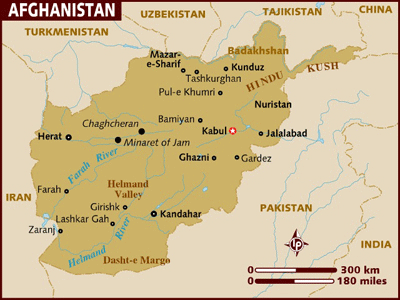
Coalition Will No Longer Publish Attack Figures

By Breaking News

afghanistan map SC Coalition will no longer publish attack figures

WASHINGTON— The U.S.-led military command in Afghanistan said Tuesday it will no longer publish figures on Taliban attacks, a week after acknowledging that its report of a 7 percent decline in attacks last year was actually no decline at all.

A spokesman for the International Security Assistance Force, or ISAF, Jamie Graybeal, said Tuesday that its reporting on the number of attacks will grow increasingly inaccurate as Afghan forces move further into the battlefield lead.

“Because (Afghan forces) are now conducting an increasing number of successful unilateral operations, often beyond the view of ISAF, we have determined that our databases will become increasingly inaccurate in reflecting the entirety of enemy initiated attacks,” Graybeal said in a written statement.

“Additionally, we have come to realize that a simple tally of (attacks) is not the most complete measure of the campaign’s progress,” Graybeal said. “At a time when more than 80 percent of the (attacks) are happening in areas where less than 20 percent of Afghans live, this single facet of the campaign is not particularly accurate in describing the complete effect of the insurgency’s violence on the people of Afghanistan.”

The Taliban have been pushed out of many population centers and have failed to regain territory they held before the surge of U.S. troops in 2010. But they are expected to test Afghan forces as U.S. and allied troops withdraw over the coming two years. All foreign combat forces are to be gone by Dec. 31, 2014.

Read More at OfficialWire . By Robeert Burns.

…read more
Source: FULL ARTICLE at Western Journalism

Afghan leader, US general discuss civilian deaths

Afghan President Hamid Karzai on Thursday demanded an explanation from the new top commander of U.S. and NATO troops for an airstrike that local officials say killed 10 civilians, half of them children.

The death of Afghan civilians during military operations has been one of the most contentious issues of the 11-year-old war.

Afghan officials said two houses were bombed late Tuesday during a joint Afghan-NATO operation in the Shigal district of the northeastern Kunar province, which borders Pakistan. Provincial police chief Ewaz Mohammad Naziri said five boys, four women and one man were killed along with four senior Taliban leaders, who were gathered in one of the homes.

The U.S.-led coalition has launched a probe to determine what happened.

Gen. Joseph Dunford, who took over Sunday for Gen. John Allen as the commander of all allied forces in Afghanistan, expressed “his personal condolences for any civilians who may have died or been injured as a result of the operation,” according to a coalition statement.

Jamie Graybeal, a spokesman for the U.S.-led coalition, said Dunford told Karzai that the coalition was conducting an assessment of circumstances surrounding this incident and that coalition officials would meet with local village elders and families of anyone harmed in the operation “to personally to express our condolence.”

Karzai’s office said Dunford explained that the coalition and Afghan forces were targeting members of al-Qaida when they summoned air support to the province.

“Pointing to a commitment Gen. Allen had previously made not to conduct any airstrike or bombing in residential areas, President Karzai reminded that such incidents must strictly be avoided in future and any recurrence is not acceptable,” the statement from Karzai’s office said.

The reported attack came as President Barack Obama announced Tuesday in his State of the Union speech that he will withdraw about half of the 66,000 U.S. troops in Afghanistan within a year — a step toward withdrawing all foreign combat forces by the end of 2014.

…read more
Source: FULL ARTICLE at Fox World News

Afghan authorities still torturing prisoners, UN says

The United Nations said Sunday that Afghan authorities were still torturing prisoners, such as hanging them by their wrists and beating them with cables, a year after the U.N. first documented the abuse and the Afghan government promised detention reform.

The report shows little progress in curbing abuse in Afghan prisons despite a year of effort by the U.N. and international military forces in Afghanistan. The report also cites instances where Afghan authorities have tried to hide mistreatment from U.N. monitors.

The slow progress on prison reform has prompted NATO forces to once again stop many transfers of detainees to Afghan authorities out of concern that they would be tortured.

In multiple detention centers, Afghan authorities leave detainees hanging from the ceiling by their wrists, beat them with cables and wooden sticks, administer electric shocks, twist their genitals and threaten to shove bottles up their anuses or to kill them, the report said.

In a letter responding to the latest report, the Afghan government said that its internal monitoring committee found that “the allegations of torture of detainees were untrue and thus disproved.” The Afghan government said that it would not completely rule out the possibility of torture at its detention facilities, but that it was nowhere near the levels described in the report and that it was checking on reports of abuse.

The findings, however, highlight the type of human rights abuses that many activists worry could become more prevalent in Afghanistan as international forces draw down and the country’s Western allies become less watchful over a government that so far has taken few concrete actions to reform the system.

As one detainee in the western province of Farah told the U.N. team: “They laid me on the ground. One of them sat on my feet and another one sat on my head, and the third one took a pipe and started beating me with it. They were beating me for some time like one hour and were frequently telling me that, ‘You are with Taliban and this is what you deserve.'”

More than half of the 635 detainees interviewed had been tortured, according to the report titled Treatment of Conflict-Related Detainees in Afghan Custody: One Year On. That is about the same ratio the U.N. found in its first report in 2011.

It’s a troubling finding given the amount of international attention and pledges of reform that came after the first report. At that time, the NATO military alliance temporarily stopped transferring Afghans it had picked up to national authorities until they could set up a system free of abuse. Though it said the findings were exaggerated, the Afghan government promised after the first report to increase monitoring.

But little appears to have changed. Once NATO forces resumed the transfers and decreased inspections, torture quickly returned to earlier levels, the report said. And even though the international military force was making a serious effort to delay transfers if there was risk of torture, about 30 percent of 79 detainees who had been transferred to Afghan custody by foreign governments ended up being tortured, the report said. That’s higher than in 2011, when the U.N. found that 24 percent of transferred detainees were tortured.

“Torture cannot be addressed by training, inspections and directives alone,” said Georgette Gagnon, the head of human rights for the U.N. mission in Afghanistan, explaining that there has been little follow-through by the Afghan government.

In particular, the U.N. report found that the Afghan government appeared to be trying to hide the mistreatment and refusing to prosecute those accused of torturing prisoners.

The U.N. team received “multiple credible reports” that in some places detainees were hidden from international observers in secret locations underground or separate from the main facility being inspected. Also, the observers said they saw what appeared to be a suspicious increase in detainees held at police facilities when an intelligence service facility nearby was being monitored.

And particularly in the southern province of Kandahar, the U.N. received reports that authorities were using unofficial sites to torture detainees before transporting them to the regular prison.

In a letter responding to the U.N. report, Gen. John Allen, the commander of U.S. and NATO forces in Afghanistan, said that his staff had written letters to Afghan ministers urging them to investigate more than 80 separate allegations of detainee abuse during the past 18 months.

“To date, Afghan officials have acted in only one instance,” Allen said in the letter. In that case Afghan authorities did not fire the official in question, but transferred him from Kandahar province to Sar-e-Pul in the north.

The report documents what it called a “persistent lack of accountability for perpetrators of torture,” noting that no one has been prosecuted for prisoner abuse since the first report was released.

Aimal Faizi, a spokesman for the Afghan president, said torture and abuse of prisoners was not Afghan policy.

“However, there may be certain cases of abuse and we have begun to investigate these cases mentioned in the U.N. report,” he said. “We will take actions accordingly.”

But he said that while the Afghan government takes the allegations in the report very seriously, “we also question the motivations behind this report and the way it was conducted.” He did not elaborate.

The NATO military alliance responded to the most recent report by stopping transfers of detainees to seven facilities in Kabul, Laghman, Herat, Khost and Kunduz provinces — most of them the same facilities that were flagged a year ago. The transfers were halted in October, when the U.N. shared its preliminary findings with the military coalition.

“This action is a result of concerns over detainee treatment at certain Afghan detention facilities,” said Jamie Graybeal, a spokesman for the international military alliance in Kabul.

He said there has been no suspension of transfers to the massive detention center next to Bagram Air Field outside of Kabul. That facility has been particularly contentious because the U.S. has held back from transferring all the detainees it holds there to Afghan custody.

But as international troops draw down in Afghanistan, there will be fewer people to monitor the Afghan detention centers. Allen said in his letter that the NATO military alliance planned to focus on monitoring only a subset of Afghan facilities in the future.

And even the manner in which the U.N. report was compiled and released shows the waning influence of Western allies over the Afghan government. Both last year and again on Sunday, the report was released without a news conference. Instead, it was quietly posted on the U.N. website in what appeared to be an effort to avoid publicly antagonizing the Afghan government that it criticizes in the report.

“I think it’s being dealt with in the appropriate way. Maybe we don’t need to do it publicly,” Gagnon said, noting that there have been plenty of discussions with the Afghan government about how to improve the prison system.

Asked what progress had been made toward improving the prison system since 2011, Gagnon was at a loss to give an example. But, she stressed: “There has been quite a lot of effort.”

Source: FULL ARTICLE at Fox World News