Tag Archives: Energizer Holdings

Why Energizer Holdings's Earnings Are Outstanding

By Seth Jayson, The Motley Fool

Filed under:

Although business headlines still tout earnings numbers, many investors have moved past net earnings as a measure of a company’s economic output. That’s because earnings are very often less trustworthy than cash flow, since earnings are more open to manipulation based on dubious judgment calls.

Earnings’ unreliability is one of the reasons Foolish investors often flip straight past the income statement to check the cash flow statement. In general, by taking a close look at the cash moving in and out of the business, you can better understand whether the last batch of earnings brought money into the company, or merely disguised a cash gusher with a pretty headline.

Calling all cash flows

When you are trying to buy the market’s best stocks, it’s worth checking up on your companies’ free cash flow once a quarter or so, to see whether it bears any relationship to the net income in the headlines. That’s what we do with this series. Today, we’re checking in on Energizer Holdings (NYS: ENR) , whose recent revenue and earnings are plotted below.

Source: S&P Capital IQ. Data is current as of last fully reported fiscal quarter. Dollar values in millions. FCF = free cash flow. FY = fiscal year. TTM = trailing 12 months.

Over the past 12 months, Energizer Holdings generated $567.0 million cash while it booked net income of $394.9 million. That means it turned 12.4% of its revenue into FCF. That sounds pretty impressive.

All cash is not equal
Unfortunately, the cash flow statement isn’t immune from nonsense, either. That’s why it pays to take a close look at the components of cash flow from operations, to make sure that the cash flows are of high quality. What does that mean? To me, it means they need to be real and replicable in the upcoming quarters, rather than being offset by continual cash outflows that don’t appear on the income statement (such as major capital expenditures).

For instance, cash flow based on cash net income and adjustments for non-cash income-statement expenses (like depreciation) is generally favorable. An increase in cash flow based on stiffing your suppliers (by increasing accounts payable for the short term) or shortchanging Uncle Sam on taxes will come back to bite investors later. The same goes for decreasing accounts receivable; this is good to see, but it’s ordinary in recessionary times, and you can only increase collections so much. Finally, adding stock-based compensation expense back to cash flows is questionable when a company hands out a lot of equity to employees and uses cash in later periods to buy back those shares.

So how does the cash flow at Energizer Holdings look? Take a peek at …read more

Source: FULL ARTICLE at DailyFinance

3 Big Brand Names That Could Be Bought Out Next

By Sean Williams, The Motley Fool

Filed under:

With the stock market tipping the scales at new highs, there has been a veritable smorgasbord of merger and acquisition activity. In just the past few weeks we’ve seen the largest leveraged buyout in the technology sector since the recession with Silver Lake Partners and Michael Dell‘s ongoing battle to take PC maker Dell private for $24.4 billion. In the airline sector we had the drawn-out merger announcement between US Airways and American Airlines parent AMR, which is aimed at reducing flight overlap, trimming costs, and boosting operating efficiency.

But no deal stands out more notably to me than the $23.2 billion purchase of Heinz by the consortium of Berkshire Hathaway and Brazil‘s 3G Capital Partners. Heinz is a household condiment name — known best for its ketchups — and it just makes money! Businesses that “just make money” might be a little boring from a growth perspective, but they generally offer solid long-term prospects, have few fluctuations when the economy ebbs and flows, and are often on the radar of conglomerates looking to add a top-notch brand-name to their portfolio.

Today I want to examine three brand-name consumer-goods companies that I think could be next up on the auction block. Let’s make this clear: These are my best guesses, and I have nothing more to substantiate these claims beyond what I’m stating here, so don’t go clicking the “buy” button tomorrow just because I said I think it’s a buyout candidate without first digging deep into these companies for yourselves. Consider this the introduction to your homework!

Energizer Holdings
The bunny hasn’t had an easy go of things since the recession hit, as Energizer announced in November that it was slashing close to 10% of its 16,000 global workforce to save $200 million annually. But as the commercials always state, even if the times get tough, that little bunny just keeps going, and going, and going.

Energizer, which makes various sized batteries and razors for personal use, plans to use its $200 million in savings by investing a quarter of it in long-term growth initiatives, while also streamlining its current operations. In other words, competition in batteries has increased from Spectrum Holdings with its Rayovac brand, and the battle for razor supremacy is heating up between it and Procter & Gamble, which owns Gillette. Energizer has responded with solid cost-reducing and efficiency-improving measures that should continue to drive its cash flow regardless of the economic conditions.

Source: Morningstar, Figures in millions.

Why I think Energizer makes a compelling takeover candidate is pretty simple. First, it’s a global brand with sales in 50 countries. The further the reach of your product, the less fluctuation in sales if a region falters. Second, it sells products with inelastic prices and steady demand. You can shop around all you want, but the price of batteries isn’t going to change much, if at all, from one place to the next …read more
Source: FULL ARTICLE at DailyFinance

This Metric Says You're Smart to Own Energizer Holdings

By Seth Jayson, The Motley Fool

Filed under:

There’s no foolproof way to know the future for Energizer Holdings (NYS: ENR) or any other company. However, certain clues may help you see potential stumbles before they happen — and before your stock craters as a result.

A cloudy crystal ball
In this series, we use accounts receivable and days sales outstanding to judge a company’s current health and future prospects. It’s an important step in separating the pretenders from the market’s best stocks. Alone, AR — the amount of money owed the company — and DSO — the number of days’ worth of sales owed to the company — don’t tell you much. However, by considering the trends in AR and DSO, you can sometimes get a window onto the future.

Sometimes, problems with AR or DSO simply indicate a change in the business (like an acquisition), or lax collections. However, AR that grows more quickly than revenue, or ballooning DSO, can, at times, suggest a desperate company that’s trying to boost sales by giving its customers overly generous payment terms. Alternately, it can indicate that the company sprinted to book a load of sales at the end of the quarter, like used-car dealers on the 29th of the month. (Sometimes, companies do both.)

Why might an upstanding firm like Energizer Holdings do this? For the same reason any other company might: to make the numbers. Investors don’t like revenue shortfalls, and employees don’t like reporting them to their superiors.

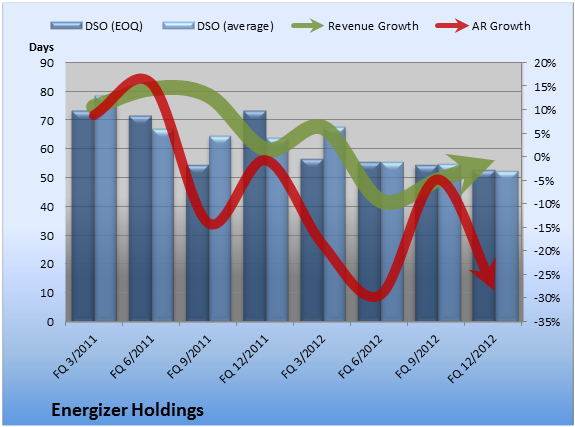
Is Energizer Holdings sending any potential warning signs? Take a look at the chart below, which plots revenue growth against AR growth, and DSO:

Source: S&P Capital IQ. Data is current as of last fully reported fiscal quarter. FQ = fiscal quarter.

The standard way to calculate DSO uses average accounts receivable. I prefer to look at end-of-quarter receivables, but I’ve plotted both above.

Watching the trends
When that red line (AR growth) crosses above the green line (revenue growth), I know I need to consult the filings. Similarly, a spike in the blue bars indicates a trend worth worrying about. Energizer Holdings‘s latest average DSO stands at 52.5 days, and the end-of-quarter figure is 52.8 days. Differences in business models can generate variations in DSO, and business needs can require occasional fluctuations, but all things being equal, I like to see this figure stay steady. So, let’s get back to our original question: Based on DSO and sales, does Energizer Holdings look like it might miss its numbers in the next quarter or two?

I don’t think so. AR and DSO look healthy. For the last fully reported fiscal quarter, Energizer Holdings‘s year-over-year revenue …read more
Source: FULL ARTICLE at DailyFinance