Tag Archives: Bentek Energy

Can the Natural Gas Rally Continue?

By Arjun Sreekumar, The Motley Fool

Filed under:

Natural gas prices are finally on the rise, having soared more than 20% so far this year. On Wednesday, gas prices closed above $4 per million BTUs for the first time since September 2011. Gas prices had remained under $4 per million BTUs for about a year and a half, even sinking below $2 in April last year — the lowest level in a decade.  

The rally was fueled by strong heating demand, as cold temperatures across major U.S. metropolitan areas in March kept gas furnaces burning longer than expected. According to Bentek Energy, demand for household heating rose 30% in March from a year ago, as measured by the number of heating degree-days.  

With gas prices at their highest level in a year and a half, traders and investors are wondering whether the rally can be sustained. Let’s look at some factors that could lead to a near-term correction in natural gas prices and some of the companies that stand to benefit big time if prices keep climbing higher.

Why the natural gas rally may falter
According to Addison Armstrong, senior director of market research at Tradition Energy, there are four major reasons we could soon see a sell-off in natural gas.

The first is declining demand during spring months. Historically, natural gas demand tends to peak in the winter and fall off during warmer months. Going forward, the combination of reduced demand for home heating and still weak demand for home cooling in the second quarter could contribute to lower prices.

The second reason is an expected increase in nuclear power capacity in the second quarter. The nation’s supply of nuclear energy has declined markedly as much greater capacity has gone off line than expected, mainly for maintenance. However, as Armstrong notes, faster-than-expected progress in maintenance and refueling suggests that the second quarter will see much more capacity coming online than previously thought.

The third is a sharp decrease in the number of power plants replacing coal with gas as their fuel of choice. Over the past year and a half, the trend of utility companies shifting away from coal-fired plants toward gas-powered ones picked up strongly. But now, with natural gas prices much higher and coal prices still very much depressed, this trend is likely to abate.

And finally, there may be some end-of-quarter profit-taking, meaning that traders who were long natural gas this quarter will want to close out their positions to lock in their gains.

Companies benefiting from rising gas prices
If a natural gas sell-off fails to materialize and prices continue to push higher, U.S. natural gas producers will be the most obvious beneficiaries.

Over the past year and a half, energy producers sharply curtailed gas drilling because of the poor economics of their gas wells. For instance, EXCO Resources slashed its rig count from 23 as of year-end 2011 to seven as of the end of last October.

Instead, companies focused primarily on drilling …read more
Source: FULL ARTICLE at DailyFinance

1 Crucial Development in the Permian Basin

By Aimee Duffy, The Motley Fool

Filed under:

Frequently lost behind the multitude of stories about America’s bursting-at-the-seams oil production is that much of this newly produced oil is just sitting around because of a lack of takeaway capacity at America’s oil hubs.

Many of our domestic oil plays lack the necessary pipeline infrastructure to bring oil to market, and that has resulted in a prolonged period of low oil prices. That’s great for refiners, but it can be rough on producers. Much of the problem is expected to be resolved by 2014, after a number of pipeline projects come online. However, oil producers in the Permian Basin are starting to see some important changes right now. Today we’ll take a closer look at what’s going on in the West Texas oil game.

The Permian
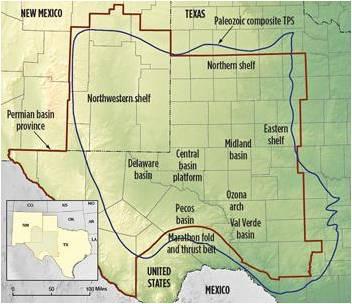
Stretching across West Texas and into New Mexico, the Permian Basin features a mix of carbonate and sandstone formations. Some formations, in fact, are stacked on top of each other in certain locations, making the region home to some pretty enticing drilling opportunities, both horizontal and vertical.


Source: U.S. Geological Survey.

Historically, this West Texas oil play is one of the most prolific oil-producing regions in the United States. Production in the Permian Basin peaked in 1973 at 2.085 million barrels per day. Current production is estimated to be close to 1 million bpd but is expected to grow significantly, reaching 1.86 million by 2016, according to Bentek Energy. The top dog in the play, Occidental Petroleum , produced 146,000 barrels of per day there in the fourth quarter of 2012.

The significance
Last year, crude oil coming out of the Permian was trading at a discount to crude oil coming out of the hub at Cushing, Okla. WTI-Midland and West Texas Sour were about $13 cheaper per barrel than the Cushing crude, largely because of intense pipeline congestion. The lack of pipeline capacity forced crude to sit, and when crude sits, it loses value.

Finally, earlier this week WTI-Midland rose to a premium over WTI-Cushing for the first time in nearly three years. The increase comes on anticipation of the start of Magellan Midstream Partners‘ Longhorn Pipeline system, which should commence shipping crude to the Gulf Coast in mid-April.

Magellan reversed the Longhorn and will be capable of transporting 75,000 barrels per day from the Permian to the Gulf. That number is expected to climb to 225,000 by the third quarter of this year.

DCP Midstream will also bring a Permian-Gulf Coast pipeline online this summer. This pipe will have an initial capacity of 200,000 bpd, eventually expanding to 350,000 bpd.

The Midland premium was only $0.10 as of Tuesday, but it’s the first premium since May of 2010, and that’s significant. West Texas Sour narrowed its discount to $0.25, the smallest gap since April 2009.

While Gulf Coast refiners may be disappointed that the price of oil is going up, it’s still cheaper than imported crude, and higher …read more
Source: FULL ARTICLE at DailyFinance